


Inspiration
In terms of regulation of synaptic connections, synaptic plasticity is an important tool for adapting the nervous system to environmental changes. The change in synaptic connections can be temporary (seconds to minutes) or continue for a long time. Long-term synaptic plasticity forms play an important role in the regulation of neuronal connections during development, cognitive functions such as learning and memory (Kessels & Malinow, 2009; Malenka & Bear, 2004). In the mammalian brain, prolonged enhancement (LTP) and prolonged depression (LTD) of the synaptic conduction (LTD) are two main forms of prolonged synaptic plasticity. The movement of alpha-amino-3-hydroxy-5-methyl-4-isoxazolpropionate (AMPA) receptors into and out of synapse appears to be the primary biological mechanism underlying synaptic activity change during LTP and LTD. However, the signal pathways and molecular mechanisms underlying LTP and LTD are not fully understood. An interesting feature of synaptic plasticity is the morphological changes accompanying the functional modification of the synapse. LTP is associated with the formation and growth of dendritic thorns (Kopec et al., 2006; Matsuzaki et al., 2004; Nagerl et al., 2004), while LTD is associated with shrinkage and loss of dendritic thorns (Okamoto et al., 2004; Zhou et al., 2004). . Synaptic plasticity is very important for the cognitive functions of the brain, such as learning and memory. Consistent with its functions in LTD and LTP, caspase-3 and caspase-1 have been reported to regulate learning and memory functions. Based on this, can anxiety caused by the social isolation model cause cell death in relation to these pathways? Is the enriched environment model a candidate to be a therapeutic application to correct possible anxiety-related cell deaths and related disruptions in learning and memory processes? In studies involving animal models such as aging, mitochondria disorder and oxidative stress, stress has been shown to trigger these processes (Salminen et al., 2012). Considering that the social isolation model creates stress and anxiety, it is foreseen within the scope of the project that the same inflammatory processes will also be activated in this system.
What it does
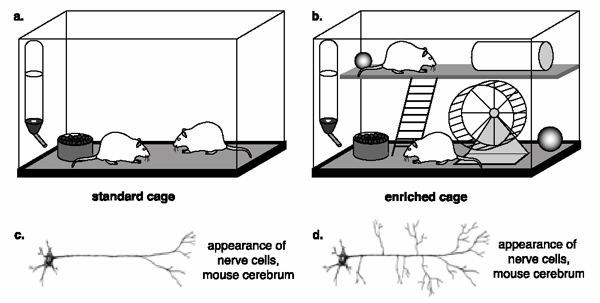
When a comprehensive research is done in the literature, a number of therapeutic agents and applications on social isolation stress have been tried in the studies to date. However, by looking at the effect of the enriched environment on socially isolated creatures, no study was conducted to illuminate the functioning of learning / memory processes and cell death mechanisms in the hippocampus. Including NMDA and AMPA receptors, where the hippocampus learning / memory process takes place; It is a brain region activated by sensory stimuli such as hearing, smell, touch and vision (Gruart et al., 2015). It is considered as a channel that transmits sensory signals. It is known to transmit signals to many areas of the brain (such as the thalamus, hypothalamus and limbic system) through the hippocampus fornix. While the individual does not give very strong responses against the stimuli that come to him under normal conditions, he can create stronger responses to stimuli that cause various sensory experiences (Hanson et al., 2015). The rich environment designed in this respect will have various stimuli necessary to create a strong response. Enriched with accessories such as toys, tunnels, different types of feed, swivel castors and swings that the animal does not encounter under normal conditions, the environment will provide a richer stimulus environment than the animal's daily neutral stimuli. Strategies to design the enriched environmental package (EEP) mentioned below will be proposed if the findings of the rich environmental arrangement envisaged as a result of the study improve the cellular and cognitive performance deterioration associated with anxiety. Within the scope of this strategy, it is aimed to present a wellness platform scenario enriched with social and cultural uses.
How I built it
The package will include an information platform to appeal to individuals from all socioeconomic classes based on the results of the study at the first stage. This information will be presented both as a video narration and as a downloadable handbook. It will contain instructions on how people can create a rich environment for them in socially isolated environments. For example; There will be a video and printed booklet narration of a training program that they can perform at home either on their own terms or with exercise sets. The aim of the first stage is to introduce the rich environmental environment to the individual and provide detailed information in this direction. In the second stage, there will be a category in which the individual can score whether his / her environment is neutral or rich environment. It will show how the individual lives in a scale from 1 to 10. The figure will be drawn. Anxiety, depression scale and memory test will also be included in the package where he will evaluate his own mood. As a result of these scales that can be filled online, anxiety and memory capacity of the individual will be scored and displayed on the system. The average result will be obtained for both the environment in which the environment and the emotional state is scaled. For individuals with high anxiety and impaired memory performance, the system will present a phrase such as "psychologist support is recommended". Our aim is to collect these data on a platform accessible by the state, and to create a database for public arrangements for the future-oriented social life. If deemed appropriate, individuals with the result of **"psychologist support is recommended" **will be able to make an online appointment by evaluating them as a priority patient in the psychologist or psychiatry clinics, and the relevant service will be offered online again. Thus, within the scope of EEP, the individual will be able to meet with the psychologist online without leaving his home. One of the indirect outcomes of EEP is that it contributes to increasing the employment of psychologists in this process.
Challenges I ran into
1- Demonstration of possible cell anxiety-related cell death mechanism and learning / memory performance impairment of the social isolation model on animals
2- Evaluation of enriched environment application as an application that can correct the pathological mechanisms created by the social isolation model and possible deterioration in behavioral performances.
3- Developing a strategy for enriched environmental package application in the light of the obtained findings
What's next for enriched environment ameloriates social isolation anxiety
In addition to the various support packages (mask and disinfectant distribution, financial support, etc.) created on the pandemic agenda, such a social package will be an important step to improve the current conditions of individuals with increased anxiety levels, which may cause a predisposition to psychiatric diseases. Minimizing the psychological and behavioral health risks caused by anxiety and fear caused by social isolation caused by pandemic is important in terms of suppressing the anxiety-related pathways mentioned above. We foresee that psychiatric disorders will increase as well as pathological disorders in the new world system created by pandemic. For this reason, it is very important for the state to have a system in which individuals can track their memory performances and emotional states, and that the information from this system is systematic in terms of designing solution tools to be developed.


Log in or sign up for Devpost to join the conversation.