-
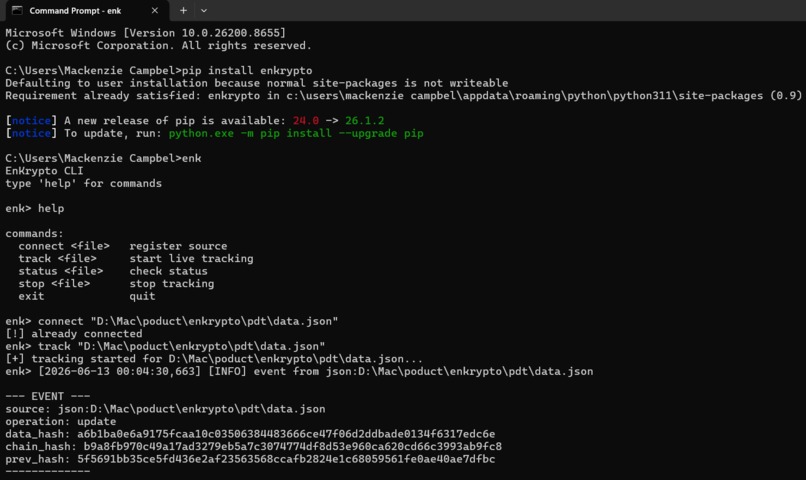
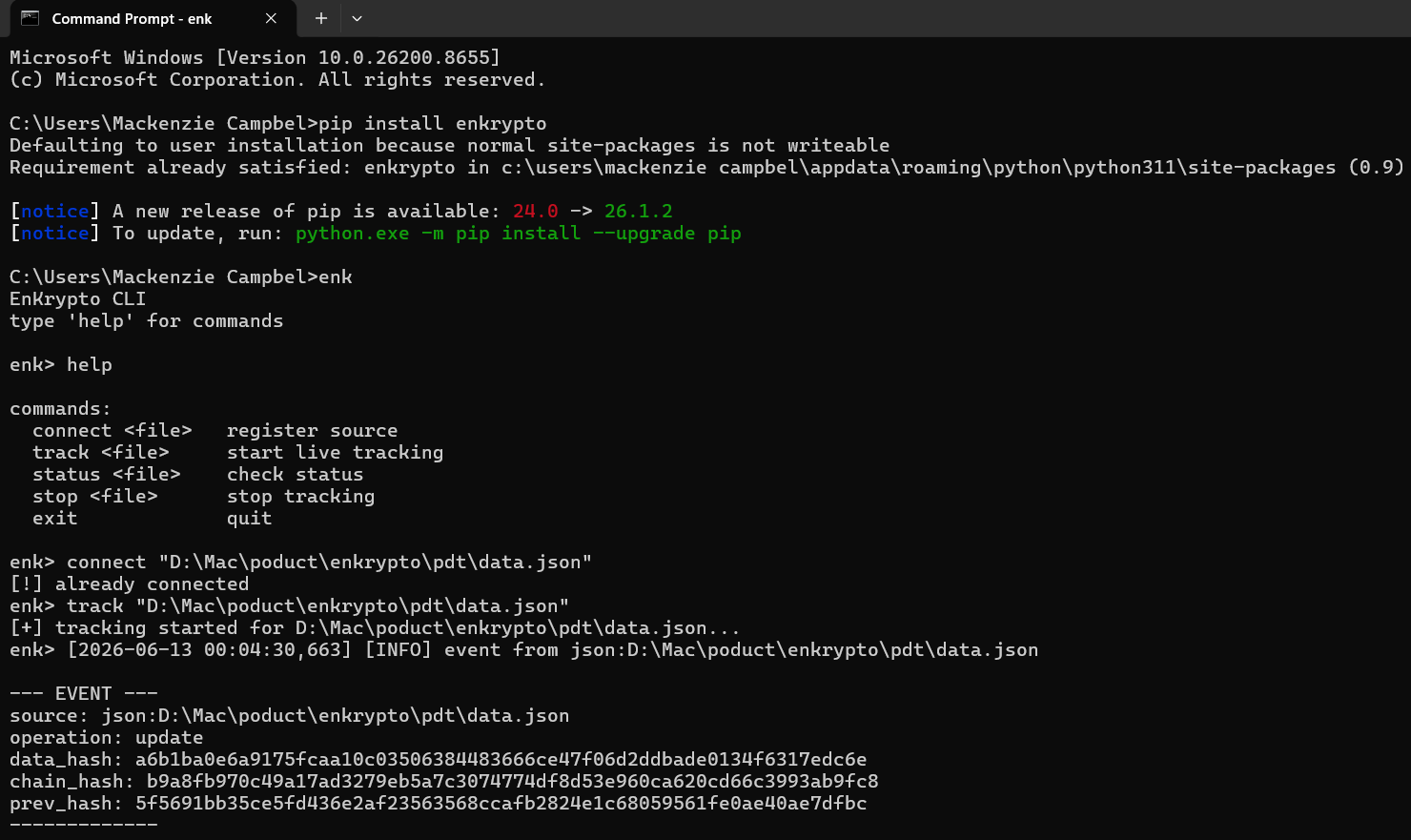
Enkrypto tracking JSON data in real time, generating cryptographic proofs to make every change verifiable and tamper evident.
Inspiration: As digital workflows become increasingly prevalent, verifying the authenticity of data has become just as important as storing it. Existing systems can retain files and records, but they often lack a straightforward way to prove that information has remained unchanged over time. This observation inspired us to build "Enkrypto: a lightweight, developer friendly framework for cryptographic integrity verification that enables trust without relying solely on centralized authorities."
What We Built: Enkrypto is a data integrity verification platform that generates cryptographic proofs for digital assets and allows independent validation of their authenticity. By computing deterministic SHA 256 hashes, the platform can reliably detect any unauthorized modification to a file or record, even if the change is as small as a single byte.
The project includes a Python based SDK distributed through pip, making it simple to integrate integrity verification into existing applications and workflows. Our long term vision is to evolve Enkrypto into foundational infrastructure for tamper evident data management across cybersecurity, enterprise systems, research, and digital compliance.
How We Built It; The core verification engine was implemented in Python using the SHA 256 cryptographic hashing algorithm. We designed the SDK to expose a minimal and intuitive interface while maintaining deterministic and reproducible verification behavior. The web presence was deployed using modern frontend technologies and hosted on Vercel, with an emphasis on simplicity and accessibility.
Rather than building another storage platform, our focus was on creating a portable verification layer that can integrate with existing systems and operate independently of where the underlying data resides.
Challenges We Faced: One of the most significant challenges was ensuring that the pip packaged SDK behaved consistently across different operating systems and Python environments. Packaging and dependency resolution varied between machines, requiring careful testing and refinement to provide a reliable developer experience.
Another challenge was architecting the verification workflow to accommodate multiple data sources and formats while preserving uniform cryptographic guarantees. Balancing extensibility with simplicity remains an ongoing design consideration as the platform evolves.
What We Learned: Building Enkrypto reinforced that security is not solely about encryption or access control but also about verifiability. We gained practical experience in software packaging, deterministic system design, and cryptographic integrity mechanisms, while recognizing the importance of usability in driving adoption of security technologies.
Looking Ahead: We envision Enkrypto as a foundational trust layer for digital systems. Future work includes support for additional data sources, decentralized proof anchoring, immutable audit trails, and deeper integration with enterprise and cloud native workflows, enabling organizations to verify the integrity of critical information with confidence.


Log in or sign up for Devpost to join the conversation.