-
-
Logo
-
engram Architecture
-
Inspiration
Every team already has the answer to "what did we decide about X?" — it's just scattered across a Slack thread, an email, a Google Doc, and a GitHub issue. Ask a normal AI assistant and it answers from the model's memory: it guesses, confidently, with no source. We wanted an agent that answers from the company's memory instead — and shows its receipts. And it had to live where the team already works: Slack.
What it does
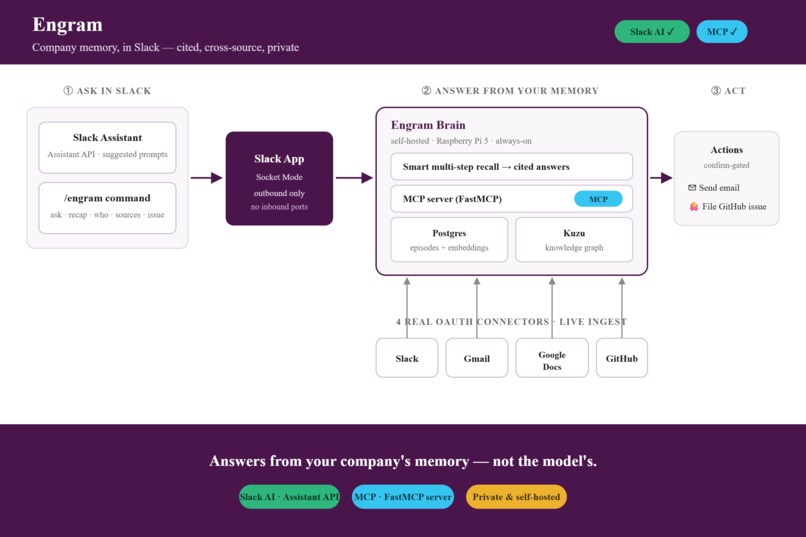
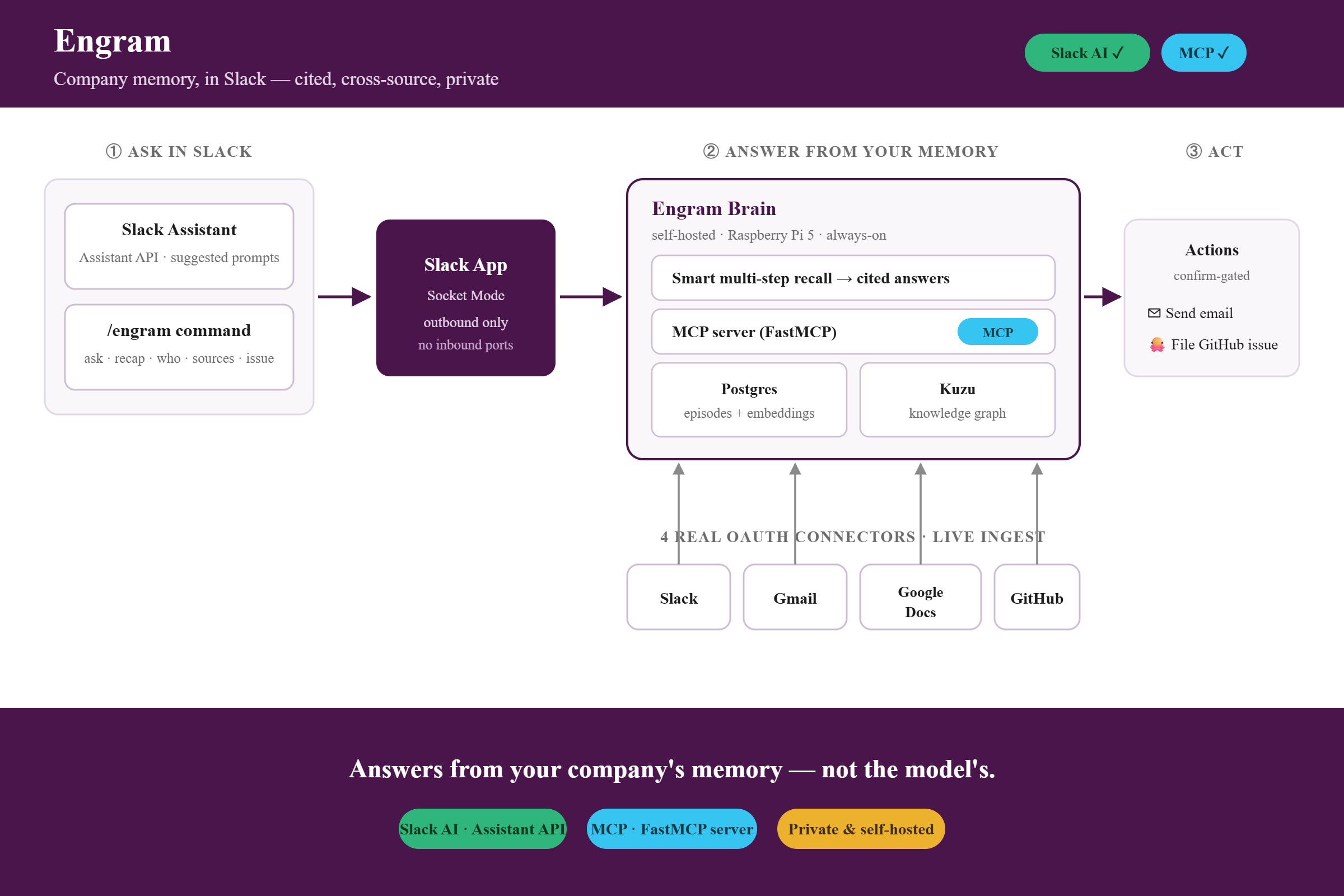
Engram is a Slack agent that answers questions from your company's own memory across Slack, Gmail, Google Docs, and GitHub — every answer cited back to the exact source. It doesn't just retrieve, it acts: draft and send an email, file a GitHub issue, share or save an answer — each gated by a confirmation modal so nothing happens behind your back.
You talk to it two ways:
- As a Slack Assistant (built on Slack's Assistant API) — open the assistant pane, get suggested prompts, ask in natural language.
- Via the
/engramslash command with 7 verbs:ask · recap · who · sources · issue · sync · help.
Ask "What did we decide about pricing for the v2 launch?" and it returns one answer stitched from a Google Doc and a Slack thread, each fact linked to its origin.
How we built it
- Slack layer: a Socket Mode app using Slack's Assistant API
(
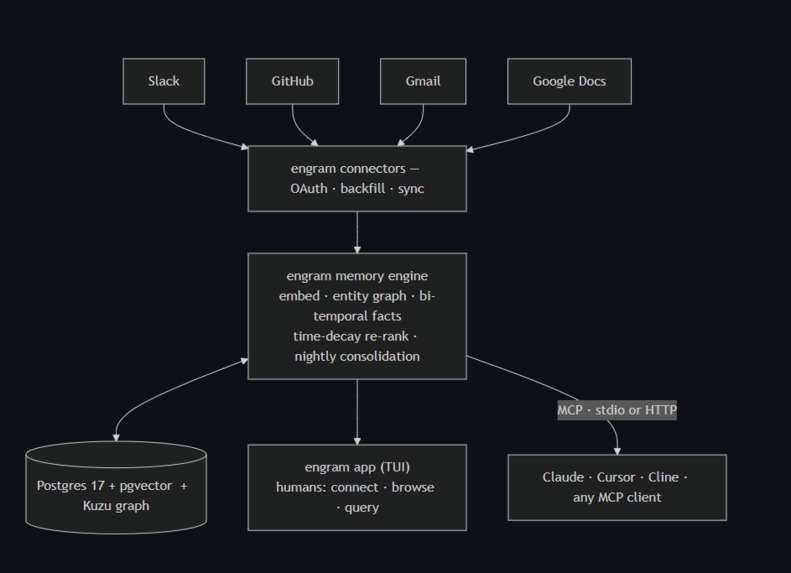
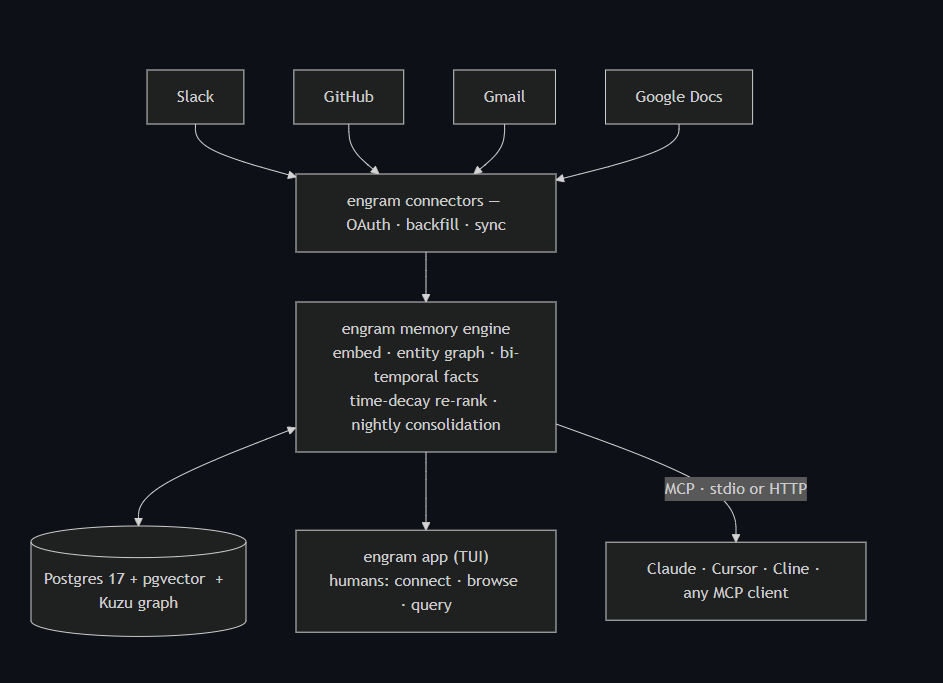
assistant_view+assistant:write, thread-started hooks, suggested prompts, live status) plus slash commands. - The brain: a cross-source knowledge graph. Content from 4 real OAuth
connectors is ingested, embedded with
BAAI/bge-large-en-v1.5, stored in Postgres (episodes/metadata) and Kuzu (the graph), and retrieved with a smart multi-step recall that assembles cited answers. - MCP: the agent reaches the Engram brain over MCP (a FastMCP server), so recall and actions are exposed as tools. Engram qualifies on both Slack AI and MCP.
- Actions: real side effects — Gmail SMTP send, GitHub issue creation — behind confirm modals, with an optional allowlist so only approved users trigger writes.
- Hosting: the entire brain runs self-hosted on a Raspberry Pi 5, always-on, with no inbound ports (Socket Mode is outbound-only). Your company's memory never leaves your infrastructure.
Challenges we ran into
- The embedding model timed out on the first query. The ~1.3GB
bge-largemodel downloaded lazily on first recall, blowing past our 20-second timeout so the very first question always errored. We baked the model into the Docker image at build time so it's ready the moment the container starts. - A UTF-16 database dump that wouldn't restore. Piping
pg_dump > file.sqlin PowerShell silently wrote UTF-16, which Postgres rejected on restore (invalid byte sequence for encoding "UTF8"). Fix: dump with-finside the container and copy the raw bytes out. - Kuzu's single-writer lock. Re-syncing while the agent was running collided
with Kuzu's single-writer constraint, so
/engram syncre-ingests in-process instead of as a competing writer. - Keeping it live for judges on a Pi — boot-time DNS resolver crashes, connector-failure isolation so one dead source doesn't break recall, and an always-on restart policy.
Accomplishments that we're proud of
A complete, live product on real data — not a mock. Cross-source cited answers from four live connectors, real actions (a GitHub issue filed and an email actually sent), and the whole thing running privately on a Raspberry Pi with zero inbound ports.
What we learned
The hard part of a "company brain" isn't the LLM — it's ingestion, the graph, keeping every answer cited, and the unglamorous ops (timeouts, encodings, single-writer locks) that decide whether it's actually live when someone asks it a question.
What's next for Engram
More connectors (Notion, Linear, Confluence), a device-code OAuth flow so non-technical teammates can connect sources without a terminal, and richer agentic actions.
Built With
- bge-large
- docker
- docker-compose
- fastembed
- fastmcp
- github-api
- gmail-api
- google-docs-api
- knowledge-graph
- kuzu
- mcp
- oauth
- openai
- postgresql
- python
- raspberry-pi
- slack
- slack-assistant-api
- slack-bolt
- socket-mode

Log in or sign up for Devpost to join the conversation.