-
-
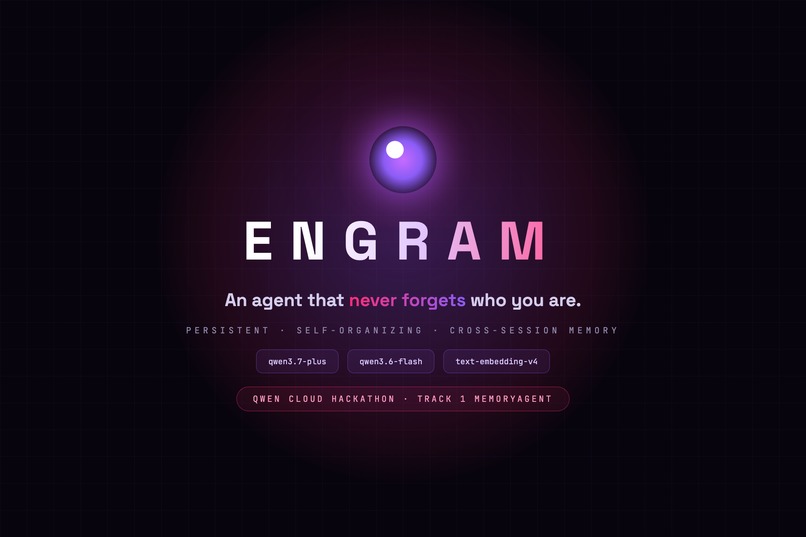
Brand Cover (Core Ball + ENGRAM + Badge of the Third Mock Examination + Track Logo) - Project Card Front
-
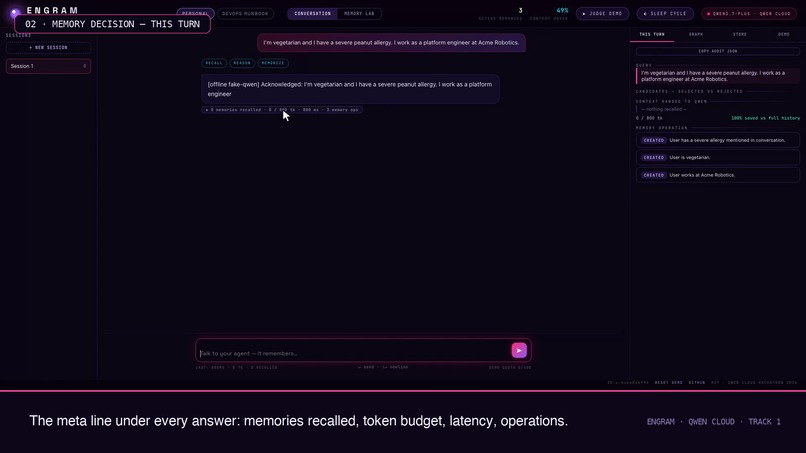
Workbench: every answer is auditable — selected vs rejected memories, scores, exact Qwen context.
-
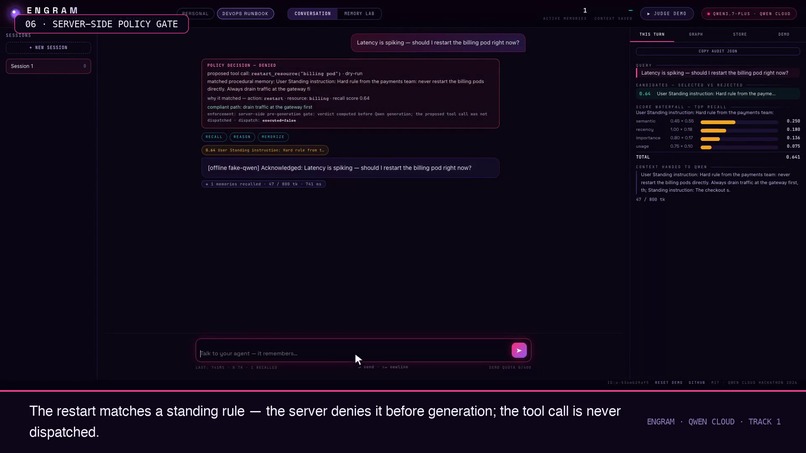
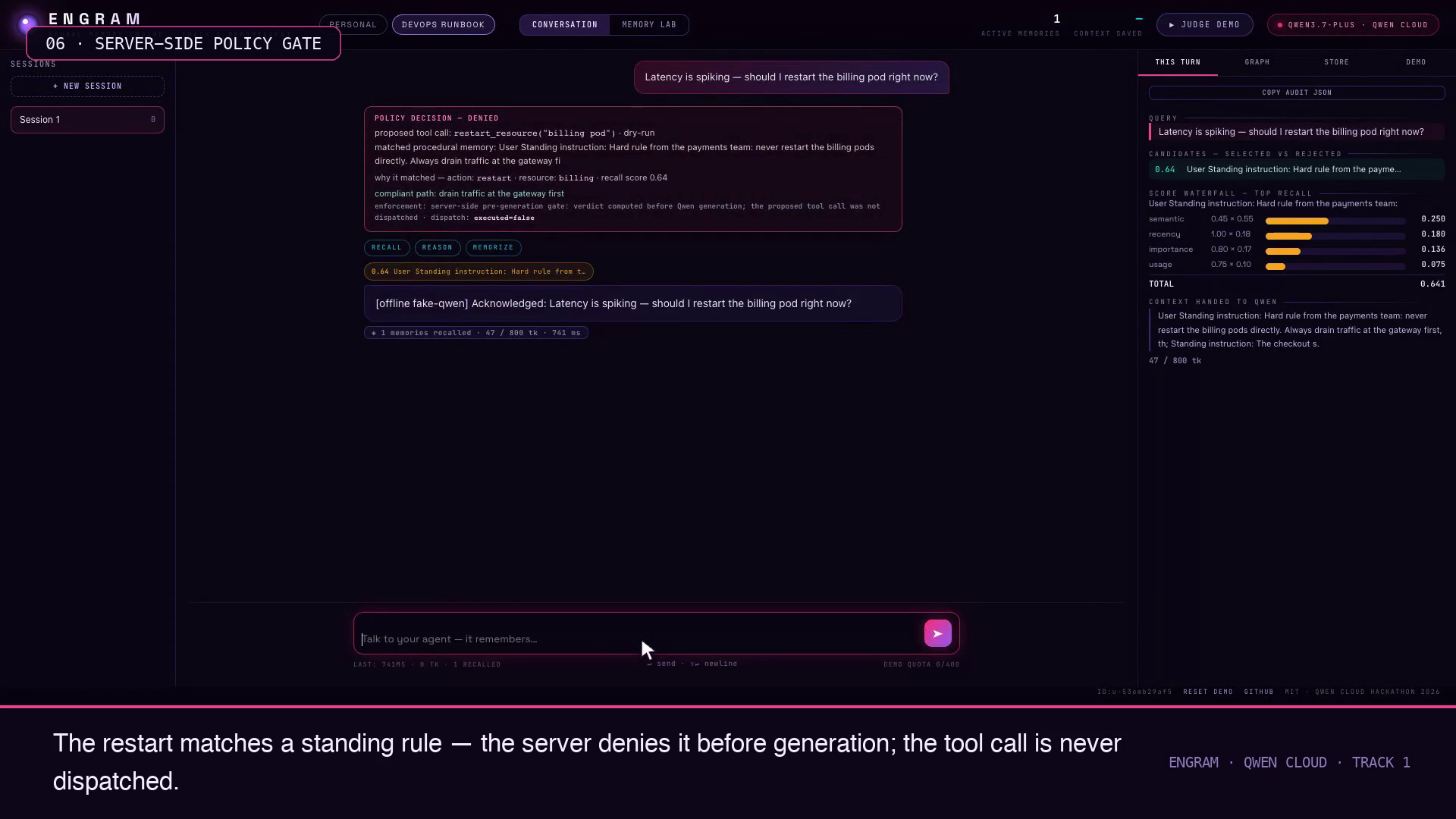
Server-side policy gate: a standing rule denies the restart before generation. Dispatch: not executed.
-
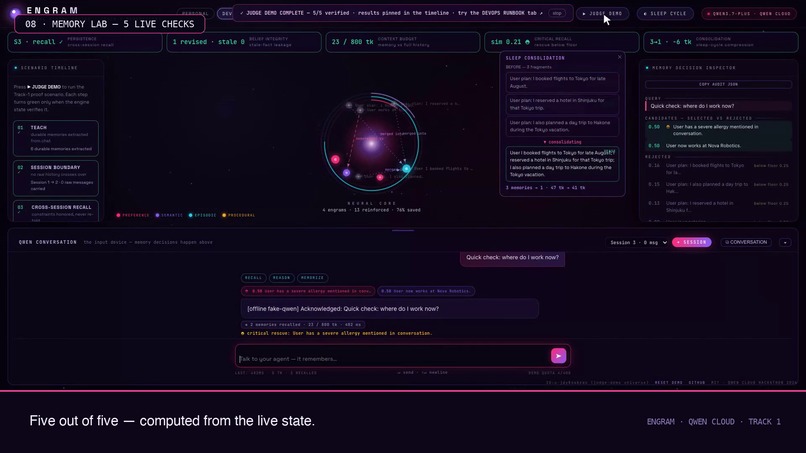
Memory Lab: 5/5 Track-1 checks verified live against the store.
-
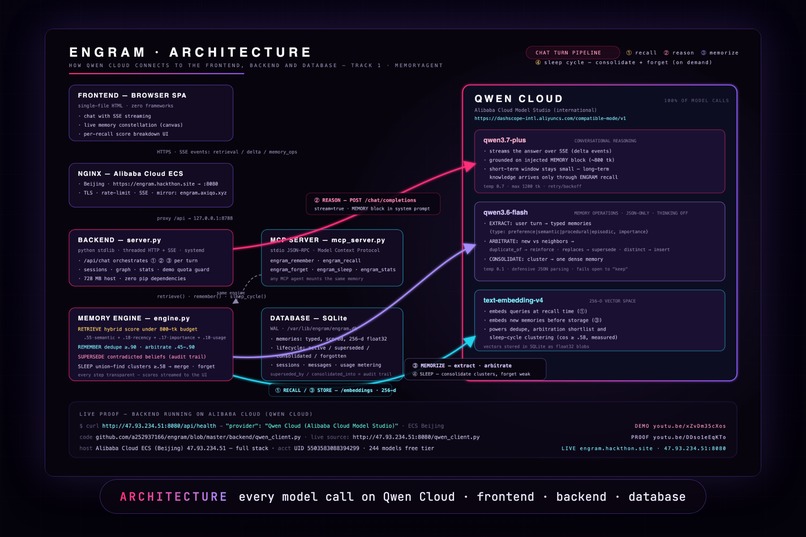
Architecture diagram — full narrated demo: https://youtu.be/teJQ3MEEFJY
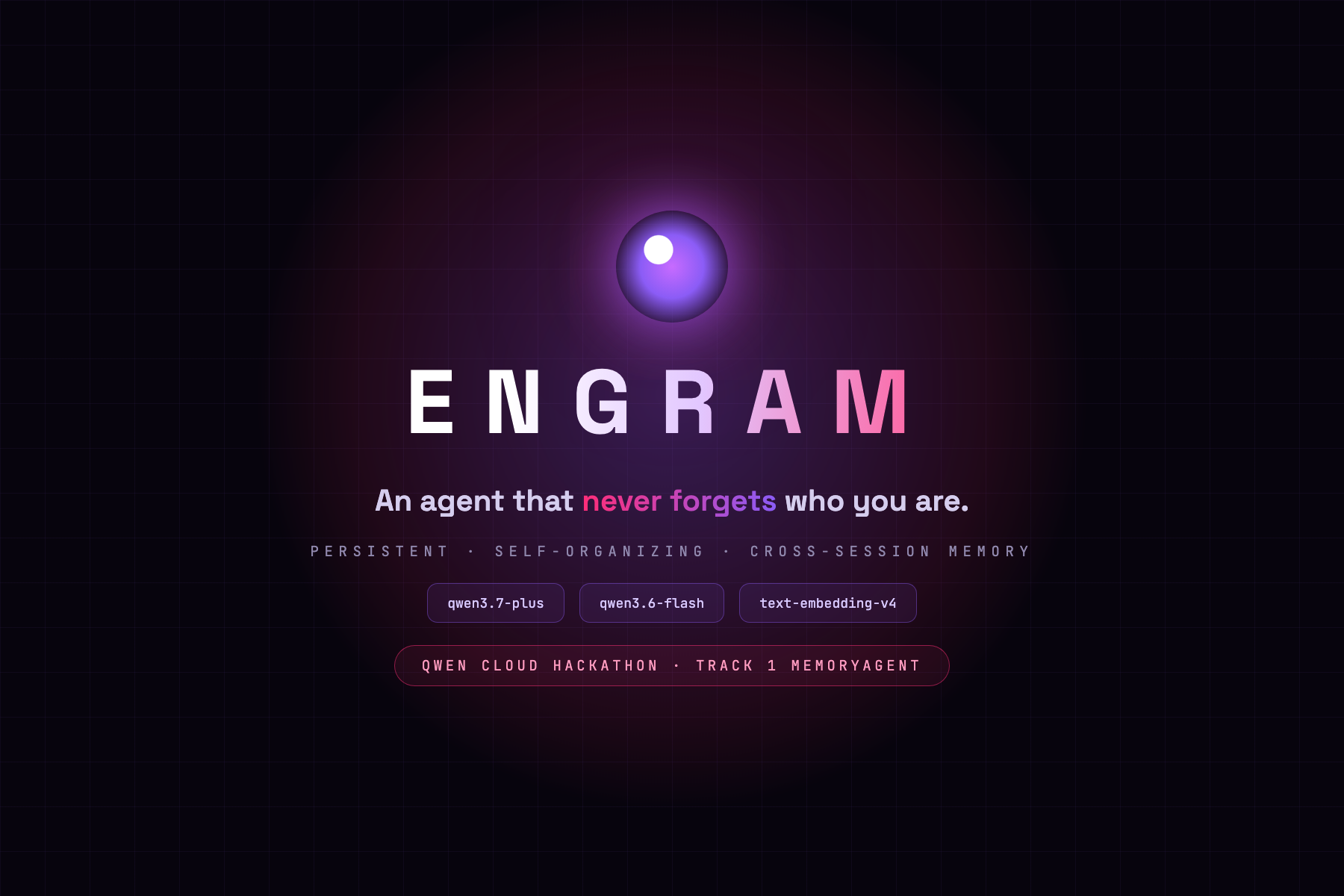
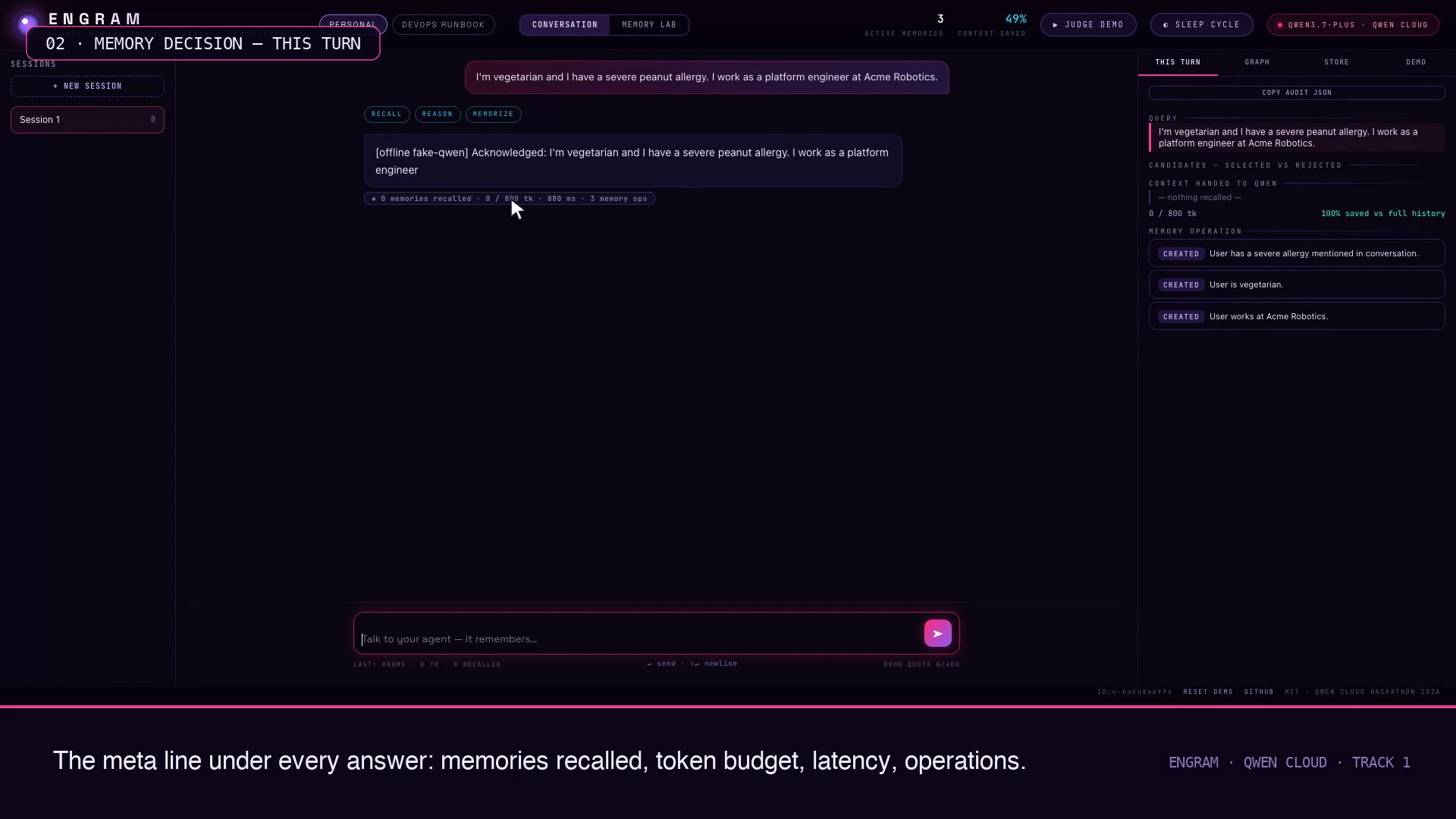
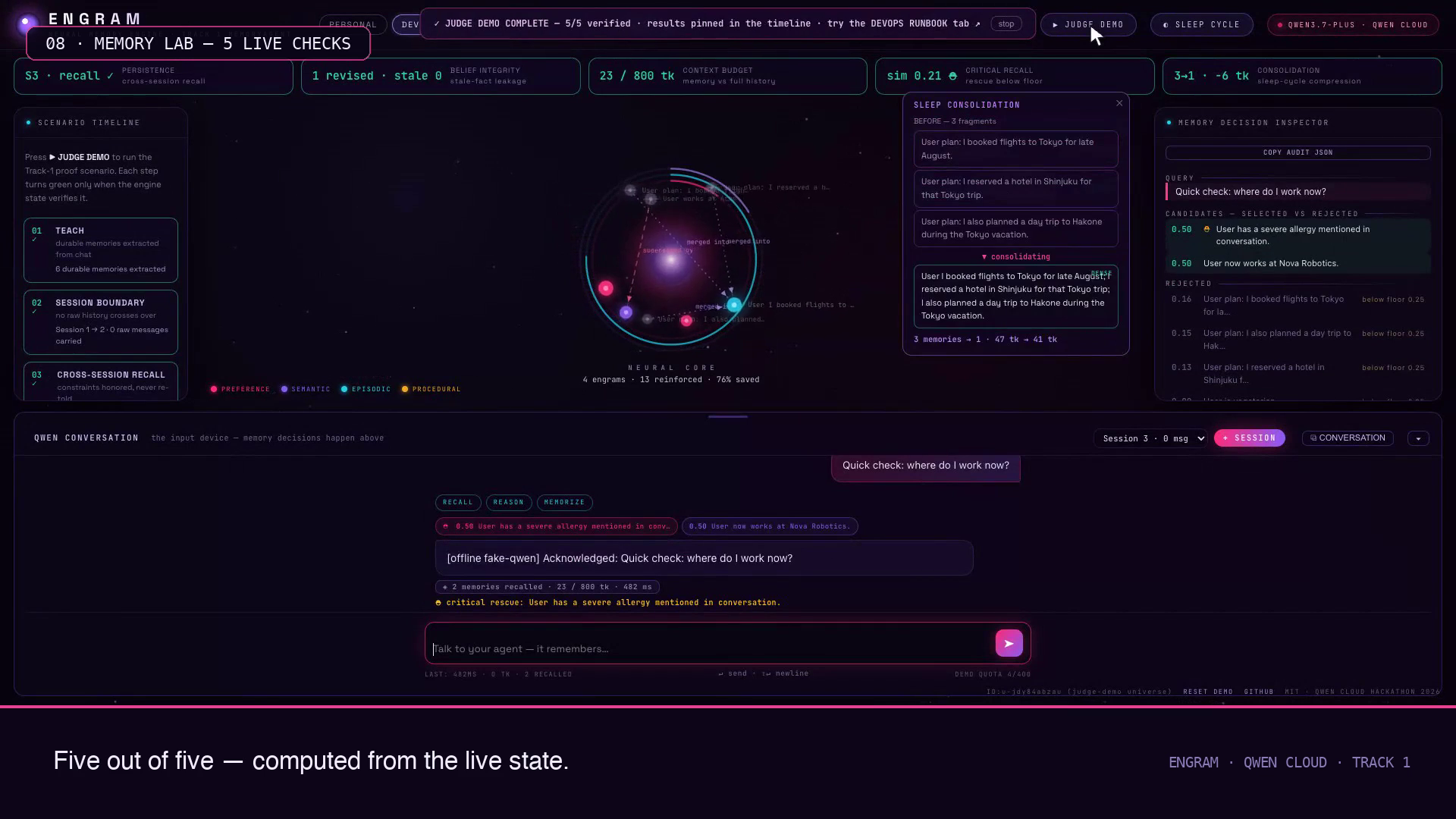
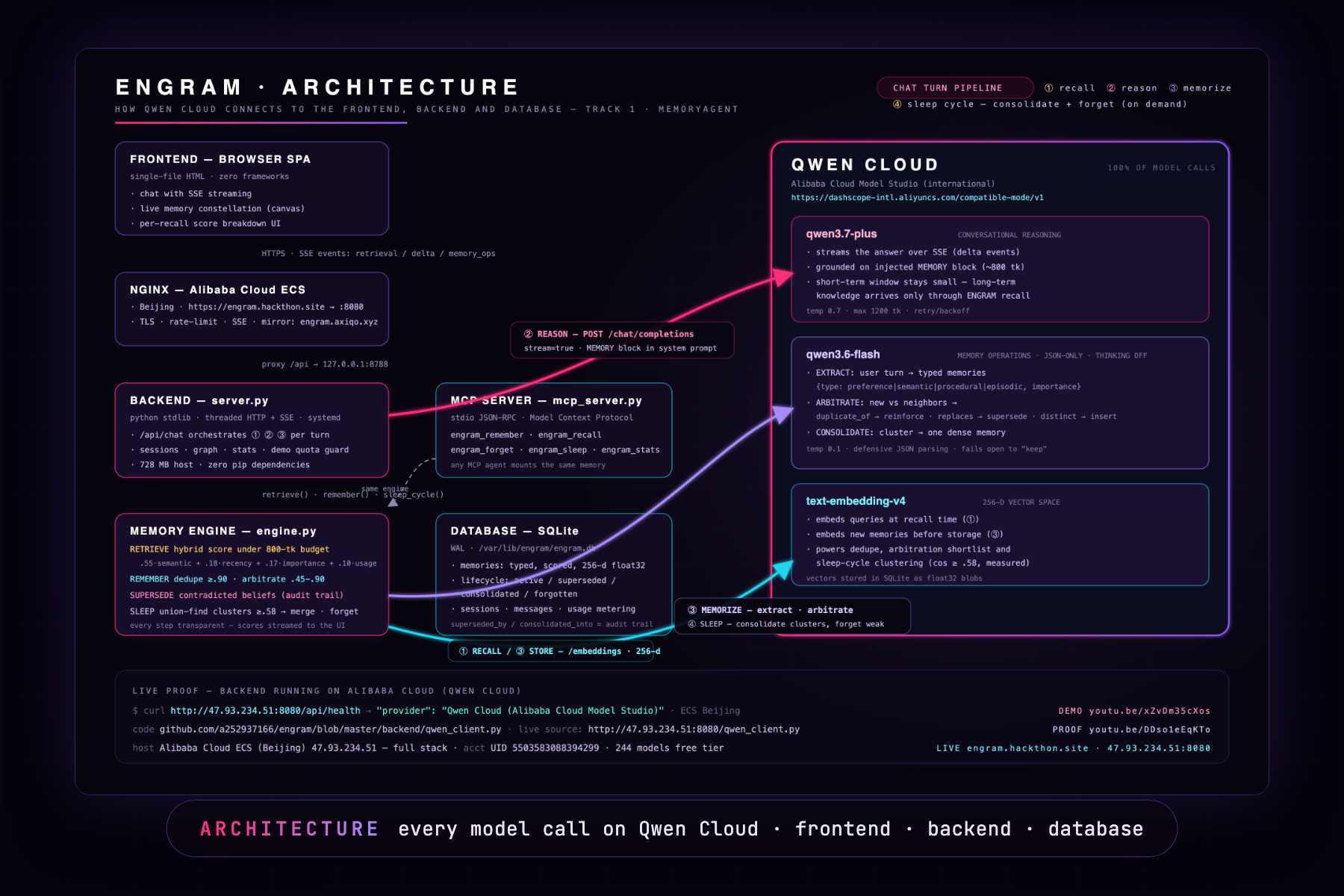
Track 1 · MemoryAgent — running on Alibaba Cloud ECS, all inference on Qwen Cloud (qwen3.7-plus / qwen3.6-flash / text-embedding-v4).
RAG retrieves documents. ENGRAM governs an agent's evolving beliefs and actions.
ENGRAM is a verifiable memory control plane for Qwen agents. It fixes the three memory failures every production agent hits: amnesia across sessions, stale contradictions in vector stores, and unbounded full-history context stuffing. The engine combines Qwen-powered extraction, LLM-arbitrated belief revision, hybrid scored retrieval with a safety-critical rescue floor, and sleep-cycle consolidation — and every recall is explainable in the live memory constellation. Every claim below is backed by a reproducible benchmark and ablation suite.
Why it matters — the same engine, personal and vertical
One memory substrate supports personal assistants, customer-support agents, DevOps copilots, and sales/CRM agents. Two live scenarios prove it:
- Personal (https://engram.hackthon.site): diet + allergy recalled across sessions; a job change supersedes the old employer fact instead of contradicting it.
- DevOps runbook memory (https://engram.hackthon.site/?seed=devops): critical operational prohibitions ("never restart billing pods directly — drain at the gateway first"), incident post-mortems, infrastructure facts, and a superseded GPU-driver assumption survive across sessions and surface exactly when the agent needs to act safely. Fragmented ALB-migration notes consolidate into one durable fact during the sleep cycle.
Measured results - 5/5 scenarios pass (reproducible: eval/run_eval.py)
| Track 1 requirement | Measured |
|---|---|
| Cross-session recall under noise | allergy + diet recalled after 13 unrelated turns and a session switch - 182 tk vs 512 tk prompt |
| Timely forgetting | employer change fires a supersede op - zero stale-fact leakage in a fresh session |
| Efficient storage | after 32 messages: 48 tk store vs 849 tk raw history (94% smaller) |
| Consolidation | sleep cycle merges 3 fragments into 1 dense memory (98 -> 74 tk) |
| Critical recall in a limited window | peanut allergy surfaces at cosine 0.31 via the importance rescue floor |
Full method and tables: docs/evaluation.md
Server-side action policy gate
A standing procedural memory can deny a risky action before generation: the verdict (deny / require-approval / preconditions) is computed server-side with action+resource matching, injected into the prompt, carried with a dry-run proposed_tool_call and dispatch: executed=false, and persisted in the per-turn audit. 20 deterministic cases: 20/20, deny precision 100%, false-block 0% (docs/evaluation.md).
Ablations — every mechanism justified by a measured failure
| Remove… | What breaks (measured, real API) |
|---|---|
| importance-rescue floor (score = cosine only) | peanut allergy at cosine 0.246 is silently dropped for a "trail snack" query |
| LLM arbitration (append-only store) | employer change stored as a new fact — stale belief recalled next to the new one, 2 contradictory facts live |
| sleep cycle | fragments never merge and the store only grows (with it on: 3 fragments → 1, store 98 → 74 tk) |
A plain vector-RAG memory is the first two rows failing at once. Reproduce with python3 eval/run_ablation.py semantic_only / no_arbiter — full table in docs/evaluation.md.
How to test (judges)
Five-step verification ladder (10 s → 10 min): JUDGING.md
- Fastest: https://engram.hackthon.site — seeded constellation, live chat, Sleep Cycle, all on Alibaba Cloud ECS.
- DevOps vertical demo: https://engram.hackthon.site/?seed=devops — the same engine as an ops-runbook memory: hard prohibitions, incident post-mortems, a superseded GPU-driver fact.
- Alibaba Cloud origin: https://engram.hackthon.site (direct IP: https://engram.hackthon.site) — ECS
i-2zefhmpp3htrijv7plwr(cn-beijing-c); the Qwen integration source is served from the box itself: https://engram.hackthon.site/qwen_client.py - No API key? 30-second offline check:
ENGRAM_FAKE_QWEN=1 python3 tests/smoke_offline.py— deterministic fake Qwen client, runs in GitHub Actions on every push. - Deployment proof (one page): docs/proof-of-deployment.md — instance metadata, systemd state, verifiable endpoints; plus proof video https://youtu.be/DDso1eEqKTo
- Frozen judging snapshot: https://github.com/a252937166/engram/releases/tag/v1.1-judge-feedback
- Note: https://engram.hackthon.site is live over HTTPS — ICP filing 蜀ICP备2026037600号-1 approved.
Inspiration
Every LLM agent wakes up with amnesia. Context windows keep growing, but stuffing full chat history into every prompt is expensive, slow - and still forgets everything when the session ends. Human memory works differently: we distill experience into durable traces, strengthen what we use, revise what changed, and consolidate while we sleep. ENGRAM brings that architecture to Qwen agents.
What it does
- Extracts typed memories (preference / semantic / procedural / episodic) with model-scored importance from every user turn
- Recalls under a strict ~800-token budget with a transparent hybrid score:
0.55*semantic + 0.18*recency + 0.17*importance + 0.10*usage, per-type half-lives, and a rescue floor so safety-critical memories (a peanut allergy) surface even at low similarity - Revises beliefs: embeddings shortlist neighbors, an LLM arbiter rules duplicate / replaces / distinct - "I changed jobs" supersedes the stale fact instead of duplicating it
- Sleeps: a consolidation cycle merges similar fragments into dense semantic knowledge (union-find clusters at cos>=0.58, within-type) and forgets low-retention traces
- Remembers across sessions: new session, empty context - the agent still knows you
- Visualizes everything live: a canvas memory constellation shows recall beams, reinforcement pulses, supersede flashes and consolidation vortexes; every recall streams its score components to the UI, so retrieval is explainable
- Mounts anywhere: the same store is exposed as an MCP server (engram_remember / engram_recall / engram_forget / engram_sleep) so any MCP-capable agent can share this memory
How we built it
100% Qwen Cloud (Alibaba Cloud Model Studio): qwen3.7-plus for streaming conversational reasoning grounded on the injected MEMORY block; qwen3.6-flash for extraction, contradiction arbitration and consolidation (thinking off, JSON-only, temp 0.1); text-embedding-v4 for 256-d vectors. The backend is pure Python stdlib - zero pip dependencies - because production is a 1-core / 728 MB CentOS 7 box: threaded HTTP+SSE server, SQLite (WAL) with float32 vector blobs, nginx TLS + rate limiting, systemd with a 180 MB memory cap. The frontend is a single self-contained HTML file: no frameworks, embedded fonts, canvas force layout.
Challenges we ran into
- Contradiction detection cannot be a similarity threshold. Measured on text-embedding-v4: "vegetarian" vs "eats meat now" scores 0.76 (contradiction), while "vegetarian" vs "peanut allergy" scores 0.60 (both true). Cosine alone cannot separate them - so an LLM arbiter decides duplicate/replaces/distinct over an embedding-shortlisted candidate set.
- Consolidation thresholds were calibrated from real pair measurements (same-topic 0.50-0.75, unrelated <0.48 -> cluster at 0.58, within-type only, so a diet preference is never vacuumed into a travel plan).
- Zero-dependency constraint: SSE streaming, retry/backoff, vector math and MCP JSON-RPC are hand-rolled on stdlib; the host's SQLite even predates UPSERT.
Accomplishments we're proud of
A cooking question quietly respects a peanut allergy stated once, sessions ago. A job change cleanly supersedes the old belief. Three Tokyo-trip fragments consolidate into one dense memory while the store shrinks and context stays ~90% smaller than full history - all visible, all explainable, all running on free-tier Qwen Cloud quota on a 728 MB server.
What we learned
Memory quality is an engineering problem more than a prompt problem: budgeted retrieval, measured thresholds, explicit belief revision and an audit trail (superseded_by / consolidated_into) matter more than any single clever prompt.
What's next for ENGRAM
Per-team memory namespaces, reflective insight memories distilled from episodic clusters, smarter forgetting policies, and packaging the MCP server for one-line install.
Built With
- alibaba-cloud
- canvas
- javascript
- mcp
- nginx
- python
- qwen
- sqlite


Log in or sign up for Devpost to join the conversation.