-
-
EngPredict Results
Inspiration
Imagine that you could predict the next time that your car's "check engine" light came on. Or the next time an appliance in your home needs to be replaced. As sensors become cheaper and find themselves onto everyday machines, an opportunity arises for an application that can predict the remaining useful life (RUL) based on the sensor outputs.
Knowing when machinery requires maintenance ahead of time is very valuable knowledge. For example, if you know that your check engine light is about to turn on in 5 days, you probably wouldn't schedule a long road trip this upcoming weekend. Alternatively, if you know that your refrigerator is going to break in 30 days, you can schedule a repair man to come by in 3 weeks.
An accurate RUL prediction is vital, otherwise, knowing an inaccurate RUL is as useless as not knowing at all. If the model predicts too high of a RUL, you may schedule the maintenance too late and risk a breakdown. If the model predicts too low of a RUL, you lose money by scheduling maintenance too soon and not getting the most out of our equipment.
What it does
EngPredicts is a product designed to tackle the problem of predictive maintenance. EngPredicts was inspired by predicting Jet Engine Remaining Useful Life but can be extended to any machine or appliance that collects data from a series of sensors. The product has capability to make predictions on RUL, even if the appliance or machine changes operating conditions. The product takes in training data in the form of sensor data and cycles remaining before failure. Then, given a set of sensor values, EngPredicts will predict the remaining useful life of the product.
How I built it
At a high level, there are 4 problems to solve so we can successfully predict the Remaining Useful Life (RUL) of our jet engine: Accounting for different operating conditions Accounting for the sensor noise and picking the useful sensors Developing a model between the sensors and the RUL Using the models to predict the RUL for the testing data engines
See Jupyter Notebook for full explanations.
Challenges I ran into
Developing a model that worked for all 4 test cases instead of just the simple test case. Also, developing our own approach to best fitting the data.
Accomplishments that I'm proud of
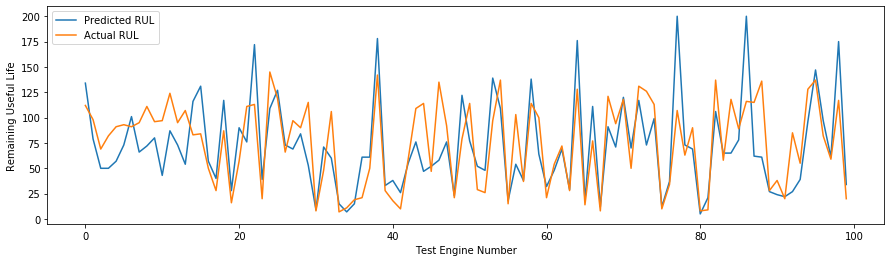
We were able to get results that closely matched the test data and we had an innovative approach compared to others who have tried this problem!
What I learned
We got way better at using pandas, sklearn and Data Science
What's next for EngPredict
Next steps for this project would be to test different machines and appliances to see if the model can be extended beyond its inital use.


Log in or sign up for Devpost to join the conversation.