ENERSENSE: Turning Energy Auditing into Continuous Intelligence
- What Inspired Us
The idea behind ENERSENSE started with a simple question: Why should factories wait for an energy audit to find out that they might be wasting electricity?
For many micro, small, and medium enterprises (MSMEs), electricity is a significant operating expense. However, understanding where energy is being wasted is not always easy. Traditional energy audits can be expensive, time-consuming, and dependent on manual inspections. Between two audits, unusual energy consumption and inefficient operating patterns may continue without being noticed.
This made us think about how technology could make energy management simpler and more accessible for smaller industries.
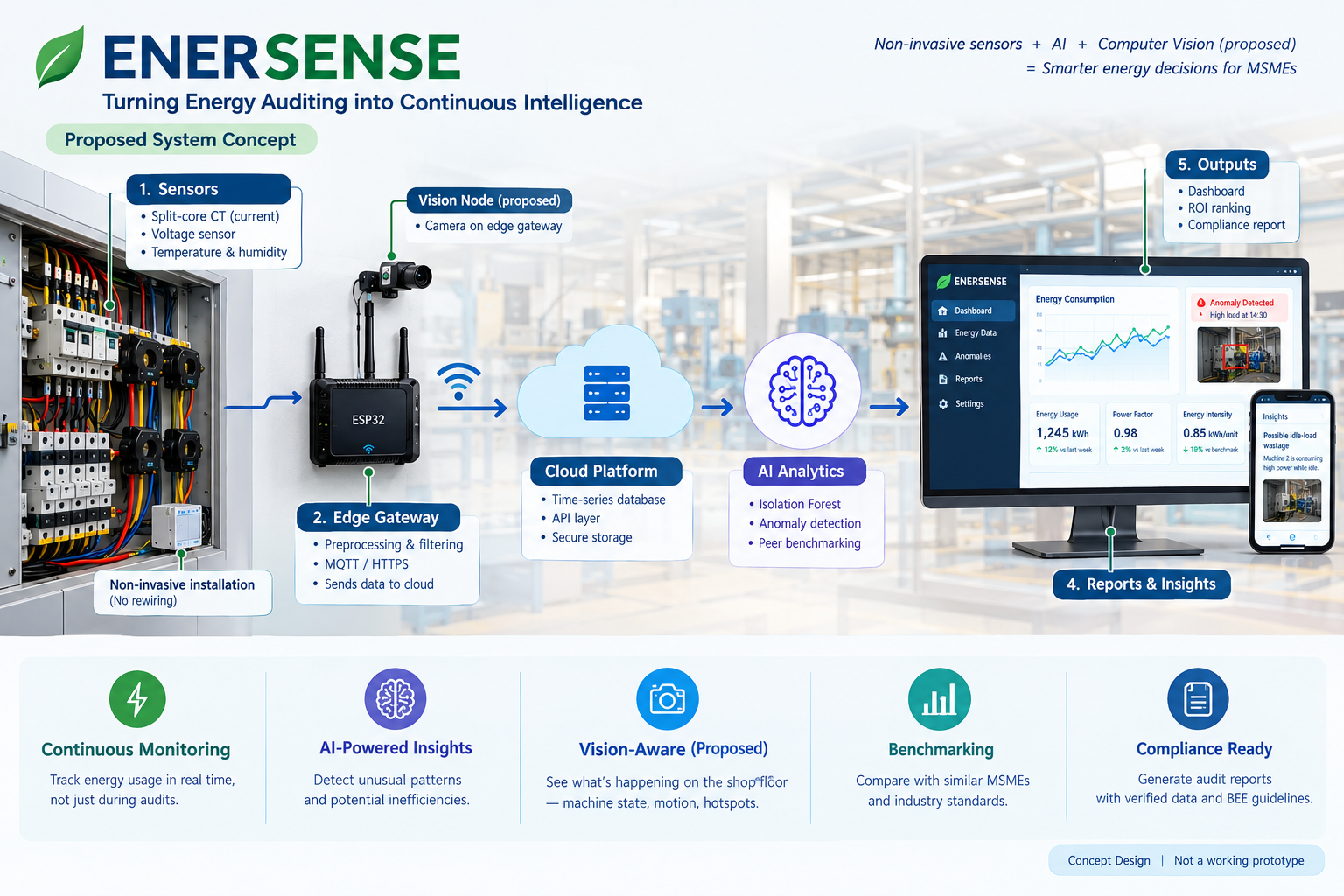
We came up with ENERSENSE, a proposed AI-powered energy monitoring and auditing system that aims to help factories track their electricity consumption continuously, identify unusual patterns, and make better decisions about energy efficiency.
Our goal is to explore how we can move from occasional energy checks to continuous energy monitoring.
- What We Learned
Working on the ENERSENSE concept helped us understand how electrical engineering and artificial intelligence can come together to solve a real industrial problem.
We explored how electrical sensors could collect energy-related data, how a gateway could transfer that data to a cloud platform, and how the collected information could be used to identify unusual consumption patterns. We realized that collecting data alone is not enough. The real value comes from turning that data into insights that factory owners and maintenance teams can actually use.
One of our important learnings was the use of unsupervised machine learning. Industrial fault datasets may not always contain enough labelled examples to train a conventional supervised model. To address this challenge, we selected Isolation Forest as a potential algorithm for detecting unusual energy consumption patterns.
We also learned that an unusual reading does not necessarily mean that a machine is faulty. Changes in production, operating hours, or machine load can also affect energy consumption. Therefore, alerts generated by ENERSENSE would need further investigation before any conclusions could be drawn.
Another important lesson was that automated energy reports must be reliable and meaningful. Accurate measurements, transparent calculations, relevant industry comparisons, and applicable Bureau of Energy Efficiency (BEE) guidelines would all be important in making these reports useful.
- How We Designed ENERSENSE
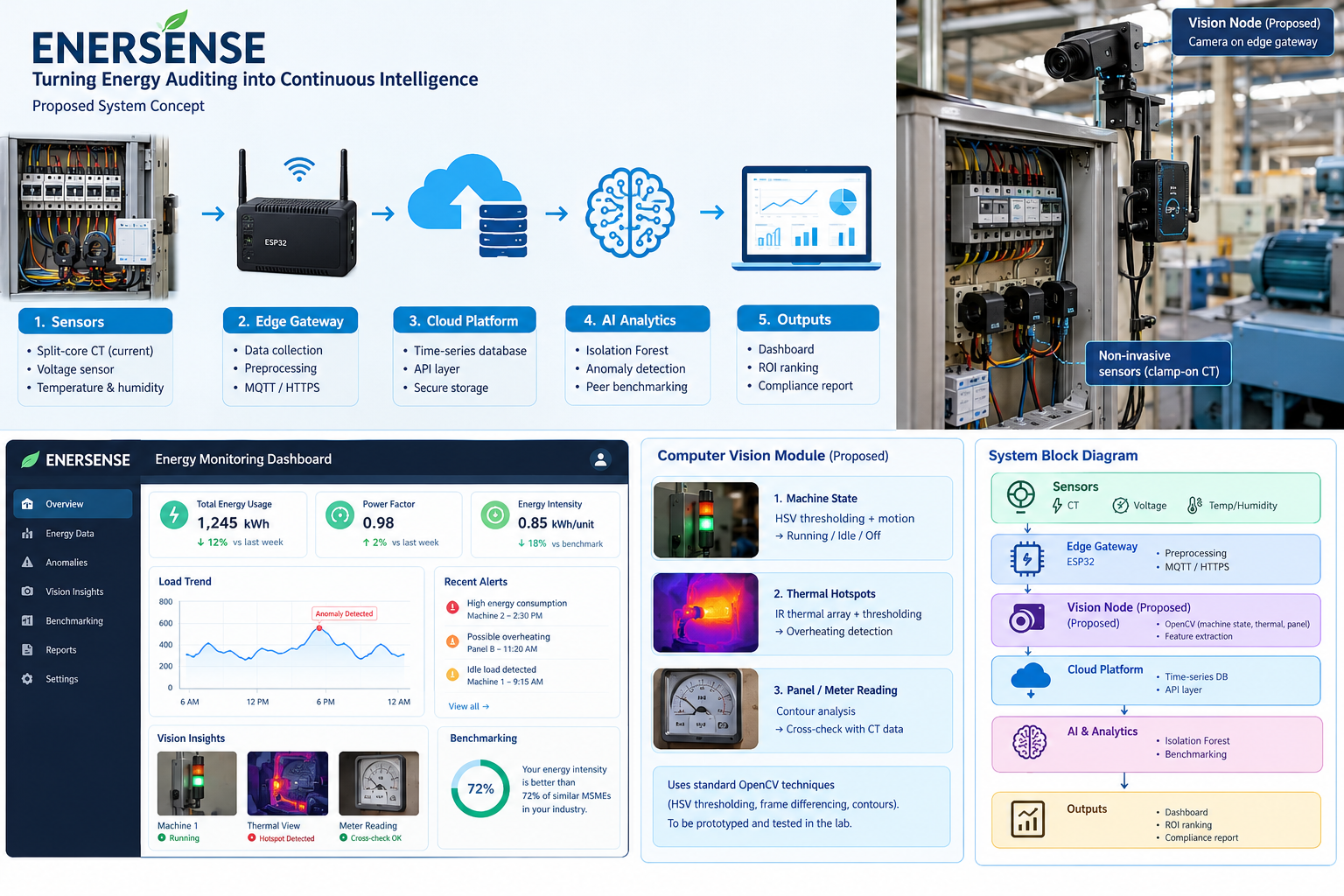
We organized our proposed system into four main stages.
Step 1: Collecting Energy Data
The first stage involves monitoring relevant electrical parameters using suitable sensors installed at an existing electrical panel. We aim to minimize disruption to factory operations by exploring a minimally invasive installation approach.
The final sensor selection and installation method would depend on the electrical system, measurement requirements, and safety considerations.
Step 2: Connecting the Gateway to the Cloud
The collected readings would be sent to a gateway, which organizes the data and securely transfers it to a cloud-based platform.
This would allow energy consumption to be recorded over time, making it easier to study operating patterns and identify changes that might otherwise go unnoticed.
Step 3: Detecting Unusual Patterns Using AI
For the AI component, we selected Isolation Forest as our proposed anomaly detection algorithm. It is designed to identify observations that differ from patterns learned from historical data, without requiring every unusual event to be labelled beforehand.
For example, if a machine begins consuming significantly more electricity than usual under similar operating conditions, ENERSENSE could generate an alert for further investigation.
The basic process is:
Energy Data → Anomaly Detection → Alert for Investigation
The purpose is not to let AI make unsupported claims about equipment faults. Instead, it is to help users recognize unusual patterns earlier and decide when further inspection may be necessary.
Step 4: Generating Reports and Comparing Performance
The final stage focuses on converting the collected data and detected anomalies into understandable reports.
These reports would include energy consumption summaries, unusual events, and information that could support an energy audit. Where reliable reference data is available, the system could also compare a factory's energy performance with that of similar facilities.
However, fair comparisons require more than looking at total electricity consumption. Production volume, operating hours, machinery, and other relevant factors must also be considered.
We also plan to explore how the reports could support applicable BEE-related auditing requirements. Any claim of regulatory compliance would require verification against the relevant standards and procedures.
The complete proposed workflow is:
Sensors → Gateway → Cloud Platform → AI Analysis → Energy Reports
Together, these stages are intended to create a continuous monitoring system that makes energy data easier to understand and act upon.
- The Challenges We Faced
One of the main challenges we considered was how to build a useful AI-based monitoring system when labelled industrial fault data may be limited. This led us to explore unsupervised anomaly detection, which can identify unusual patterns without requiring every possible fault to be labelled in advance.
Another challenge was affordability. MSMEs need solutions that are practical for their budgets and existing infrastructure. A system that requires expensive equipment, major electrical modifications, or lengthy production shutdowns would be difficult for many small factories to adopt. For this reason, we prioritized a low-cost design with minimal installation disruption. However, the final cost, measurement accuracy, and installation safety still need to be validated.
We also recognized that comparing energy performance across different factories is not straightforward. Two factories may consume different amounts of electricity simply because they have different production levels, machinery, or operating schedules. Developing meaningful benchmarks will therefore require suitable reference data and careful consideration of these differences.
A further challenge is ensuring that the generated reports are genuinely useful. A report should not simply present numbers and graphs; it should explain where unusual patterns occurred, how the findings were calculated, and what information needs further investigation.
At the current design stage, these challenges have helped us identify the key requirements of ENERSENSE. We still need to test our proposed solutions through implementation and practical evaluation.
- Our Vision and Next Steps
Our vision for ENERSENSE is to make continuous energy monitoring and data-driven energy auditing more accessible to Indian MSMEs.
Our next step is to turn the proposed design into a working prototype. We plan to compare sensor readings with a reliable reference instrument, collect representative energy consumption data, and evaluate how effectively Isolation Forest identifies unusual patterns.
We also want to measure the model's false-alarm rate, test the automated report generation process, and explore suitable datasets for industry benchmarking. These tests will help us understand the system's actual performance and identify areas that need improvement.
Rather than assuming that the system will reduce electricity bills or prevent equipment failures, we aim to measure its impact through practical testing before making such claims.
For us, ENERSENSE is more than an energy monitoring concept. It is an opportunity to apply our knowledge of electrical engineering and AI to a problem faced by real industries.
Our vision is simple: help factories understand their energy consumption continuously, identify potential inefficiencies earlier, and make informed decisions toward better energy management.
Built With
- ai
- analytics
- data
- efficiency
- energy
- green
- iot
- sustainable
- tech
