-
-
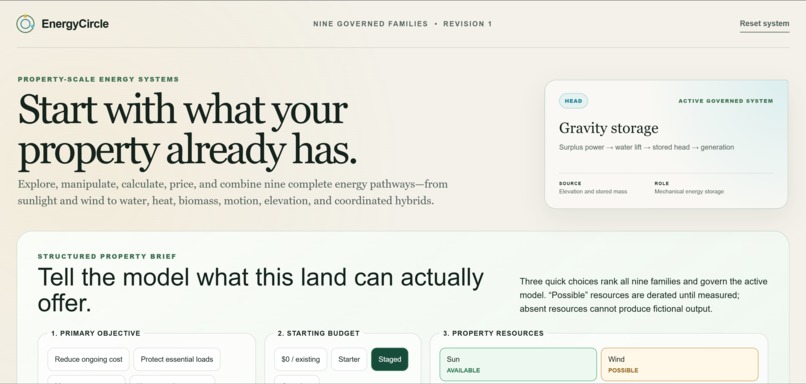
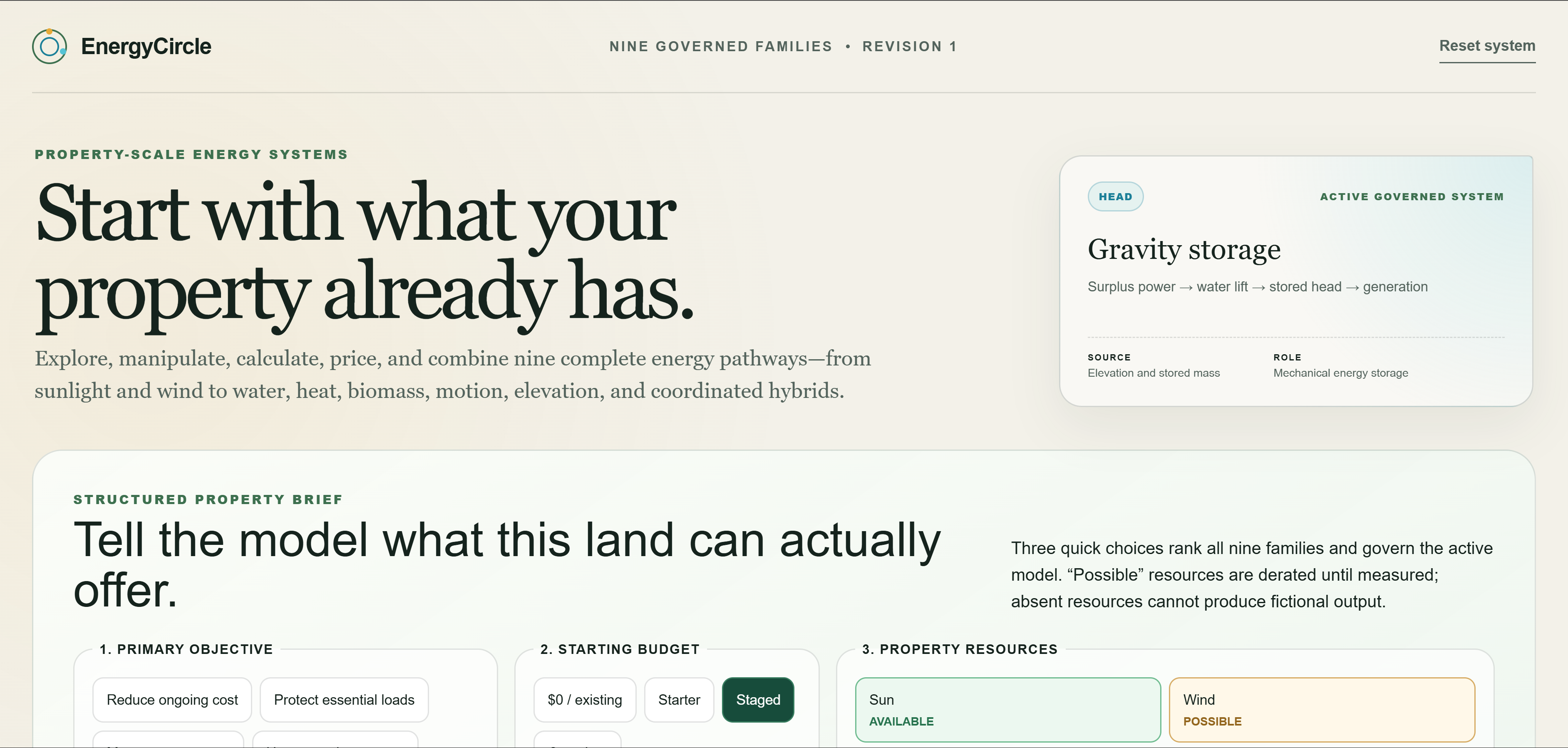
Start with what your property already has—not what a template assumes.
-
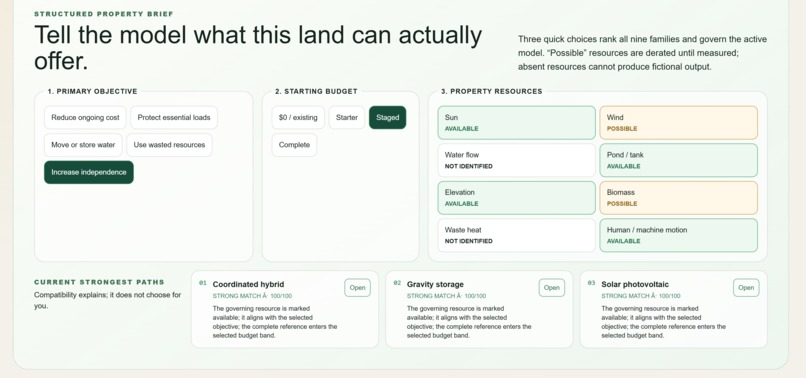
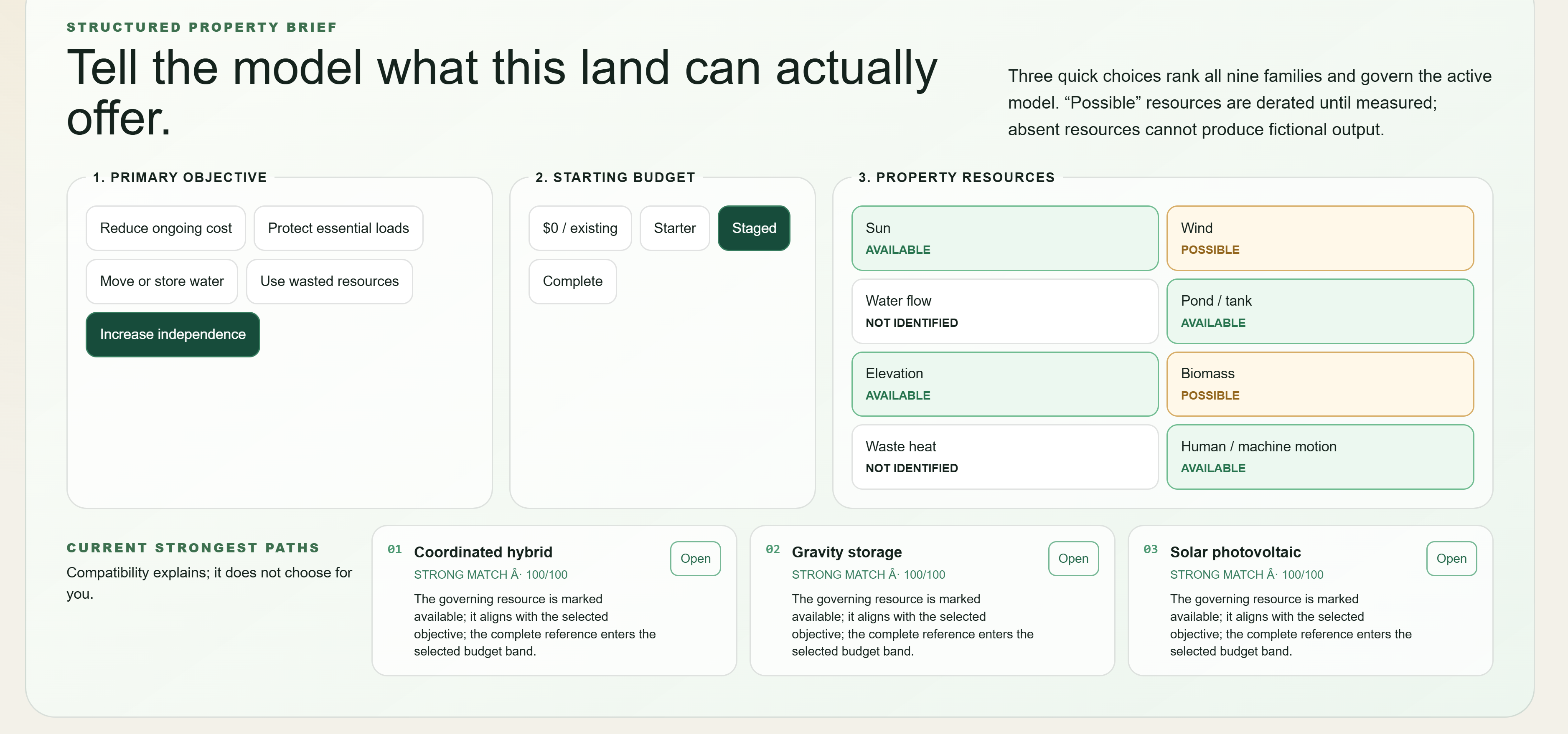
Define your objective, budget, and available resources to identify the strongest energy paths.
-
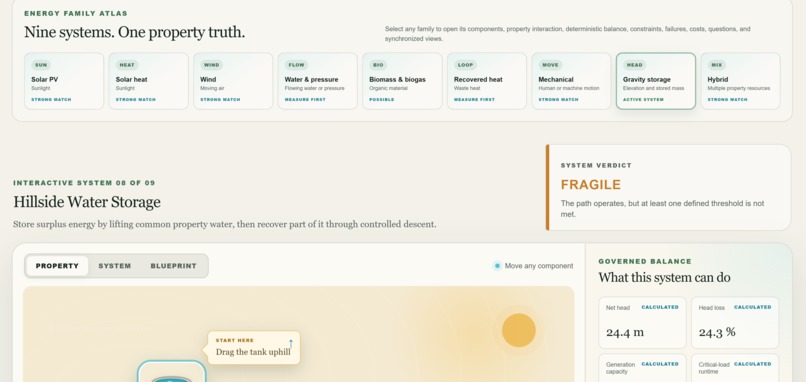
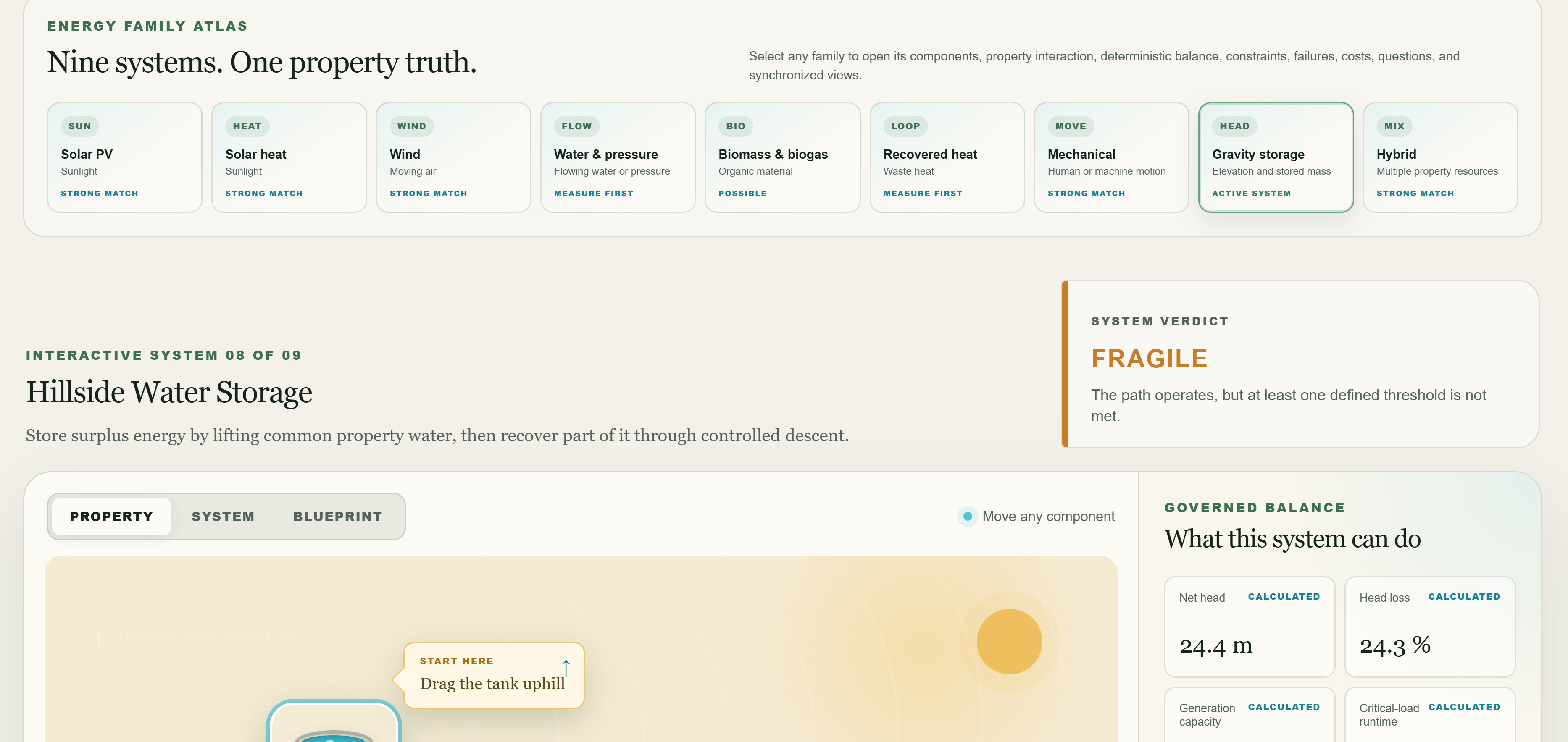
Explore nine governed energy families and choose the best system for your property.
-
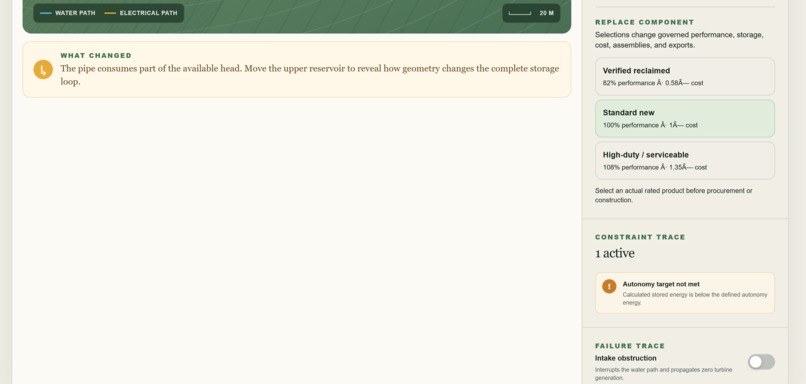
Every design begins with a live engineering verdict before any optimization begins.
-
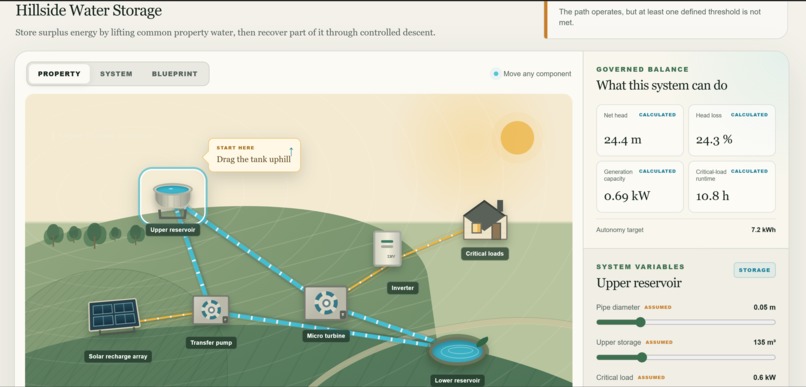
Drag and position system components directly on the property to test real-world layouts.
-
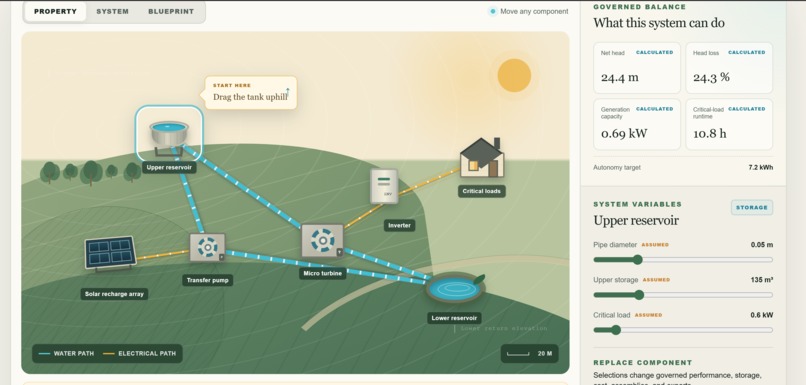
Adjust engineering variables and instantly update the governed system model.
-
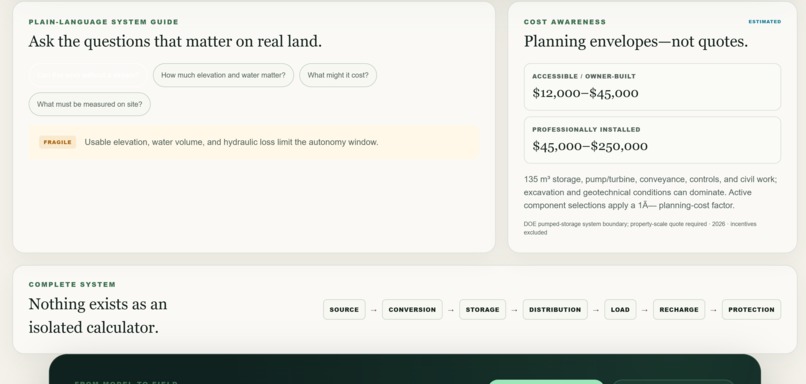
Understand failures, compare solutions, and trace every engineering decision through the model.
-
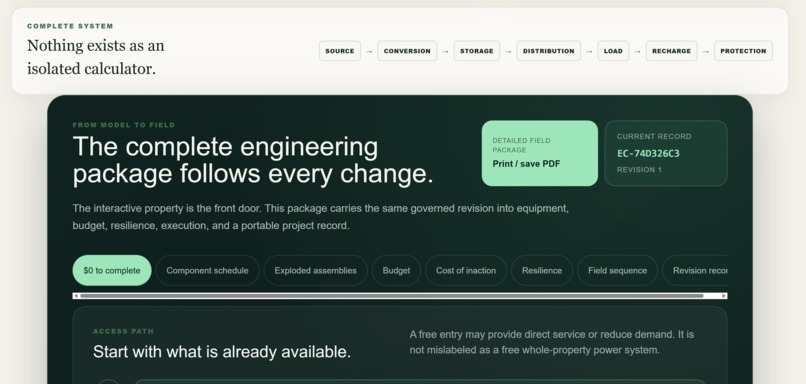
Every design revision generates a complete engineering package with budgets, assemblies, and field-ready documentation.
Inspiration
Properties often contain useful energy resources—sunlight, wind, flowing or stored water, elevation, waste heat, biomass, and human motion—but existing tools usually examine them separately. A homeowner can find thousands of pages of information and still not understand what a complete system would look like, what limits it, what it may cost, or what must be measured next.
EnergyCircle makes property-scale energy systems legible. It begins with a living reference property rather than an empty form, then lets the user directly manipulate the physical system and see the consequences.
What it does
EnergyCircle contains nine governed system families:
- Solar photovoltaic
- Solar thermal
- Wind generation and water lifting
- Water flow and pressure recovery
- Bioenergy
- Thermal recovery
- Mechanical and human power
- Gravity storage
- Coordinated property hybrids
Each family is a working deterministic reference model with its own components, property interaction, variables, energy or resource balance, storage behavior, failure condition, warnings, feasibility verdict, cost range, and questions.
A structured property brief captures the user's objective, starting budget, and eight resource conditions. EnergyCircle compares all nine families with a visible compatibility score, evidence-based reason, next measurement, and reference verdict. The comparison explains what fits; it does not choose a system for the user. An absent required resource produces zero fictional output, while a possible but unmeasured resource visibly derates the model.
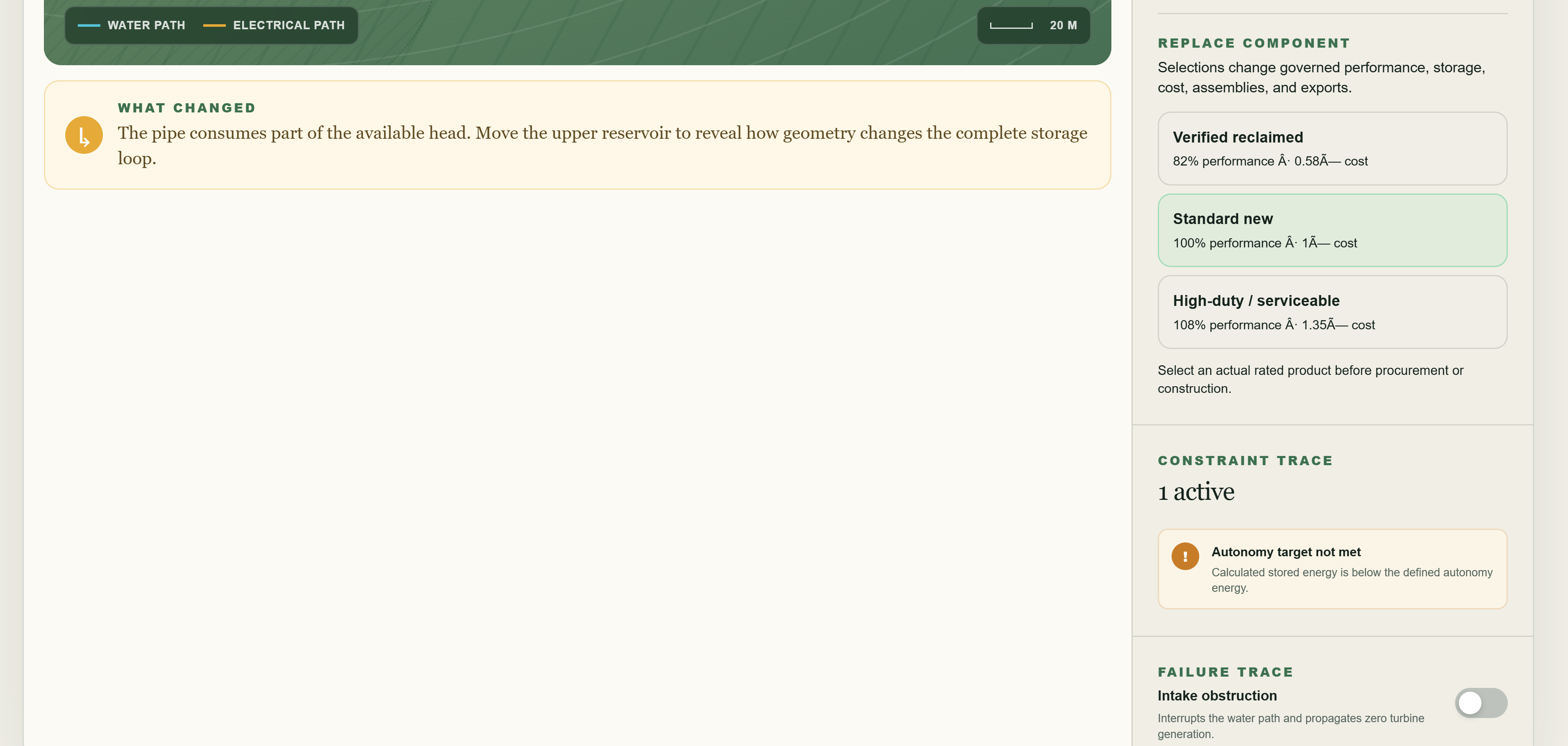
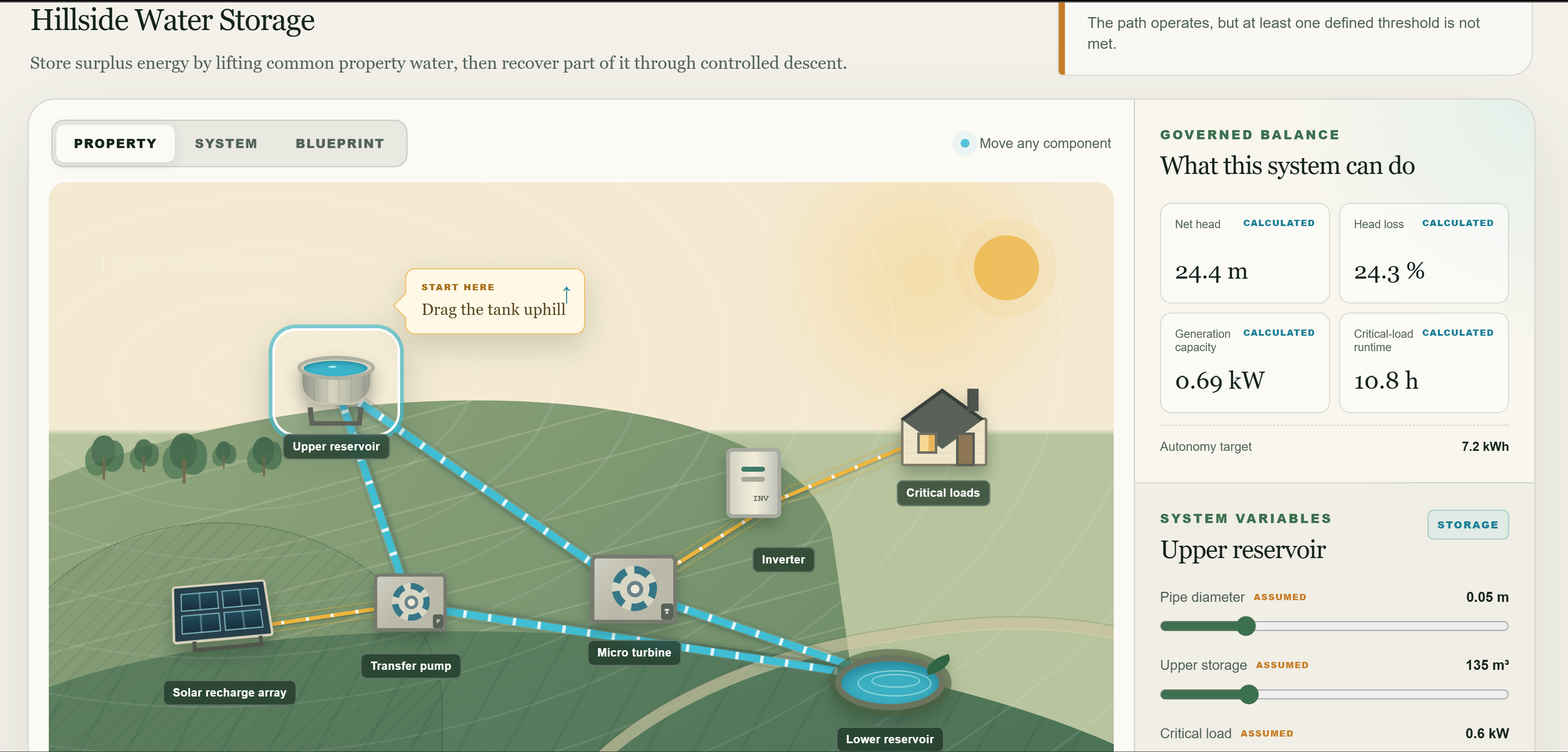
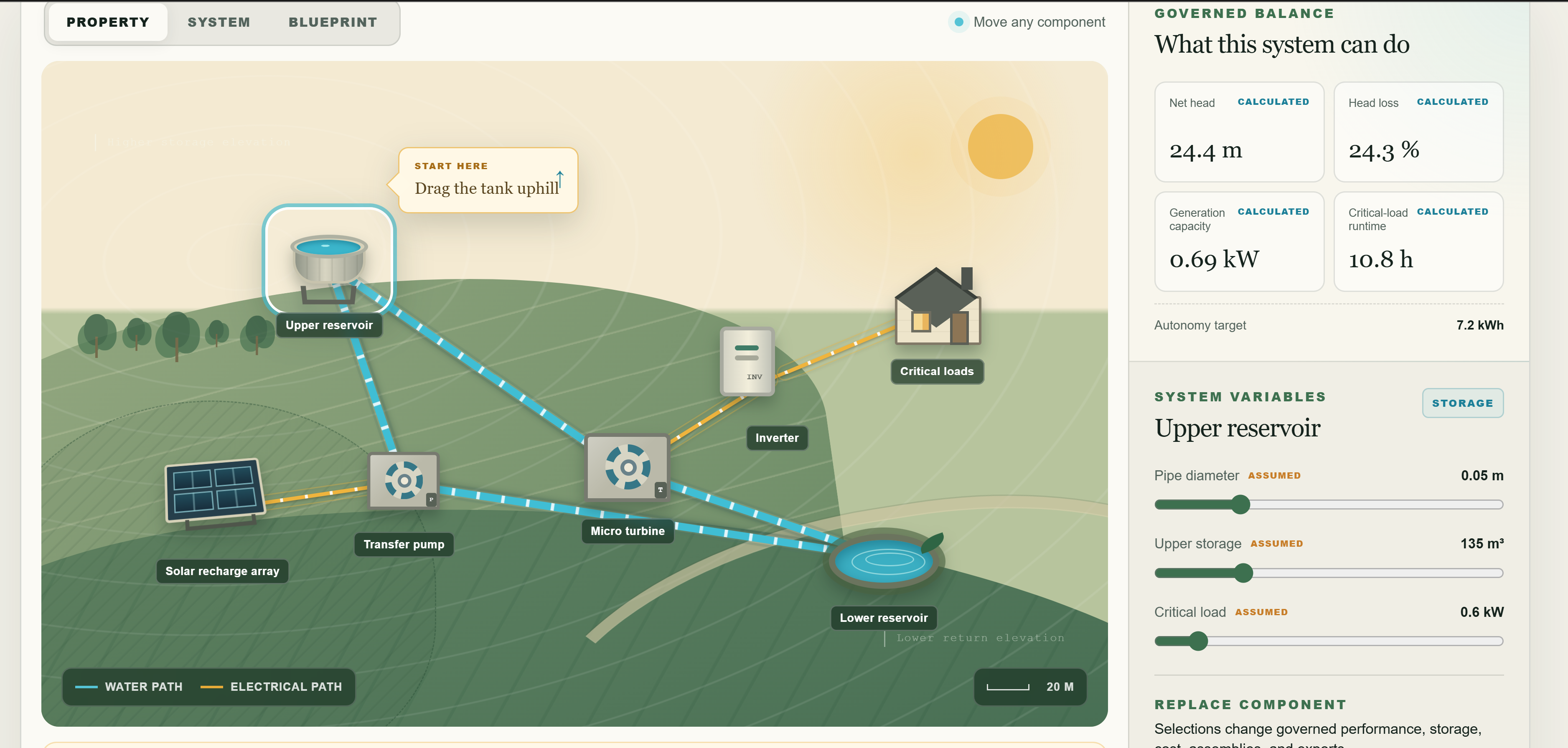
In the gravity-storage demonstration, moving one reservoir changes geometry, hydraulic head, route length, Darcy-Weisbach losses, stored energy, runtime, warnings, feasibility, visualization, and the causal explanation through one governed state transition. The visual never changes independently of the calculation.
Access from $0 to complete
A full installation is not everyone's starting point. Every family includes a five-stage access path:
- Use what already exists with $0 in new equipment
- Reclaimed or assisted entry
- One-service starter
- Expandable staged system
- Complete reference system
The free level may reduce demand or provide a direct service; it is never misrepresented as free generated electricity. Starter and staged outputs are recalculated by the governed engine and state their prerequisites and limits.
From interaction to a field package
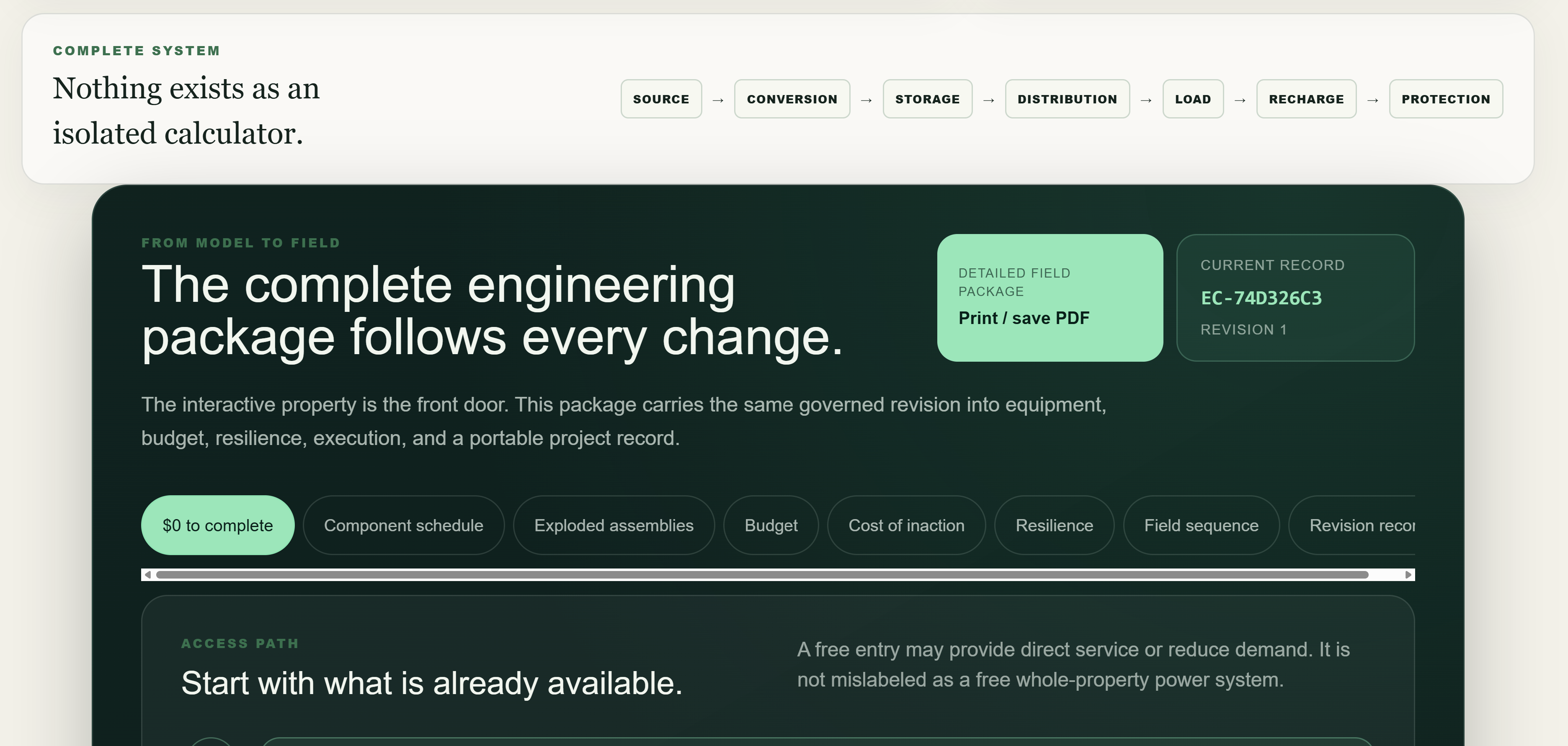
Every active revision produces an Engineering Package containing:
- Connected component schedule
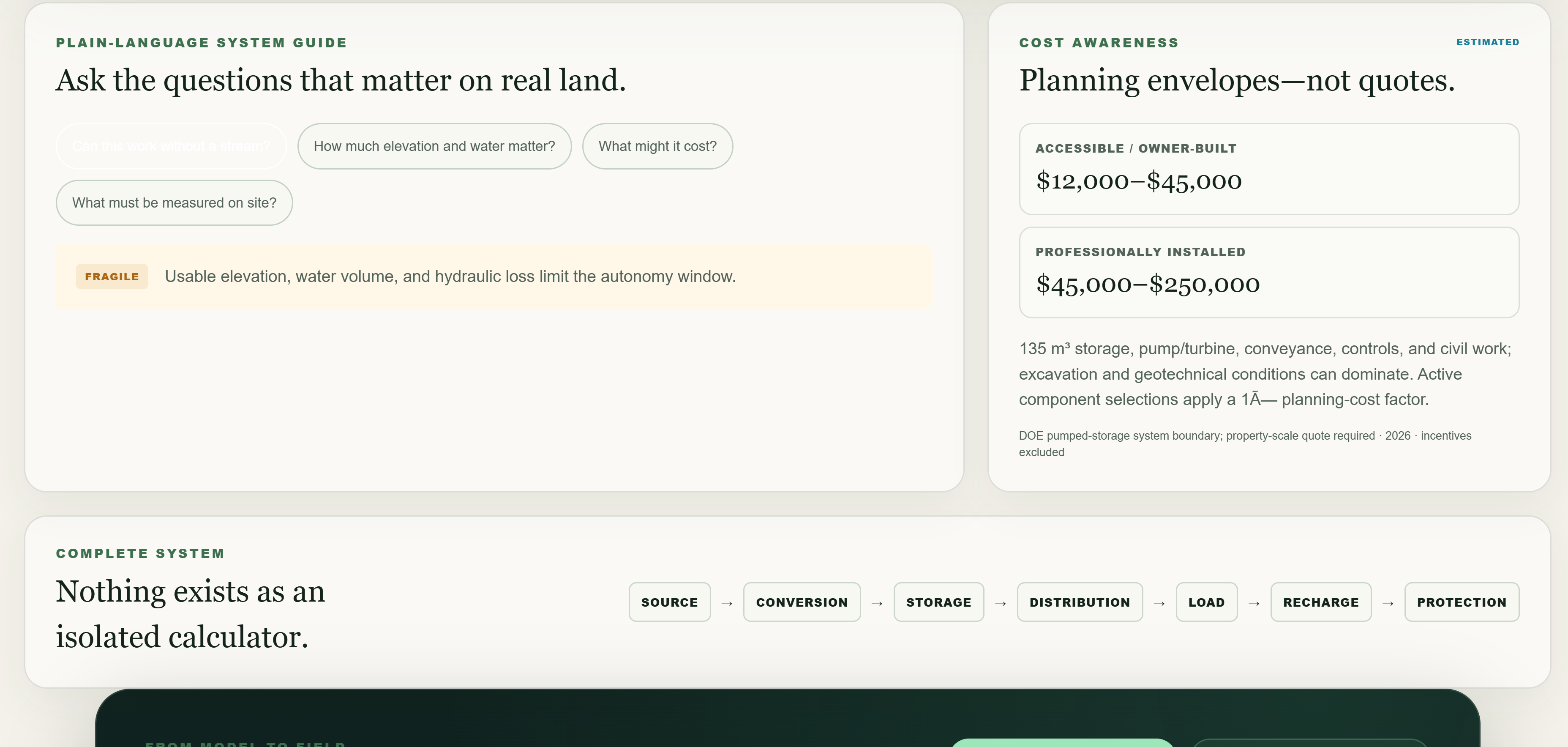
- Itemized accessible and installed planning budgets
- Governed reclaimed, standard-new, and high-duty component replacement
- Exploded assemblies with parts, interfaces, inspection gates, failure effects, service access, isolation, and assembly sequence
- Editable cost-of-inaction scenarios with visible assumptions and unpriced effects
- Deterministic resilience matrix
- Family-specific field sequence
- Assumptions, unknowns, exclusions, and professional-review boundaries
- Stable revision fingerprint
- Downloadable canonical JSON record
- Detailed multi-page print/PDF pre-build package
- Property brief and complete nine-family architecture comparison
The export supports measurement, comparison, quoting, procurement conversations, commissioning, and maintenance planning. It does not pretend to replace local permits, selected-equipment data, licensed design, or site inspection.
Technical implementation
EnergyCircle is built with React, TypeScript, vinext/Vite, and a deterministic system engine. Its central invariant is:
No representation may update independently of canonical project state.
Every meaningful interaction passes through a governed preview transaction. Pointer movement can preview calculations without changing project truth; the completed interaction commits exactly one project revision. Calculations, warnings, verdicts, costs, resilience cases, visualizations, explanations, and exports derive from that revision.
Values are labeled as measured, assumed, calculated, estimated, or unknown. AI-generated language cannot create physical values or feasibility scores.
How Codex and GPT-5.6 were used
Codex and GPT-5.6 served as the implementation partner throughout Build Week. They accelerated:
- Translation of the approved product scope into production code
- Provenance review of pre-existing product-direction material
- Design and implementation of the canonical transaction model
- Deterministic hydraulic, electrical, thermal, wind, biogas, mechanical, and hybrid calculations
- Responsive interface and direct-manipulation development
- Accessibility and truth-state review
- Engineering-package and export generation
- Automated unit, server-render, production-build, and browser tests across all nine families
The human product decisions remained explicit: preserve the full nine-family vision, expose uncertainty, make access part of every system, and prevent AI explanations from overriding physical truth.
Build Week provenance
A July 8, 2026 EnergyCircle prototype was used only as product-definition lineage for the nine-family catalog. Its code, calculations, interface, and assets were not imported. The prior Metabolic Systems Builder was inspected as design lineage and as a source of architectural lessons; no source code or assets from it were reused. The implementation in the submitted repository was written as new Build Week work, with dated commits and the disclosure preserved in the README.
What I learned
An interactive engineering product cannot treat visualization as decoration. When a user moves a real component, every representation must follow the same physical truth. EnergyCircle also demonstrates that accessibility is not the same as pretending complex infrastructure is free: a responsible tool can show what someone can do today, what can grow later, and where safety and professional review remain necessary.
Built With
- cloudflare-workers
- gpt-5.6
- openai-codex
- react
- typescript
- vinext
- vite

Log in or sign up for Devpost to join the conversation.