-
-

Drain
-

Recover
-
Clarity

Energy Sense
A new sense for the energy within.
Inspiration
Throughout the day, something shifts inside us.
A moment of unusual clarity opens up while working. A long conversation slowly pulls something away. Late at night, a quiet pressure builds — asking, without words, for rest.
These changes happen before we consciously notice them. And by the time we do, we have already made the wrong decision: pushed through the fog, stayed too long, ignored the signal.
The problem is not that these states don't exist. It's that we have no sense for them.
We can feel temperature. We can hear silence. But we cannot perceive our own cognitive clarity, our social drain, or our body's need for recovery.
We asked: what if we could?
Energy Sense is a speculative sensing system that gives people a new kind of awareness — the ability to perceive their own internal energy state before misalignment becomes damage.
What it does
Energy Sense translates invisible internal signals into a perceivable landscape.
It detects three signals that shape how we think, connect, and recover:
Cognitive Clarity — whether the mind is currently ready for deep work. Reflected through patterns such as attention stability and task switching.
Social Drain — the cost that social interaction places on the system. Reflected through patterns such as conversation length and interaction tempo.
Recovery Pressure — the body's accumulated need for rest. Reflected through patterns such as sleep debt and circadian timing.
These three signals combine into a single Energy Landscape — a living visual field that continuously shifts to reflect the user's internal state. Not numbers. Not a dashboard. A perceivable environment that changes the way the body changes: gradually, honestly, without alarm.
The system's role is not optimization. It is awareness of misalignment — the gap between what the body needs and what the person is doing:
- Cognitive Clarity is low, but the user is attempting deep work.
- Social Drain is high, but the conversation continues.
- Recovery Pressure is rising, but the phone stays on.
When misalignment appears, Energy Sense surfaces a quiet signal. Not a command. An awareness.
Three states shape the landscape:
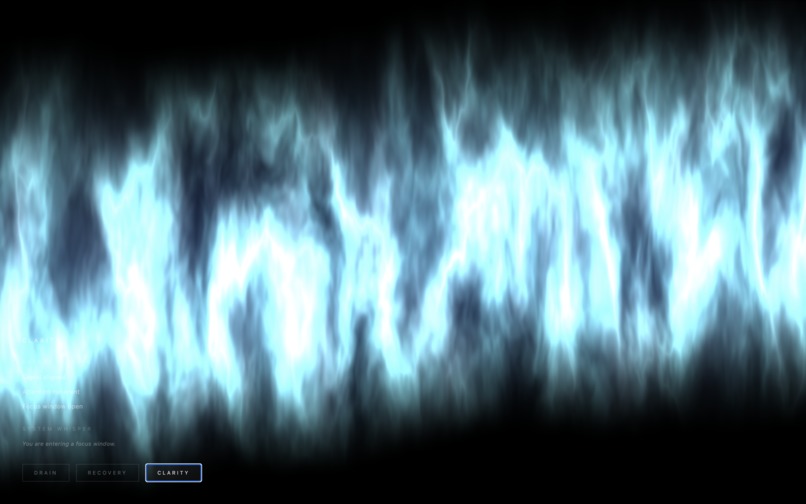
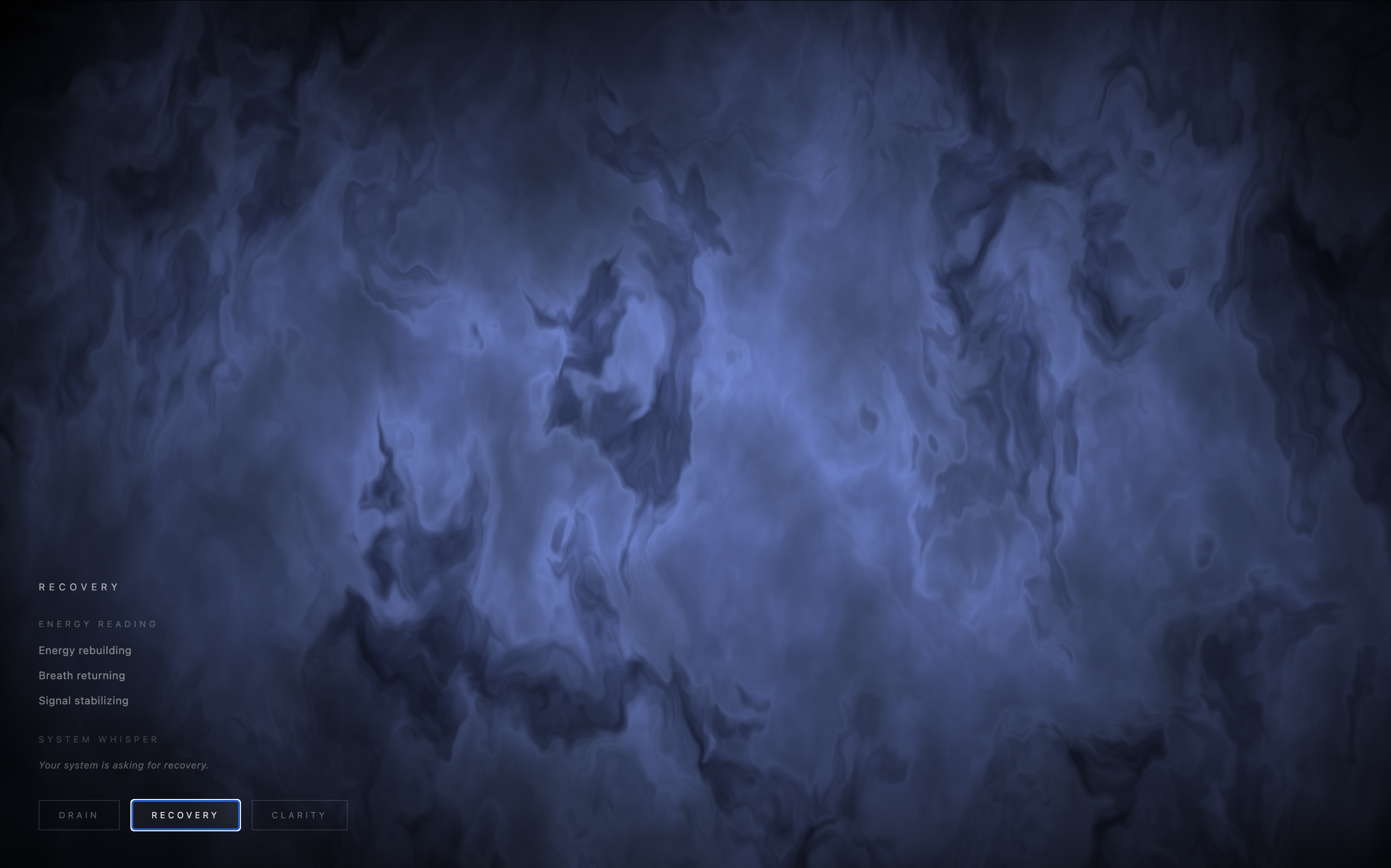
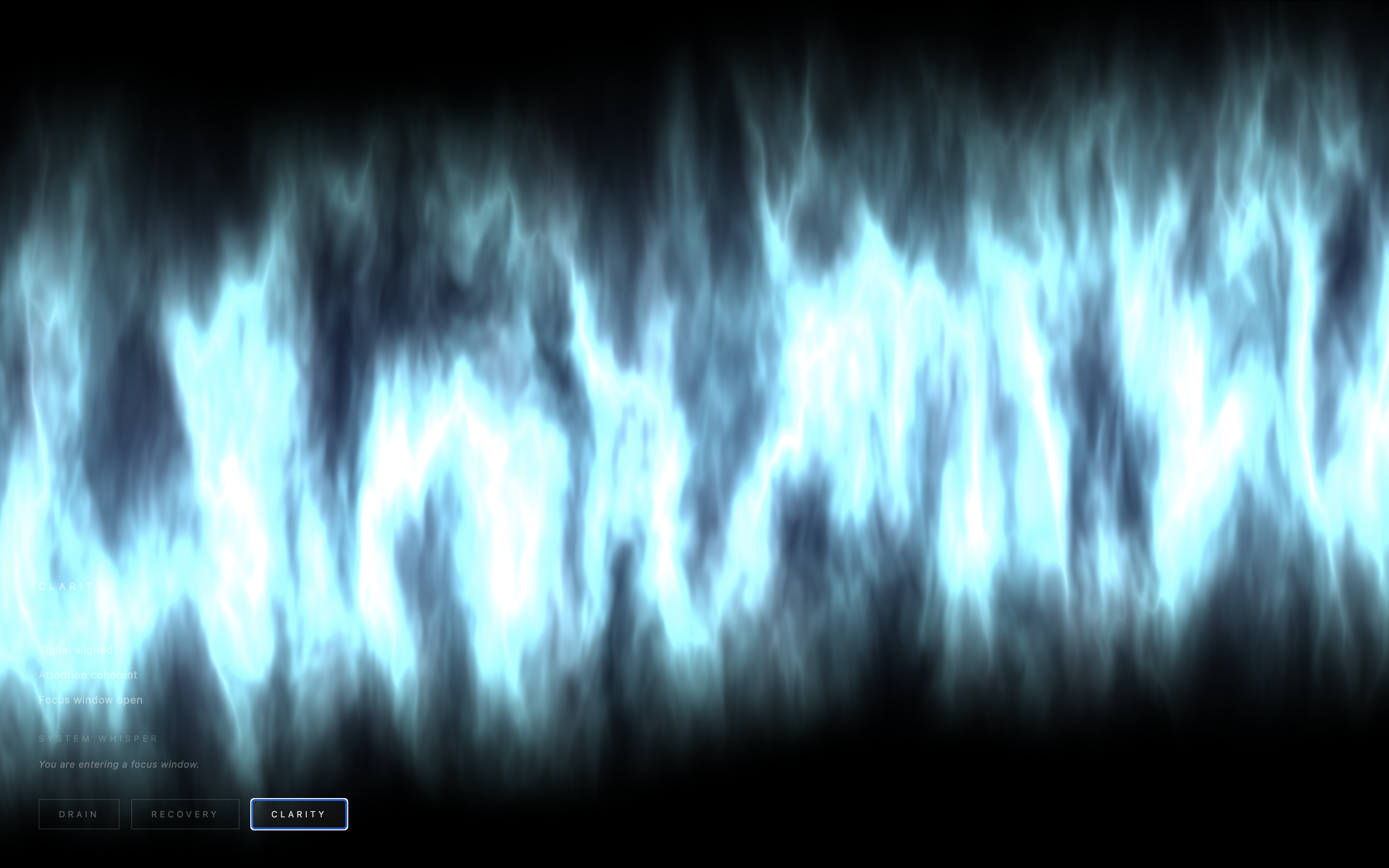
Drain — the field grows dense and slow. Recovery — structure begins to reappear. Clarity — the landscape opens into directional flow.
How we built it
We built an interactive prototype that renders the Energy Landscape in real time.
The landscape continuously evolves rather than switching between screens. As the energy state shifts, the visual field transforms in color, motion, and structure to reflect that shift.
The interface has two layers: the Energy Landscape, a dynamic visual environment, and the Energy Reading, a short qualitative phrase that names the current state in plain language.
Three use cases shaped every design decision:
Deep Work Window. The system detects rising Cognitive Clarity and falling distraction. It surfaces a quiet message: "You are entering a focus window." The user chooses to begin deep work — at the right moment, not by habit.
Social Fatigue. After extended social interaction, Social Drain rises. The system surfaces: "Your social energy is dropping." The user has permission, now, to step away.
Night Recovery. As Recovery Pressure climbs in the evening, the landscape shifts. The system surfaces: "Your system is asking for recovery." The user puts the phone down.
In each case, Energy Sense does not decide. It makes the invisible perceivable, and returns the choice to the person.
Challenges we ran into
The hardest design challenge was restraint.
Early versions of the landscape were visually expressive but emotionally illegible — they communicated texture without meaning. It took several iterations to find a visual language where Drain, Recovery, and Clarity felt genuinely distinct while still belonging to the same continuous environment.
The second challenge was tone. A system that monitors internal states can easily feel surveillance-like — clinical, anxious, prescriptive. We had to continuously pull the design back toward something quieter: a companion that notices, not a system that judges. Every word in the interface was chosen to reflect that difference.
Accomplishments that we're proud of
We are proud that Energy Sense evolved from an abstract question into a working interactive prototype with a coherent sensing model.
The system demonstrates a real-time visual interface where internal energy states transform a living environment. Rather than presenting data as numbers or alerts, it communicates through perception — the way light communicates weather, or posture communicates mood.
We are also proud of the design principle that held throughout: Energy Sense offers awareness, not control. The goal was never to optimize the user. It was to give them a sense they were missing.
What we learned
We learned that sensing does not require precision to be meaningful.
Qualitative signals — a shift in visual density, a short phrase, a change in the color of light — can communicate complex internal states more intuitively than any number on a screen. The body already knows these states.
The design problem is translation, not measurement.
We also learned that the most important safeguard in a sensing system is scope. Energy Sense perceives only the user's own internal state. It does not monitor others, share data externally, or make recommendations beyond the moment. It is a mirror, not a map.
What's next for Energy Sense
This prototype explores what it feels like to have a sense you were never born with.
In the future, Energy Sense could integrate signals from wearable devices — making the landscape responsive to real physiological data rather than behavioral proxies. The visual field could extend beyond a screen: ambient light, spatial sound, subtle haptics. More broadly, we see this as the beginning of a new category of interface — one that helps people sense their internal rhythms and act in alignment with them.
Not to perform better. To live more honestly with what the body already knows.
Safeguards
Energy Sense was designed around a single ethical principle: awareness, not surveillance.
- The system senses only the user's own internal state. It does not monitor others.
- No energy data is shared externally without explicit consent.
- Suggestions are non-prescriptive. The system surfaces a signal; the user decides what to do with it.
- The interface is designed to reduce anxiety, not generate it. Misalignment is framed as information, not failure.
Extra perception comes with responsibility. Energy Sense is built to expand self-awareness — not to create a new source of self-judgment.


Log in or sign up for Devpost to join the conversation.