Project Story
Inspiration
The idea for Energy Saver App came from the increasing need for sustainable energy use. Seeing households and businesses struggle with high energy bills and inefficient power consumption inspired us to create a solution that not only tracks usage but also provides actionable insights. We wanted to combine AI technology with practical energy management to empower users to make smarter, greener choices.
What it does
Energy Saver App helps users monitor, analyze, and optimize their energy consumption. Key features include:
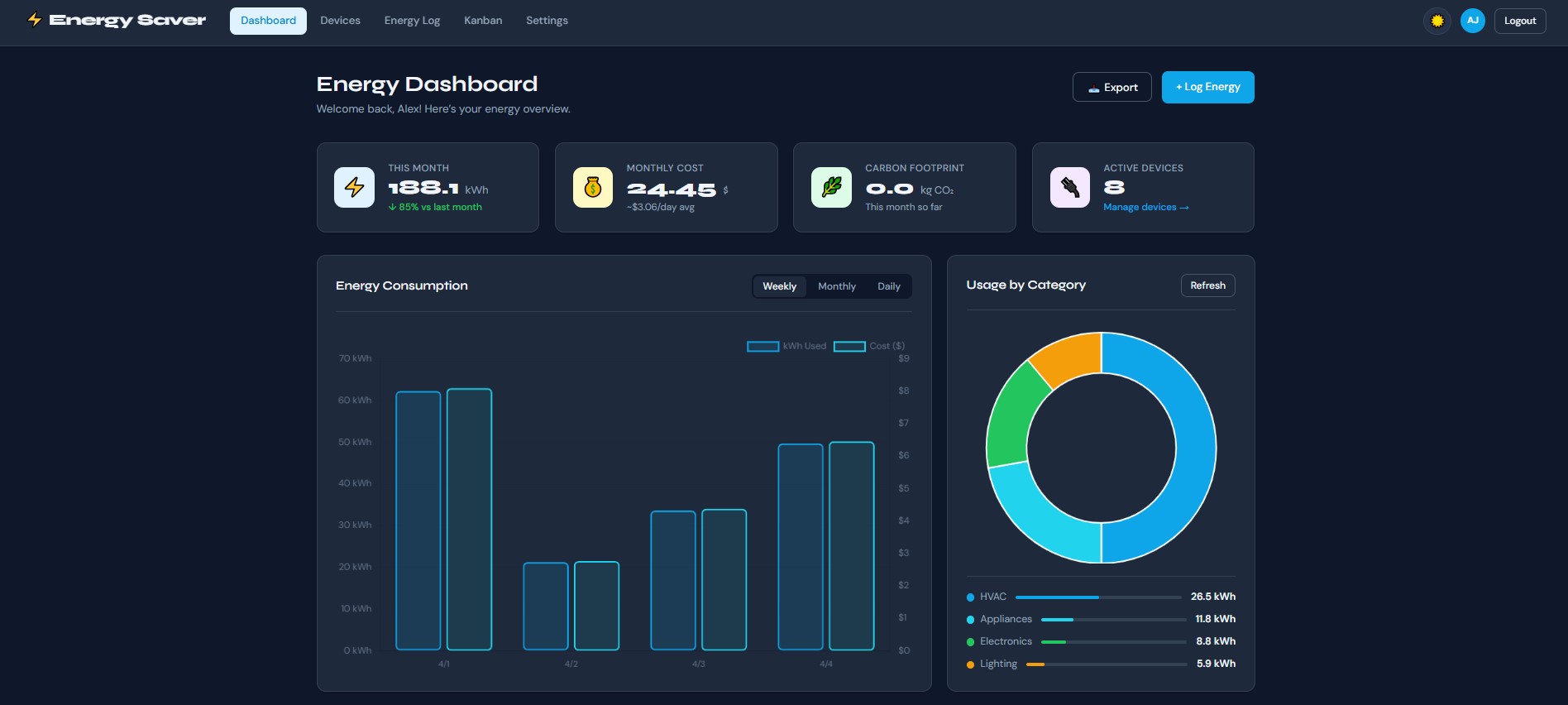
- Interactive Dashboard: Displays daily, weekly, and monthly energy usage, costs, and carbon footprint.
- AI Recommendations: Personalized energy-saving tips powered by Anthropic Claude.
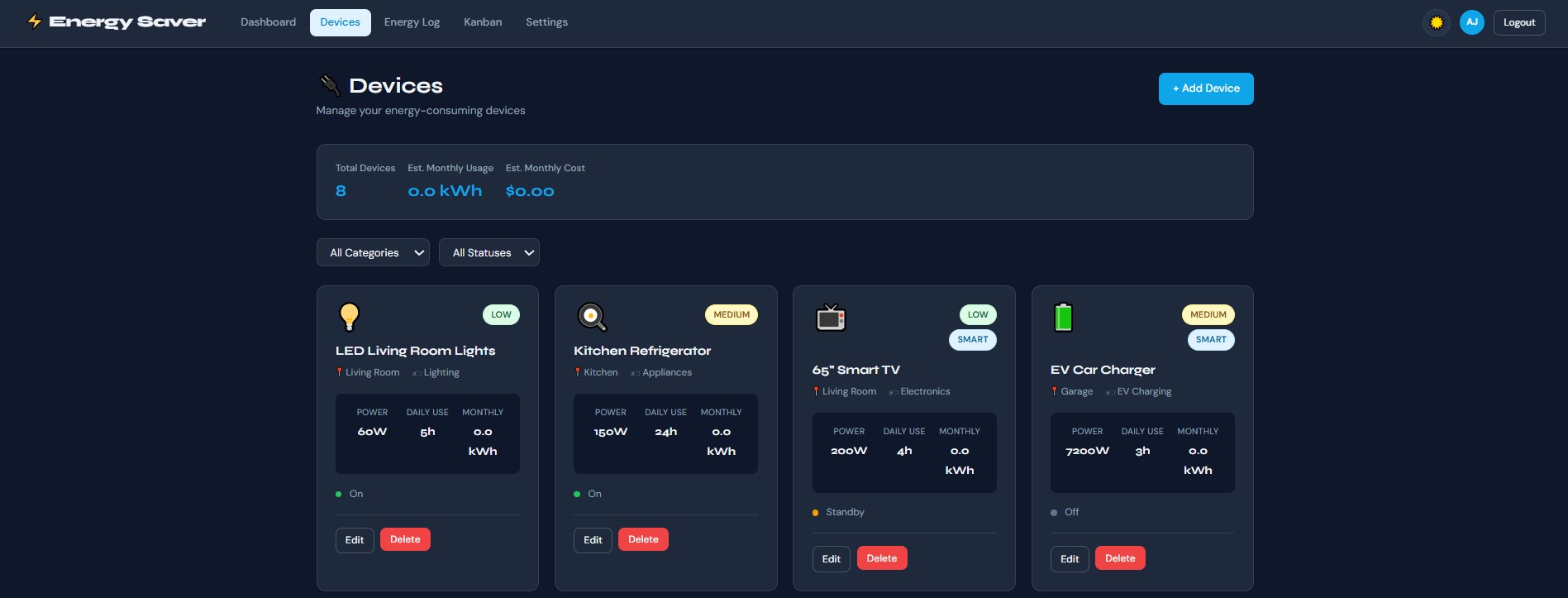
- Device Management: Track appliances with wattage, usage hours, and status.
- Kanban Board: Manage energy-related tasks, like appliance maintenance or upgrades.
- Energy Log: Detailed records with category filters and CSV export.
- Settings & Notifications: Customize rates, currency, dashboard, and alerts.
- Secure Authentication: Protect user data with hashed passwords and sessions.
Mathematically, it calculates energy costs and carbon footprint using formulas like:
[ \text{Cost} = \sum_{i=1}^{n} (P_i \times H_i \times R) ]
[ \text{Carbon Footprint} = \sum_{i=1}^{n} (P_i \times H_i \times F) ]
Where (P_i) is power consumption (kW) of device (i), (H_i) is usage hours, (R) is electricity rate, and (F) is the emission factor.
How we built it
The app is a full-stack solution using:
- Backend: Node.js with Express and MongoDB for database management.
- Frontend: Vanilla JS with Chart.js for interactive visualizations.
- AI Integration: Anthropic Claude API for real-time energy-saving recommendations.
- Security: bcrypt for password hashing, sessions stored in MongoDB.
- Design: Responsive UI using CSS variables for themes, fonts Syne + DM Sans.
We structured the code with clear separation of concerns: controllers, models, routes, services, and middleware to make it maintainable and scalable.
Challenges we ran into
- Real-time analytics: Aggregating energy data efficiently for charts and AI insights.
- Device tracking: Handling CRUD operations for dynamic appliances with variable wattage and usage.
- AI integration: Ensuring fallback recommendations work when the API is unavailable.
- Responsive design: Making the dashboard and Kanban board work seamlessly across devices.
- Security: Protecting sensitive user data while maintaining usability.
Accomplishments that we're proud of
- A fully functional AI-powered dashboard with personalized recommendations.
- Efficient energy cost and carbon footprint calculations using real data.
- Smooth drag-and-drop Kanban board for energy management tasks.
- A secure authentication system with hashed passwords and session management.
- Clean, responsive UI that works on desktop, tablet, and mobile.
What we learned
- How to integrate AI APIs into a full-stack application.
- Best practices in Node.js + MongoDB development for data-intensive apps.
- Efficient energy data aggregation and visualization with Chart.js.
- Importance of user experience and responsive design in practical tools.
- Challenges of secure authentication and session handling.
What's next for Energy Saver App
- Mobile app version for iOS and Android.
- Smart appliance integration via IoT for automated monitoring.
- Predictive AI features to forecast energy consumption and costs.
- Gamification to encourage energy-saving habits.
- Community insights: Allow users to compare usage and share tips.
Built With
- ai
- bcrypt
- bycrpt
- chart.js
- css
- express.js
- html
- javascript
- mongodb
- node.js


Log in or sign up for Devpost to join the conversation.