-
-
Main
-
error generation
-
CMD tool

Inspiration
We built Endternet because the internet itself is the biggest, strangest shared machine humanity has ever builta nd the idea of its graceful (or chaotic) collapse is both terrifying and oddly poetic. For CODEPOCALYPSE, we wanted a concept that’s immediately visceral: no dashboards or ML models, just a pure, shareable experience that looks like something the web would dream as it stops existing. We drew inspiration from glitch art, vaporwave interfaces, and old Windows error dialogs mixing nostalgia with a comedic, apocalyptic tone.
What it does
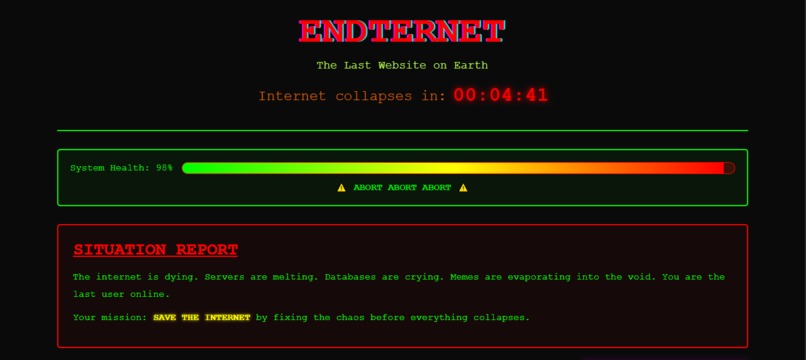
Endternet is an interactive front-end experience that simulates the final moments of the internet. When a user opens the page:
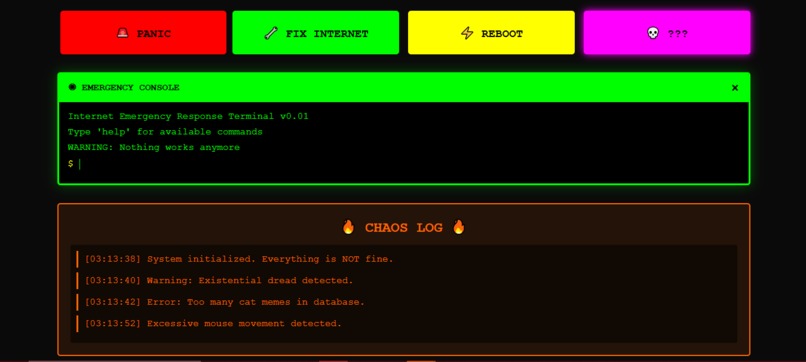
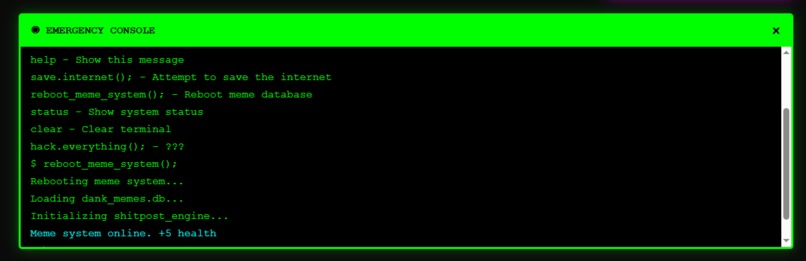
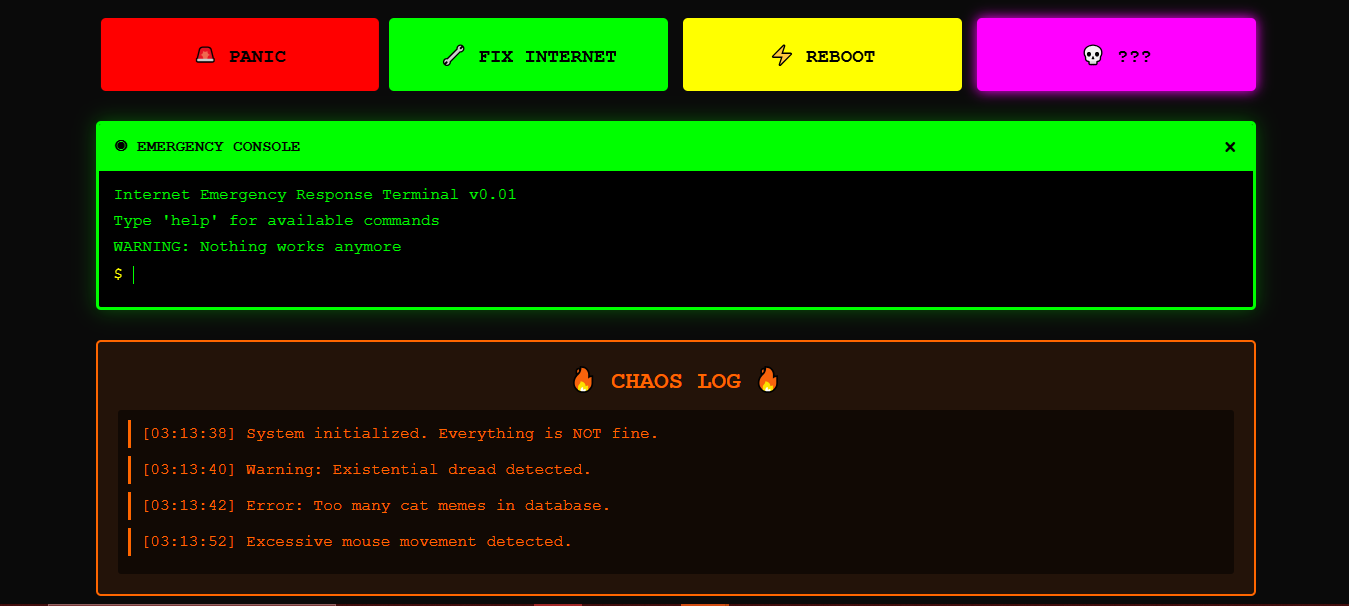
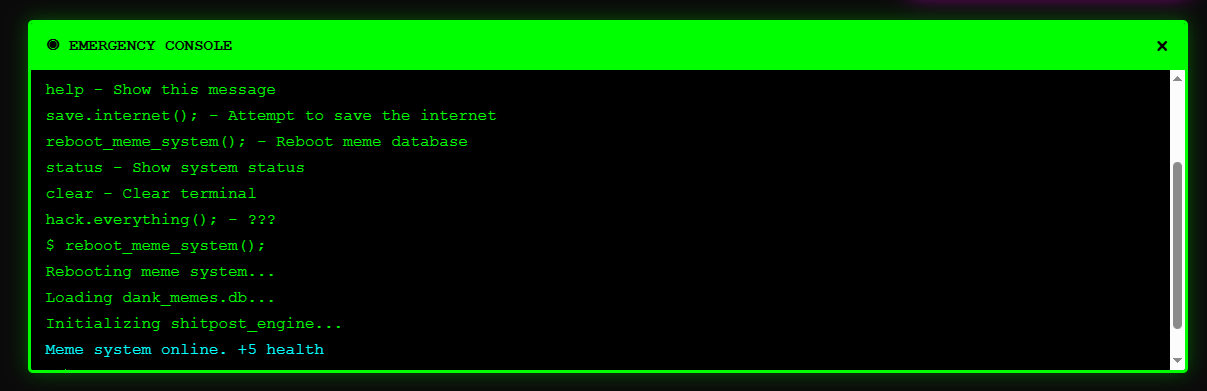
A countdown ticks toward "collapse." UI elements progressively glitch (text distortion, color inversion, melting animations). Fake error popups and system messages spawn randomly. A built-in terminal accepts playful commands (save.internet(); reboot_meme_system(); hack.everything();) which trigger in-page events with real game-state effects (health/time changes). User actions (mouse movement, scrolling, clicking) increase or alter chaos, creating emergent moments. When the timer hits zero, the screen fades to static and reveals an ASCII ending: "You survived the Endternet. Welcome to Offline Mode." It's an experience that’s equal parts interactive art and micro-game: there's no backend, everything runs client-side for instant sharing.
How we built it
Tech: Vanilla HTML, CSS and JavaScript intentionally frameworkless to keep the project light, portable, and predictable across browsers. Visuals: CSS keyframe animations, blend modes and text-shadow tricks for glitching effects; a Canvas-based static noise overlay for authentic apocalypse grain. Interaction: Event-driven architecture using DOM listeners (mousemove, scroll, click, keydown) to scale chaos dynamically; a lightweight state machine tracks health, time, and chaos level. Terminal:In-page faux-terminal implemented with content insertion and a small command parser that maps friendly commands to deterministic effects and RNG outcomes. Assets: Hand-drawn ASCII ending, curated error messages, and lightweight SVG/PNG screenshots for Devpost and social share previews. Everything is self-contained: open index.html and it runs no server, no build.
Challenges we ran into
Balancing chaos vs. playability: Early prototypes were too aggressive (users couldn't interact meaningfully). We iterated the intensity curve so the experience escalates slowly and gives players agency (fix/reboot/hack) to influence outcomes. Cross-browser visuals: Some CSS blend and canvas behavior varied between Chrome and Firefox. We fall back gracefully to simpler effects on browsers that lacked a feature. Mobile performance: Canvas-generated static noise can be expensive. We added throttling and an opacity toggle to avoid frame drops on older phones. Keeping novelty high: Randomness can feel repetitive; we invested in a larger pool of messages, varied delays, and multi-step events (e.g., closing an error sometimes spawns two more) to keep moments surprising.
Accomplishments that we're proud of
A fully self-contained, shareable front-end experience with no backend judges can open index.html and see everything immediately. A polished visual language for "internet death": glitch animations, static overlay, and dramatic ASCII ending that creates a strong gut reaction. An interactive terminal that’s both a toy and a mechanic it rewards exploration with meaningful changes to game state. Strategic bugs-as-features decisions (e.g., error popups multiplying on close) that turned prototyping mishaps into memorable moments. Rapid iteration and creative prioritization in 48 hours to ship a coherent experience. What we learned
Feature-first UX matters: Give players control early (simple buttons/commands) even in a chaotic experience — it increases engagement and shareability. Small, composable animations can produce cinematic results when layered (text-shadow, blend modes, canvas noise). Constraints spark creativity: Building without frameworks kept us focused on experience rather than tooling. Testing on real devices is essential an effect that's beautiful on desktop can be unusable on a low-end phone.
What's next for Endternet The Last Website on Earth
Polishing:Add configurable difficulty modes (gentle, chaotic, absurd) and a short tutorial prompt for new players. Accessibility: Provide high-contrast and reduced-motion options, and ensure terminal interactions are keyboard-accessible. Social features: Add a "Share your collapse" snapshot that generates a short animated GIF or a permalink with final state for social sharing. Mini-games: Expand the "save" mechanics into bite-sized puzzles (code-fixing snippets) that reward success with alternate endings. Deploy: Host on GitHub Pages and add an automated screenshot + demo video in the repo for the judges.
Built With
- css3
- frontend
- html5
- javascript
- ui
- ux

Log in or sign up for Devpost to join the conversation.