-
-
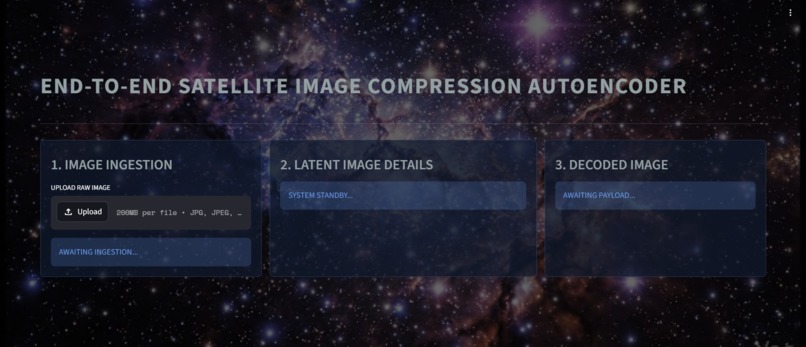
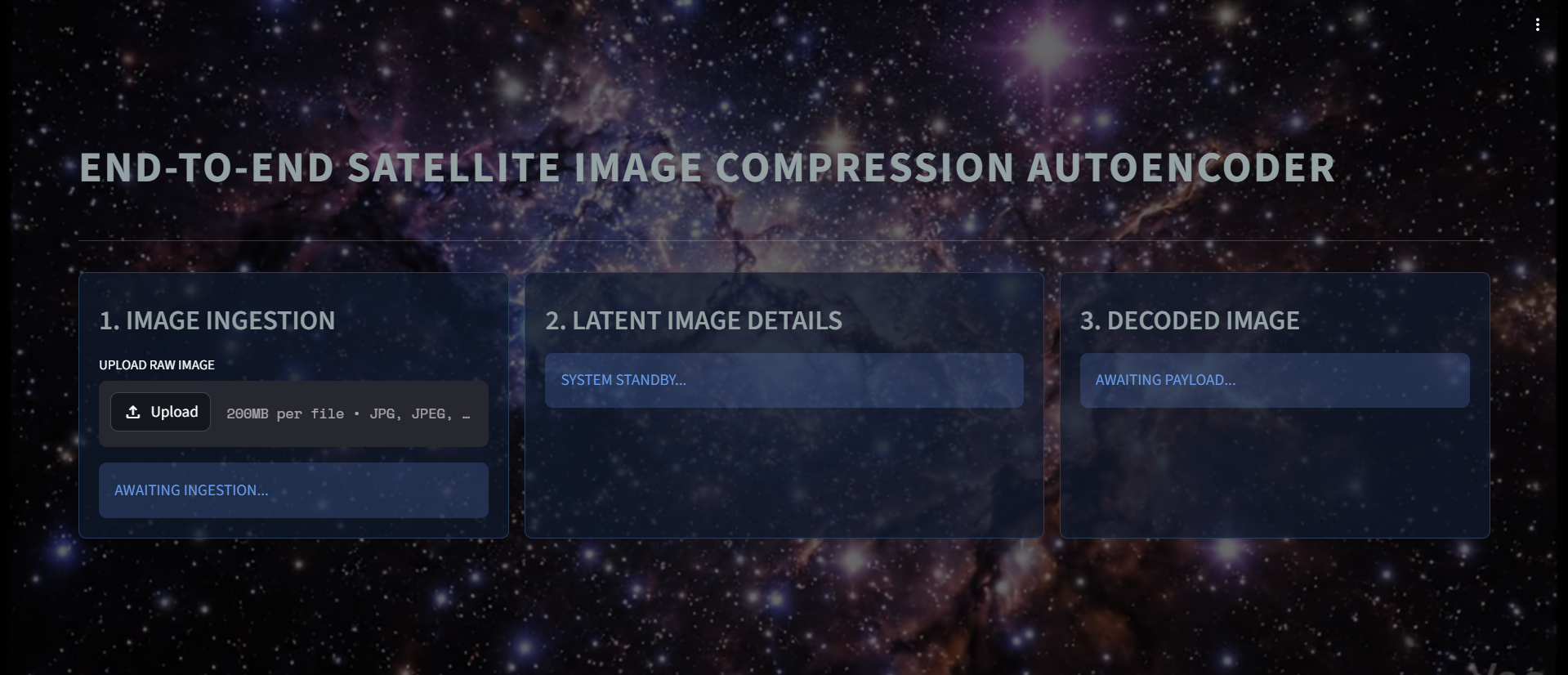
Dashboard Prototype
Inspiration
In the space industry, downlinking high-resolution imagery is like trying to force a firehose through a straw. Bandwidth is strictly limited, and data transfer is astronomically expensive. We realized that traditional compression isn't enough; the industry doesn't just need smaller files—it needs intelligence. The goal was to achieve the smallest possible mathematical footprint without sacrificing the visual and structural integrity required for mission-critical orbital discovery.
What it does
Our solution is an End-to-end Learned Image Compression Autoencoder that splits the compute load between orbit and Earth. On the satellite, it transforms raw sensor data into an ultra-dense, low-bitrate latent code. This tiny mathematical footprint is all we beam back, drastically cutting transfer costs and latency at the source.
Once on the ground, the system rebuilds the imagery, recovering sharp, high-fidelity details without the blocking or blurring artifacts that plague traditional codecs. In our live environment, the system successfully shrinks a 1449 KB raw NASA image down to just 27.2 KB—an 98.1% reduction—while maintaining a 99.36% structural fidelity rate.
How we built it
Rather than reinventing the wheel, we utilized a proven, high-performance architecture developed by Mahmoud Ashraf (2022). Developing the pipeline utilizing a robust TensorFlow Compression environment, we designed an Encoder that processes raw data using Residual Blocks equipped with 2D Convolutional and Generalized Divisive Normalization (GDN) layers to aggressively strip out redundant spatial data.
The core of the system is the Quantizer and Entropy Model, which handles the extreme bit-reduction. For the ground-based Decoder, we utilized Subpixel Convolutions for upsampling. We trained the entire feed-forward neural network on a Rate-Distortion tradeoff using Learned Perceptual Image Patch Similarity (LPIPS), ensuring the model matches both human and machine perception rather than just mindlessly matching pixels.
Challenges we ran into
The most significant hurdle wasn't just the theoretical math; it was the infrastructure required to actually deploy the model. Because we were optimizing a specific, highly-tuned architecture, we had to meticulously reconstruct its original operating environment. This meant navigating dependency hell to correctly align older, strict versions of Python, TensorFlow, and TensorFlow-Compression. Getting the custom entropy bottlenecks to compile and run reliably in this rigidly constrained, older ecosystem proved to be a massive technical roadblock that we had to solve before we could even begin validating our rate-distortion tradeoffs.
Accomplishments that we're proud of
We are incredibly proud of the metrics: achieving a 98.1% reduction in bandwidth requirements while verifying a 99.36% fidelity rate is a massive leap forward. Beyond the backend architecture, we successfully built a streamlined dashboard interface for real-time evaluation, allowing users to watch the latent-space transformation and monitor key performance indicators dynamically. Ultimately, we are enabling the space industry to process massive 2026-scale data volumes using standard 2020-scale infrastructure.
What we learned
We learned that optimizing for perceptual metrics like Learned Perceptual Image Patch Similarity (LPIPS) yields far superior results for structural integrity than traditional loss functions. The project also reinforced the power of edge intelligence—shifting the heavy compute to the ground decoder keeps the satellite payload light while enabling the recovery of high-frequency textures. Navigating the intricacies of deep learning-based image compression solidified our understanding of how mathematical transformations in latent space directly solve real-world operational bottlenecks.
What's next for End-to-end Satellite Image Compression Autoencoder
As we push toward the end of 2026, the next step is rigorous real-world testing against a wider variety of specialized satellite sensors. One may also plan to integrate model interpretability tools into the pipeline to better analyze exactly which spatial features the neural network prioritizes during the quantization phase, ensuring that no mission-critical detail is ever left in the dark.

Log in or sign up for Devpost to join the conversation.