-
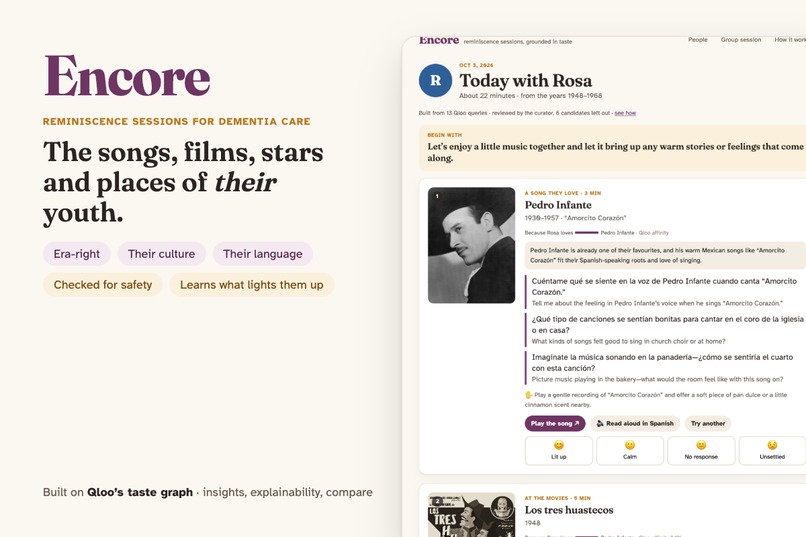
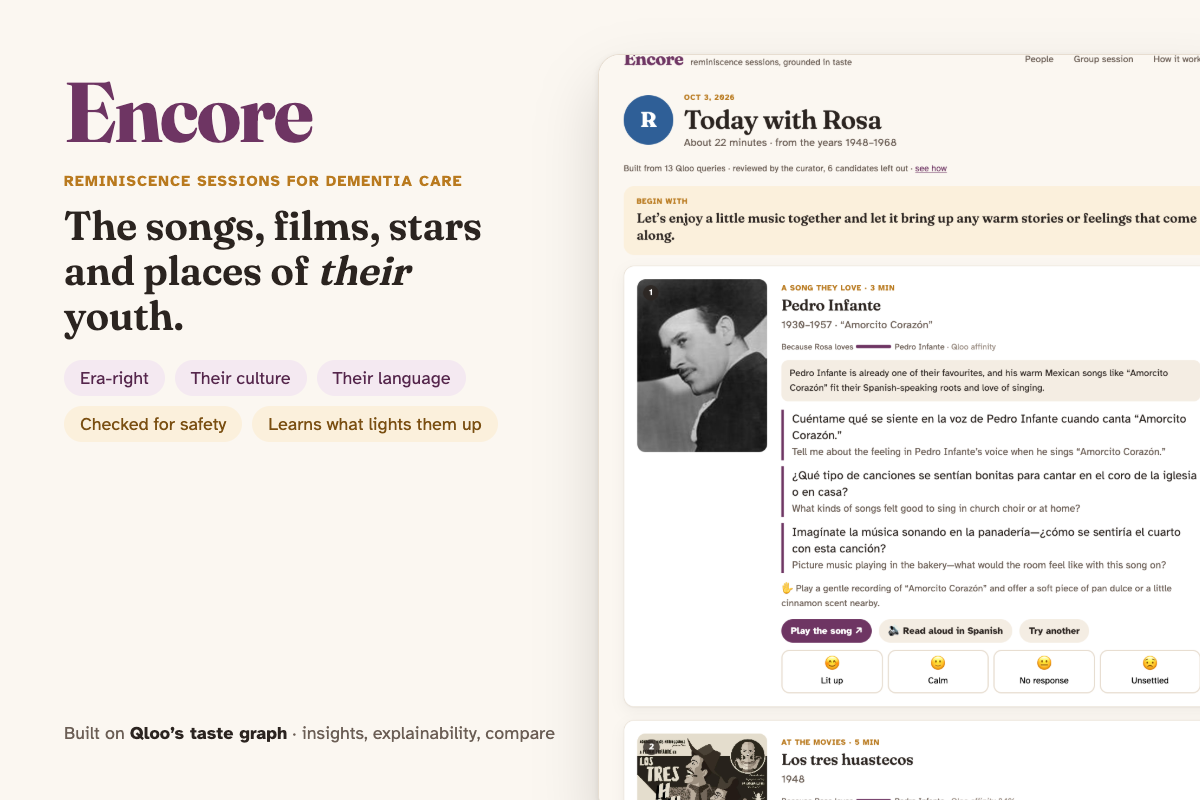
Encore: the songs, films, stars and places of a person's own youth, from Qloo's taste graph
-
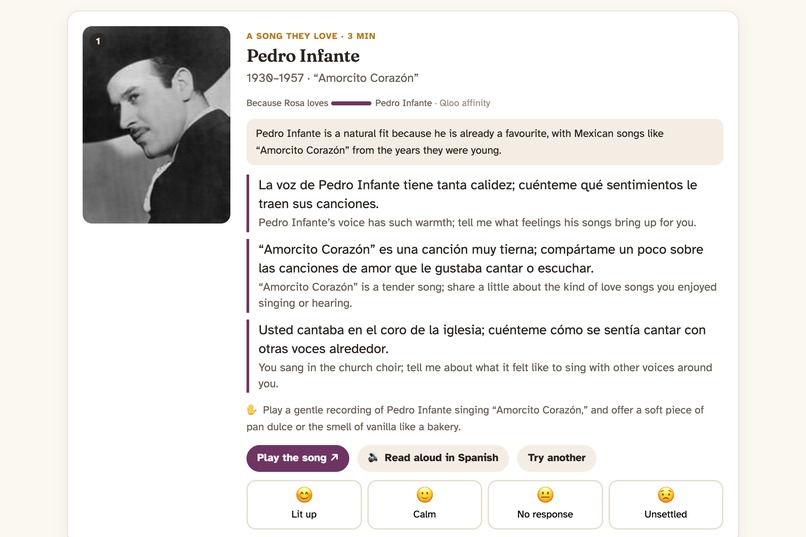
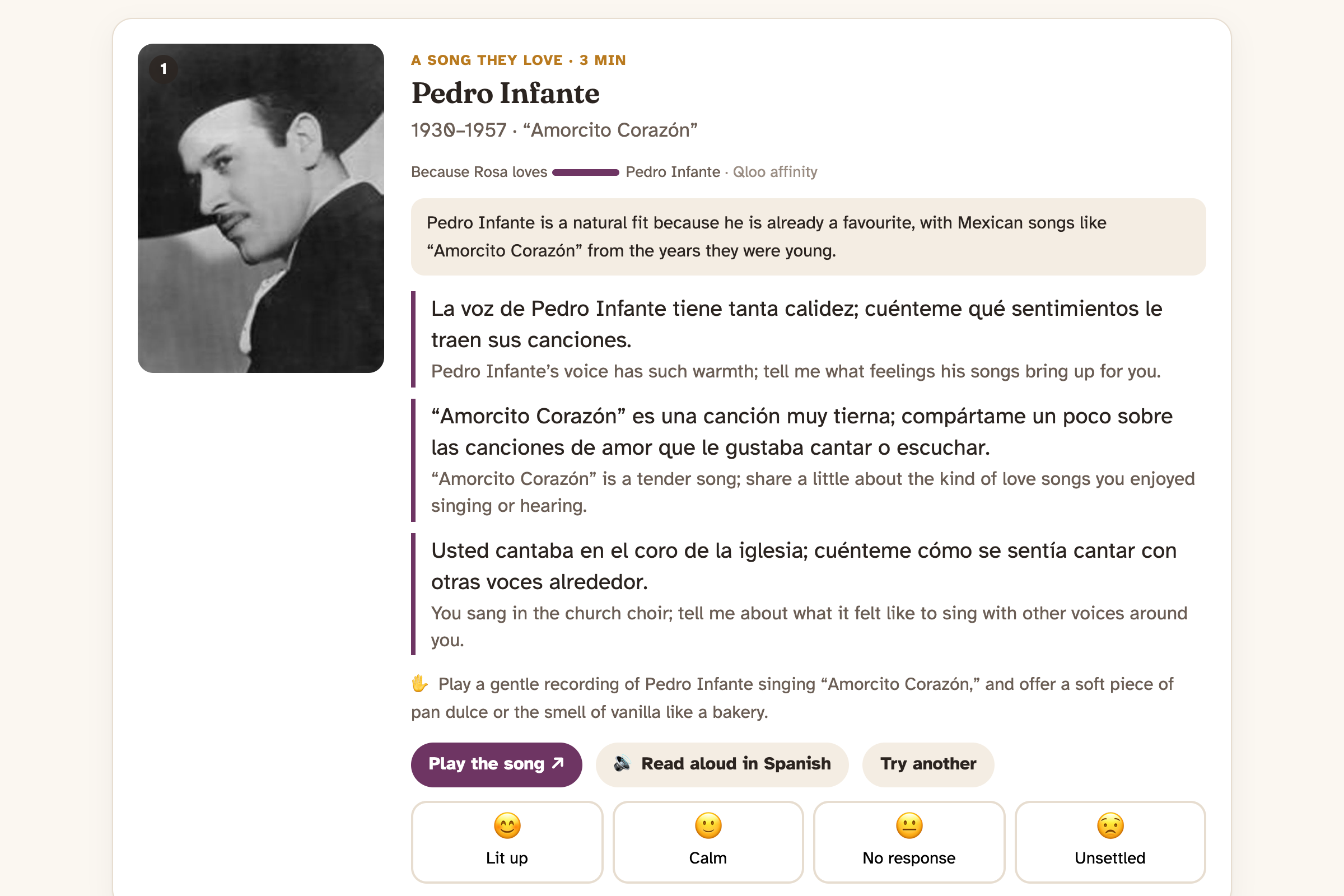
Rosa's session: prompts in Spanish with English underneath, and why each pick fits Rosa's favourites
-
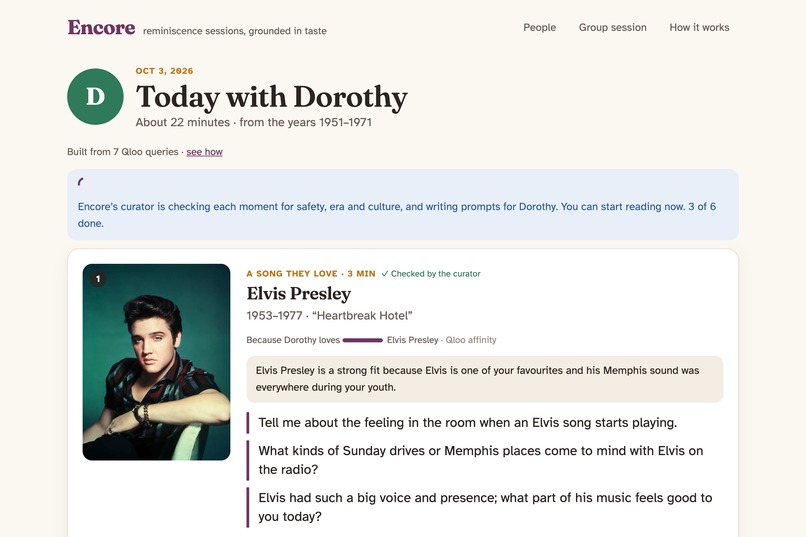
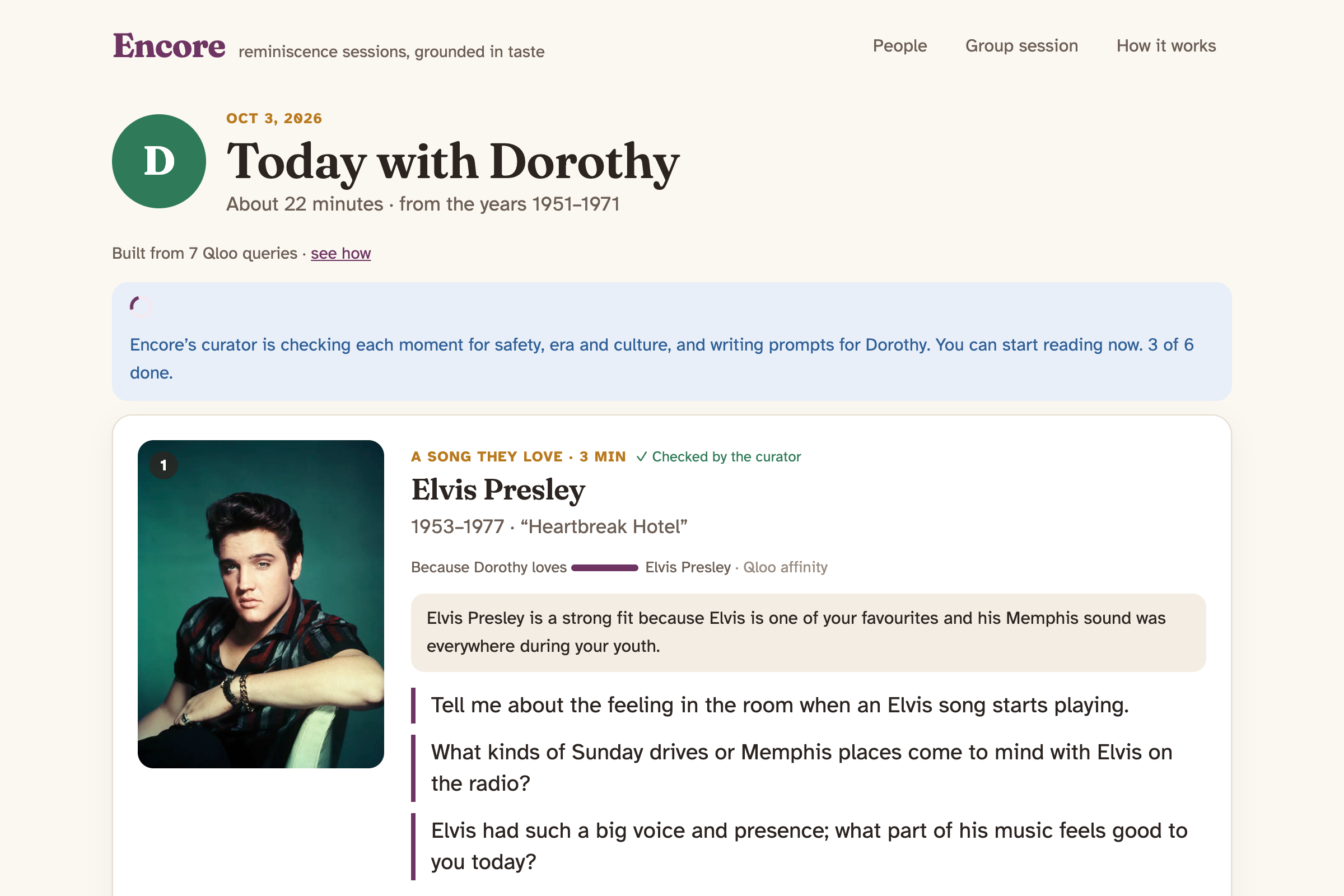
A live plan: the first plan appears in seconds, then the curator checks each moment side by side
-
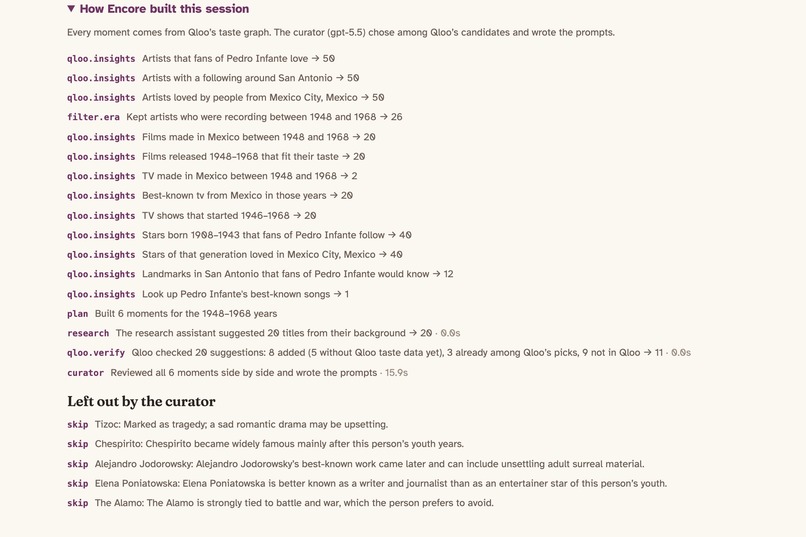
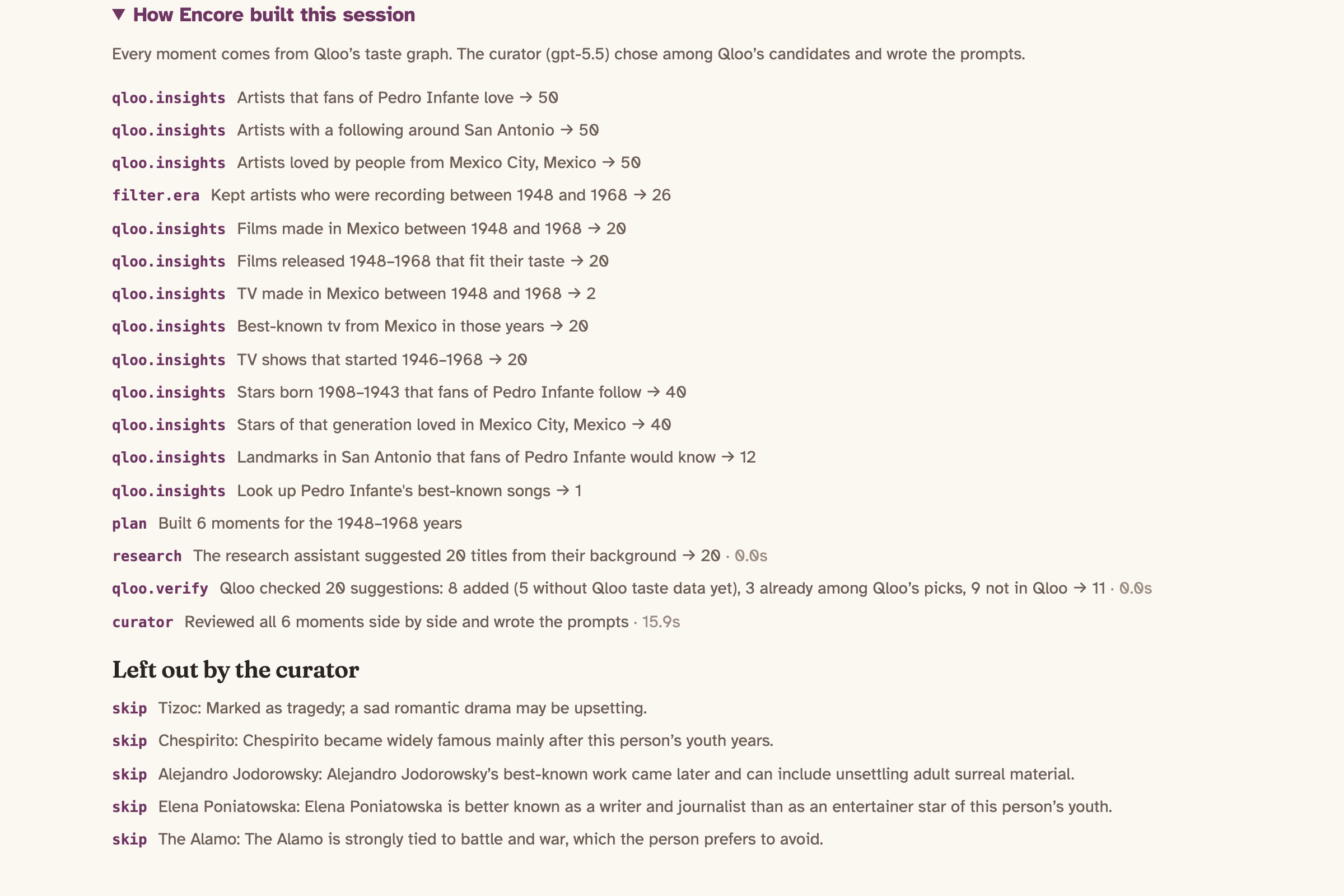
How Encore built the session: every Qloo query, the research Qloo grounded, and what the curator left out and why
-
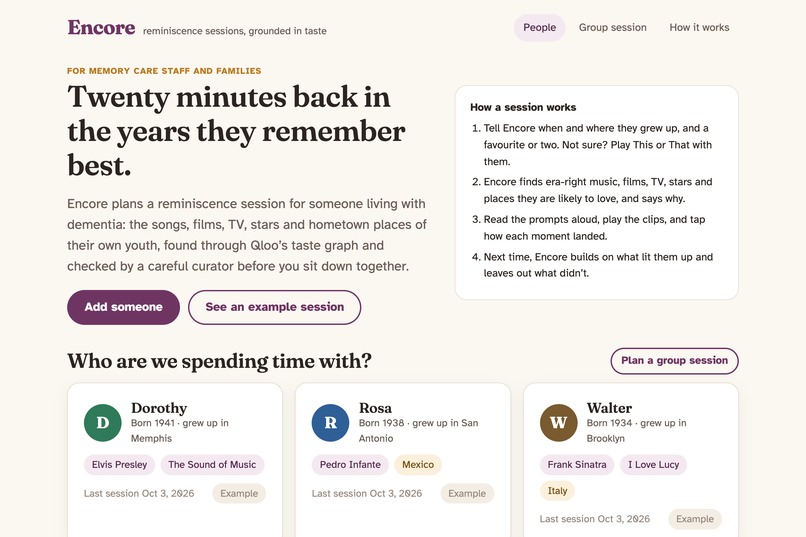
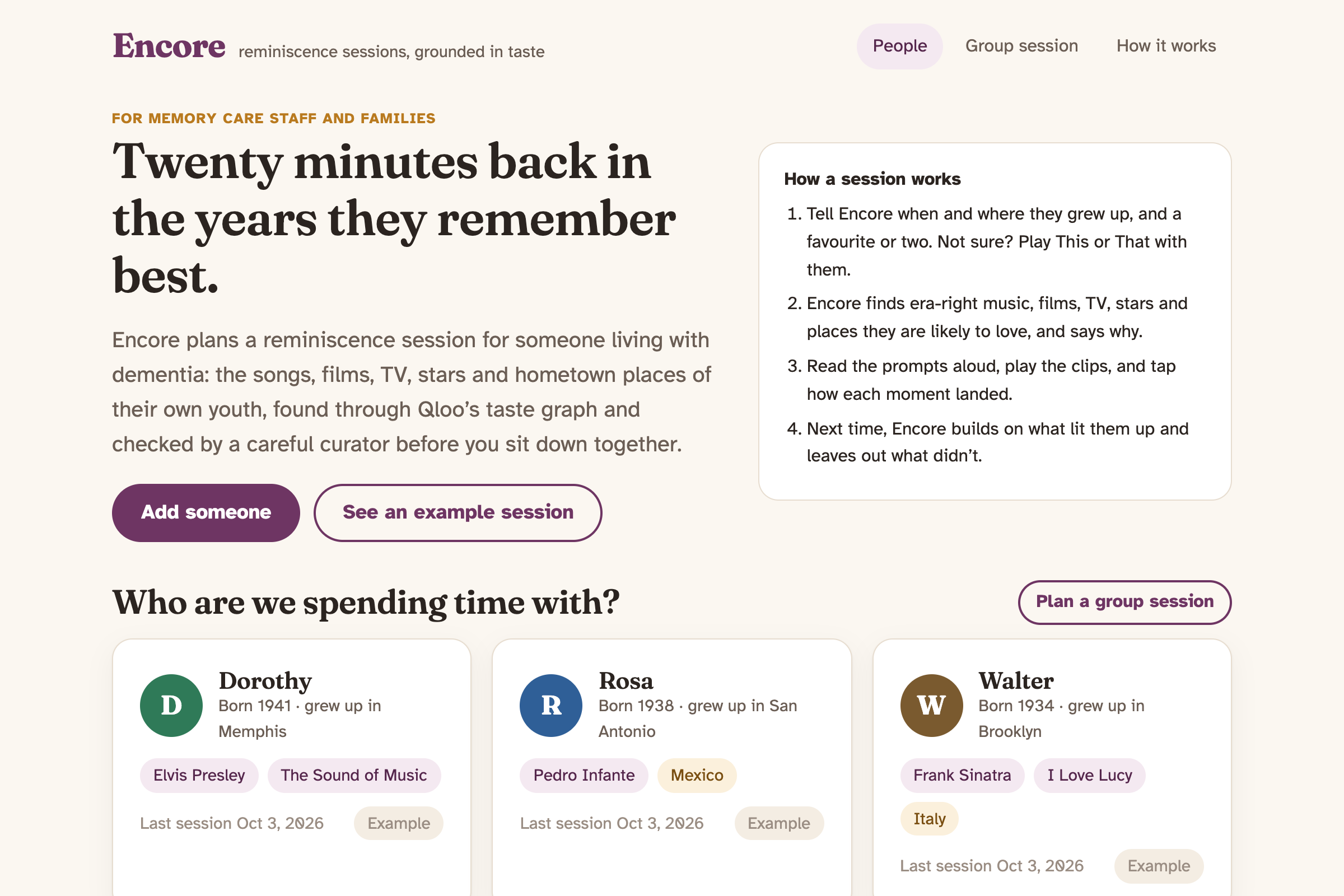
People are kept in the browser; three example people are ready to try, and group sessions plan for a whole table
Inspiration
More than 55 million people live with dementia (WHO). One of the few things that still reliably reaches many of them is the music, film and places of their youth. Reminiscence work is a mainstay of dementia care: a 2018 Cochrane review found small but real benefits for communication, mood and, in care homes, quality of life, and U.S. nursing homes are required to offer activities that match each resident's own interests (CMS F679).
In practice it is one oldies playlist for everyone. A woman who grew up in San Antonio singing Pedro Infante in the church choir gets Glenn Miller. A Korean War veteran is shown a war film. Activity staff have minutes per resident, and families often don't know what their mother loved at nineteen.
The gap between "an oldies playlist" and "her songs" is a taste problem. Qloo's taste graph is built for exactly that.
What it does
Encore plans a 20-minute session a caregiver can run at a bedside: a song they love, a film, a star of their day, a TV show, a hometown landmark and a closing song.
- From their youth. People remember ages 10 to 30 most vividly (the reminiscence bump). Encore searches those years: films and TV released then, artists recording then, stars a few years older than them.
- From their culture. Family roots steer it to films made at home, artists loved there, stars of that generation. Rosa from San Antonio gets Pedro Infante, Los tres huastecos, Germán Valdés "Tin Tan", Los Beverly de Peralvillo, Mi Tierra Café y Panadería and a bolero by Armando Manzanero; Walter from Brooklyn gets Sinatra, The Caddy, Phil Rizzuto, The Honeymooners, L&B Spumoni Gardens and Vic Damone.
- Researched, then grounded in Qloo. Taste signals know less about older films, TV and stars from outside the U.S., so a research assistant suggests what people of that background loved. Qloo decides: each suggestion must resolve to a Qloo entity from the person's youth and is scored against their favourites. An Athenian born in 1940 gets Nana Mouskouri, Maiden's Cheek and Aliki Vougiouklaki; a Torontonian gets Gordon Lightfoot, Hockey Night in Canada and Dave Keon.
- In their language. Prompts come in Spanish, Greek, Hindi… with English underneath for staff, and a button reads them aloud.
- Explained. Every pick says which favourites it comes from and how strongly, from Qloo's explainability and affinity: "Because Dorothy loves The Sound of Music and Elvis Presley · Qloo affinity 84%".
- Checked for safety. A curator model reviews Qloo's candidates and leaves out what could upset someone with dementia: violent or grief-laden stories, political figures, places tied to tragedy, attractions that didn't exist yet. It chooses only among Qloo's candidates, so nothing is invented, and it shows what it left out and why.
- This or That. When nobody can name a favourite, the person points at one of two era-right choices. Music first; their picks then steer which films Encore asks about.
- It learns. Tap how each moment landed. What lit them up becomes a stronger Qloo signal next time; what unsettled them is excluded for good.
- Ask Encore. "It's December, make it festive." "Nothing about the sea — her brother was lost at sea." A tool-using agent searches Qloo for the entities and tags that express the request, and plans again.
- Group sessions. Several residents at one table: everyone's taste counts equally, everyone gets a moment that is theirs, anything one person must avoid is avoided for all, and Qloo's compare endpoint names what the group shares.
- An MCP server, so agents people already use can plan sessions with Encore's tools.
How Qloo is used
/search turns favourites into entities. /v2/insights does the heavy lifting across five entity types with weighted signal.interests.entities, signal.interests.tags, signal.location.query (hometown and country of roots), filter.release_year, filter.date_of_birth, filter.release_country, filter.tags (landmarks), filter.exclude.tags / filter.exclude.entities, filter.results.entities (an artist's notable songs) and feature.explainability. /search plus filter.results.entities with the person's signals also ground the research assistant's suggestions and score them. /v2/tags powers Ask Encore, and /v2/analysis/compare finds a group's common ground.
How we built it
Several agents share the work: a researcher proposes, Qloo decides, a curator judges each moment and writes what to say, Ask Encore is a tool-using agent over Qloo search and tags, and the MCP server lets other agents use Encore's tools. Cloudflare Workers serve the API and the React app. The engine queries Qloo in parallel (paced under the rate limit, cached at the edge), ranks candidates by affinity, familiarity and how squarely they sit in the person's youth, and streams each step to the browser so a first plan appears in a few seconds. The research assistant starts as soon as the person's page opens and drafts its suggestions while Qloo works; Qloo then grounds them. The curator reviews each moment in its own call, all at once, and every moment updates on screen as soon as its review is done (about 10 seconds for six). The curator and Ask Encore run on GPT-5.5 with structured outputs and tool calls. Names and notes never leave the browser; group sessions call people "Person A", and the browser puts the names back.
Challenges
- The age signal backfired. For a Mexican grandmother,
signal.demographics.age=55_and_olderturned her films into Buñuel art cinema, because today's older Qloo users are not her. Personal signals come first; demographics are only a fallback. - Global popularity favours the famous over the beloved, so era fit and affinity outweigh popularity in ranking.
- Thin data for some countries' older titles. When taste signals find few Puerto Rican films, Encore asks for the country's best-known titles of those years (Los peloteros, La criada malcriada).
- "Kingston" is Kingston, Ontario and "Athens" is Athens, Georgia to a location query. When a hometown is the main city of the family's home country, Encore names the country too.
- Known but not yet scored. Qloo knows Melina Mercouri and Aliki Vougiouklaki but has no taste data for them yet, so scoring returns nothing. Encore keeps such entities when search confirms the name and their dates fit, and says how many there were.
- Ten milliseconds of CPU. The Workers free plan allows about 10 ms per invocation, and one session first took 767 ms. Each Qloo answer is now trimmed in its own invocation, each pool, research check and model call runs in another, and the model relay returns finished answers instead of token streams. Most of what was left was the cost of waking up for each answer and event, so the session itself now runs in two invocations that write straight into the response stream: the request uses about 1 ms, and no invocation goes over 10 ms.
- Places are current. "Landmarks in San Antonio" includes a water park from 1990; the curator removes anachronisms and anything tied to war (the Alamo, for a woman whose family asked to avoid war).
Does Qloo make a difference?
We planned sessions for 24 people born 1932–1955, in the U.S. and abroad, with Encore and with the same model on its own, then looked every pick up in Qloo (eval/REPORT.md in the repo).
| Encore | Encore, Qloo only | Model without Qloo | |
|---|---|---|---|
| Picks that resolve to a Qloo entity | 100% | 100% | 86% |
| Songs, films and TV from their teens and twenties | 99% | 99% | 94% |
| Roots abroad: films and TV made in that country | 70% | 68% | 70% |
| Roots abroad: films, TV and artists from that country | 64% | 57% | 54% |
| Distinct picks across all 24 people | 141 | 127 | 134 |
| Picks shared by three or more people | 0% | 2% | 2% |
One in seven of the model's own picks isn't in Qloo at all, so it can't be shown, dated or explained. Qloo alone already beats the model on era; the research step, grounded in Qloo, adds the culture: Cantinflas for a San Antonio grandmother, Raj Kapoor in Mumbai, Aliki Vougiouklaki in Athens. Our first research prompt pushed classics (Singin' in the Rain for five people); asking for what was particular to each person's place and roots took repeats to zero.
What we learned
Taste data and a language model are good at different things. Qloo knows what people who love X actually love and can be filtered by year, country and theme; the model is good at judgment and language. Encore lets each do its part, and never lets the model invent a title.
What's next
- Photo prompts: family photos matched to the decade and the hometown.
- Facility mode: a month of individual and group sessions for a whole floor, with a printed calendar.
- Outings: wheelchair-accessible places near the care home that serve the food of someone's childhood (Qloo places already carry accessibility tags).
Built With
- cloudflare-workers
- mcp
- openai
- qloo
- react
- typescript
- vite

Log in or sign up for Devpost to join the conversation.