-
-
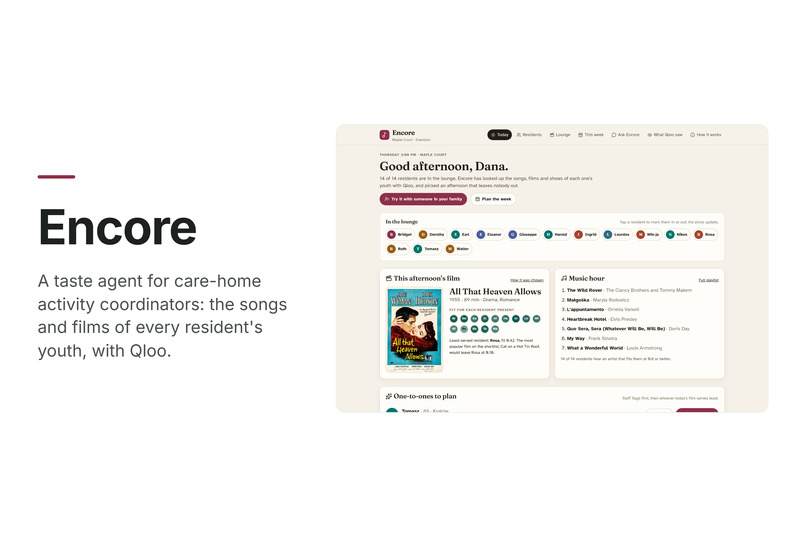
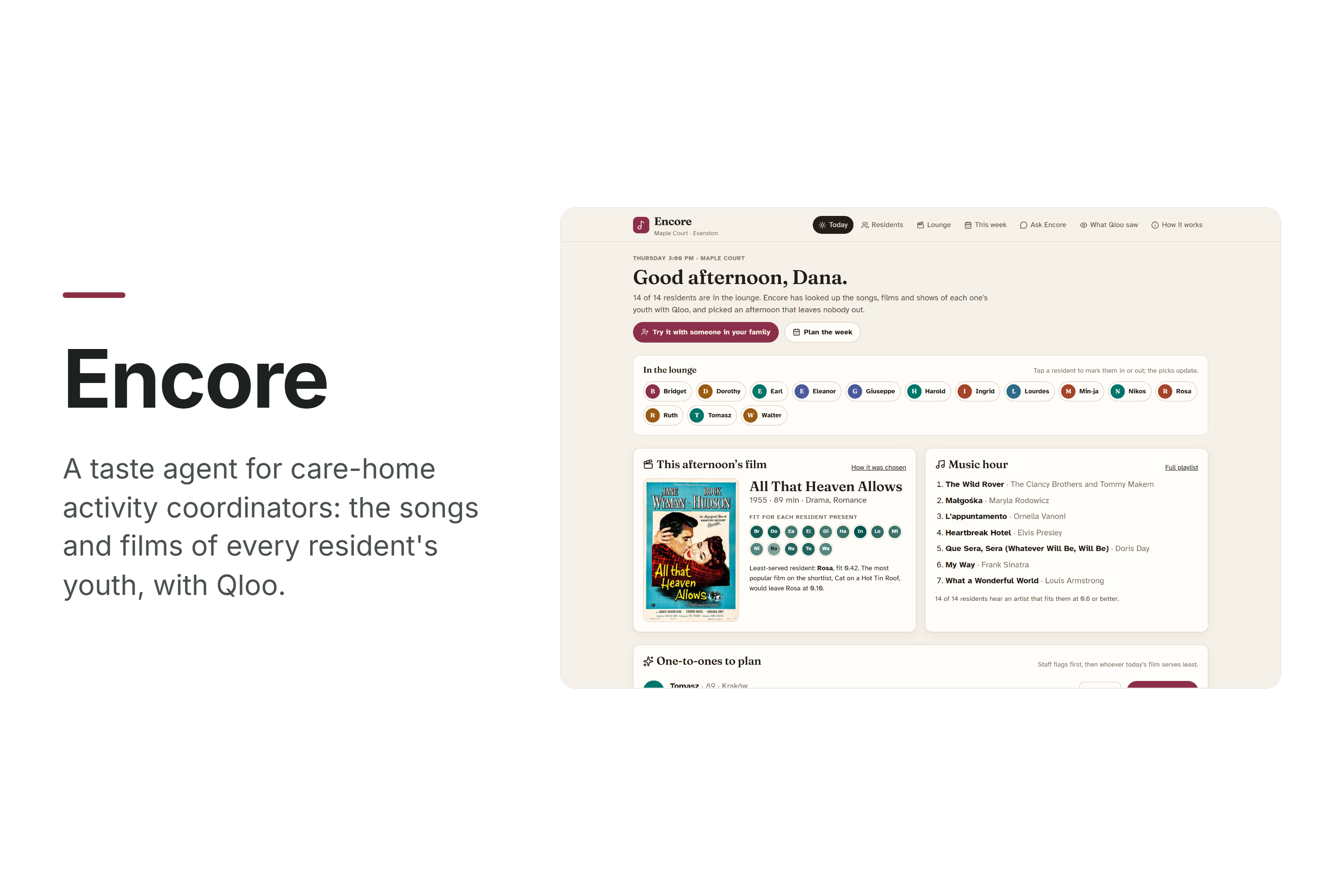
Encore uses Qloo to bring back the songs and films of each care-home resident's youth, and plans a week nobody is left out of.
-
The problem: a resident and a carer decades and continents apart, and a family who can name only a singer or two.
-
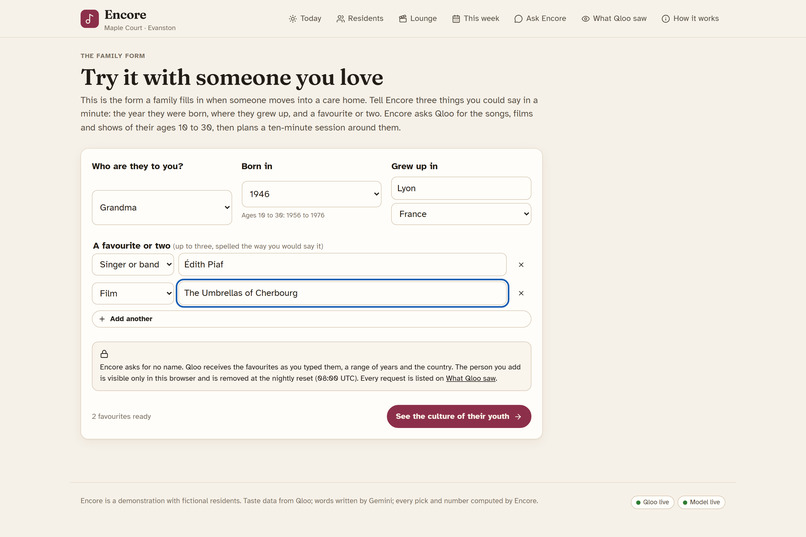
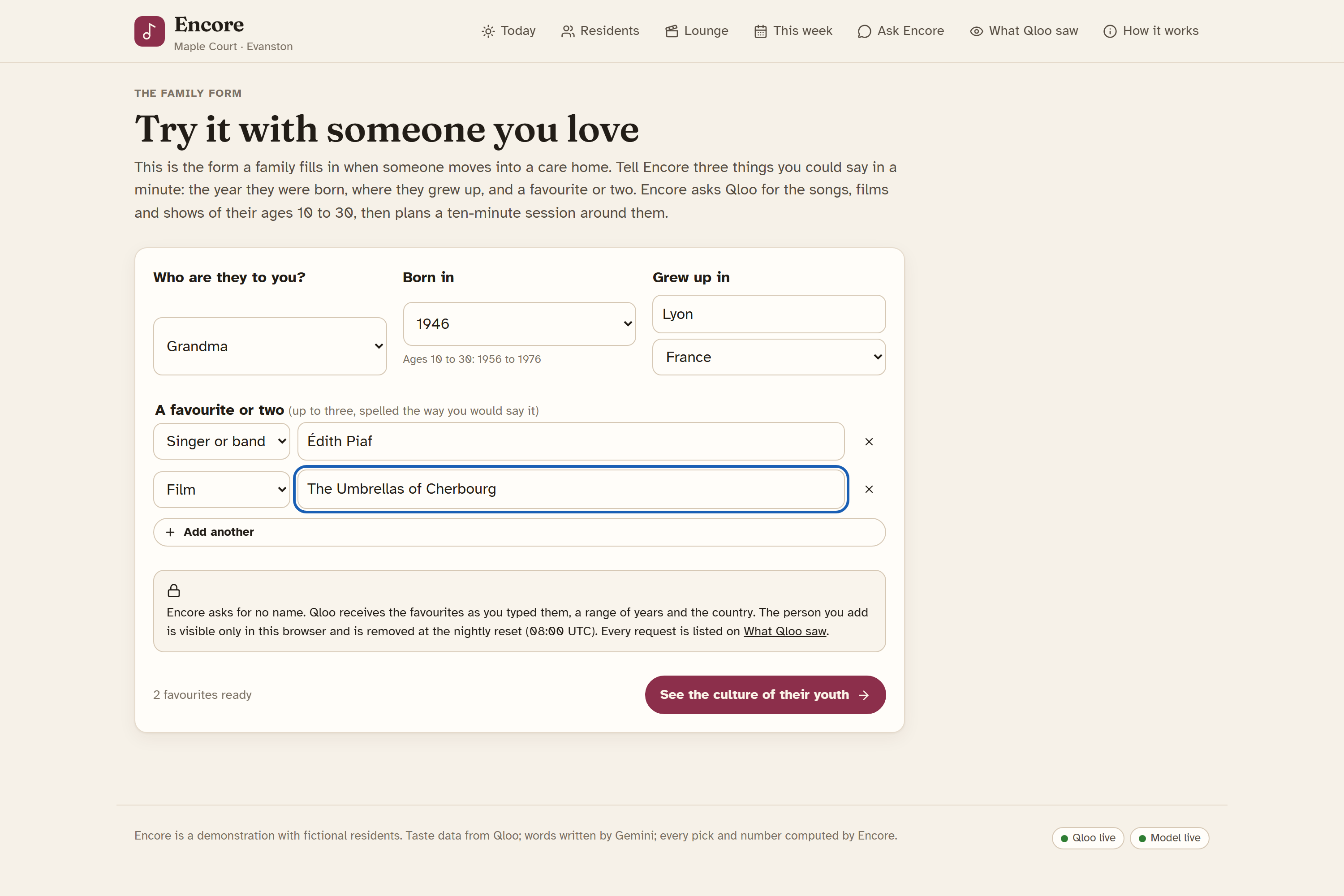
The family form: who they are to you, the year they were born, where they grew up, and a favourite or two. No name is asked.
-
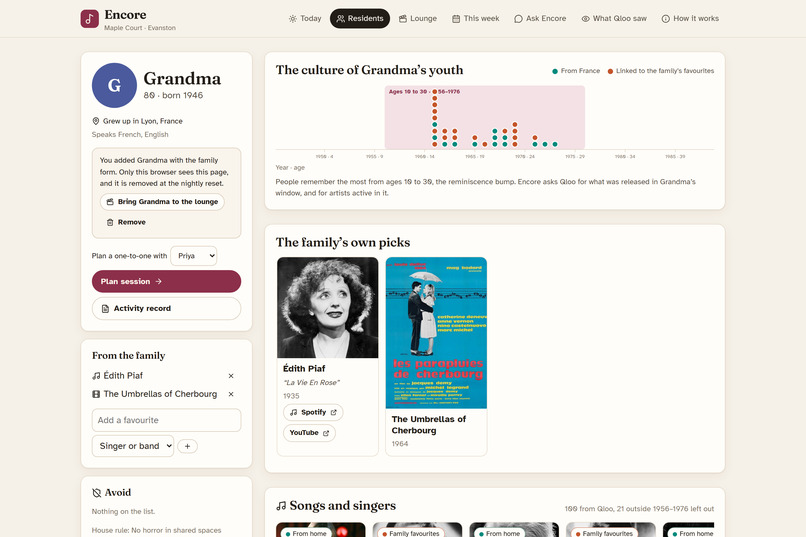
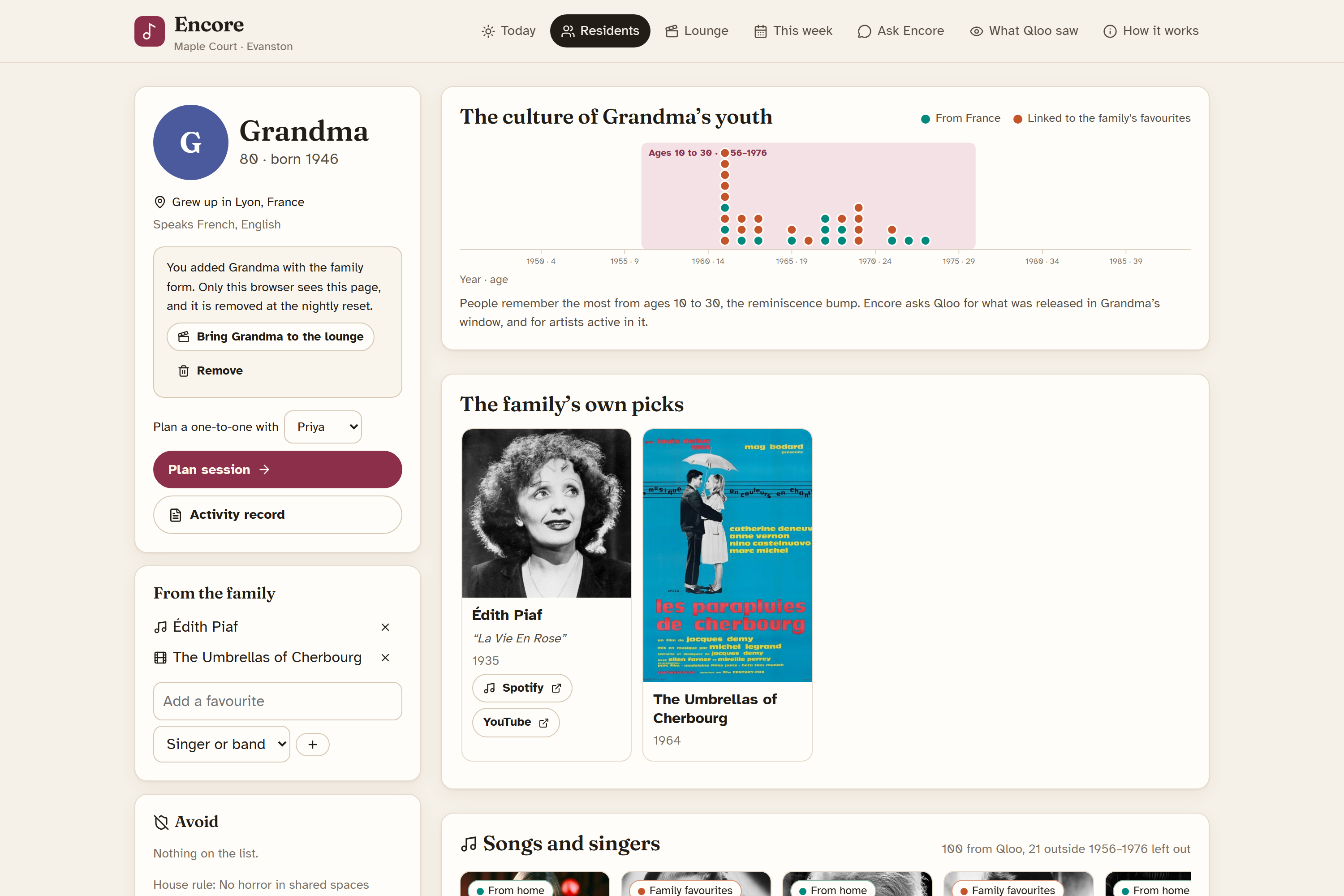
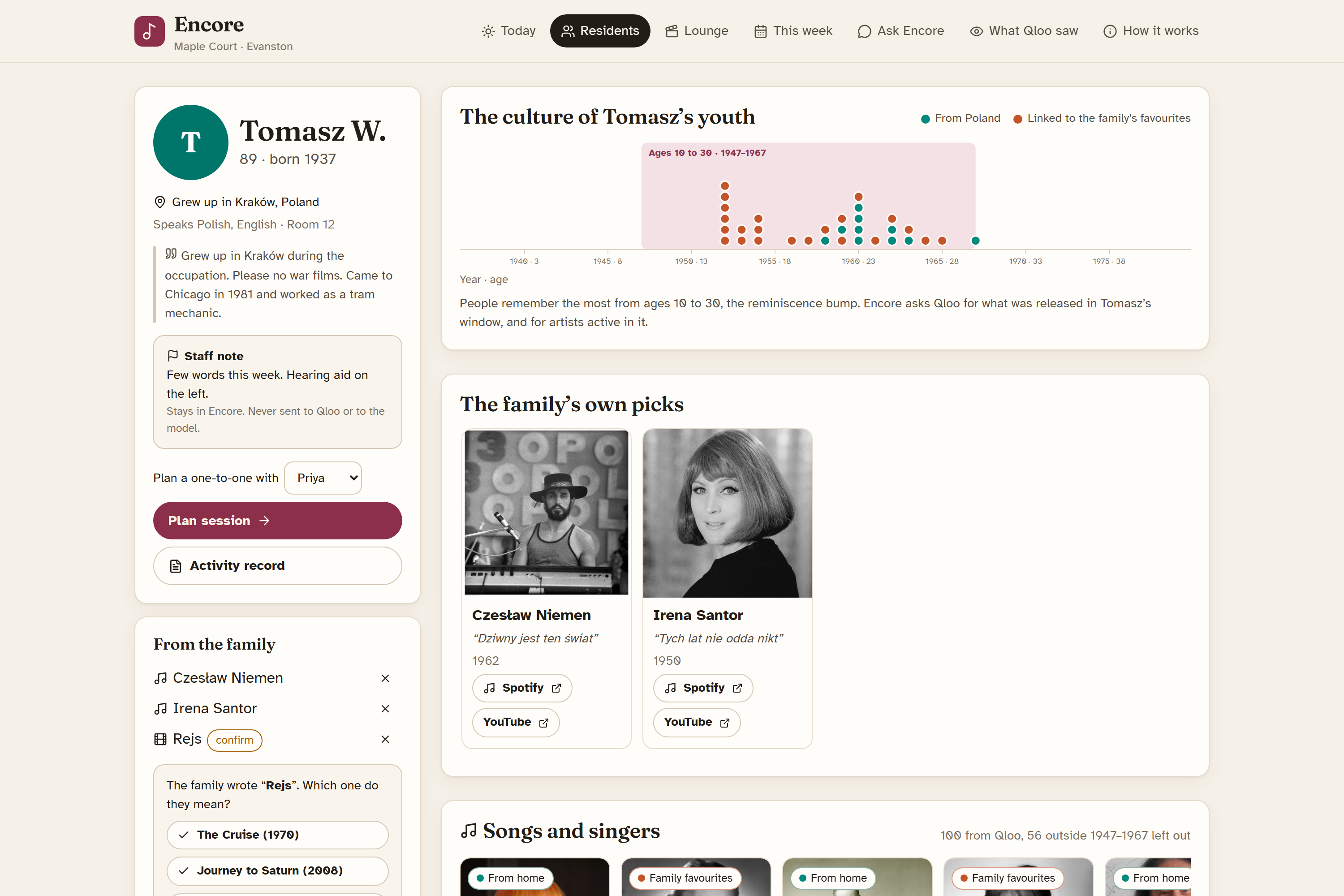
In seconds, the culture of their ages 10 to 30, in two lanes: what the family named and what came from home.
-
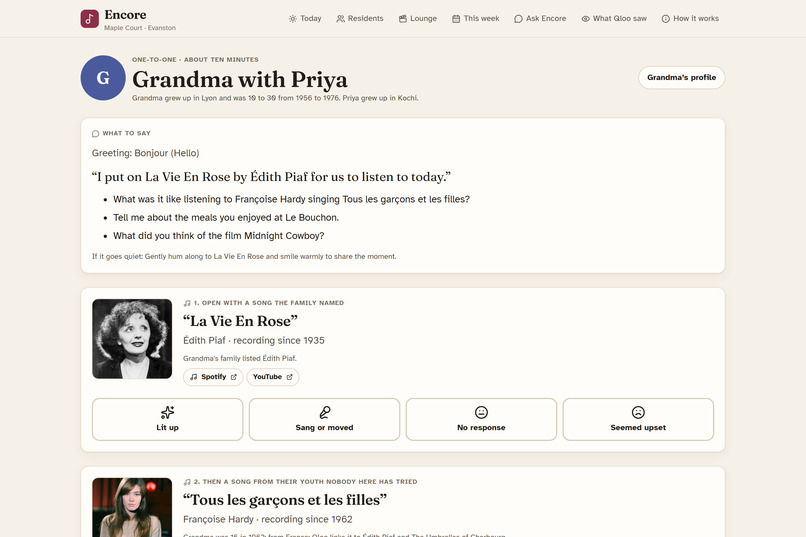
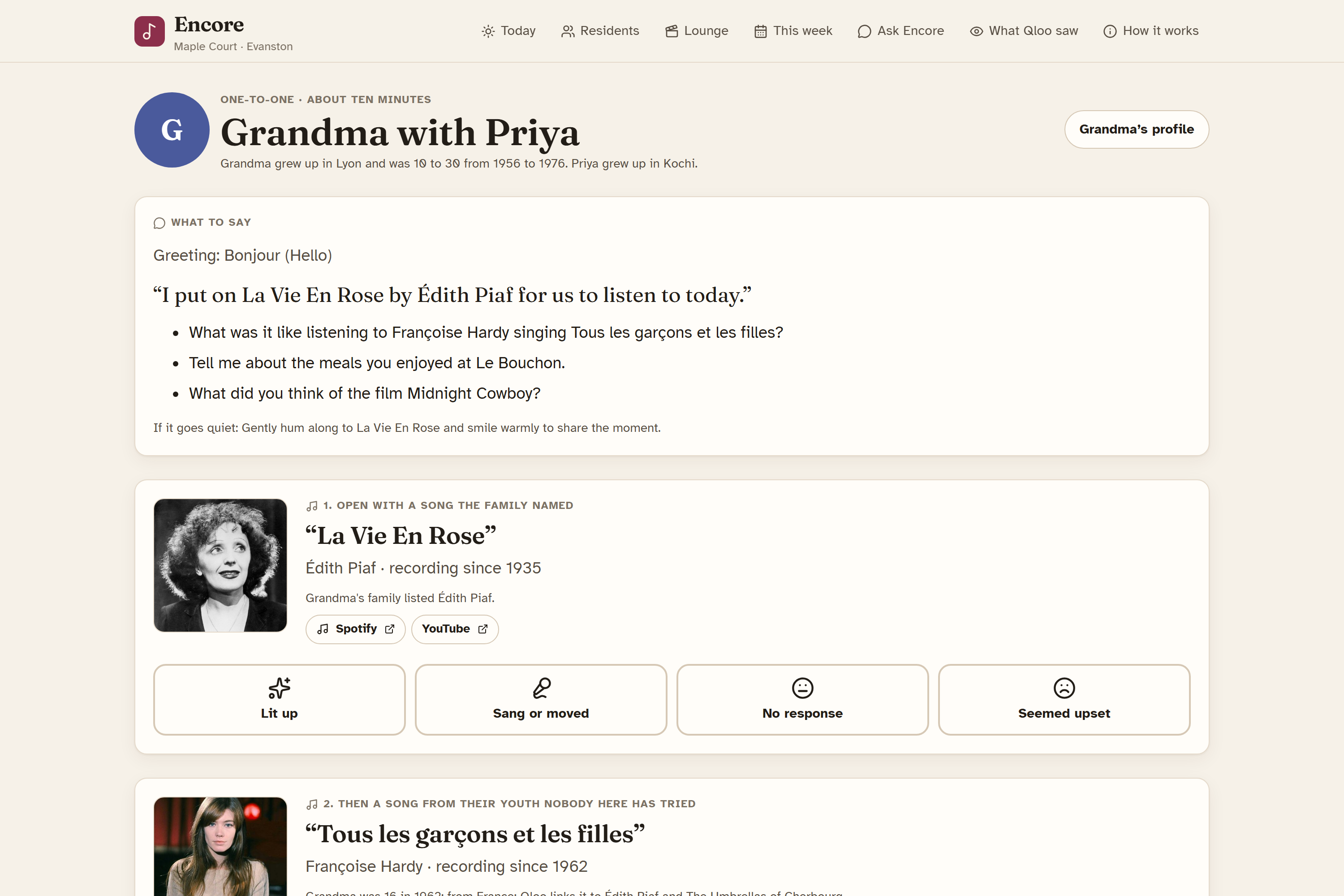
A ten-minute session plan with the words a carer says: "Tell me about…", never "Do you remember…".
-
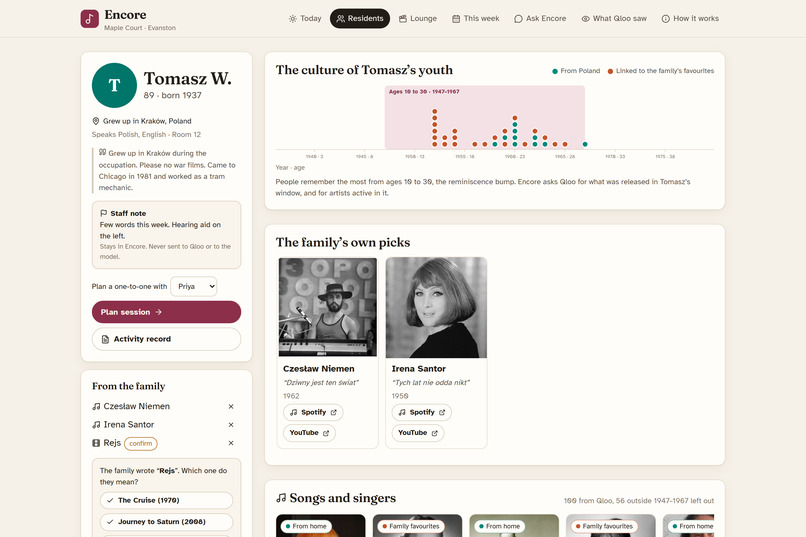
Tomasz's profile: a timeline of his youth, his family's picks, and Polish songs Qloo links to them.
-
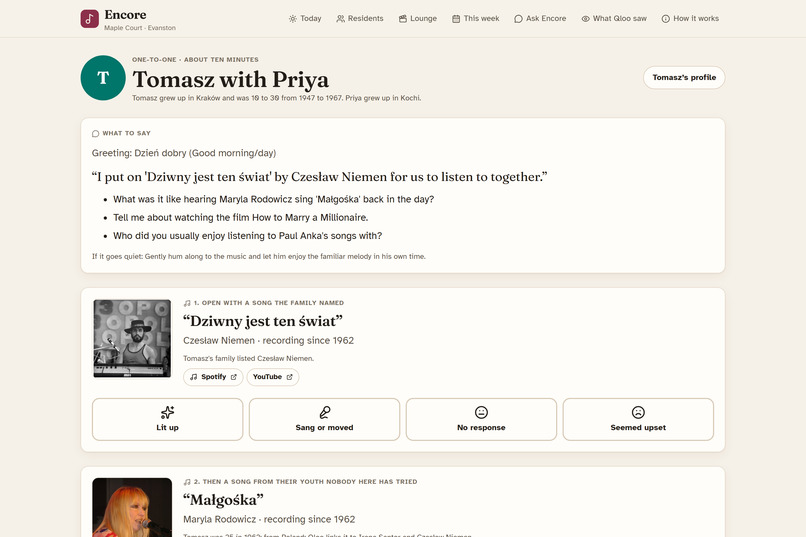
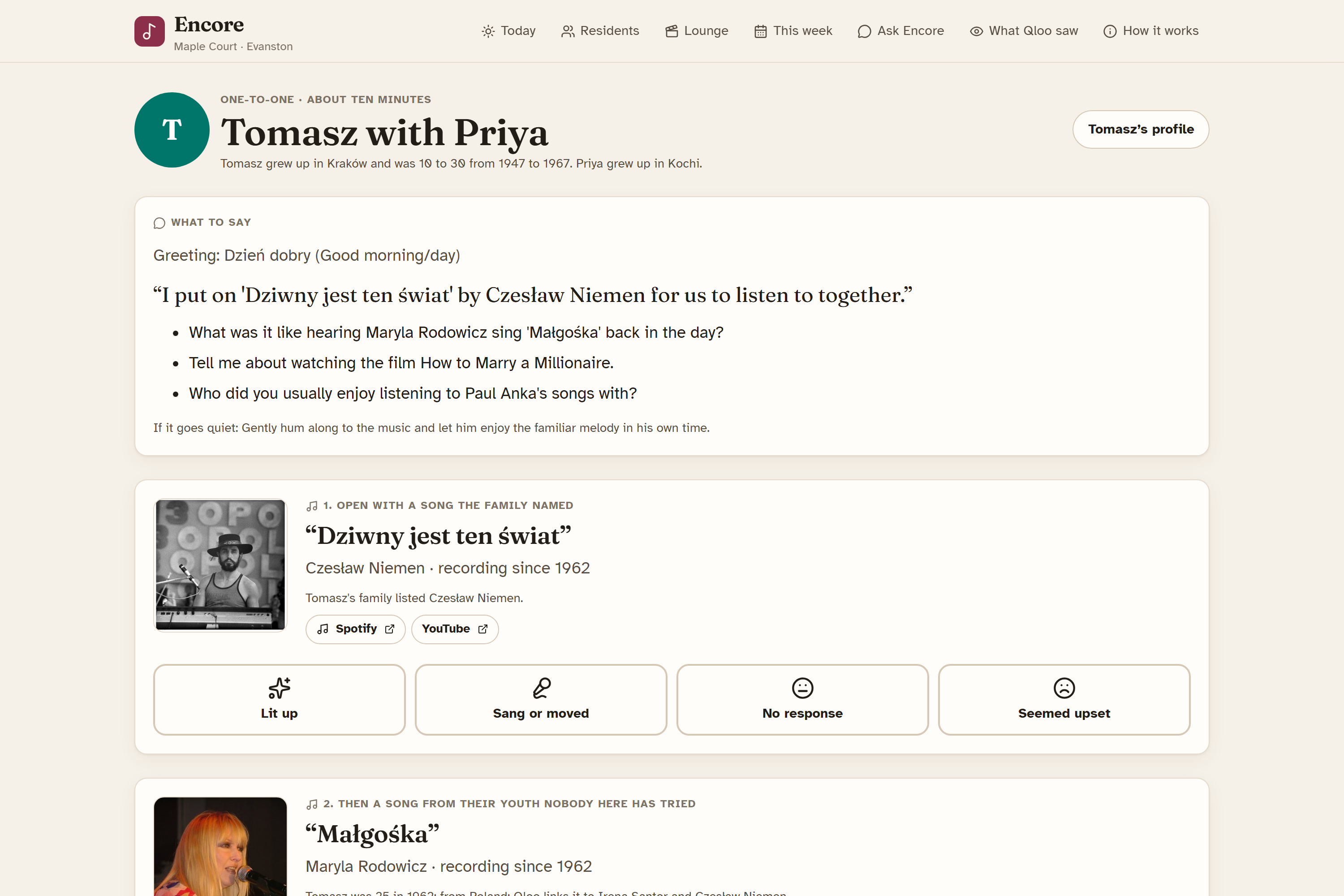
Tomasz with Priya: a song his family named, one nobody has tried, and Paul Anka, whom both their favourites pull toward.
-
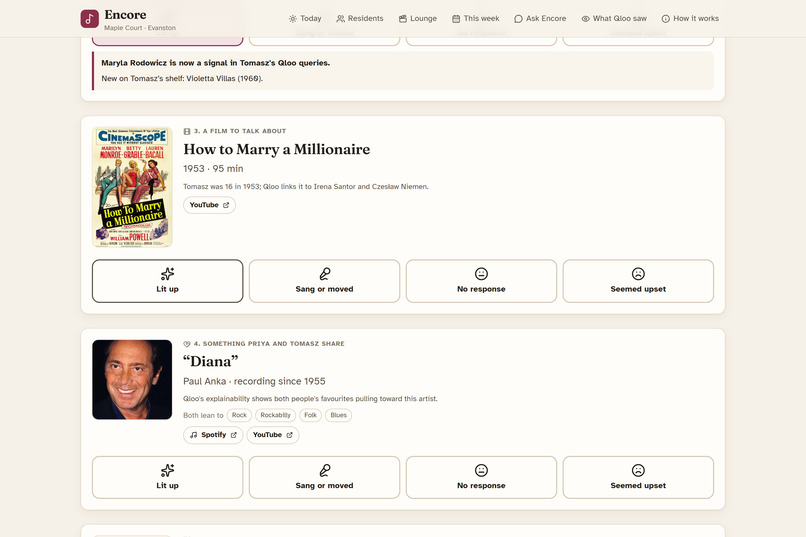
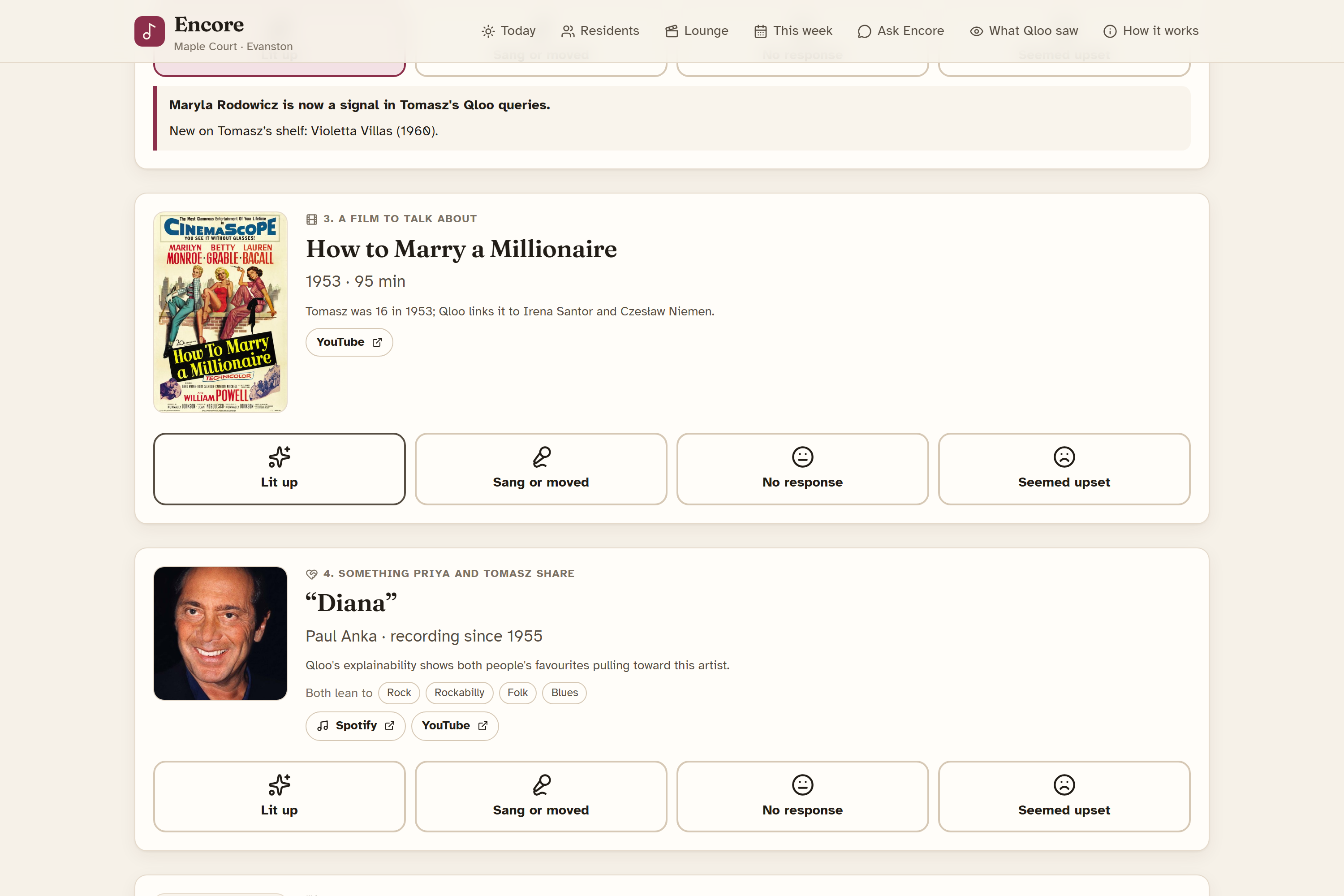
Four large buttons. Lit up turns the item into a new Qloo signal; seemed upset removes it at once.
-
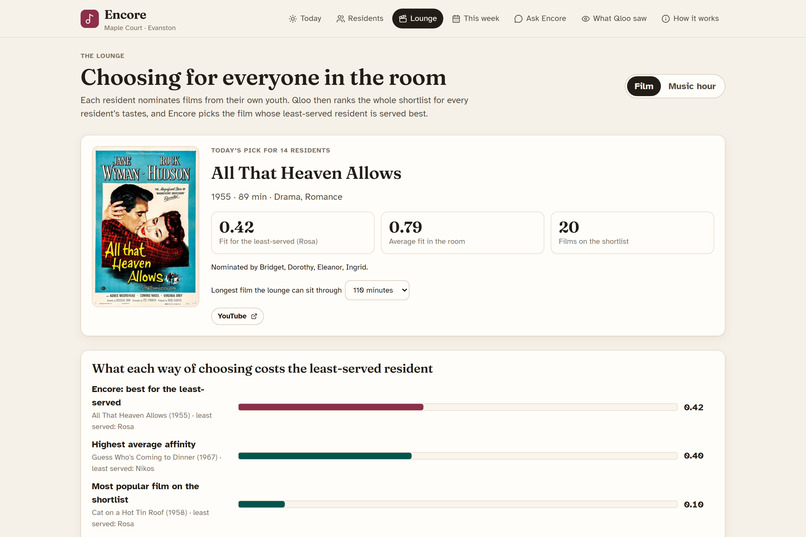
The lounge film that serves its least-served resident best, and what the popular and average choices would cost them.
-
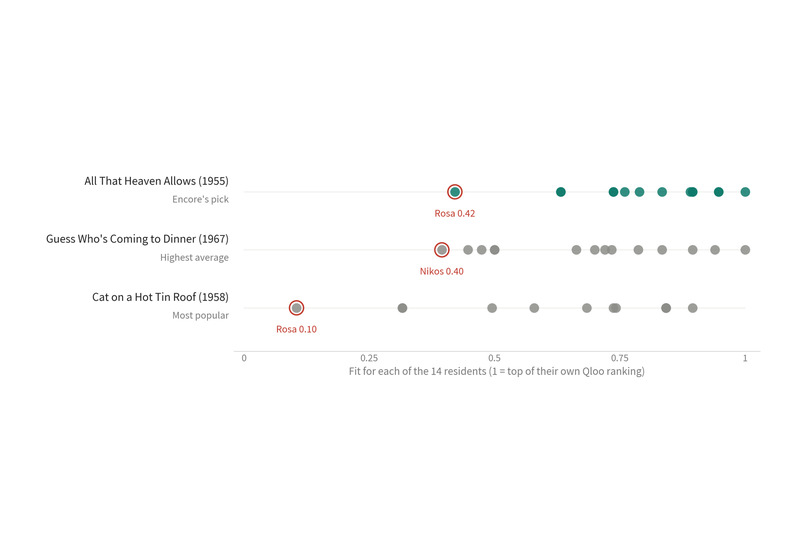
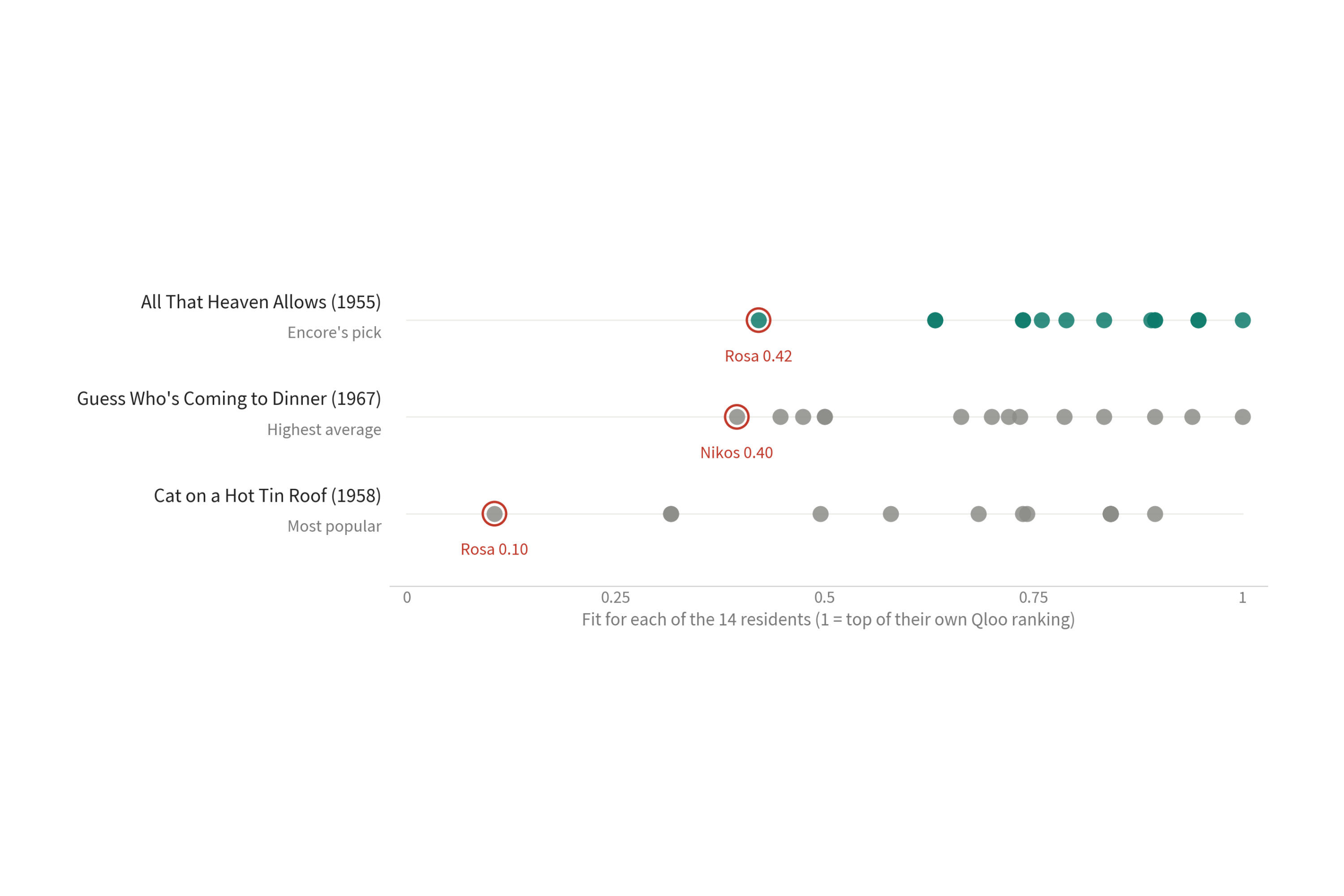
Each dot is a resident. Encore's pick keeps its least-served resident at 0.42; the most popular film leaves Rosa at 0.10.
-
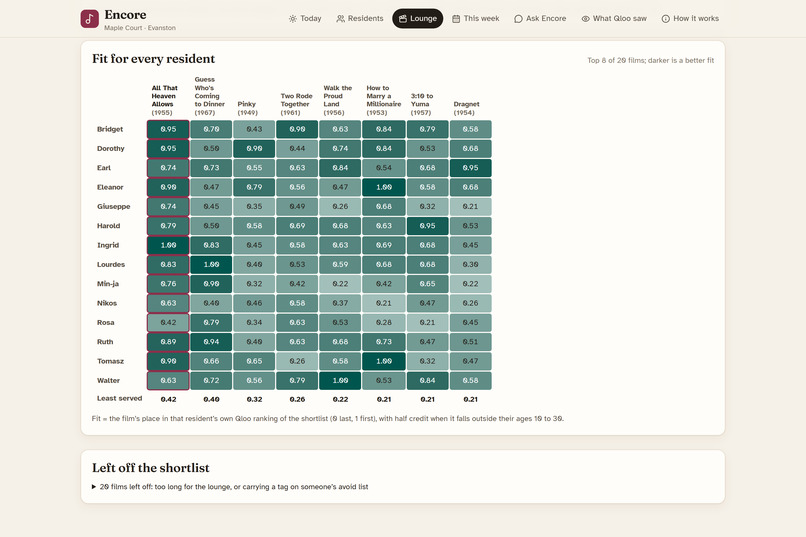
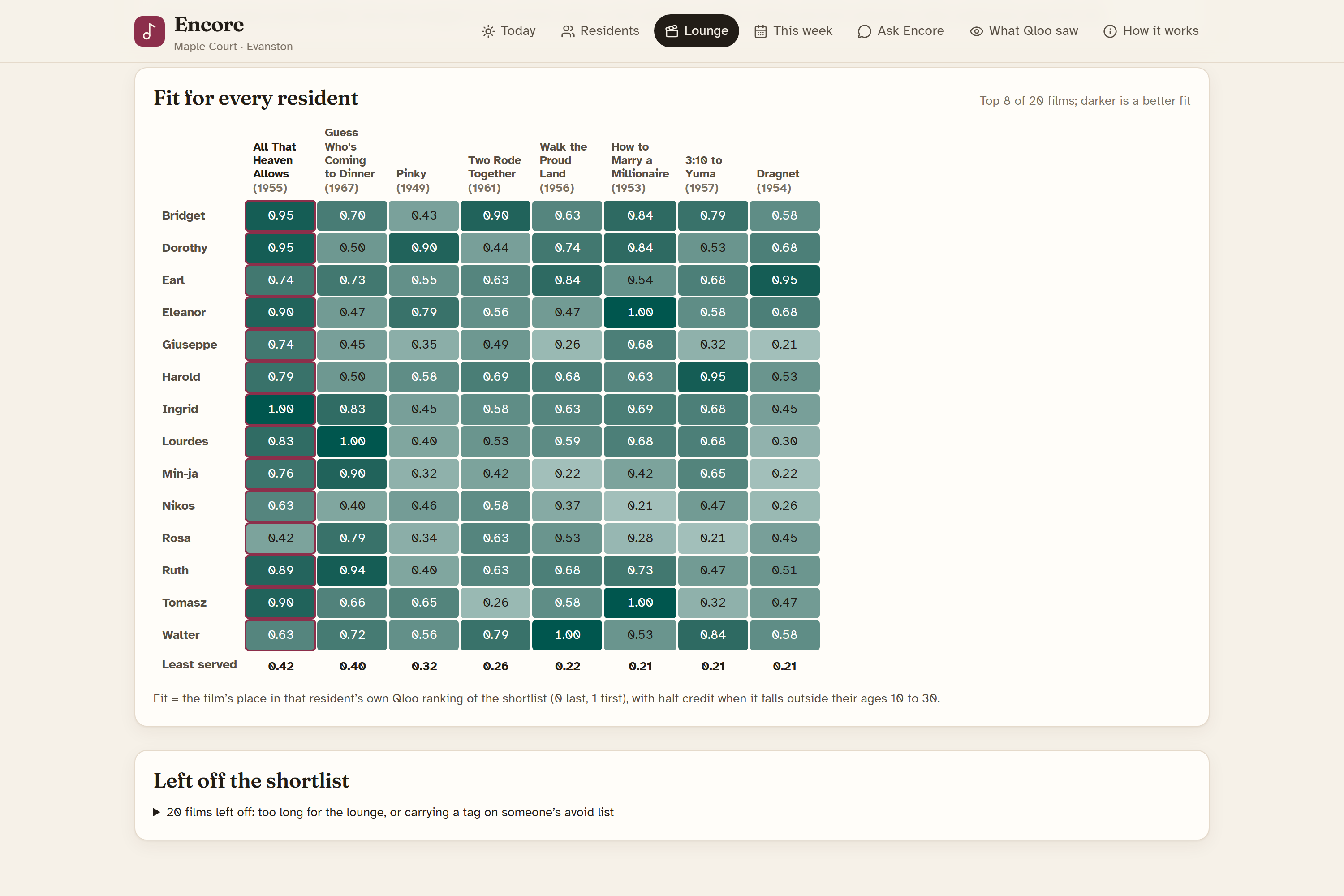
Fit for every resident and every film, each from that resident's own Qloo ranking of the shortlist.
-
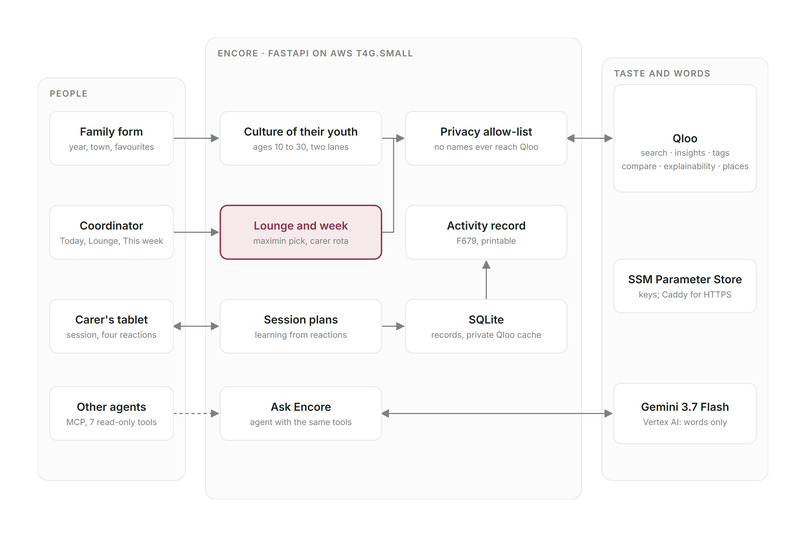
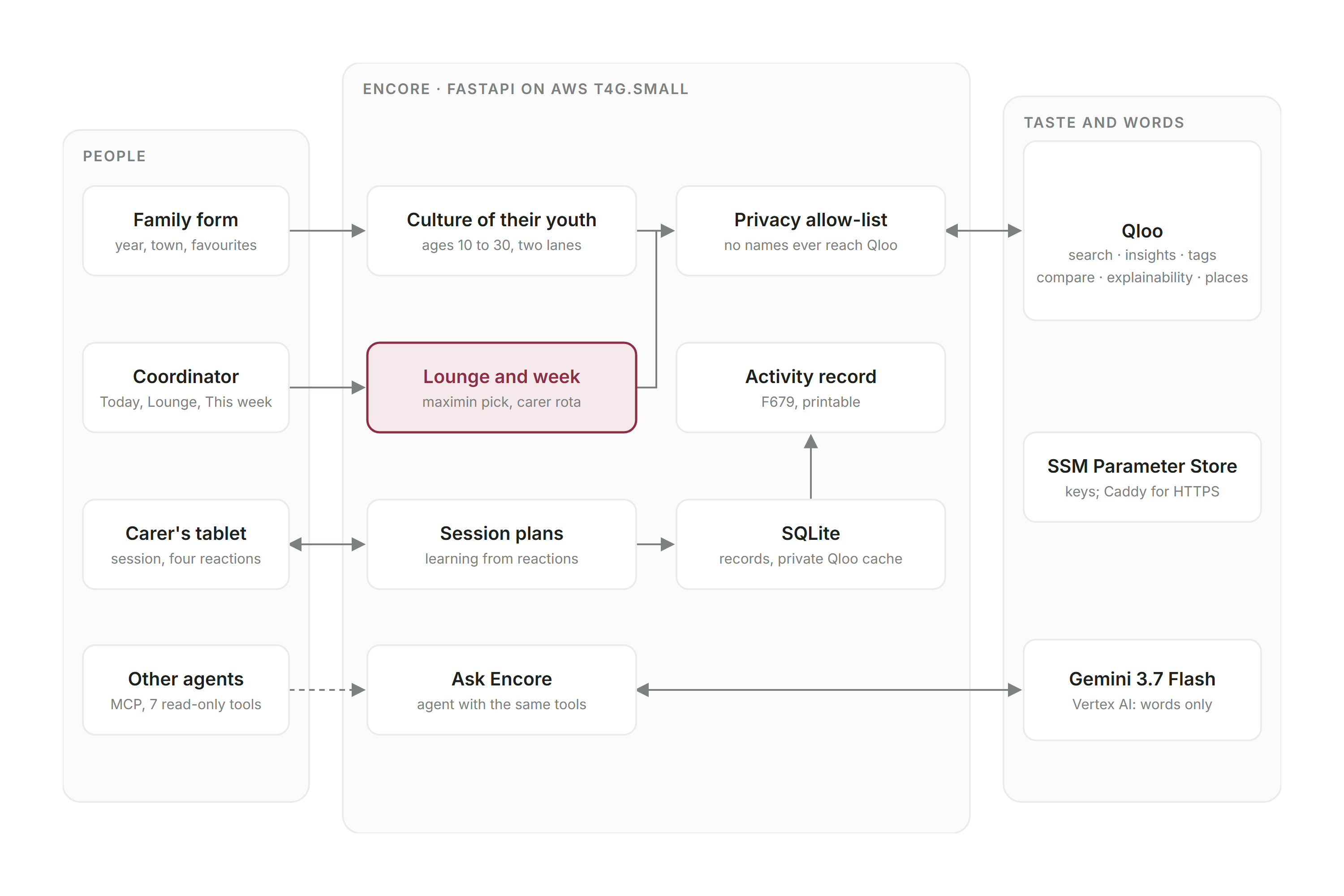
Architecture: Qloo picks and ranks, code decides, Gemini writes the words, and a privacy allow-list guards every request.

About the project
Encore is a taste agent for care-home activity coordinators. From a birth year, a hometown and a few favourites a family can name in a minute, it uses Qloo to find the songs, films and shows of each resident's youth, plans one-to-one reminiscence sessions a carer can run in ten minutes, picks the lounge films that leave no resident out, and pairs each resident with the carer whose tastes are closest to theirs.
Try it with someone in your family: https://44-199-155-121.sslip.io/add. Pick who they are to you, the year they were born, where they grew up and a favourite or two. Encore asks for no name. In a few seconds you see the culture of their ages 10 to 30, a session plan with the words to say, and where they would sit in today's lounge.
The scene
Thursday, 3 pm, the lounge at Maple Court in Evanston, Illinois. Fourteen residents, born between 1932 and 1944, who grew up in Kraków, Guadalajara, Naples, Dublin, Manila, Kingston, Seoul and Memphis. Tomasz, 89, from Kraków, has said little all week. His carer, Priya, is 26 and grew up in Kochi.
Encore gives Priya Czesław Niemen's "Dziwny jest ten świat" to open with, because his family named Niemen. Then Maryla Rodowicz, a Polish singer nobody at the home has tried with him, whom Qloo links to his family's favourites. Then Paul Anka's "Diana", an artist Qloo's explainability shows both his favourites and hers pulling toward. Then a Polish restaurant ten kilometres away. For the lounge it picks All That Heaven Allows (1955, 89 minutes), the film on the shortlist that serves its least-served resident best: Rosa, at 0.42. The most popular film on the shortlist, Cat on a Hot Tin Roof, would leave her at 0.10.
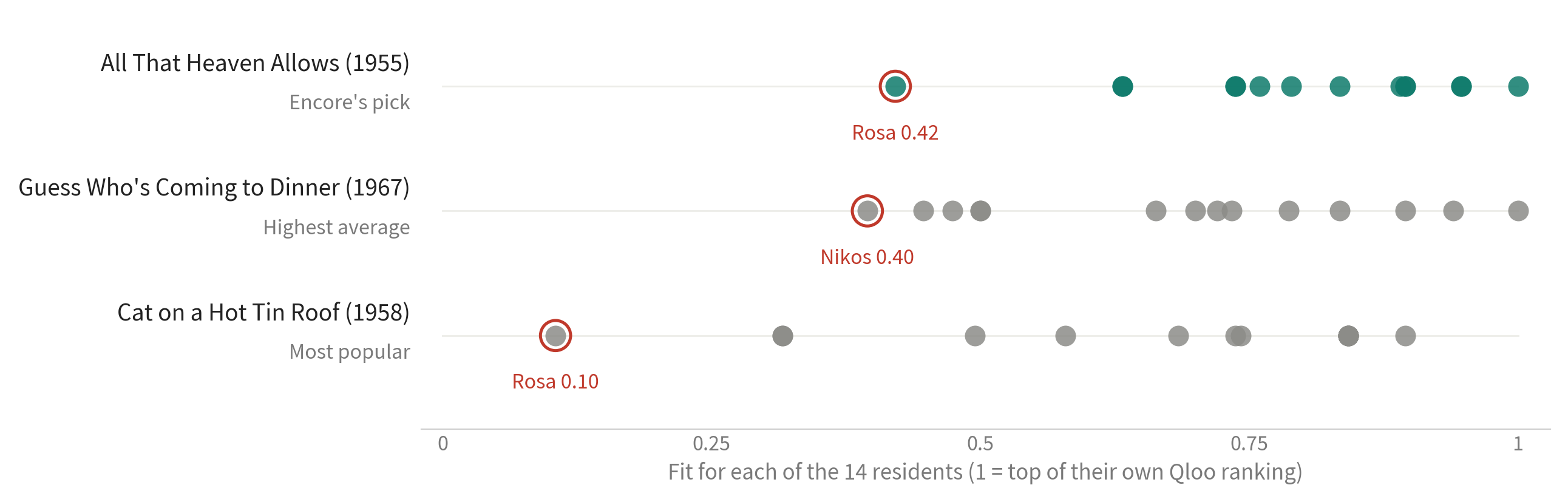
Each dot is one of the fourteen residents, placed by where the film falls in that resident's own Qloo ranking. Encore's pick keeps its least-served resident at 0.42. The highest-average film leaves Nikos at 0.40, and the most popular leaves Rosa at 0.10.
On Monday, Encore had already put Tomasz with Priya for the week: Qloo's Compare finds 38 tastes their favourites share ("Rock: Tomasz's Czesław Niemen and Priya's Coldplay"), against 5 with Ana.
Why this problem
- 14,742 US nursing facilities are certified by CMS, with about 1.24 million residents (KFF, 2025). 41.1% of residents had Alzheimer's disease or another dementia in 2022 (CDC NCHS).
- Each must run "an ongoing program to support residents in their choice of activities ... designed to meet the interests of and support the physical, mental, and psychosocial well-being of each resident" (42 CFR 483.24(c)(1), survey tag F679). The activities coordinator plans it for dozens of residents from different decades and countries.
- A Cochrane review of 22 randomised trials with 1,097 people with dementia in institutional care found that music-based interventions probably reduce depressive symptoms and improve overall behavioural problems at the end of treatment (van der Steen et al., 2018).
- 21% of nursing assistants in US nursing homes are immigrants (PHI, 2025). The carer and the resident often grew up decades and continents apart.
- People recall the most from ages 10 to 30, the reminiscence bump (Rubin, Rahhal and Poon, 1998). A family can name a singer or two. What they cannot hand over is the rest of that culture, in the right years and the right country. That is what Qloo's taste graph holds.
What it does
- The family form. A visitor tells Encore who someone is to them, the year they were born, where they grew up (54 countries) and up to three favourites. Encore matches the favourites in Qloo, asks staff to choose when a title is ambiguous, and builds that person's profile. It can seat them in today's lounge, scored the same way as every resident. The person is visible only in that browser and is removed at the nightly reset.
- The culture of each resident's youth. Two lanes per domain: the family's favourites, and home (country of release, or the home country's music genre). Films, TV and books are filtered to the years the resident was 10 to 30; artists are checked against their active years. A timeline shows where each item falls in the resident's life.
- One-to-one sessions. A song the family named, a singer from their youth the team has not tried, a film, common ground with the carer, and food from home near the care home. Gemini writes the words the carer says, following reminiscence practice: "Tell me about…", never "Do you remember…".
- The lounge. Qloo ranks one shortlist for every resident, and Encore picks the film whose least-served resident is served best, showing what the highest-average and most-popular choices would cost that person. Music hour gives every resident in the room an artist that fits them.
- The week. Two lounge films chosen as a pair, so the resident one film serves least gets a film that ranks well for them. Each resident gets a one-to-one with the carer Qloo's Compare finds closest to them, with each carer given an even share, and a printable plan.
- Learning from sessions. A carer taps one of four large buttons: lit up, sang or moved, no response, seemed upset. Lit up turns the item into a signal for the next Qloo query, and the screen shows what changed on the shelf. Upset excludes it at once and offers its genres as avoid tags.
- Ask Encore. A Gemini agent plans with the same tools ("Plan this week: which two films, and who should sit with whom?") and shows every tool call with the Qloo requests behind it. The same seven read-only tools are served over MCP at
/mcp/. - The activity record. A printable record per resident: interests and their source, what to avoid, participation and response.
Technological Implementation
Encore makes nine kinds of Qloo request, each doing a specific job:
| Need | Qloo call |
|---|---|
| Resolve the family's words; pick the 1961 West Side Story for a woman born in 1941 | /search with types |
| Films, TV and books of ages 10 to 30 | /v2/insights, filter.release_year.* / filter.publication_year.*, signal.interests.entities, signal.demographics.age |
| The home lane | filter.release_country, or a music genre tag found with /v2/tags |
| Music of the era | filter.tags=urn:tag:genre:music:oldies for people born before 1955, plus code on start_year / end_year |
| Avoid lists and house rules | filter.exclude.tags (no war films for Tomasz, no horror in shared rooms) |
| "Qloo links it to Irena Santor" | feature.explainability |
| Rank one shortlist for every resident | filter.results.entities |
| Common ground with a carer, and the week's carer rota | /v2/analysis/compare, using the tags both people's favourites carry and the favourite on each side behind each tag |
| Food of home near the care home | place insights with filter.location.query, filter.location.radius and a cuisine tag |
Every pick, rank and number comes from Qloo and code. The model writes words only, and the product keeps working on templates without it. The week's film pair reuses the per-resident Qloo rankings of the lounge shortlist: Encore tries every pair of films and keeps the one whose least-served resident's better film fits best. The carer rota scores all 42 resident and carer pairs with Compare, then gives each carer an even share, residents with the clearest best match choosing first.
The Qloo client paces requests, retries with backoff, and serves answers from a private server-side cache. 33 tests run with no network against a synthetic Qloo stand-in, including one that drives every feature and then reads every request that left.
Measured against the model on its own. I gave the same model (Gemini 3.7 Flash) each resident's birth year, hometown and favourites and asked for ten singers and ten films from their youth, then looked every answer up in Qloo and scored both sides with the same code:
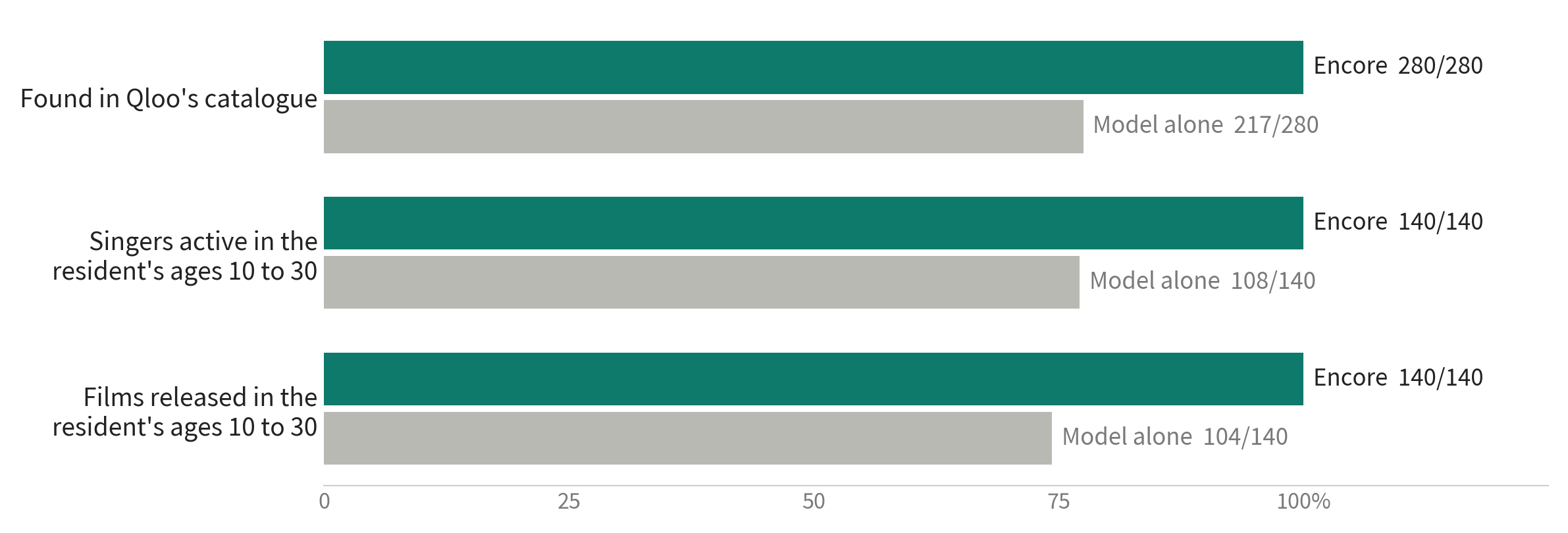
Every answer Encore gives exists in Qloo and falls inside the resident's ages 10 to 30. The model on its own: 217 of 280 answers found in Qloo, 108 of 140 singers active and 104 of 140 films released in those years.
In the same evaluation run, scored on one pool (Encore's shortlist plus the model's choice), the model chose Singin' in the Rain for the lounge, which ranks last for Rosa (fit 0.00). Encore's pick, All That Heaven Allows, kept its least-served resident at 0.45.
The week, on the live demo:
| Least-served resident's best film of the week | |
|---|---|
| One lounge film | 0.42 (Rosa) |
| Two films chosen as a pair | 0.63 (Walter), average 0.86 |
| One-to-ones for 14 residents, 3 carers | Tastes shared in Qloo, summed over the pairs |
|---|---|
| Matched by Compare, even share per carer | 269 |
| Alphabetical rota | 179 |
The music lanes were tuned on the same residents. Seeded by the family's favourites, Qloo artist results fall inside a resident's ages 10 to 30 635 times out of 700 with the oldies genre tag, against 501 with the 55-and-older age signal, so Encore uses the tag. For people born from 1955 on, the favourites alone keep the most artists in their window (49 of 50 for fans of Madonna and Prince born in 1962), so the family form uses them directly.
Design
The product follows the coordinator's week and afternoon: Today (who is in the lounge, the film, the music hour, the one-to-ones to plan), Residents (a profile per person with a timeline of their youth), the session screen a carer holds on a tablet (large type, four large reaction buttons), Lounge (the pick, what each rule costs the least-served resident, and a fit matrix for every resident and film), This week (the film pair, the rota by day, and the shared-taste matrix behind it), Ask Encore, What Qloo saw and How it works. The family form is one screen that works on a phone. Typography is Atkinson Hyperlegible, designed for low vision, with Fraunces for headings. Light and dark modes, colours checked for colour-blind separation, and a printable week and record.
Potential Impact
Encore writes the programme the F679 rule asks for and the record a surveyor reads, for a coordinator who today assembles it by hand from family notes and internet searches. It starts from what families already give, a year, a town and a few favourites, and the family form is the intake screen a home would send them. It leaves a trail: every session's items and responses go into the resident's record. The carer pairing matters as much: Encore gives a 26-year-old carer from Kochi and an 89-year-old man from Kraków a first song they both have reason to enjoy, and tells the coordinator on Monday which carer to send.
Quality of the Idea
Qloo's taste graph is usually used to predict what someone will like next. Encore points it backwards, at the years a person remembers most, and uses it in four places where a generic model falls short: the right years for each person, the right country, a fair choice for a room of fourteen people with different pasts, and the carer each of them has most in common with. The design follows reminiscence practice: invite, never quiz, rest what got no response, and drop at once anything that upset someone.
Privacy
Qloo receives entity IDs, years, a hometown, genre words and an age bracket. Names, rooms, care notes and reactions stay in Encore, and the family form asks for no name at all. An allow-list in the client refuses any request carrying a resident's or carer's name, and the What Qloo saw page lists every request. Qloo answers are cached privately on the server and never committed to the repository. The residents in the demonstration are fictional.
How I built it
Python and FastAPI for the agent, the taste engine and the API; SQLite for the home's records and the private cache; React and TypeScript for the web app; Gemini 3.7 Flash on Vertex AI for the words and the agent; the MCP Python SDK for the tool server; Playwright to drive the real interface in checks. It runs on an AWS t4g.small behind Caddy, with the keys in SSM Parameter Store.
Challenges
Keeping music in the right decade took the most work. Qloo filters films, TV and books by release year; for artists, Encore checks each one's active years in code and picks the Qloo signal that keeps the most results inside each person's youth, measured above. A favourite the family named always ranks first for that resident in the lounge, because it is the strongest signal of all. For the carer rota, Encore counts the distinct genres, instruments and themes Qloo's Compare finds in both people's favourites, which separates strong pairs clearly (38 shared tastes for Tomasz and Priya, 5 for Tomasz and Ana).
What's next
A pilot with an activities coordinator, a family link that a home sends with its admission pack, and export of the activity record to the care-planning software homes already use.
Built With
- amazon-web-services
- ec2
- fastapi
- gemini
- mcp
- python
- qloo
- qloo-insights-api
- react
- sqlite
- typescript
- vertex-ai
- vite

Log in or sign up for Devpost to join the conversation.