-
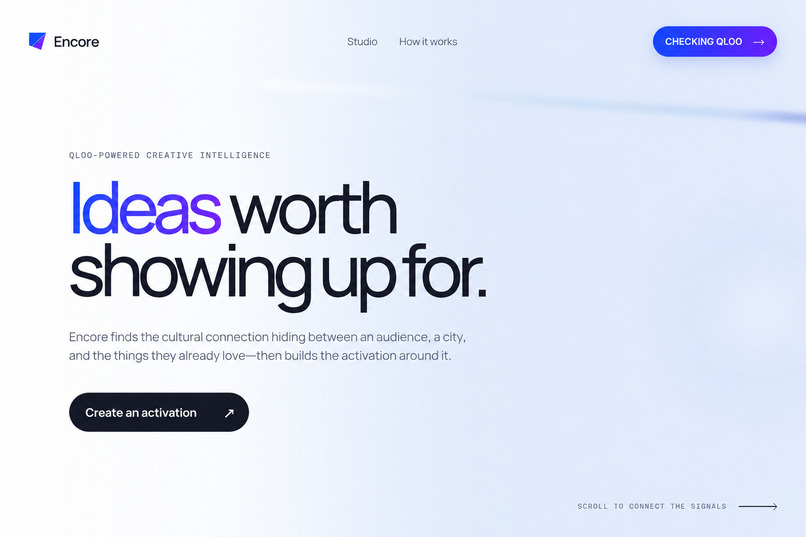
Encore cultural activation briefing interface
Inspiration
Experiential producers need collaborations that feel culturally natural to a specific audience and city. Early research is usually scattered across venues, artists, brands, audience assumptions, and generic search results. We built Encore to turn cultural affinity into an inspectable creative starting point.
What it does
A producer enters an artist, film, game, or brand together with a city, audience, objective, budget, format, and constraints. Encore resolves the cultural anchor through Qloo Search, investigates related places, brands, and artists through Qloo Insights, and composes three deliberate routes: closest fit, cultural bridge, and plot twist.
Every route keeps its Qloo evidence visible. Selecting one creates an activation dossier with the guest journey, possible partner roles, production priorities, limitations, and the checks a human producer must complete.
How we built it
Encore is a Node.js application deployed on Vercel. The server keeps the Qloo event credential private and exposes concept, dossier, and status endpoints. The Qloo layer resolves anchors, calls Insights, normalizes evidence, caches responses, coalesces duplicate requests, retries bounded rate-limit failures, and applies request deadlines. The composition agent validates the brief, classifies venue suitability, creates the three strategies, preserves the evidence ledger, and builds the dossier.
The browser interface manages the structured brief, live research trail, concept board, and dossier. Qloo is the grounding layer: removing it removes live anchor resolution, cultural-affinity discovery, local place research, and the evidence attached to each concept.
Agentic workflow
- Resolve the submitted anchor with Qloo Search.
- Discover local places and related brands and artists with Qloo Insights.
- Normalize and rank the evidence for the requested brief and event scale.
- Compose three strategically different activation hypotheses.
- Turn the selected route into a verification-ready production dossier.
Challenges we faced
Raw affinity is useful but does not prove operational suitability. Testing exposed small venues in flagship briefs, weak locality, competitor conflicts, broad anchors, rate limits, and stale browser state. We added stricter flagship venue rules, explicit research-lead language, caching, bounded retries, request deadlines, stale-board clearing, and browser bundle versioning.
Accomplishments
- A complete live brief-to-concept-to-dossier workflow.
- Inspectable Qloo evidence on every concept.
- Honest boundaries around availability, rights, pricing, partner interest, and demand.
- Fifteen automated tests passing.
- One hundred sample scenarios and ten diverse live scenarios reviewed across music, film, sport, and consumer platforms.
- A public deployment and MIT-licensed repository.
What we learned
Cultural affinity is strongest as a research signal, not an automatic truth. A useful agent must preserve its evidence, surface uncertainty, reject unsuitable results, and make human verification part of the output.
How we used Codex
Codex helped shape the product thesis, implement the application and Qloo integration, redesign the interface, deploy the product, test diverse scenarios, diagnose reliability and venue-classification failures, and maintain the documentation and claims ledger. Human judgment remained responsible for assessing cultural, emotional, local, and operational fit.
What's next
We plan to add a cultural reranker for city relevance, emotional intent, event scale, competitor conflicts, and venue suitability; structured producer feedback; and stronger operational data for capacity, access, rights, and availability.
Try it
- Live application: https://encore.nuvixes.studio
- Source code: https://github.com/Nifemi0/encore-cultural-producer
Built With
- css3
- html5
- javascript
- node.js
- qloo
- vercel

Log in or sign up for Devpost to join the conversation.