What it does
Encore is a one-song countdown studio for independent cover artists. It turns a lyric-free Song Map into a dated practice workflow: generate a structured plan, log confidence by section, inspect mastery trends, make an explainable recording decision, create a Making Of caption, and confirm publication.
The Build Week demo is deliberately bounded to one checked-in Song Map for “Dreams.” Plans, logs, decisions, and publication milestones are stored in the browser. There are no accounts, audio analysis, or direct publishing integrations.
How it works
Encore is built with Next.js 16, TypeScript, React, Zod, the OpenAI Responses API, localStorage persistence, Vitest, Playwright, and Vercel.
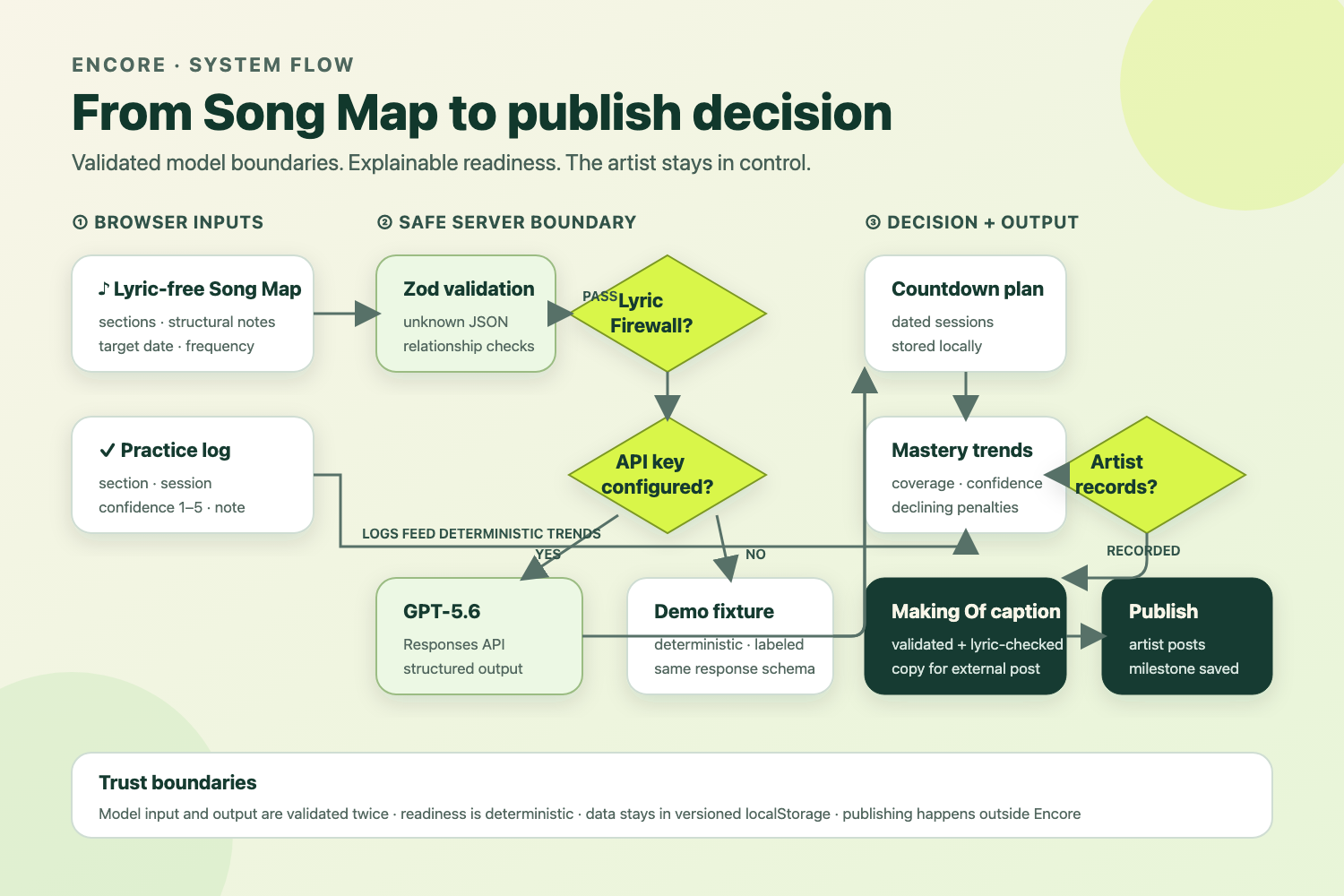
Two narrow server boundaries request strict structured outputs from gpt-5.6 when a server-only API key exists: a countdown practice plan and a short Making Of caption. A deterministic Lyric Firewall checks artist notes before model use and checks the caption again on return. Recording readiness is deliberately not generated by AI; it is visible application logic based on section coverage, confidence, trends, remaining time, and explicit penalties.
The public deployment has no OpenAI API key. It returns deterministic fixtures matching the production response schemas and labels them prominently as mock data. Those fixtures are not presented as live GPT-5.6 output.
Architecture
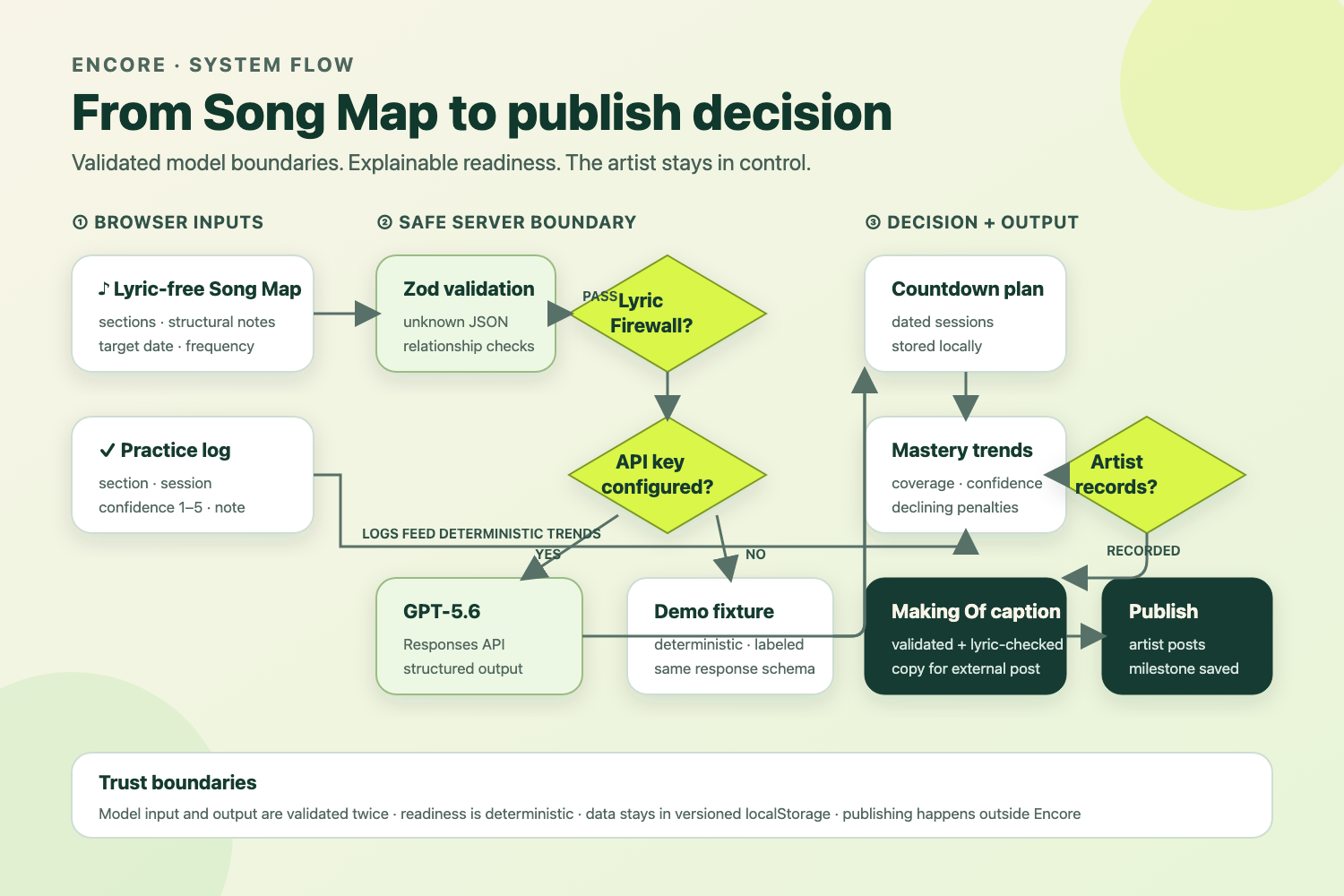
Encore keeps generation narrow and decision support explainable:
- The browser loads a lyric-free Song Map and stores the plan, practice logs, recording decision, and publication milestone in versioned
localStorage. - Next.js API routes validate unknown JSON with Zod and run the Lyric Firewall before any model boundary.
- With
OPENAI_API_KEY, the server calls GPT-5.6 through the Responses API. Without it, the same routes return prominently labeled deterministic fixtures. - Structured outputs are validated again before the browser accepts them.
- Practice logs feed deterministic mastery trends and transparent recording readiness. Encore recommends; the artist decides.
- After recording, validated practice history produces a lyric-checked caption. Publishing happens outside Encore; only the milestone is stored locally.
How it looks
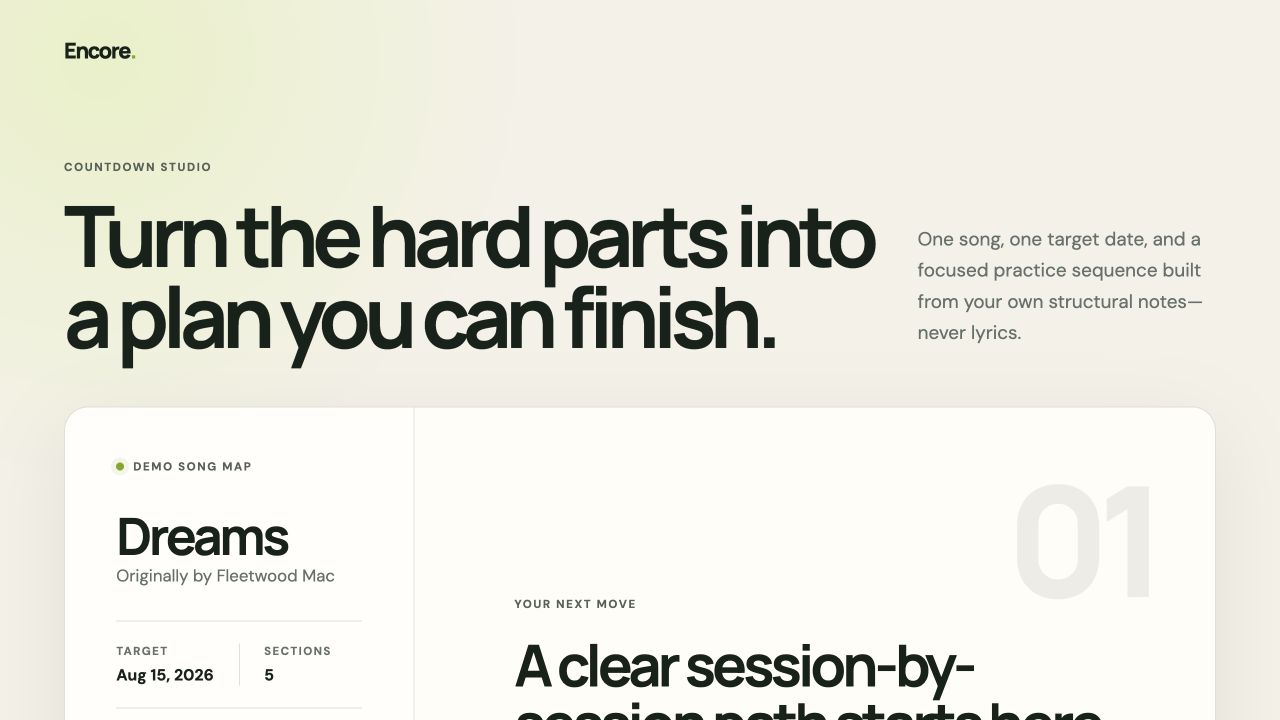
Start with a lyric-free Song Map
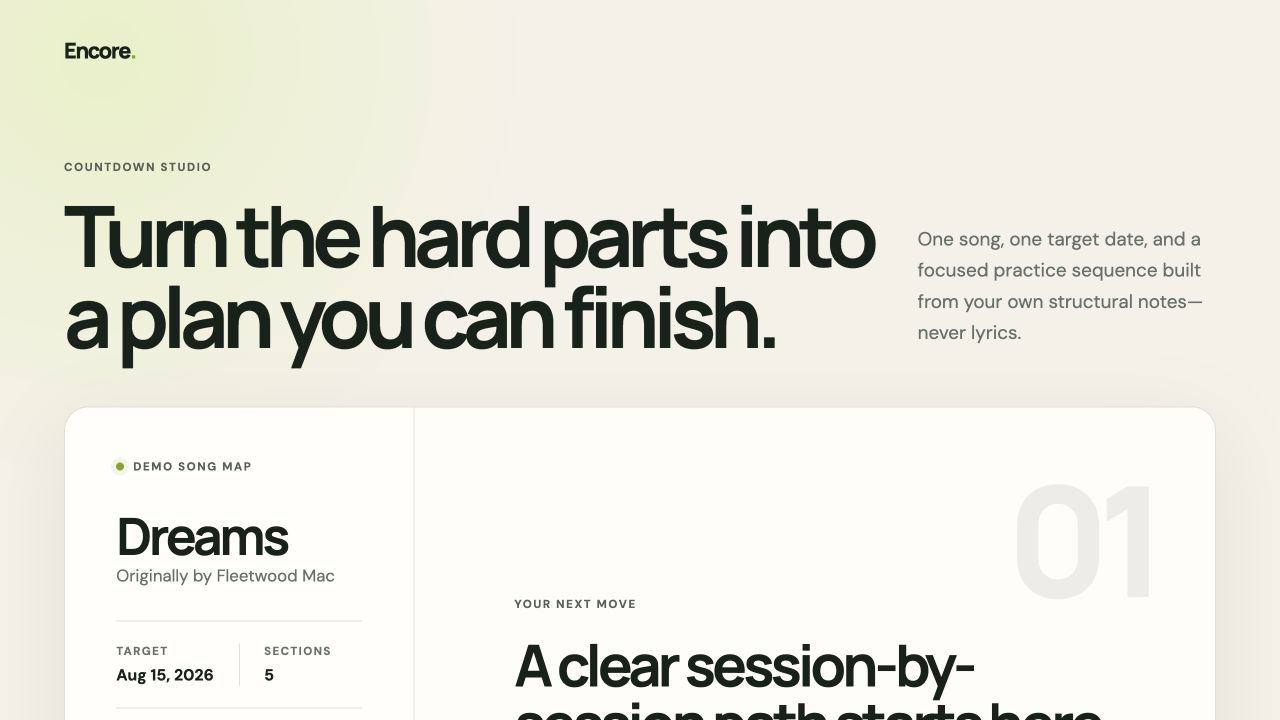
One read-only map captures the song structure, original difficulty notes, and target date—never lyrics.
Generate the countdown
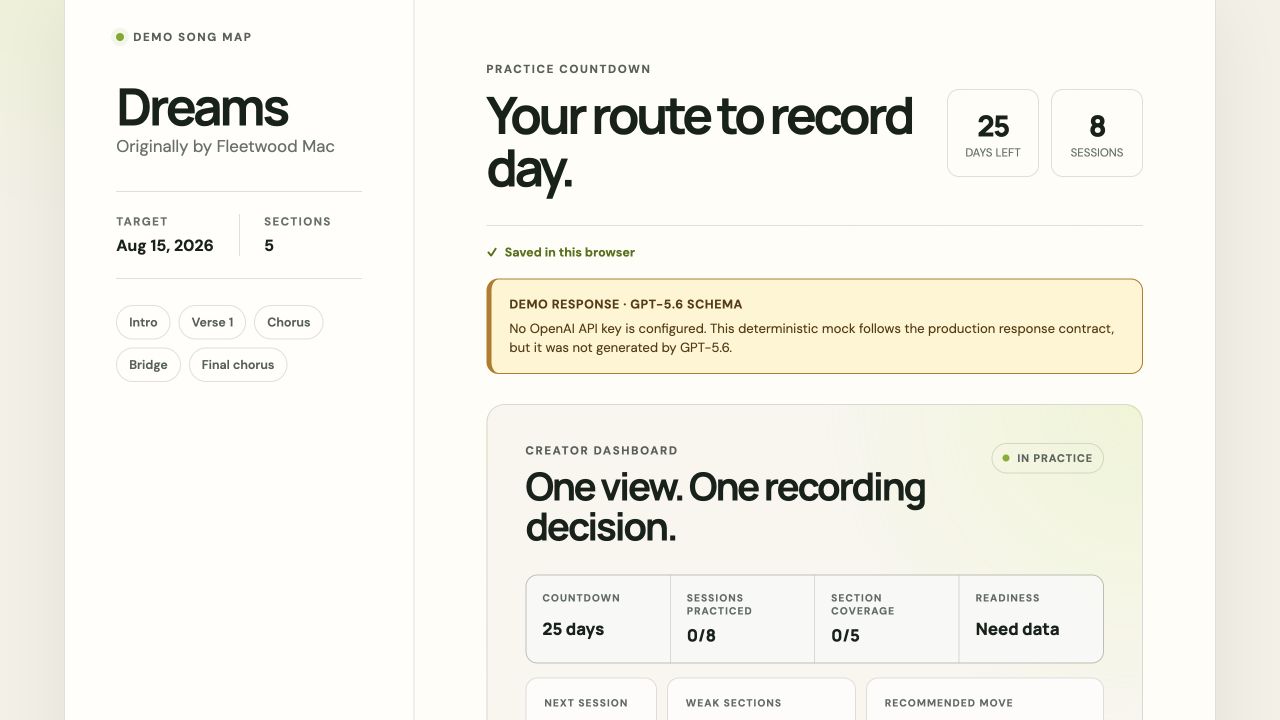
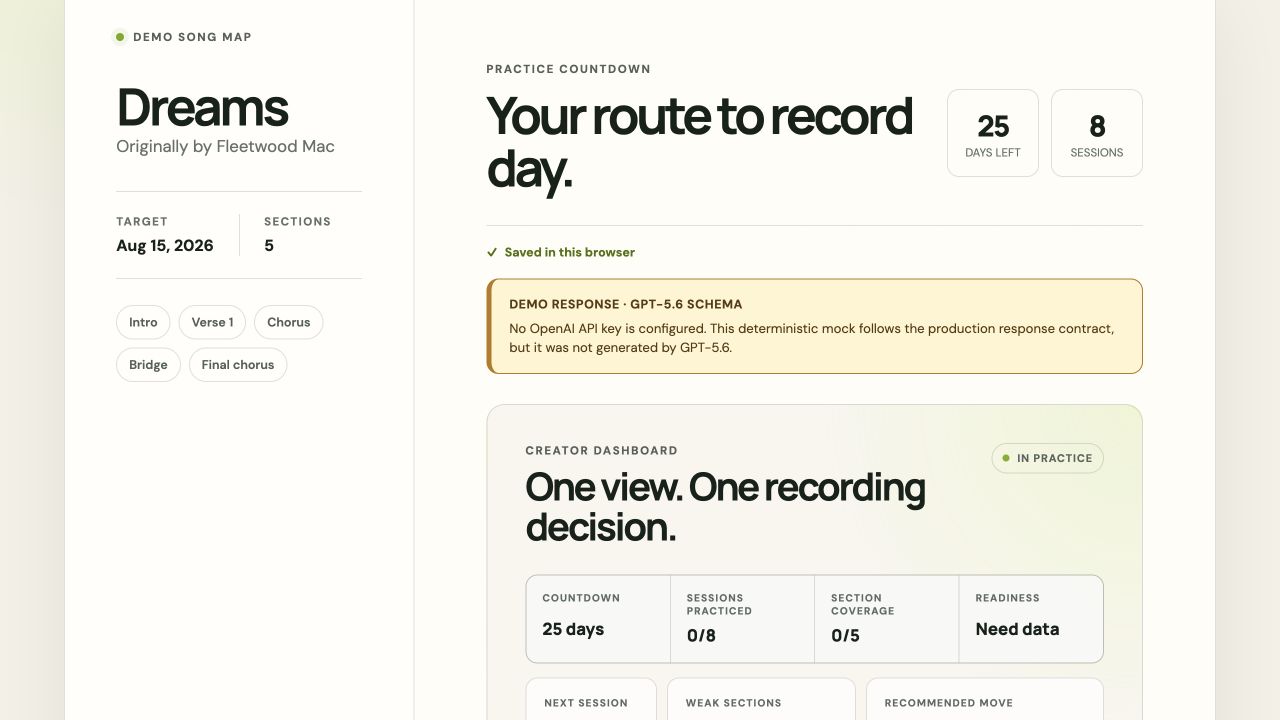
The public no-key deployment shows a deterministic response shaped like the production GPT-5.6 schema and labels it clearly as mock data.
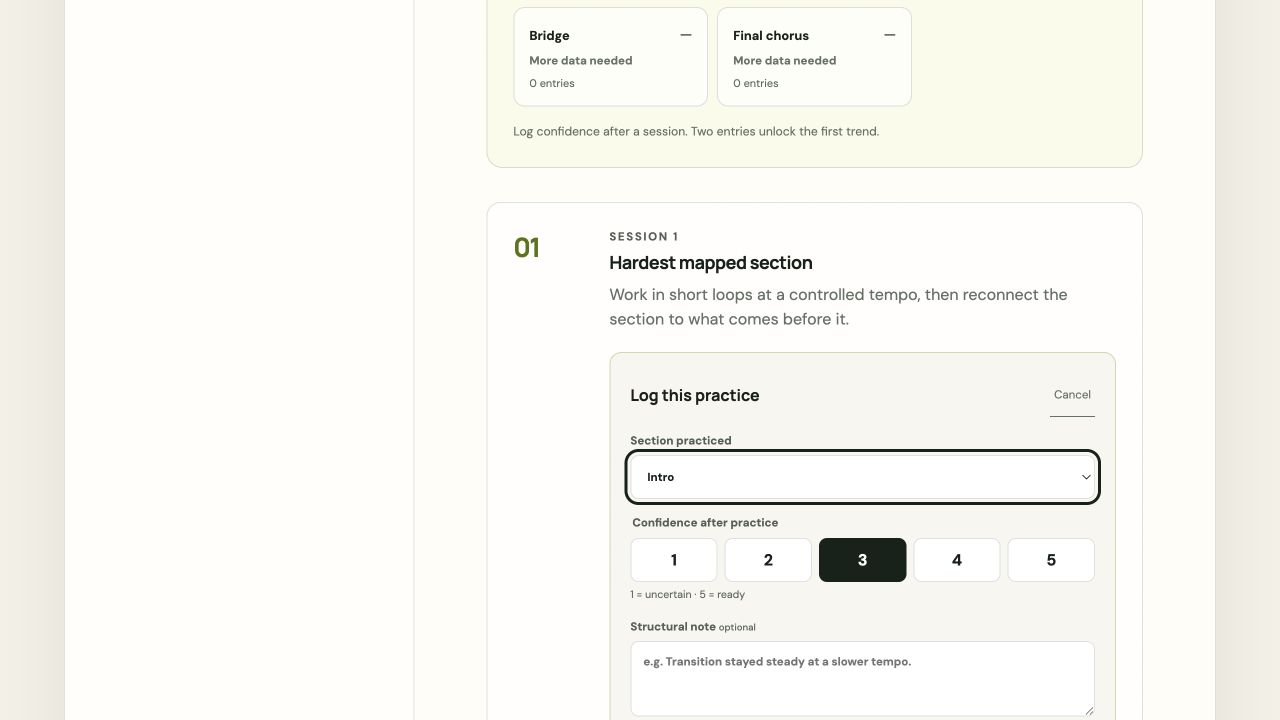
Log practice by section
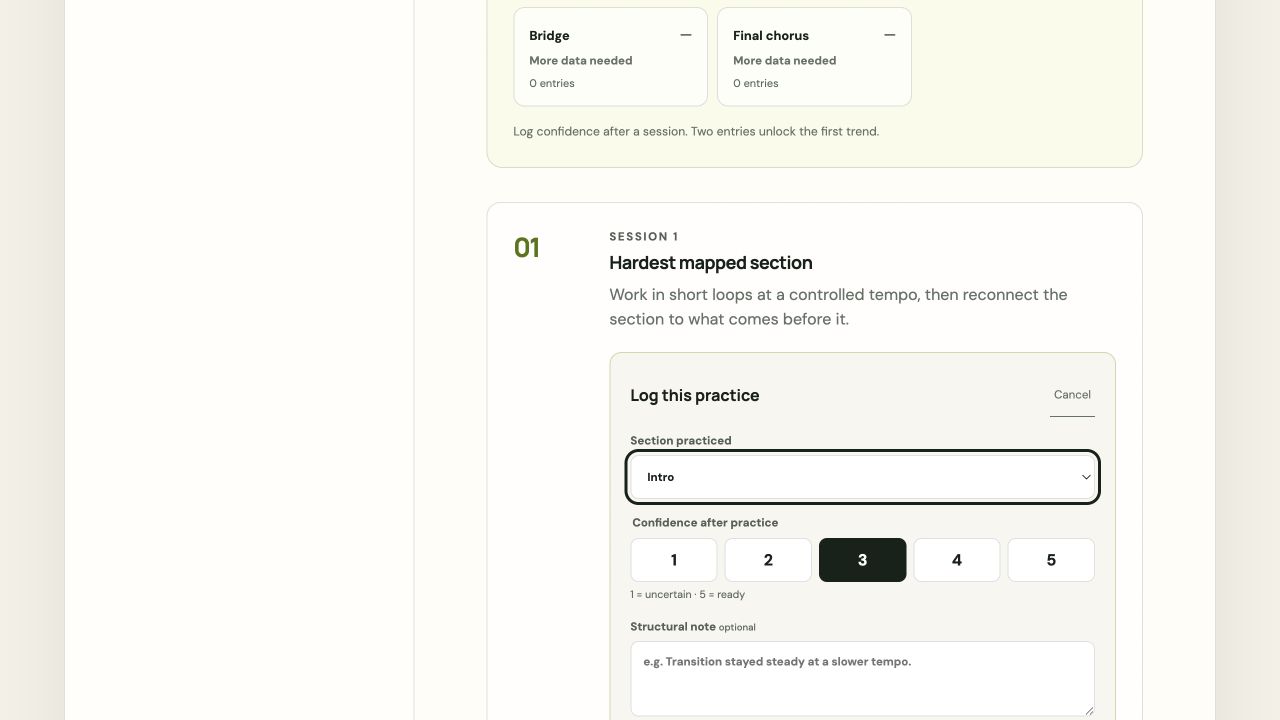
Each entry connects a mapped section and plan session to confidence from 1–5 and an optional lyric-checked structural note.
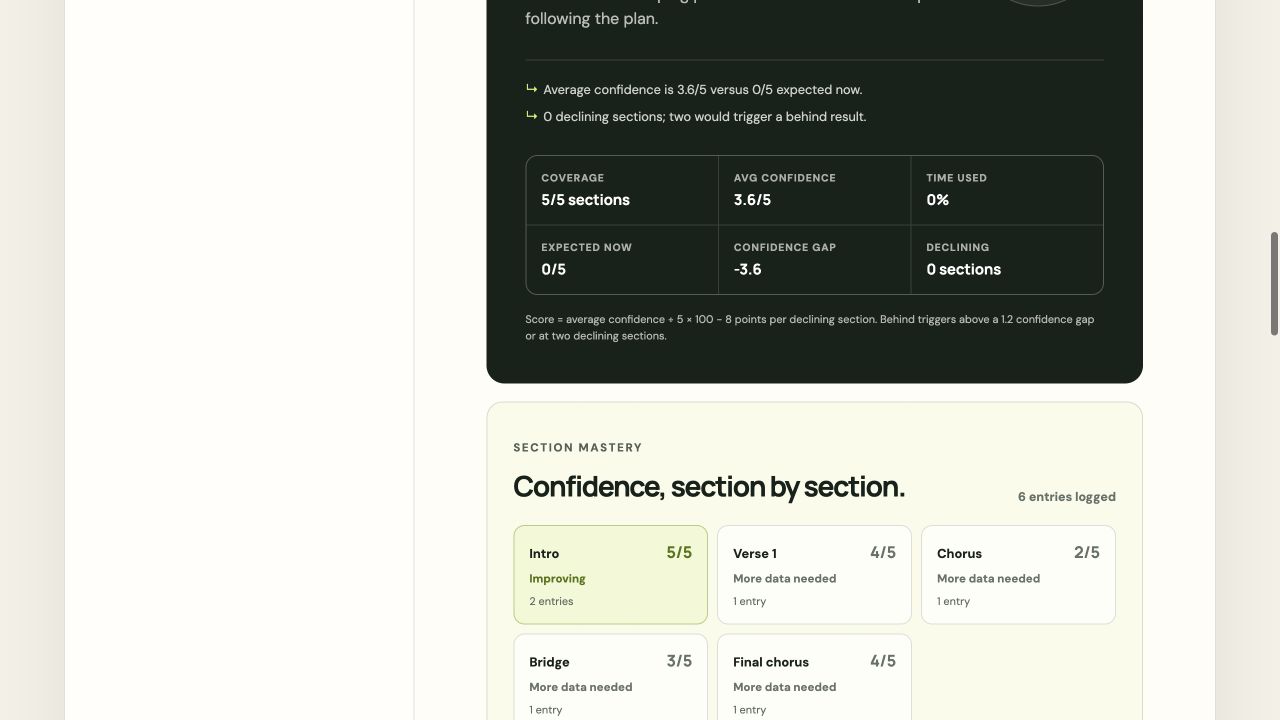
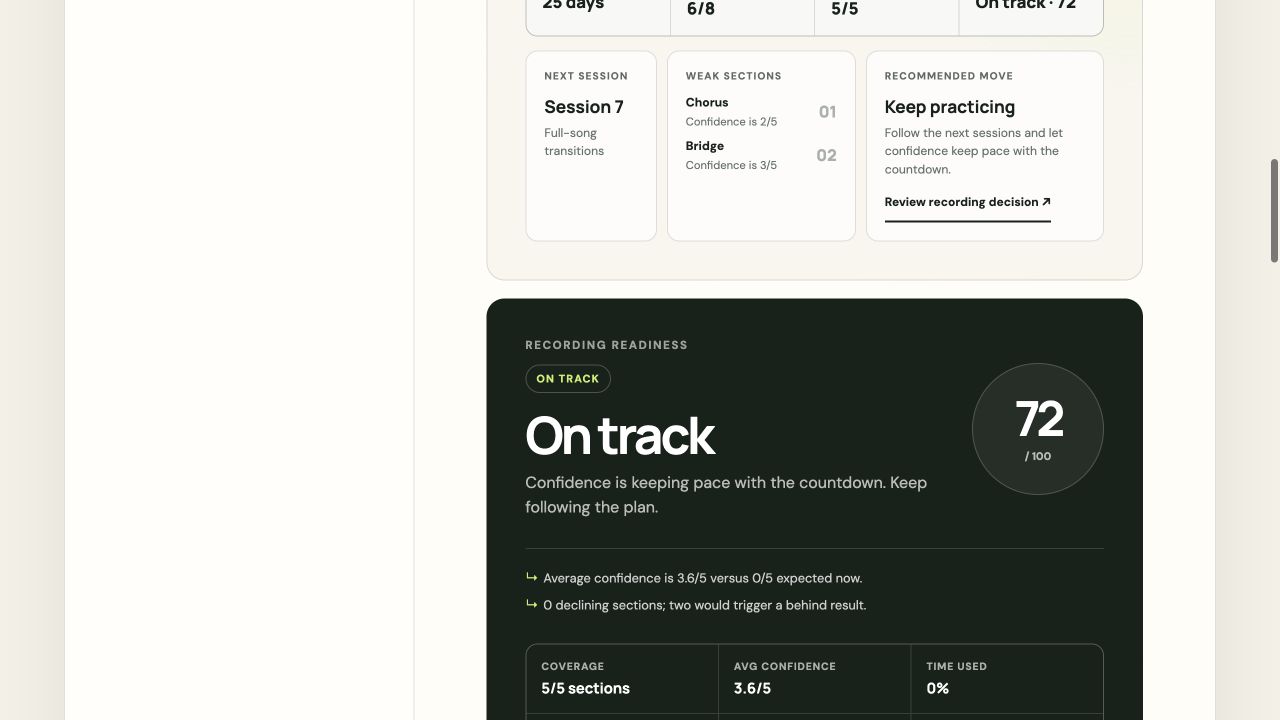
Inspect mastery and explainable readiness
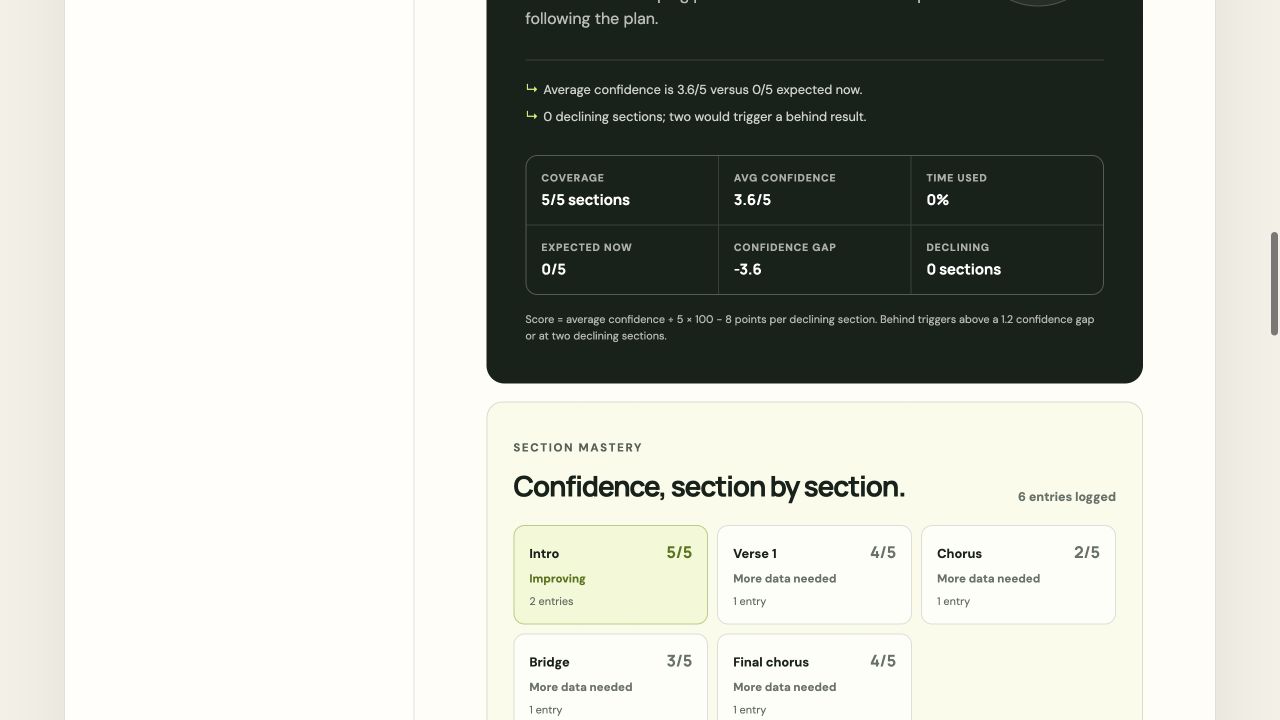
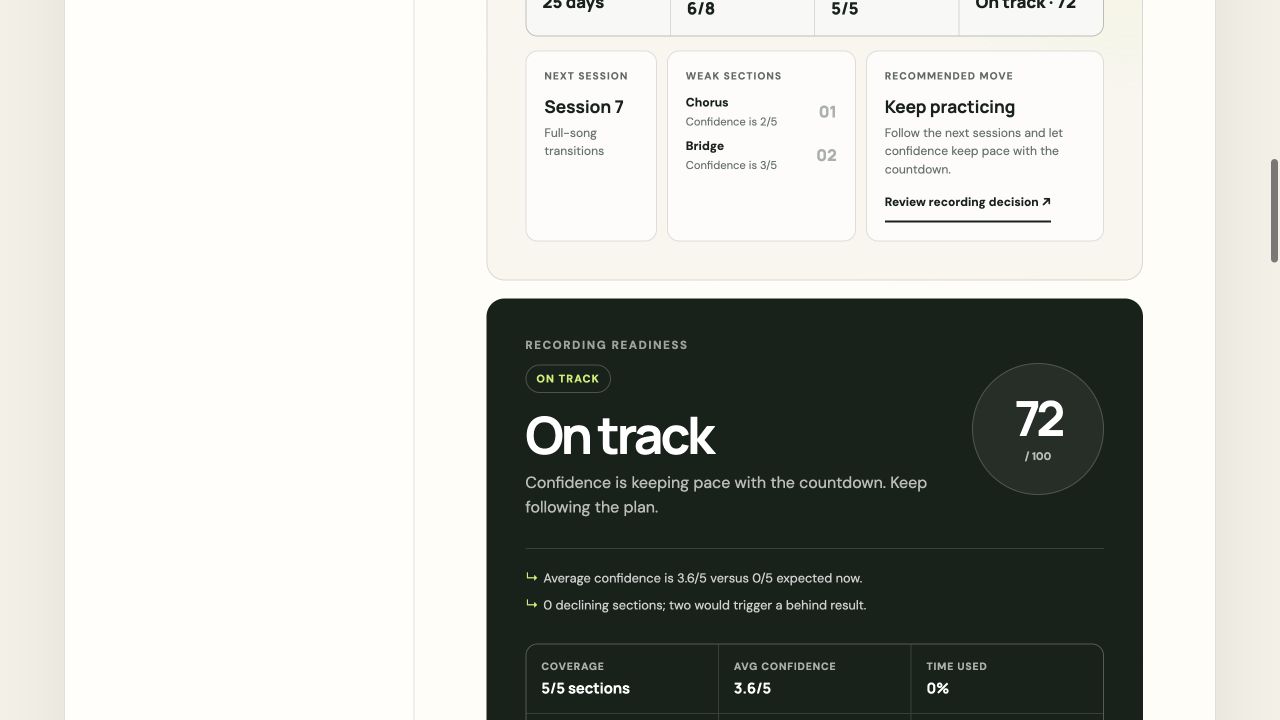
Coverage, recent trends, thresholds, and declining-section penalties remain visible. Readiness is calculated by application logic, not predicted by a model.
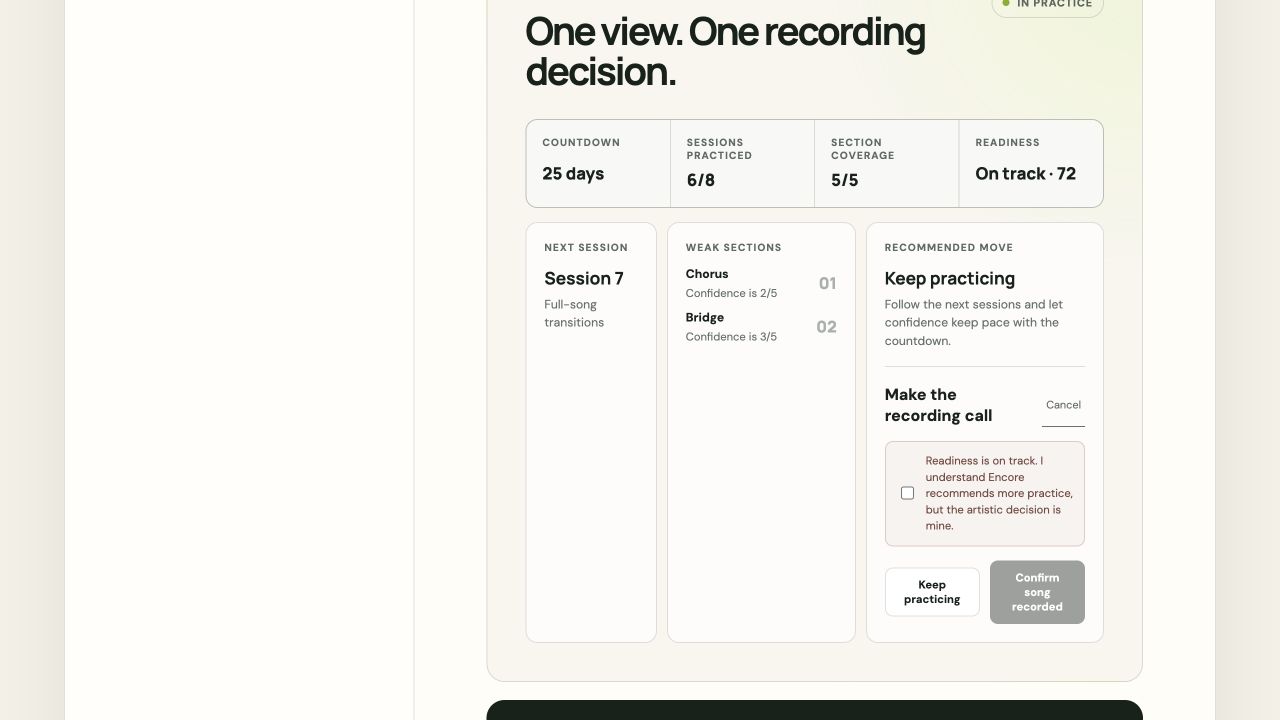
Make the recording decision
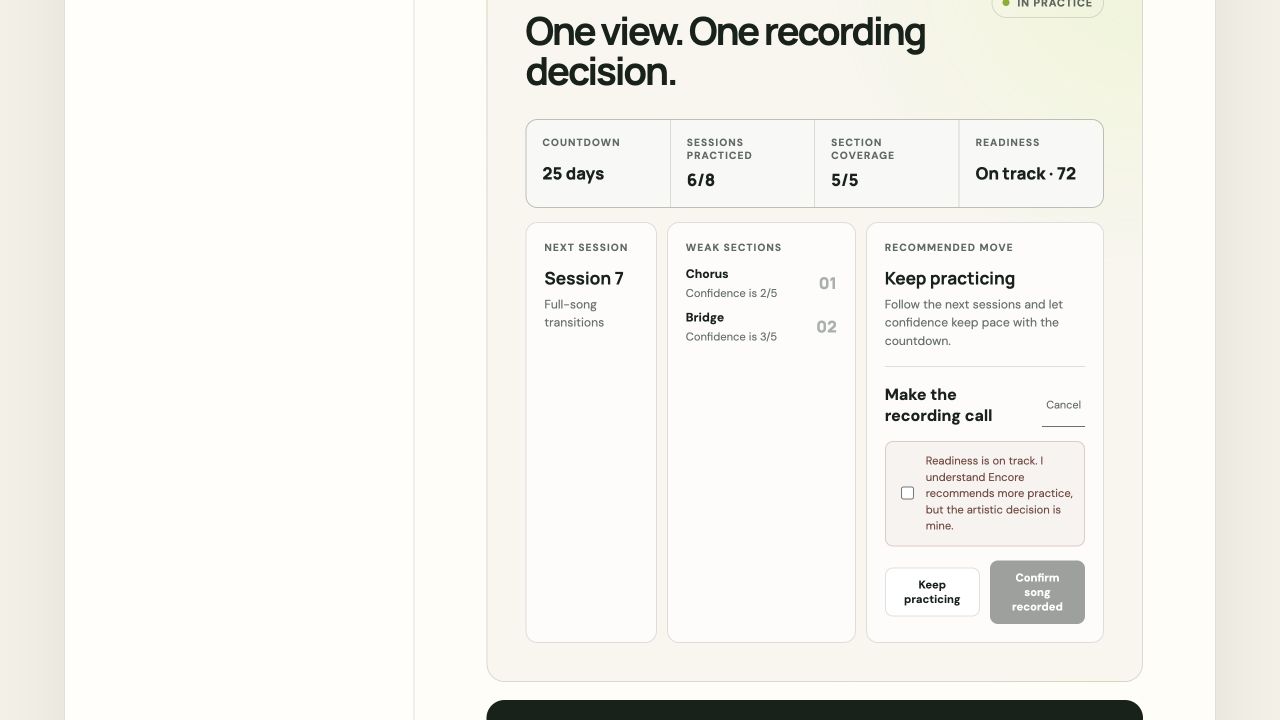
Encore recommends the next action, while the artist keeps the final decision and explicitly acknowledges an early recording choice.
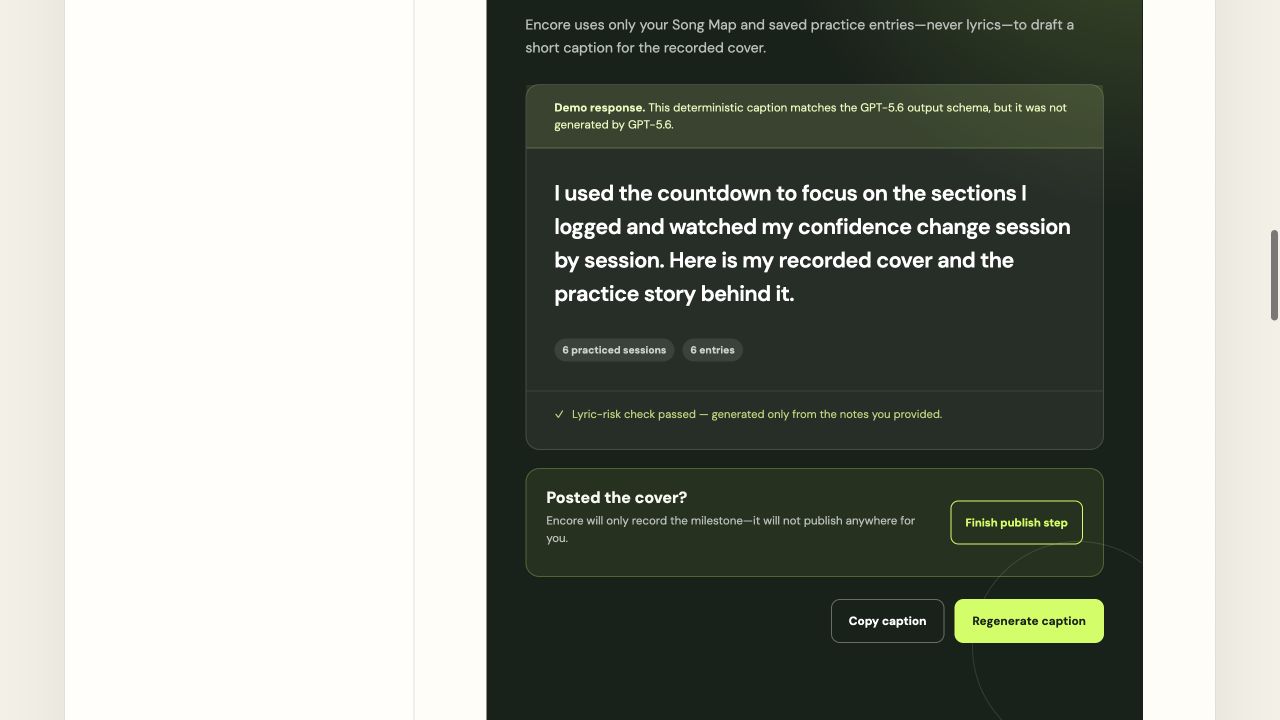
Create the Making Of caption and confirm publication
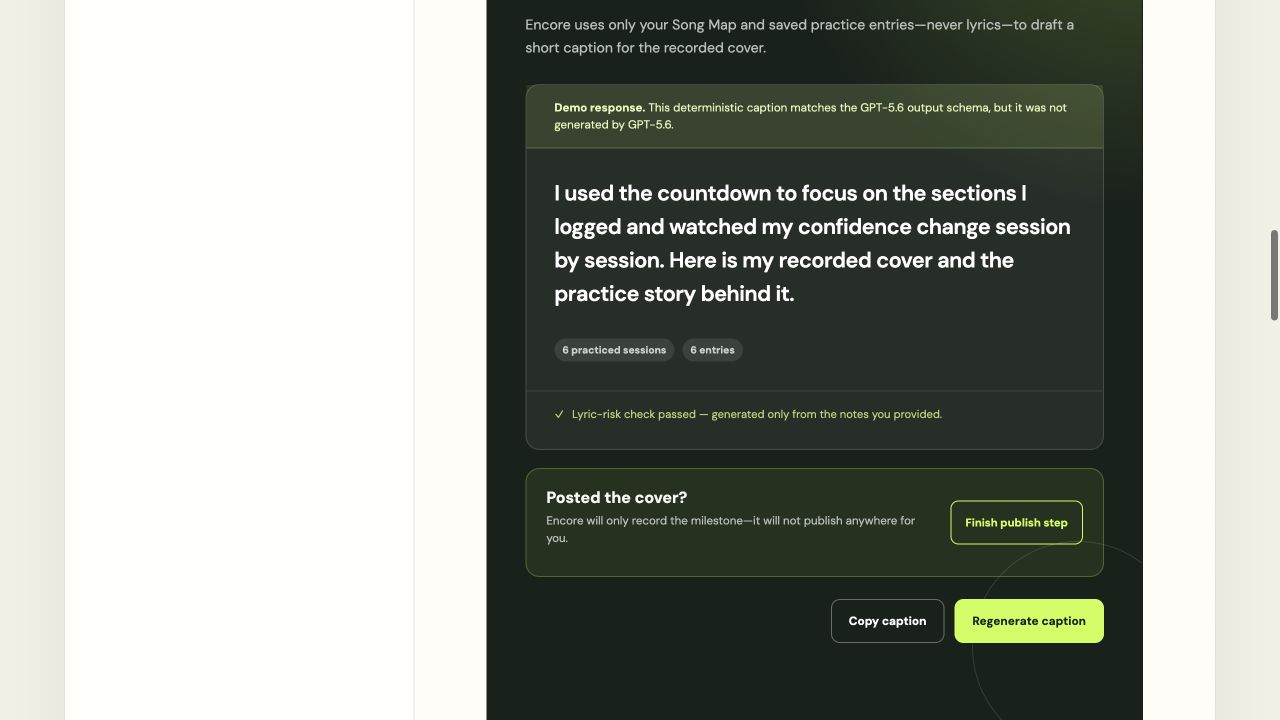
The caption crosses the same validated runtime boundary and a second lyric-risk check. The artist publishes externally; Encore stores only the confirmed milestone.
Measured verification
The v1.0.0 repository passes 140 unit and integration tests across 23 files, one Chromium golden-path flow, strict lint, TypeScript checking, and the production build. GitHub Actions and Vercel passed on the public main-branch merge.
How Codex was used
Codex turned an ordered product thesis into scoped GitHub issues and reviewable pull requests. It inspected the repository, implemented each increment, wrote tests, ran browser flows, diagnosed failures, checked accessibility, refreshed documentation, and shipped the tagged v1.0.0 release.
Important decisions made with Codex include:
- Ship one coherent song lifecycle instead of a shallow multi-song library.
- Accept structural notes rather than stored lyrics.
- Keep readiness deterministic and explainable instead of using an opaque model score.
- Validate model input and output at two narrow server boundaries.
- Make the no-key fallback unmistakably mock.
- Preserve artist agency: Encore recommends, but the artist decides whether to record.
Precise GPT-5.6 contribution
The primary /feedback session is 019f74c9-756b-7421-a9e2-68d08be3bb63. Local Codex session metadata records gpt-5.6-sol for the core implementation turns beginning with the Lyric Firewall and structured planner and continuing through practice persistence, mastery trends, explainable readiness, creator decisions, caption generation, the record-to-publish path, hardening, accessibility, deployment, documentation, and release.
The GPT-5.6 evidence record maps those turns to the public pull-request sequence.
How judges can test it
Hosted path—no build, account, API key, or credentials:
- Open the production demo.
- Generate the countdown and confirm the highlighted mock-data notice.
- Log practice, inspect trends and readiness, and save a recording decision.
- Generate the labeled mock caption and confirm publication.
Local development—no production rebuild required:
git clone https://github.com/manojmallick/encore.git
cd encore
pnpm install --frozen-lockfile
cp .env.example .env.local
pnpm dev
Automated path:
pnpm test
pnpm exec playwright install chromium
pnpm test:e2e
The checked-in Song Map is the sample data. The automated browser path starts its own server and supplies deterministic API responses.
Challenges and learning
The hardest problem was preserving a coherent creative workflow without overstating what the prototype does. Free text had to remain useful without becoming lyric storage. Readiness had to avoid comforting averages that hide unpracticed or declining sections. Separating model-generated planning from deterministic readiness made Encore easier to explain, test, and trust.
Repository
Public source, tests, architecture, reproducibility guide, evidence record, and MIT license: github.com/manojmallick/encore
Tagged release: v1.0.0
What is next
The strongest candidates are editable Song Maps, multiple songs, accounts and cross-device sync, and optional publishing integrations. Audio analysis remains a separate research direction rather than a hidden claim in this release.
Built With
- codex
- gpt-5.6
- next.js
- openai-responses-api
- playwright
- react
- typescript
- vercel
- vitest
- zod

Log in or sign up for Devpost to join the conversation.