-
-
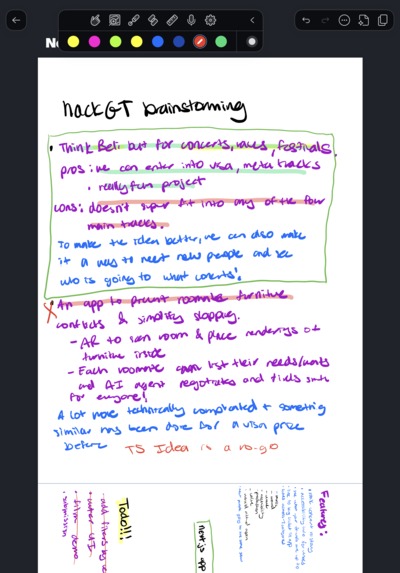
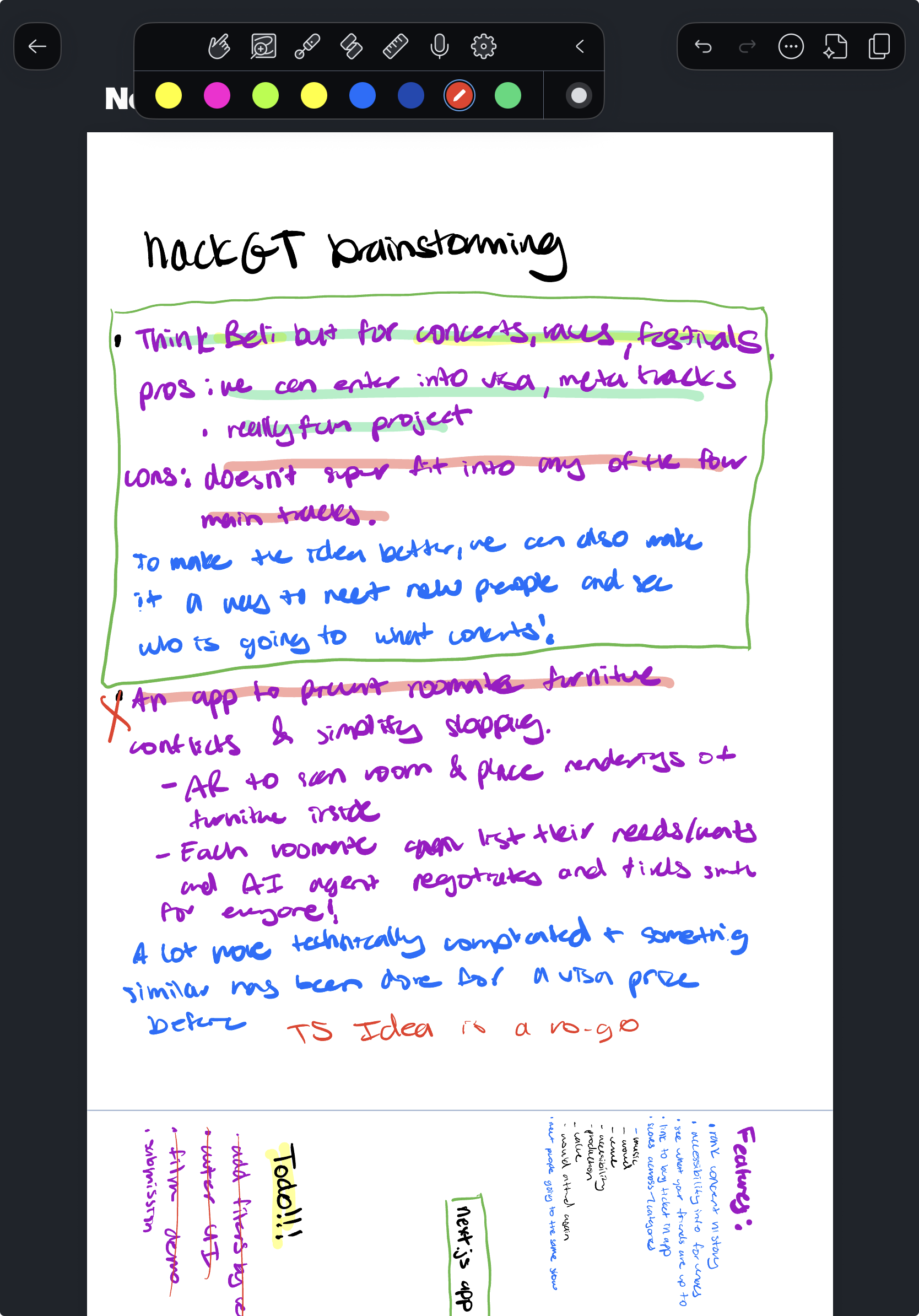
brainstorming with notability!
-
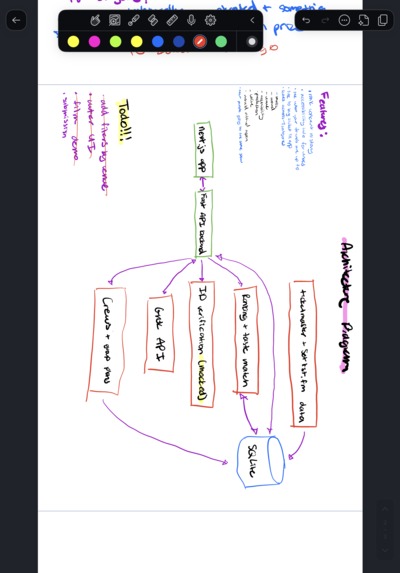
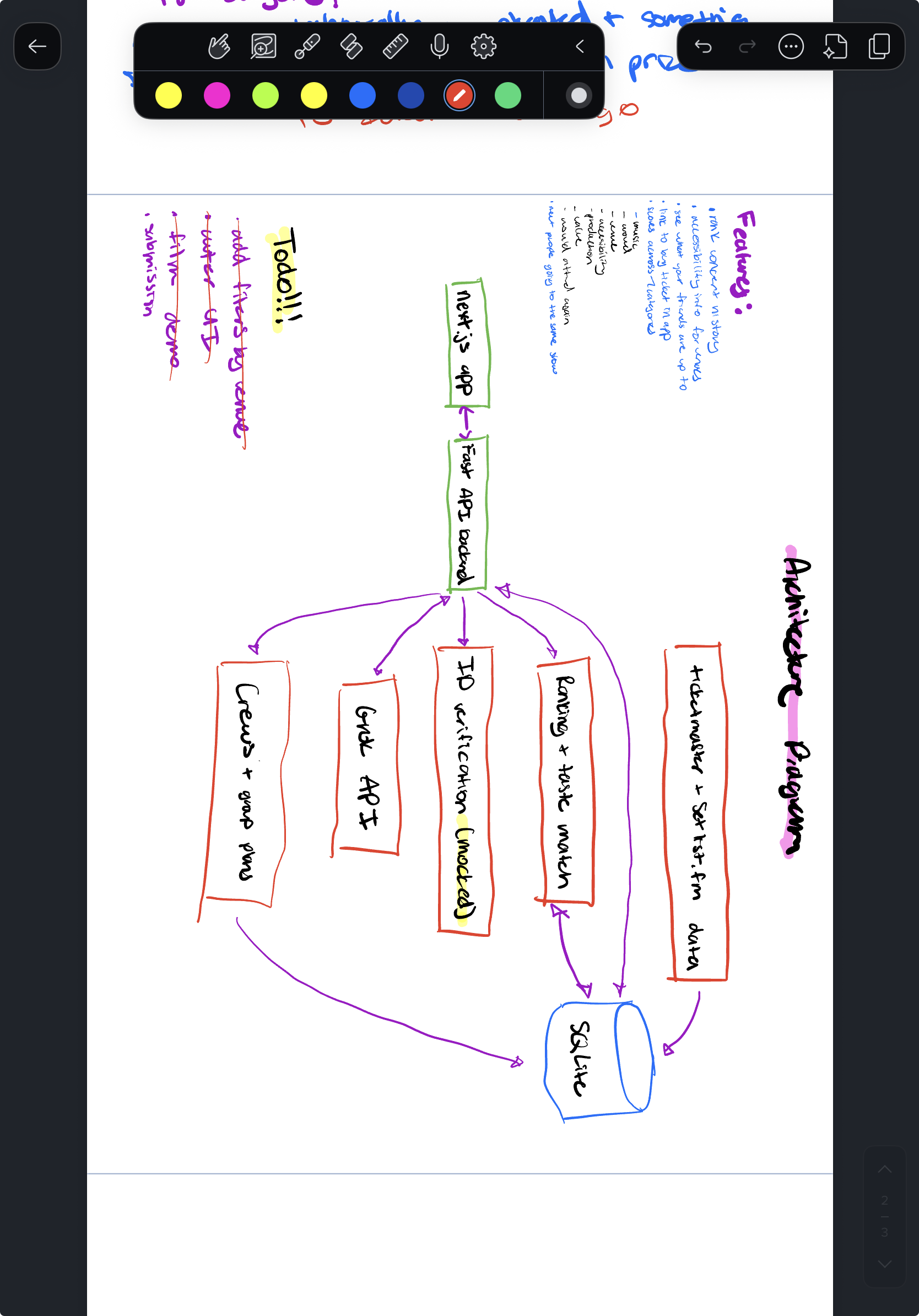
planning with notability!
Inspiration
Everyone remembers the best show they've ever seen, and nobody keeps track of the rest. Beli made eating social and competitive by making ranking the core loop; Bandsintown and Songkick only tell you what's coming. We wanted that loop for live music: log a show, rank it against your own history, see what your friends thought, and use that taste graph to find the right people to go with next.
What it does
- Log & rank: search a show (or add one that isn't listed), tap I went, rate seven dimensions (music, crowd, venue, accessibility, production, value, would‑again), then answer a few "better or worse than…?" questions. Shows land in a tiered ranking and the app learns what you actually care about.
- For you: upcoming shows scored by friends going (weighted by taste match), verified fans like you, artists and venues you've seen, related artists and genre, with the reasons shown.
- Real shows and prices: 422 upcoming shows at seven Atlanta venues scraped from the venues' own sites, ~550 real past shows, direct Ticketmaster/AXS/Eventbrite links, live resale price comparison.
- Fans like you: verified people within two hops with a taste match, an explanation and an icebreaker (behind ID verification) because it connects strangers.
- Crews: group chat per show and a one‑tap plan that respects everyone's budget and accessibility needs.
- Moments: photos and videos attached to shows, shared with followers, in a home feed.
How we built it
- Next.js 14 + Tailwind + Recharts in a phone frame; FastAPI + SQLite; NumPy/SciPy for the ML.
- Ranking is a multi‑dimensional Bayesian Bradley–Terry model with a particle posterior over preference weights and information‑gain pair selection; taste match is Spearman‑on‑shared‑shows blended with cosine similarity of weights; the planner maximizes total fit minus variance under budget/access constraints.
- Data comes from keyless scrapers of venue websites (Live Nation JSON‑LD, the AEG calendar feed, WordPress cards) plus Wayback Machine replays for history, MusicBrainz + Deezer for genres/related artists/pictures, Gametime + Eventbrite for prices, Nominatim for geocoding.
- Grok writes match explanations and crew plans through an OpenAI‑compatible client with a 6‑second cap and deterministic fallbacks. The seed is byte‑identical every run and the demo path is a test.
Challenges we ran into
- Every ticketing site blocks servers (Ticketmaster 401; AXS, SeatGeek, StubHub 403), so prices had to come from the few sources that publish them, with keyed adapters ready for the rest.
- No venue publishes an archive and setlist.fm/Songkick block scraping; we replayed Wayback Machine snapshots through the same parsers and got rate‑limited doing it.
- Photo‑based show detection (EXIF time + GPS → show) was unreliable without complete past‑show data, so we removed it rather than ship something flaky.
- Keeping a scraped, deterministic, tested seed
Accomplishments that we're proud of
- Real data and ranking model that visibly learns from three taps; a taste match that surfaces sensible strangers
- A full social loop (follow → moments → fans like you → crew → plan)
What we learned
- Scraping and data reliability is a bigger problem than the model. We spent far more time getting trustworthy event and price data than we did building the ranking or matching logic. Every venue site has its own quirks, ticket prices for the same show vary across Ticketmaster, AXS, SeatGeek, and the venue's own page, and past setlist data is inconsistent or missing entirely
- Designing a pleasant, seamless UX was one of the hardest parts. Ranking shows with Bradley–Terry and info-gain pair selection was a solved problem once we sat down and wrote it. But making the ranking process actually feel fast and fun to a user tapping through comparisons on a phone
What's next for Encore
Reliable photo‑based logging (detecting the show and venue from photo metadata) which needs a complete history of past shows. We couldn't scrape venue archives reliably, and setlist.fm access fixes that. Then more cities via venue adapters or Ticketmaster's city feed, hosted media storage, and a real identity provider behind the existing verification interface.


Log in or sign up for Devpost to join the conversation.