-
-
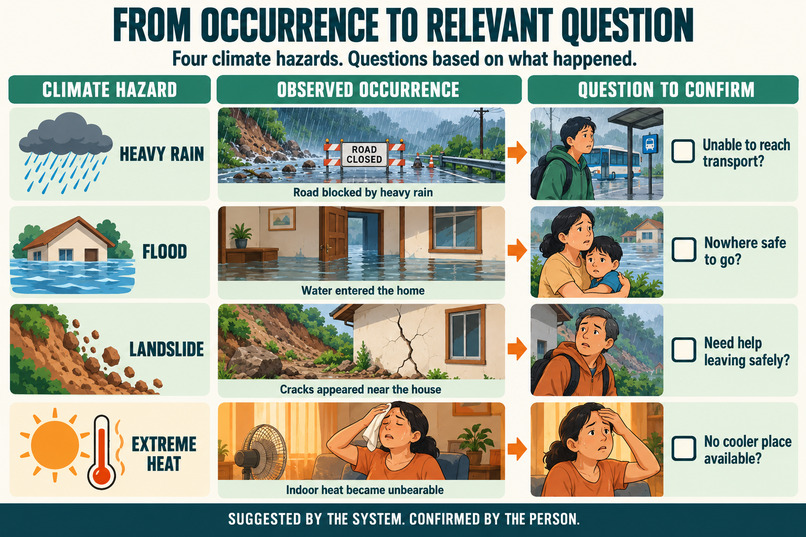
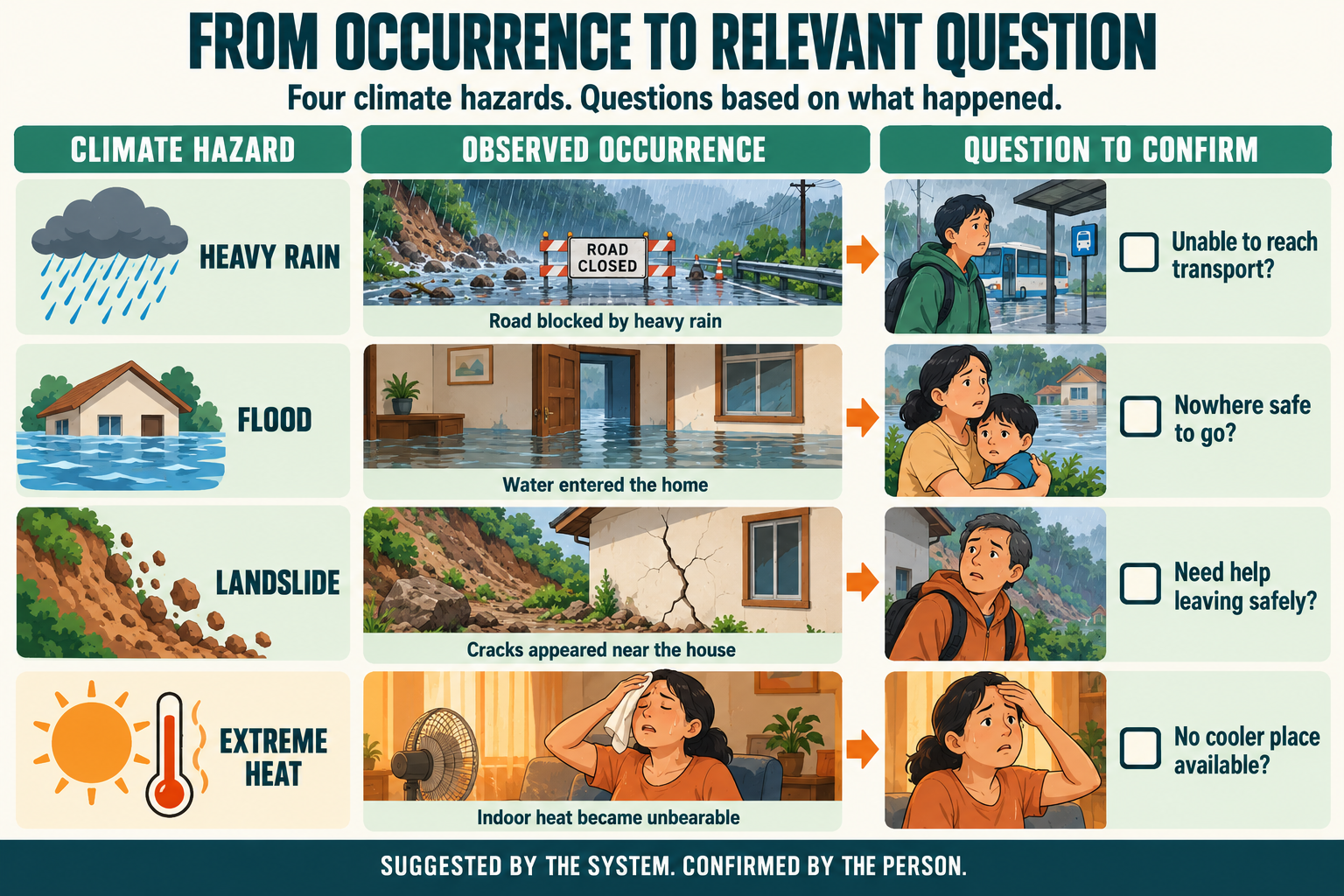
From occcurence to relevant question
-
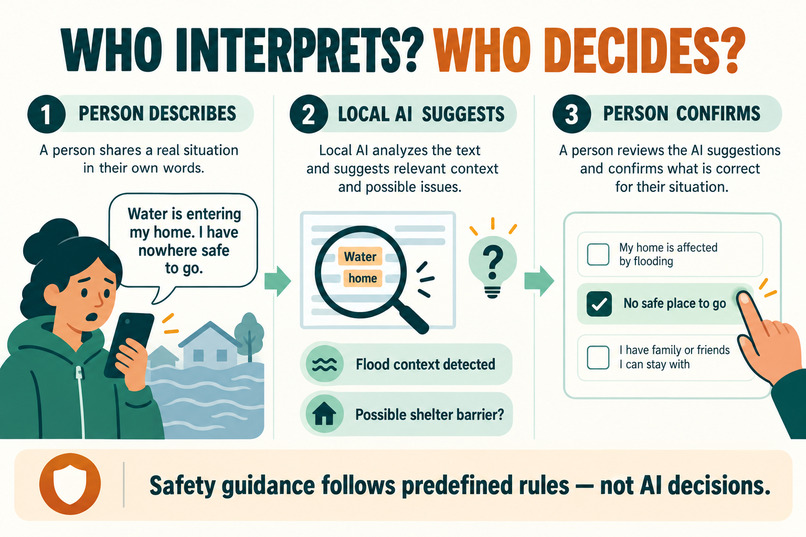
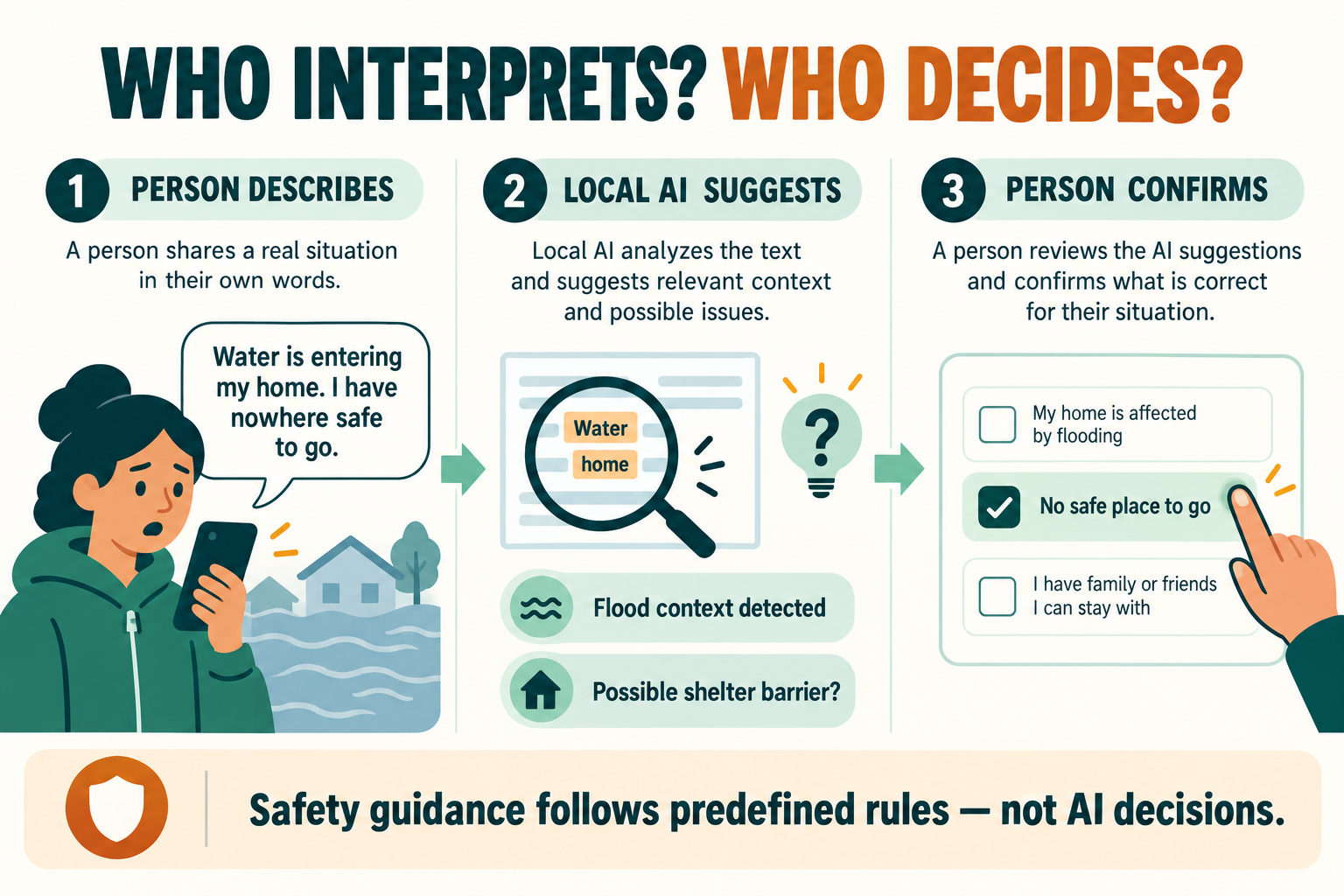
who interprets? who decides?
-
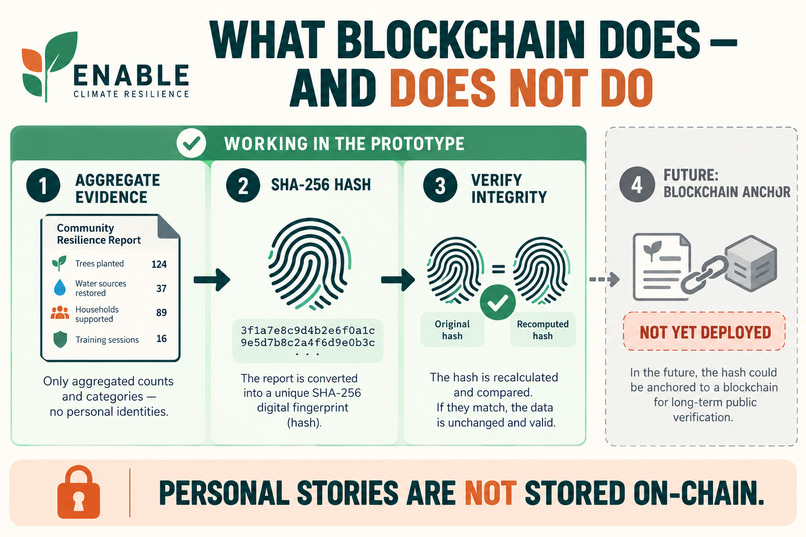
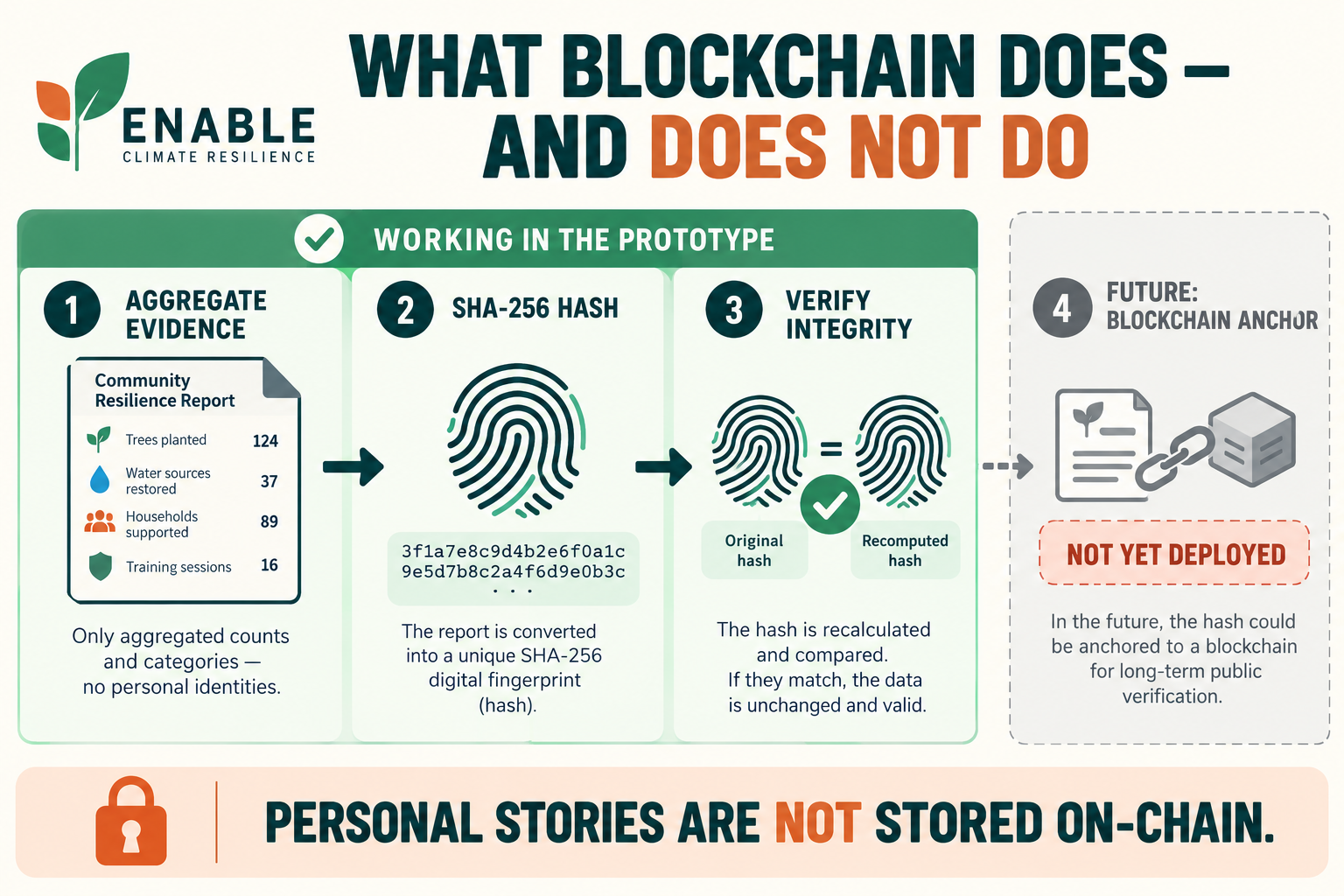
What blockchain does and does not do
-
Enable climate resilience
-
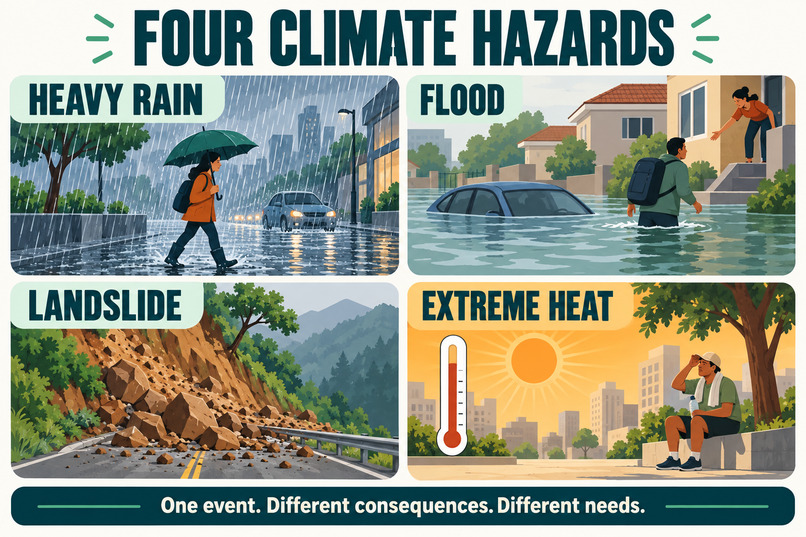
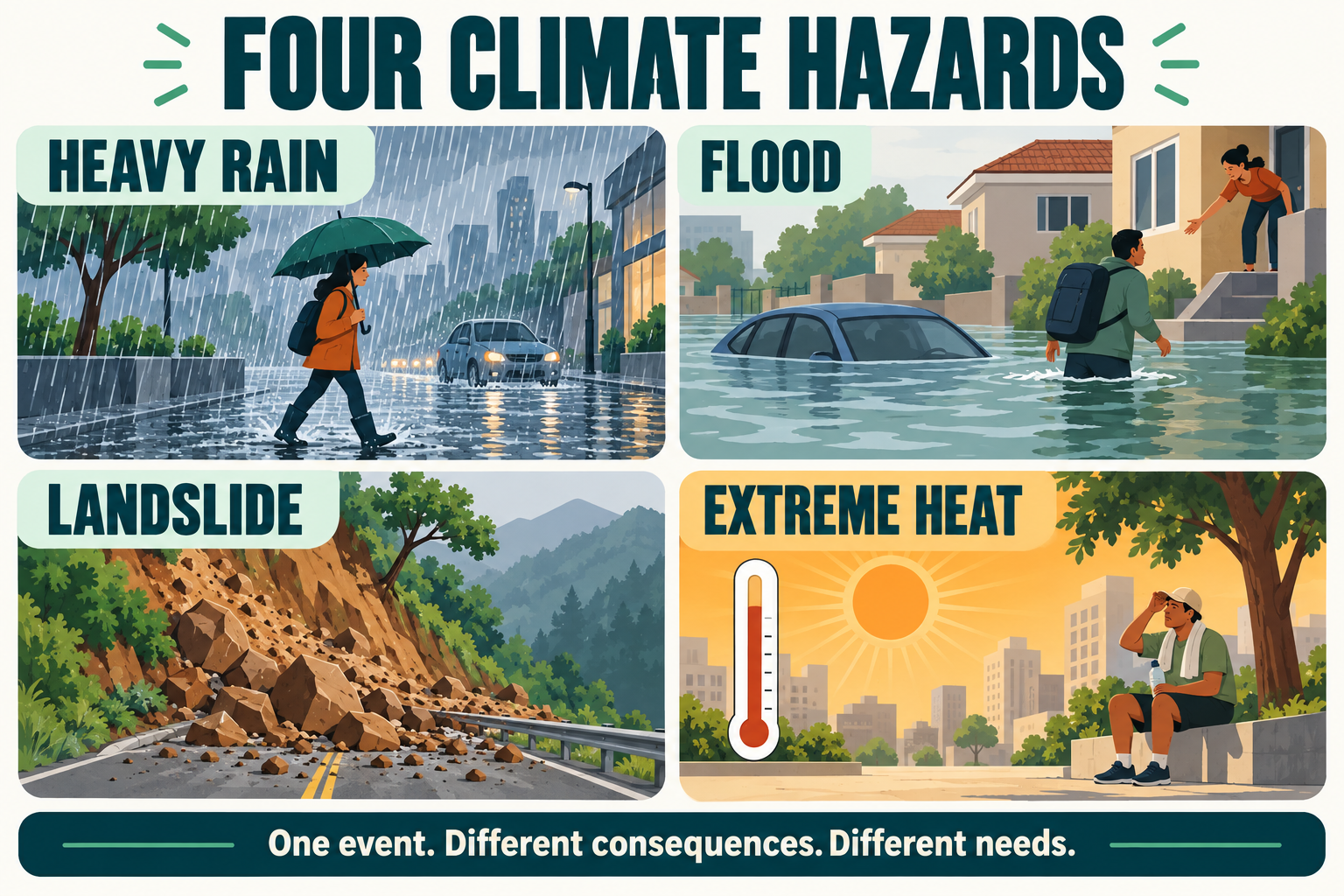
Four climate hazards
-
Enable Climate Resilience
Inspiration
A warning is only useful when people can act on it.
Climate emergencies reveal a critical gap between receiving an alert and being able to take protective action. A person may know that floodwater is rising but have nowhere safe to go. Someone facing a landslide threat may be unable to leave because they care for a family member with limited mobility.
We created ENABLE to address a question that conventional warning systems do not always answer:
What prevents someone from protecting themselves during a climate emergency?
Our guiding principle is simple: Climate resilience starts with people.
What it does
ENABLE is a human-centered web application designed to identify barriers to personal protection during four climate-related hazards:
- Heavy rainfall
- Flooding
- Landslides
- Extreme heat
Users can identify what is happening through simple, accessible options or describe their situation in their own words.
The application:
- Recognizes the selected hazard and reported occurrence.
- Displays prominent safety notices for predefined dangerous situations.
- Identifies protection barriers directly related to the situation.
- Uses experimental AI to suggest relevant barriers from optional written accounts.
- Allows users to confirm which difficulties actually apply.
- Demonstrates how aggregated information could support transparent climate-resilience planning.
ENABLE is a research prototype. It does not replace official warnings or dispatch emergency services.
How we built it
We developed ENABLE as a lightweight, self-contained web application using HTML, CSS, and JavaScript, without requiring installation or user registration.
The system combines three components:
1. Human-centered interaction
A simplified interface that minimizes unnecessary questions and adapts the available options to the selected situation.
2. AI-assisted interpretation
A local text-classification approach combining curated vocabulary, TF-IDF representations, and nearest-neighbour classification.
The experimental dataset includes 120 authored synthetic examples, with 96 used for development and 24 reserved for evaluation.
AI suggestions require user confirmation.
3. Evidence integrity
Generation and local SHA-256 verification of synthetic aggregate records, complemented by a Solidity smart contract designed for future blockchain anchoring.
Emergency safety notices follow predefined rules and remain separate from experimental AI predictions.
The blockchain contract has been developed but has not yet been deployed.
Challenges we ran into
Our greatest challenge was creating an application for people who may be frightened, overwhelmed, or facing serious difficulties.
Early interface iterations revealed that presenting too many possible barriers could introduce irrelevant questions. We therefore redesigned the interaction to prioritize contextually related options and reduce cognitive burden.
Another challenge was developing AI functionality with limited training data while avoiding misleading conclusions.
We addressed this by maintaining transparent model limitations, requiring user confirmation, and keeping emergency notices independent of machine-learning outputs.
Finally, we had to reconcile evidence traceability with privacy. Our proposed blockchain architecture records cryptographic fingerprints rather than personal narratives.
Accomplishments that we're proud of
- Developed and publicly deployed an interactive, browser-based prototype.
- Implemented four climate-hazard scenarios and 33 observable occurrence options.
- Created prominent safety notices for predefined urgent situations.
- Implemented context-sensitive identification of barriers to protection.
- Integrated experimental natural-language interpretation with user confirmation.
- Tested the application's main interaction paths, including written reports and emergency notices.
- Implemented local SHA-256 evidence generation and integrity verification.
- Developed a Solidity evidence-registry contract for future blockchain integration.
Try ENABLE:
Launch the interactive demonstration
What we learned
Receiving information and being able to act are fundamentally different challenges.
We also learned that accessible design is not simply about using larger buttons or shorter sentences. It requires asking relevant questions at the right moment.
Our development reinforced three principles:
- Less is more: every unnecessary question increases the burden on someone facing an emergency.
- AI should support, not replace, human judgment: suggested barriers must remain transparent and confirmable.
- Trust requires accountability: safety rules, personal information, and evidence-integrity mechanisms must have clearly defined responsibilities.
What's next for ENABLE
Our next steps are to:
- Conduct usability evaluations with diverse users, including people with disabilities and limited digital literacy.
- Expand and validate language models using appropriately sourced real-world narratives.
- Evaluate linguistic and regional differences across Brazil.
- Review emergency guidance with qualified disaster-risk professionals.
- Deploy the evidence-registry contract on a blockchain test network and publish verifiable transaction records.
- Explore partnerships with civil protection organizations and communities.
Our long-term vision is to help make barriers to climate protection more visible, understandable, and actionable.
ENABLE — Because climate resilience starts with people.## Inspiration
Built With
- css3
- html5
- javascript
- k-nearest-neighbors
- machine-learning
- natural-language-processing
- sha-256
- tf-idf
- web-crypto-api

Log in or sign up for Devpost to join the conversation.