Inspiration
The rapid advancement of AI has made it easier than ever to generate highly realistic content, from deepfake videos to sophisticated phishing messages. As a result, users are increasingly exposed to digital deception at scale, where even experienced individuals struggle to distinguish between authentic and manipulated content.
We observed that most existing solutions are either reactive (after damage is done) or limited to a single type of threat. There is a clear gap for a system that works in real time, across multiple content types, and directly within the user’s browsing experience. This led us to build EmpowerNet—a platform designed to act as a trust layer for the modern internet, helping users verify content at the exact moment they interact with it.
What it does
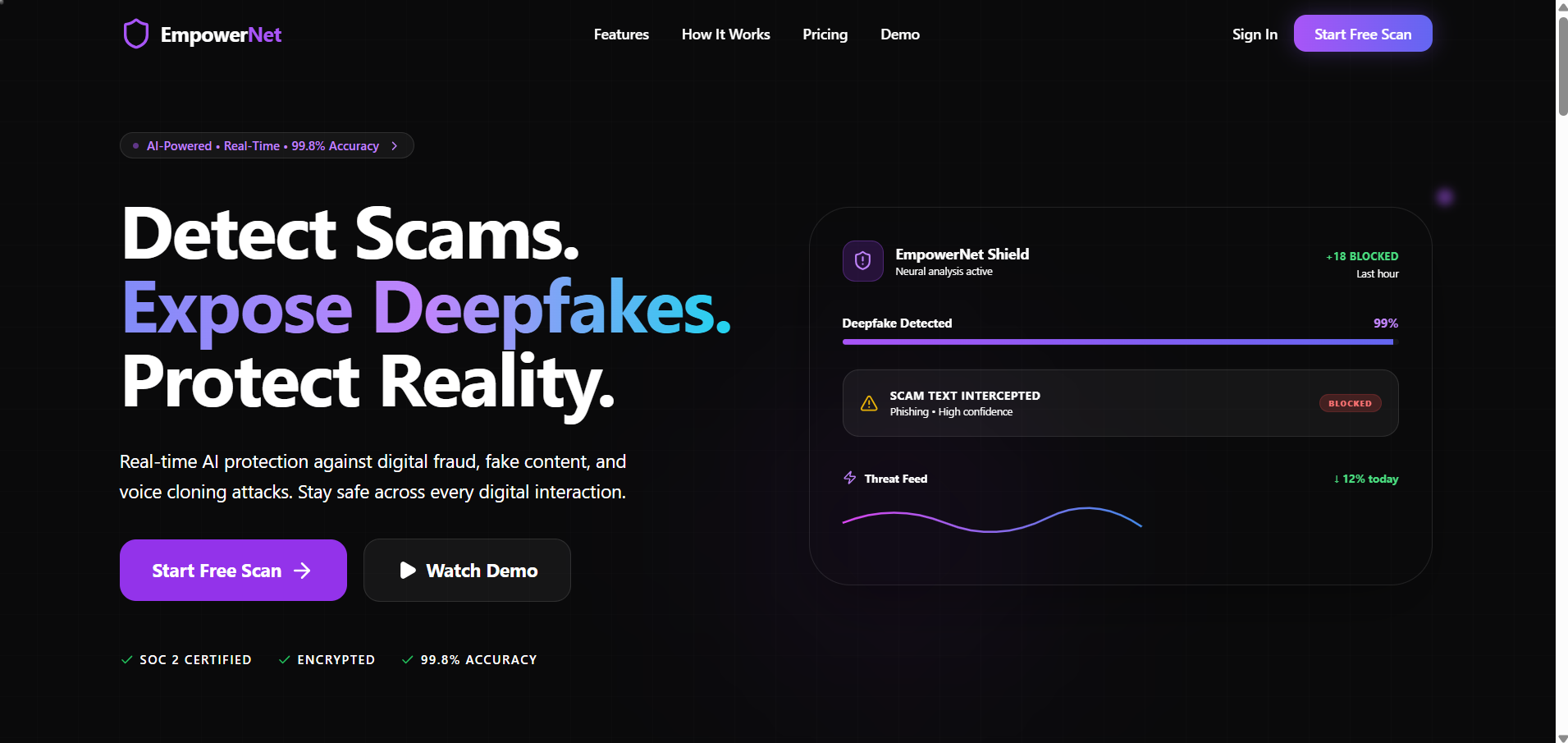
EmpowerNet is a real-time digital trust platform that detects scams and deepfakes across text, images, audio, and video. It leverages a combination of AI models and forensic techniques to analyze content and generate a unified risk score (0–100) along with detailed, human-readable explanations.
Instead of simply flagging content, EmpowerNet explains why something is suspicious—whether it's phishing intent in text, visual inconsistencies in images, synthetic patterns in audio, or temporal artifacts in video. This ensures users are not only protected but also educated and aware.
The system is designed to integrate seamlessly into everyday workflows through a browser-based interface, enabling real-time protection without requiring technical expertise.
How we built it
EmpowerNet is built as a multi-modal AI pipeline, where each content type is analyzed through a dedicated processing system:
Text Analysis:
Uses transformer-based NLP models to detect phishing, fraud intent, coercion, harassment, and social engineering. This is enhanced by a heuristic risk engine that identifies urgency cues, financial pressure, authority impersonation, and emotional manipulation patterns.Image Analysis:
Combines deep learning models with forensic techniques. Face detection and alignment are used alongside deepfake artifact detection to identify inconsistencies such as unnatural textures, blending errors, and edited regions. OCR is also used to extract embedded text for additional scam analysis.Audio Analysis:
Applies signal processing techniques such as MFCC and spectral feature analysis to detect anomalies in speech. These methods help identify synthetic voice patterns by analyzing frequency distributions and missing human micro-variations.Video Analysis:
Performs frame-level analysis combined with temporal consistency checks. It detects flickering artifacts, facial instability, and lighting inconsistencies across frames to identify deepfake content.
All these pipelines feed into a centralized scoring engine, which aggregates results into a unified risk score and provides explainable outputs via an API and user interface.
Challenges we ran into
One of the biggest challenges was orchestrating multiple heavy AI models efficiently, especially under limited computational resources. Running text, image, audio, and video pipelines simultaneously required careful optimization and smart resource management.
Another challenge was maintaining real-time performance without sacrificing accuracy, as detection systems often involve trade-offs between speed and precision.
Additionally, designing an explainable output system was non-trivial. We had to ensure that complex AI and forensic results could be translated into clear, actionable insights for non-technical users.
Accomplishments that we're proud of
- Successfully built a multi-modal detection system covering text, image, audio, and video
- Developed a unified explainable risk scoring system (0–100)
- Integrated AI models with forensic techniques for higher reliability
- Achieved near real-time analysis capabilities
- Designed a system that balances technical depth with usability
- Created a functional prototype with practical real-world applications
What we learned
Through building EmpowerNet, we learned that accuracy alone is not enough in security systems—explainability is equally critical. Users need to understand why something is flagged in order to trust the system.
We also learned how to effectively combine machine learning with traditional forensic approaches, improving detection robustness.
Additionally, working on this project helped us understand the importance of system optimization, modular architecture, and user-centric design, especially when dealing with real-time, multi-modal data processing.
What's next for EmpowerNet – Real-Time Digital Trust Platform
Our next focus is to improve model accuracy, scalability, and performance, particularly for real-world deployment. We aim to refine the browser extension experience to make detection seamless across platforms.
We also plan to expand detection capabilities, enhance the explainability layer, and explore integrations with platforms that require content verification and fraud prevention.
In the long term, our vision is to establish EmpowerNet as a widely adopted trust layer for the internet, enabling users and platforms to navigate digital interactions with confidence and security.

Log in or sign up for Devpost to join the conversation.