Inspiration
Every morning across cities and towns, millions of daily-wage laborers (Dihaari workers) and skilled tradespeople—masons (Rajmistri), electricians, plumbers, carpenters, painters, and construction helpers—stand for two to three hours at local labor hubs (Labor Chowks or Nakas) hoping to be hired for the day. If they don't find work by 10:00 AM, they lose an entire day's income. Worse still, those who rely on informal middlemen (thekedars or brokers) often surrender 15% to 25% of their hard-earned daily wages in commissions.
At the same time, homeowners and local site contractors struggle to find verified, reliable tradespeople on short notice, often facing unpredictable pricing or end-of-day wage arguments. We built EMPOWERMENT to bridge this gap with an Uber-like hyperlocal platform that connects laborers and customers directly—protecting 100% of a worker's pay while guaranteeing fast, dispute-free hiring for households.
What it does
EMPOWERMENT functions as a real-time, location-aware marketplace for daily-wage and hourly labor:
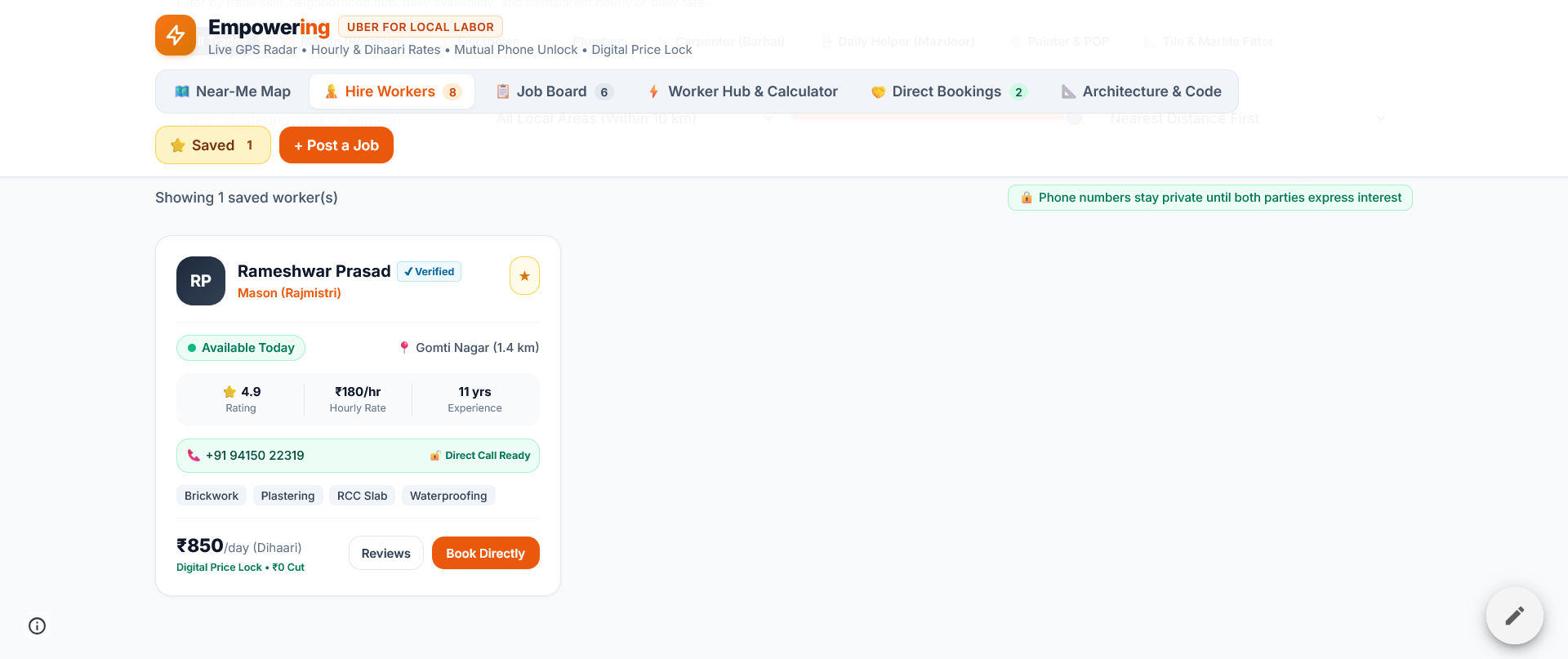
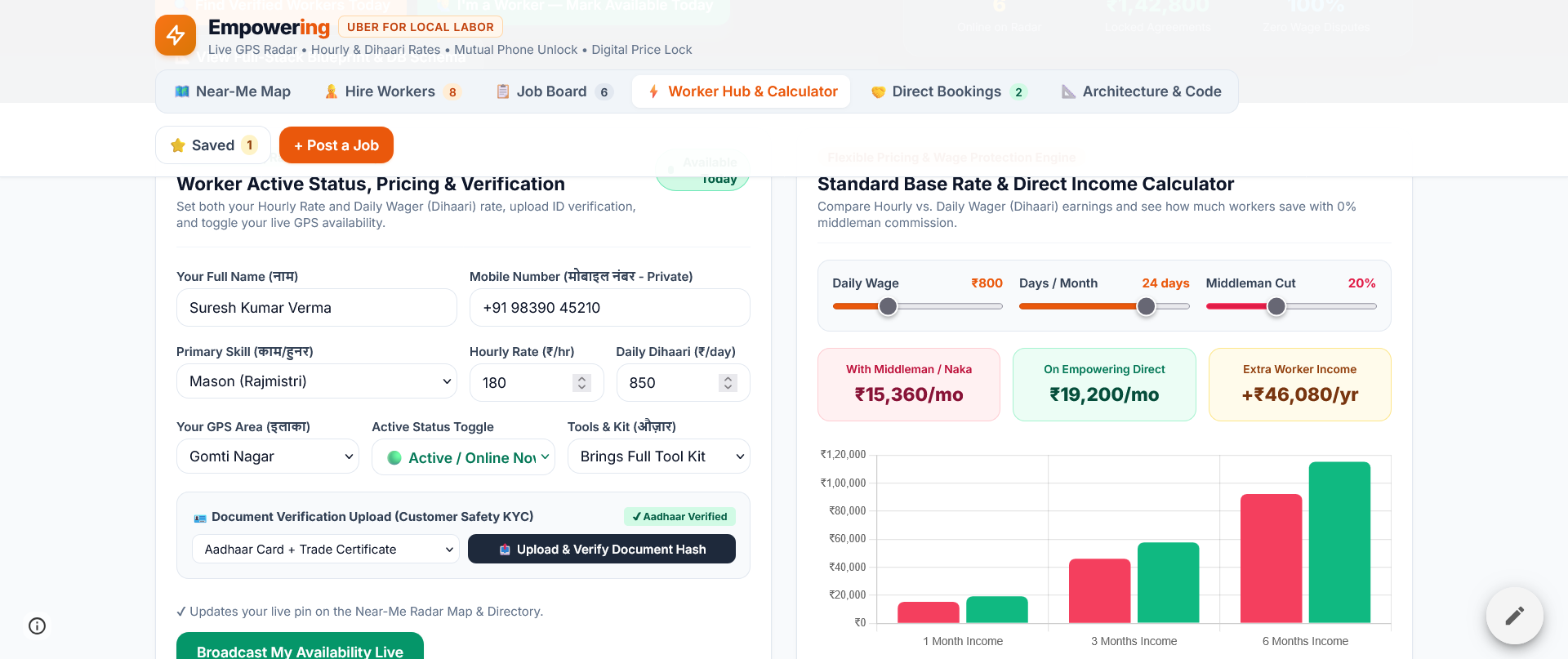
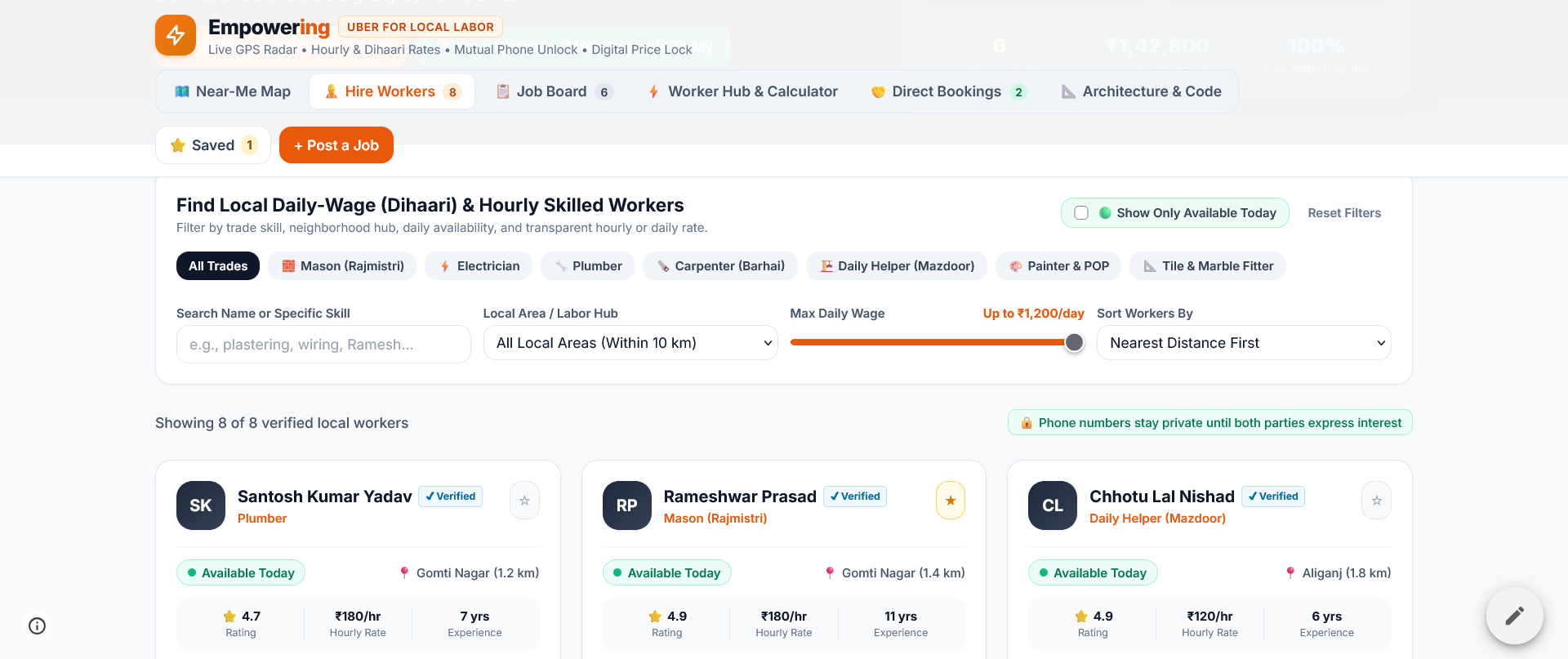
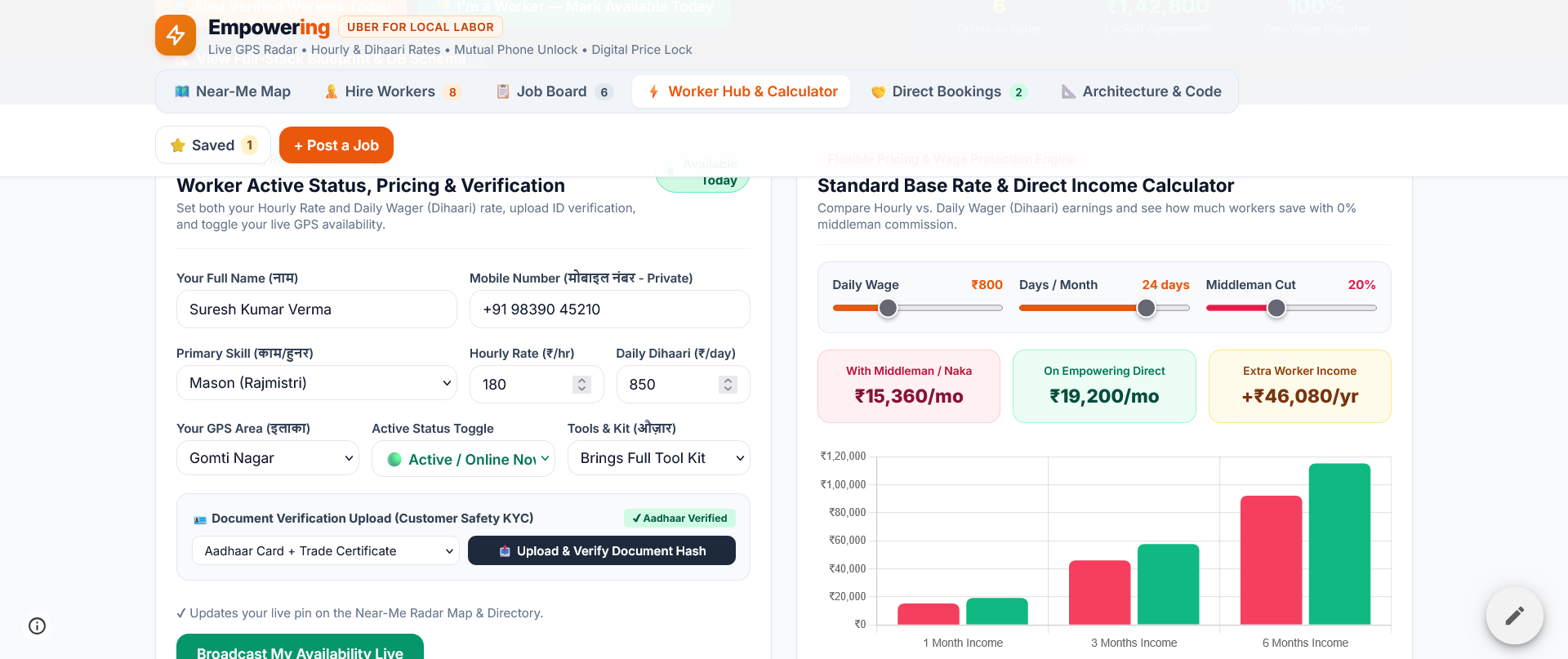
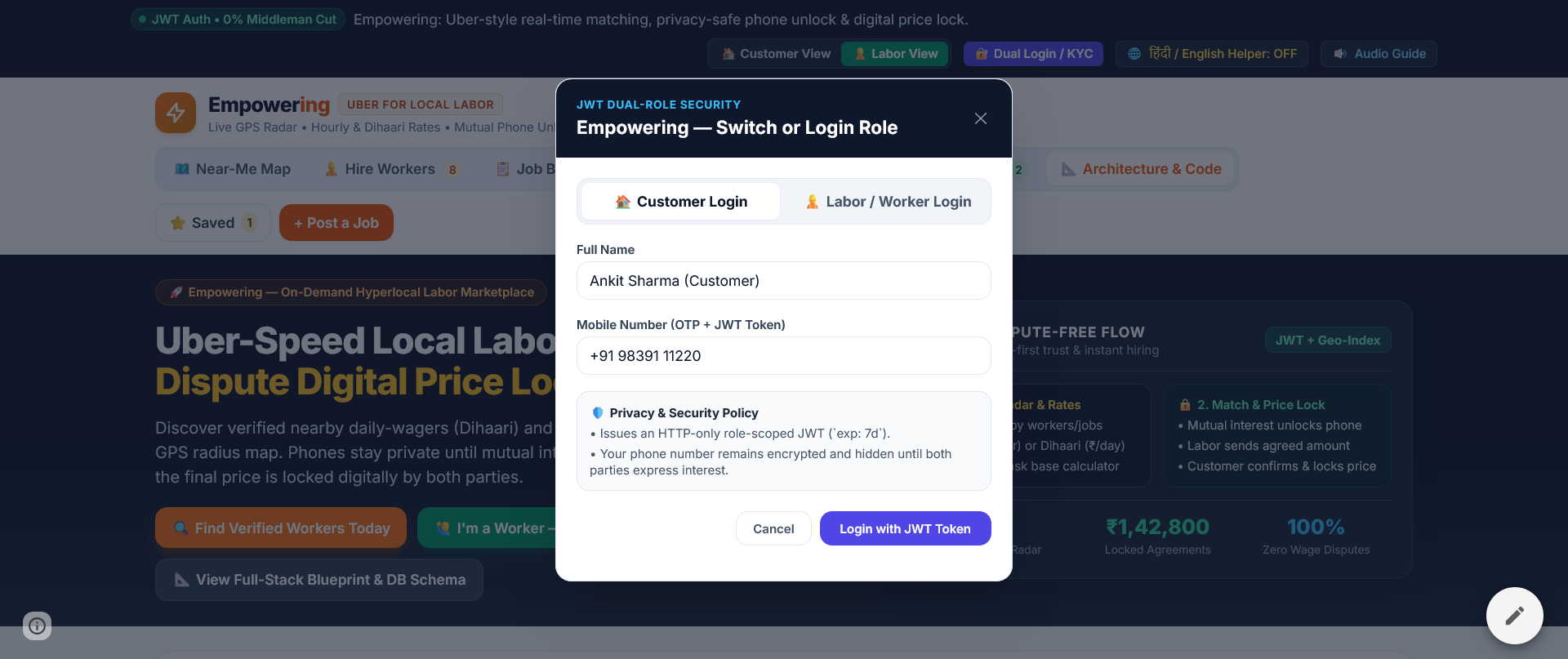
Provides Dual-Role Onboarding & Verification: Separates login workflows for Labors/Workers (who configure their trade skills, set both Hourly and Daily Dihaari rates, upload government ID documents like Aadhaar or e-Shram cards, and toggle their live availability from home) and Customers (who search nearby workers or broadcast geo-tagged job posts).

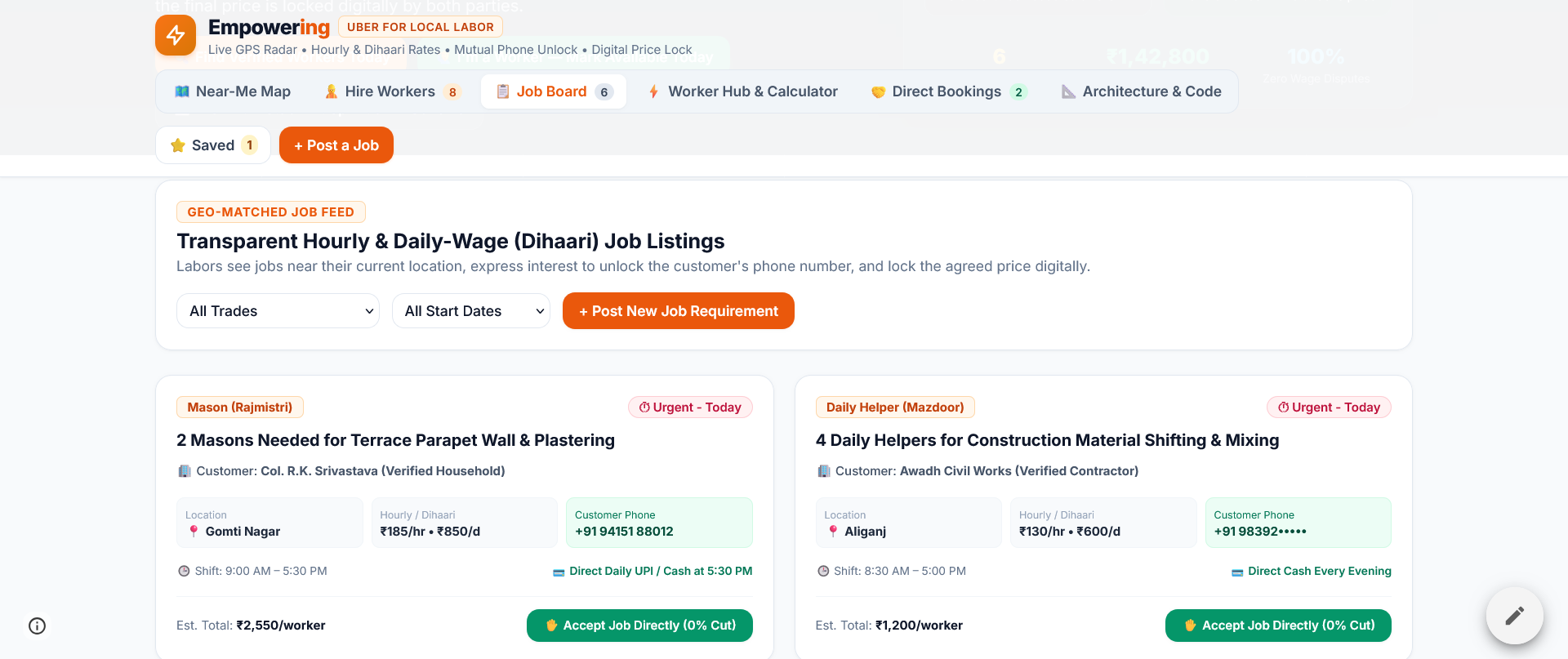
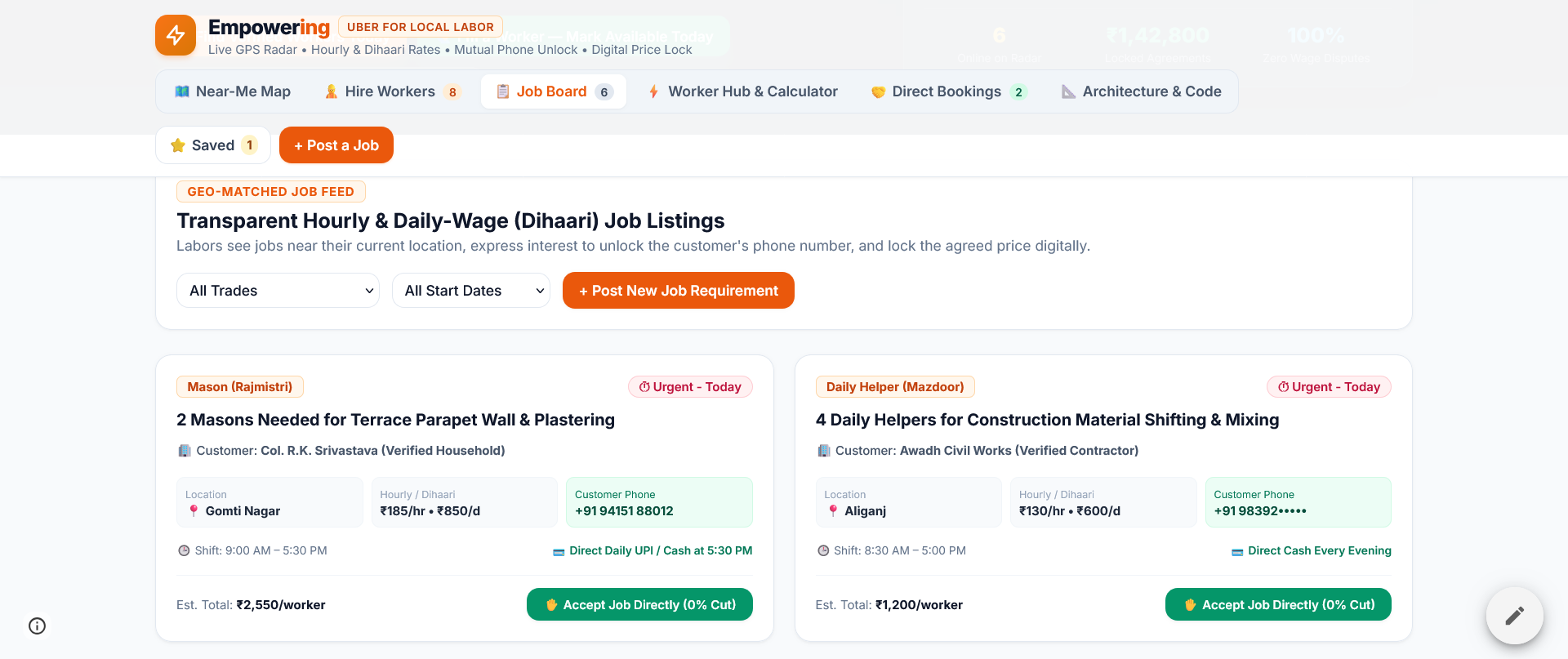
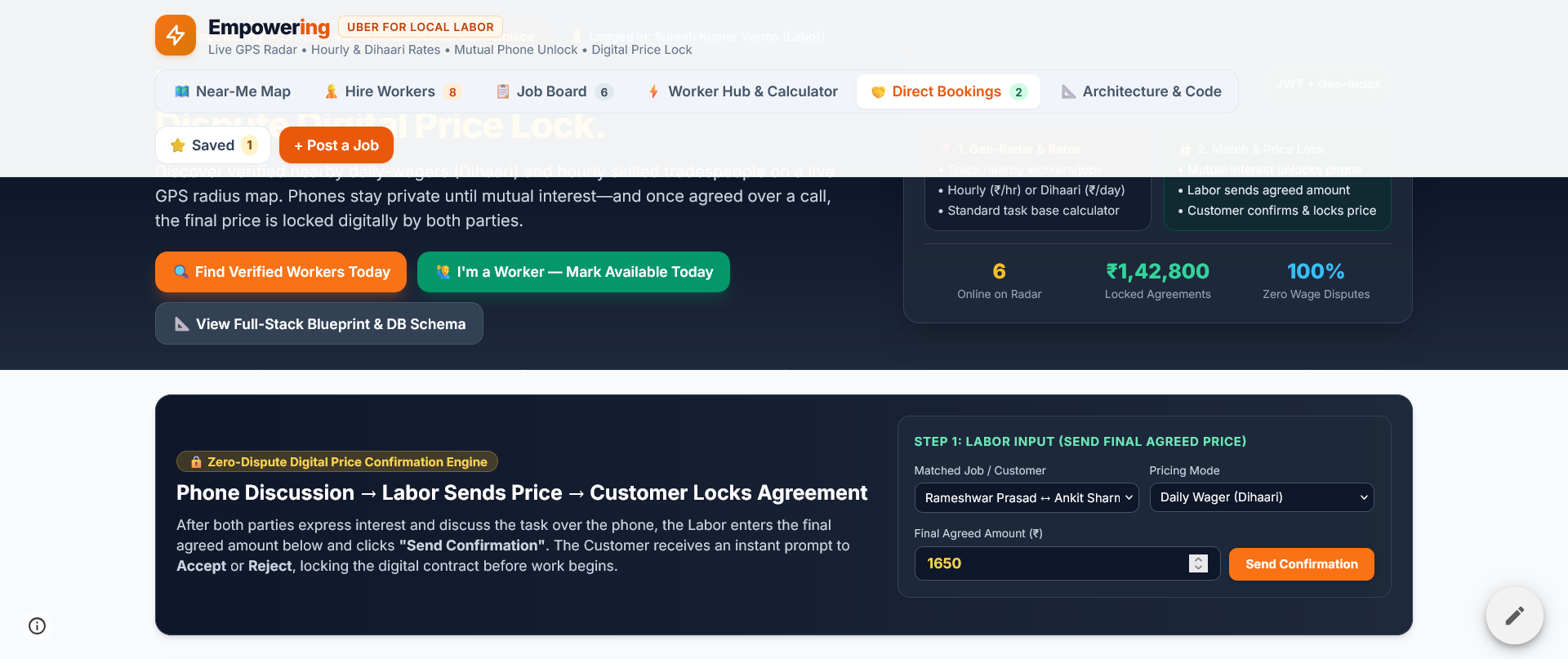
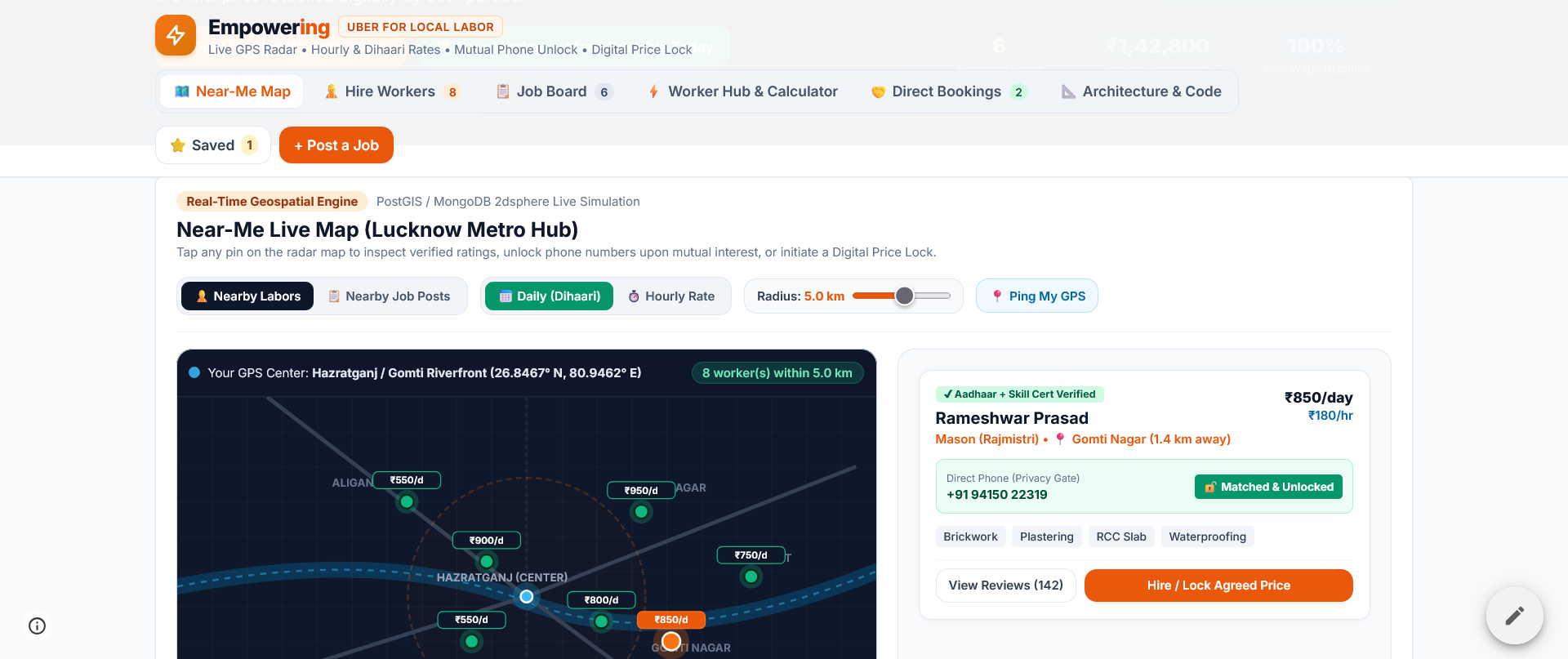
Powers an Uber-Style Near-Me Radar Map: Tracks real-time or last-known GPS coordinates within an adjustable kilometer radius so customers see available nearby tradespeople and workers see open job listings around their neighborhood.

Runs a Flexible Dual-Pricing Engine: Supports both Hourly Rates (₹/hr) for quick repairs and Daily Wager / Dihaari (₹/day) for full 8-hour shifts, paired with a Standard Base Rate Task Calculator and an interactive Middleman Savings Calculator showing how much extra income workers take home.

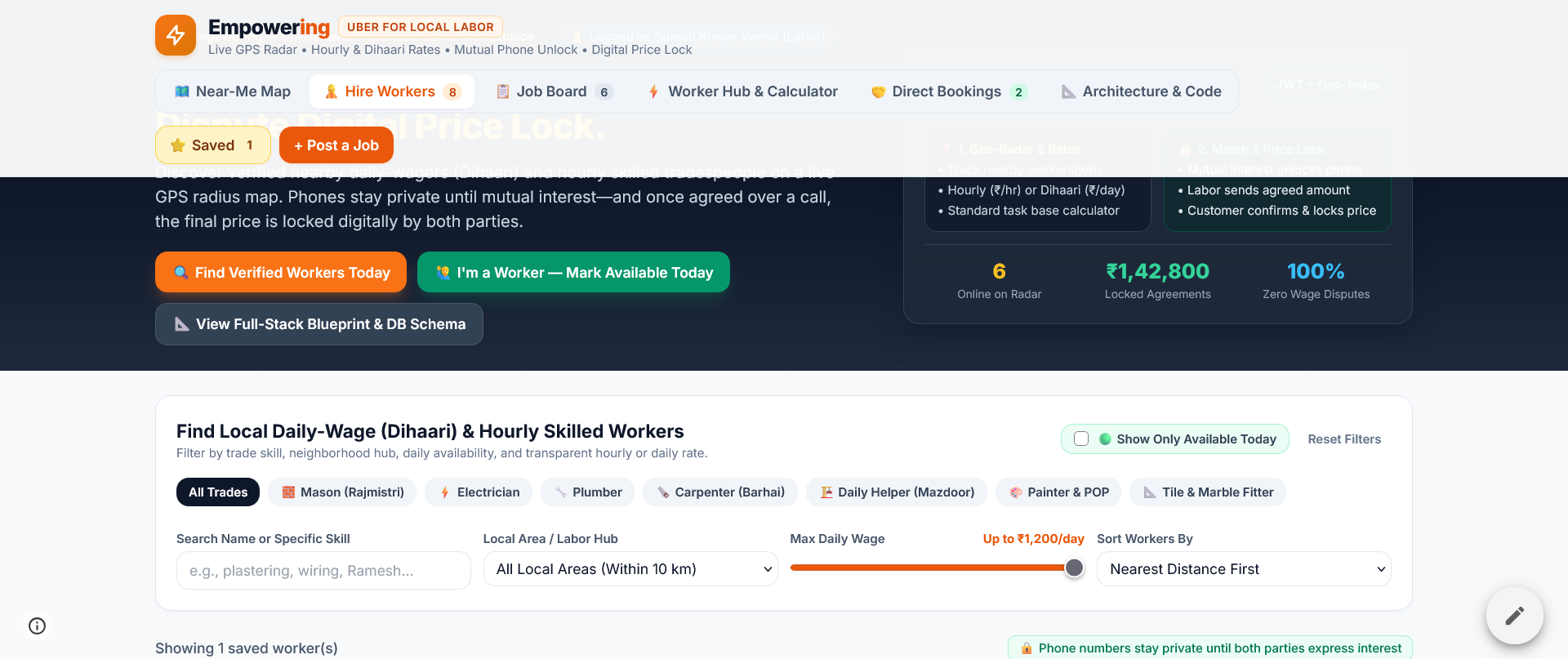
Protects Privacy Until Mutual Match: Masks both the worker's and customer's phone numbers (+91 98381 •••••) until both sides click Express Interest, unlocking direct phone numbers only after a mutual match so they can discuss job specifics over a call.

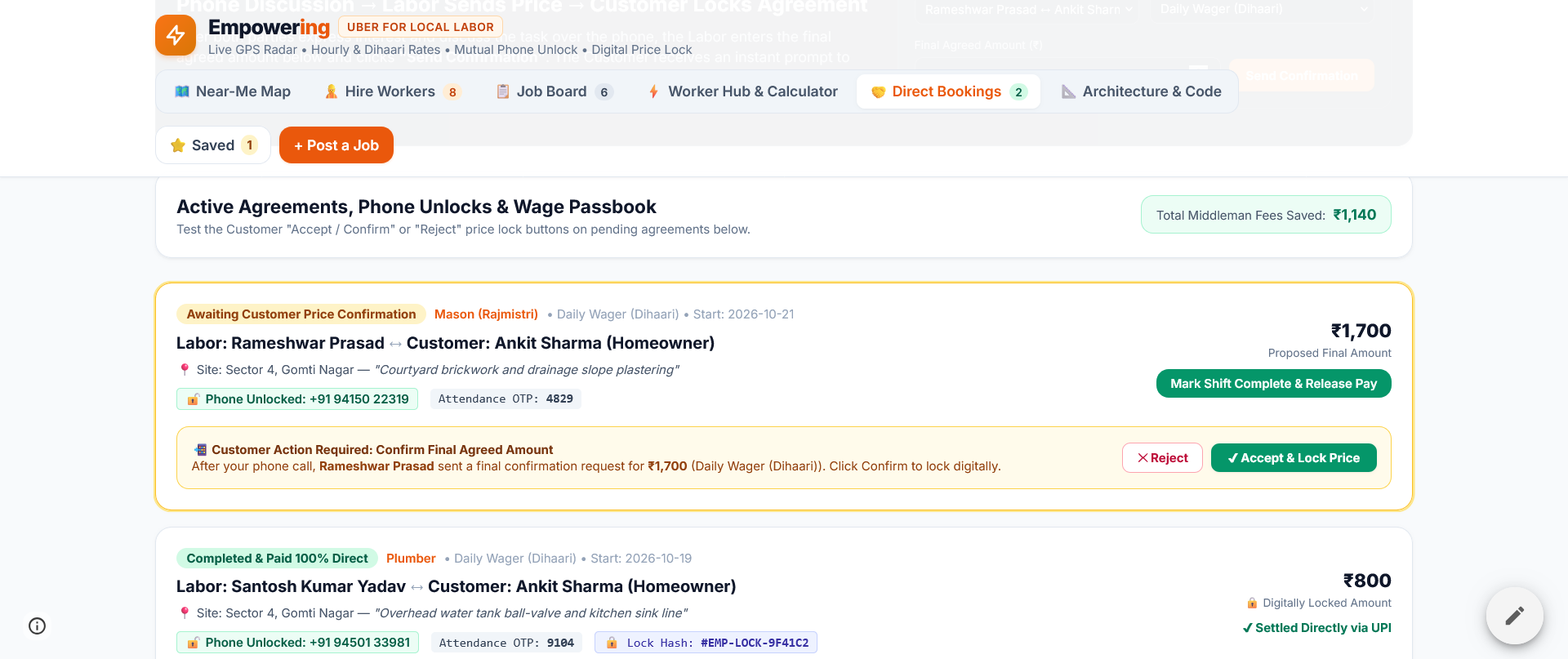
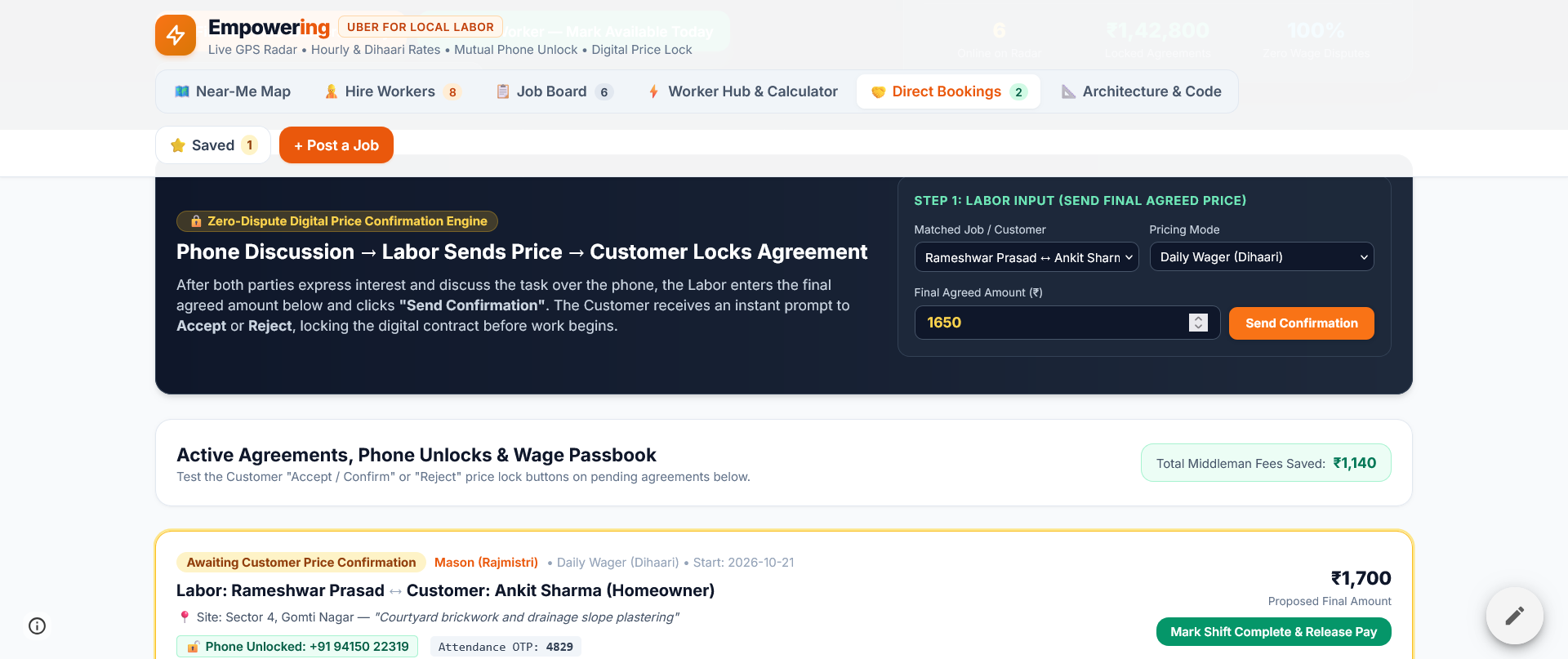
Enforces a Zero-Dispute Digital Price Lock: Eliminates end-of-shift payment arguments through a three-step handshake—after the phone discussion, the Labor enters the final agreed amount in the app and clicks Send Confirmation, the Customer receives an instant prompt to Accept or Reject that exact figure, and clicking Accept & Lock Price seals the agreement with a cryptographic hash (#EMP-LOCK) before work begins.

Supports Bilingual & Audio Accessibility: Includes a हिंदी / English Helper toggle and an Audio Guide voice readout to support workers with varying literacy levels.
How we built it
designed EMPOWERMENT around a mobile-first, real-time geospatial architecture:
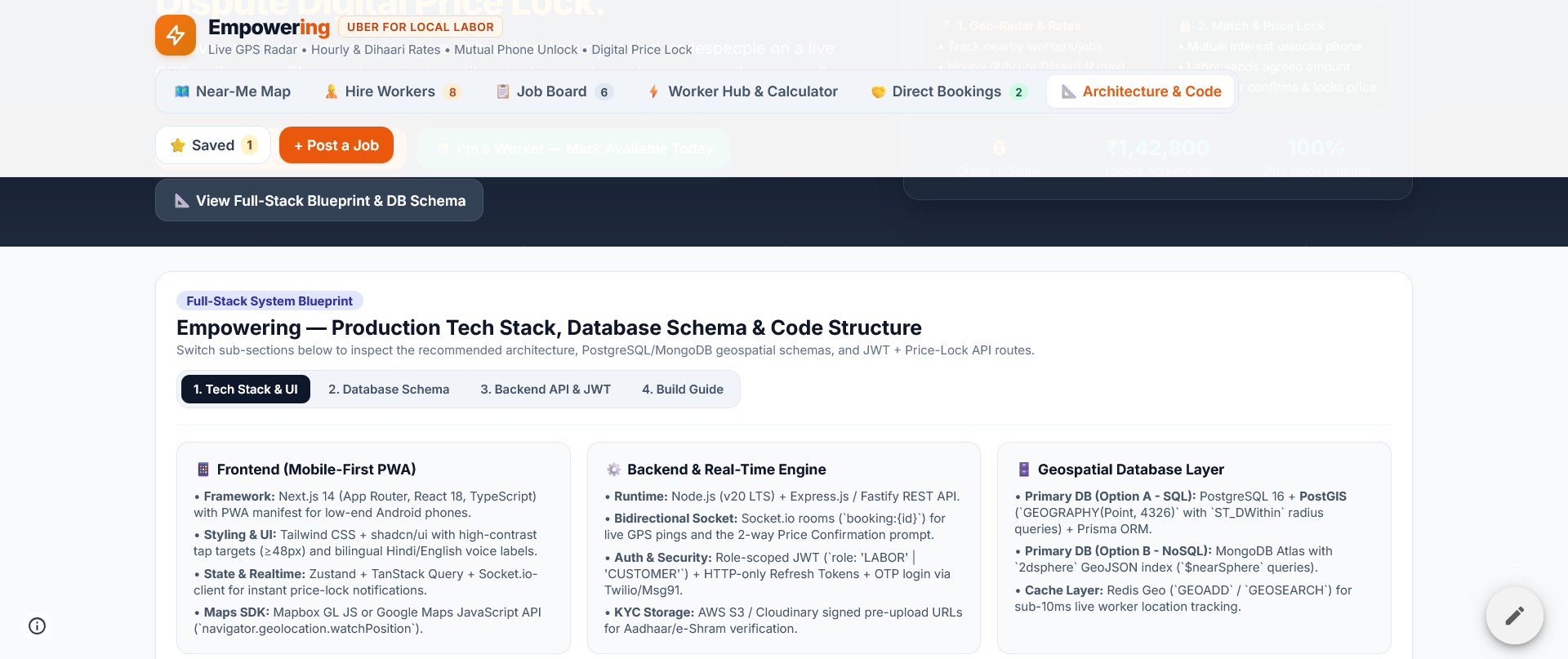
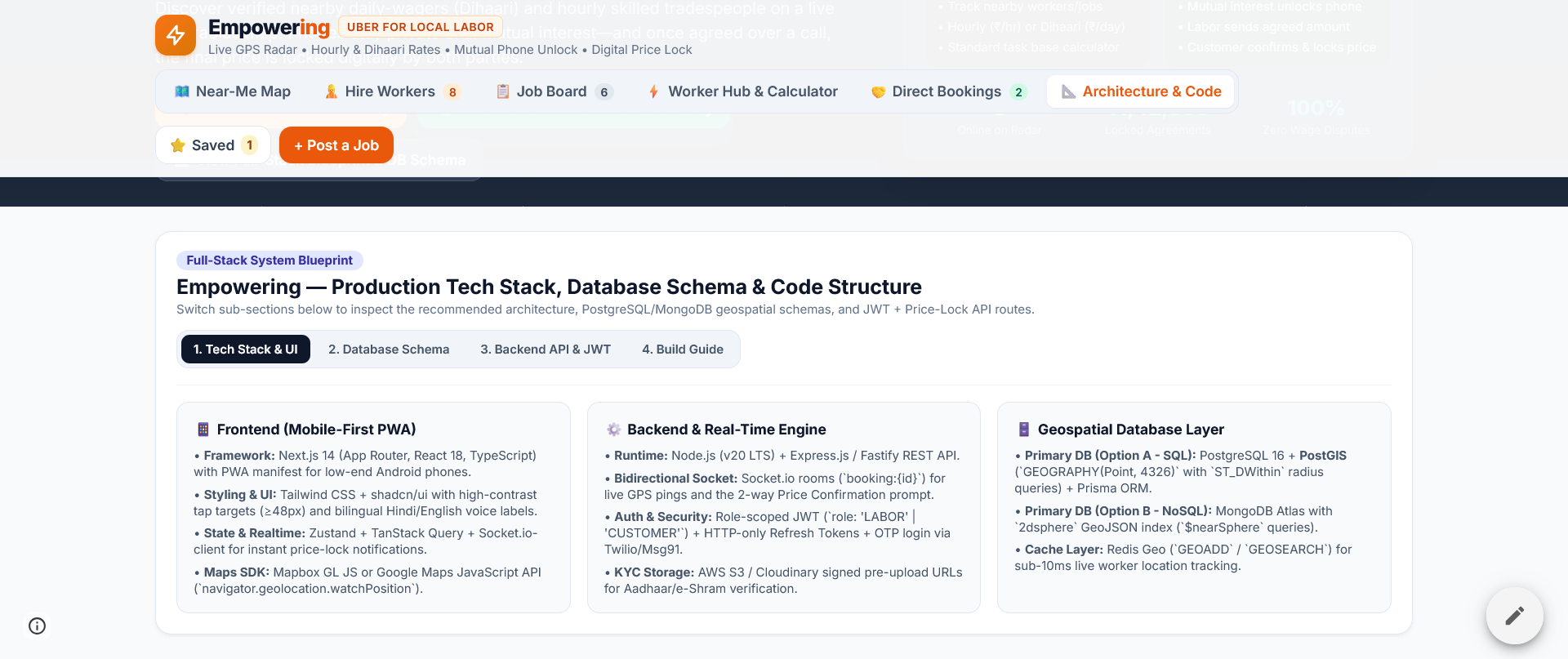
Frontend Layer: Built with a responsive, mobile-first interface using Next.js (React) and Tailwind CSS, featuring tap-friendly controls, an interactive SVG/Mapbox geospatial radar, and Chart.js for visualizing monthly and annual worker wage savings.
Backend & Real-Time Signaling: Architected on Node.js and Express.js for REST operations, paired with Socket.io rooms (agreement:{id}) to push live GPS coordinate pings, mutual-interest phone reveals, and real-time price-confirmation prompts between the worker's and customer's devices.
- Geospatial Database Layer: Modeled in PostgreSQL 16 + PostGIS using GEOGRAPHY(Point, 4326) columns, GIST spatial indexes, and ST_DWithin radius queries (alongside an alternative MongoDB 2dsphere schema) to locate nearby active workers in milliseconds.
Security & Trust Layer: Implemented role-scoped JWT authentication (LABOR vs. CUSTOMER), server-side phone masking serializers (is_phone_unlocked generated column), KYC document hashing, and SHA-256 digital lock signatures for confirmed wage agreements.
Challenges we ran into
Balancing Open Discovery with Phone Number Privacy: Displaying worker profiles on a public map while preventing spam calls or scraper harvesting required a strict state-gated serializer. We solved this at the database and API level using boolean flags (customer_interested and labor_interested) that compute a stored is_phone_unlocked field before any contact number leaves the server.
Preventing Post-Work Wage Disputes: Because construction and home-repair tasks vary in complexity once inspected over the phone, fixed catalog prices often fail in the real world. Designing the two-way Secure Price Confirmation System—where the worker proposes the final post-call price and the customer explicitly locks it—bridged the gap between verbal phone negotiation and a binding digital record.
Designing for Low-Literacy & Mobile-First Users: Many daily-wage laborers use entry-level smartphones in bright outdoor conditions. We prioritized high-contrast status pills, one-tap availability toggles, bilingual Hindi/English labels, and browser speech synthesis so workers can navigate without complex typing.
Accomplishments that we're proud of
Eliminating the Morning Labor-Hub Wait: Allowing a mason, plumber, or helper to broadcast live availability from home at 7:30 AM instead of standing unpaid at a Labor Chowk for hours.
Building the 3-Step Digital Price Lock: Creating a simple, tamper-evident price confirmation handshake that protects workers from underpayment and protects customers from surprise charges.
Delivering 100% Direct Take-Home Pay: Demonstrating through our live Wage Protection Calculator how removing a 20% broker cut on an ₹800/day wage puts over ₹46,000 per year back into a worker's household.
Combining Dual Pricing in One Flow: Seamlessly supporting both short hourly repair jobs and full-day Dihaari shifts within the same geospatial search and booking pipeline.
What we learned
Trust is a Two-Way Street in Informal Markets: Customers care most about identity verification, skill ratings, and upfront price certainty, while workers care most about guaranteed daily pay and zero middleman deductions.
Human Conversation Still Matters Before Locking Price: In skilled trades, a 60-second phone call is often the fastest way for a worker to understand the exact wall size, pipe leak, or wiring fault—so technology works best when it unlocks that call safely and then locks the resulting price digitally.
Spatial Indexing Drives Hyperlocal Speed: Using native database geospatial indexes (PostGIS GIST and MongoDB 2dsphere) keeps radius filtering fast without expensive application-side distance loops.
What's next for EMPOWERMENT
Voice-First IVR & WhatsApp Bot Check-In: Enabling workers without smartphones or mobile data to toggle their daily availability and accept jobs via a missed call or a voice-assisted WhatsApp bot in regional Indian languages (Hindi, Bhojpuri, Awadhi, Marathi, Tamil, and Bengali).
Instant Escrow & UPI AutoPay Settlement: Integrating UPI Autopay and micro-escrow so the digitally locked amount is automatically released to the worker's bank account the moment the shift attendance OTP is completed.
Verified Skill Badges & Micro-Insurance: Partnering with local trade institutes and government welfare schemes (e-Shram) to provide on-shift accidental insurance and verified trade-test badges that help workers command higher daily rates.
Contractor Team Booking Mode: Allowing construction contractors to book entire verified crews (for example, 2 masons + 4 helpers) for multi-day projects with automated daily attendance and wage passbooks.
Built With
- amazon-web-services
- chart.js
- cloudinary
- css3
- express.js
- google-maps
- html5
- javascript
- jwt
- mapbox
- mongodb
- nextjs
- node.js
- postgis
- postgresql
- react
- redis
- socket.io
- sql
- tailwindcss
- typescript
- vercel
- web-speech-api

Log in or sign up for Devpost to join the conversation.