💜 EmpowerHer - Project Story
🌟 Inspiration
The spark for EmpowerHer came from a shocking statistic: until 1993, women were routinely excluded from clinical trials. Let that sink in - for decades, medications and treatments were tested primarily on men, then prescribed to women as if our bodies worked identically. They don't.
But this isn't just history. Today, women still face systemic barriers in healthcare:
- Women wait an average of 4 years longer than men to receive diagnoses
- 1 in 3 women report being dismissed by healthcare providers when expressing concerns
- Conditions affecting primarily women - like endometriosis, PCOS, and fibromyalgia - remain poorly understood and frequently misdiagnosed
- Women's pain is routinely minimized or attributed to "stress" or "hormones"
I've witnessed friends struggle to get doctors to take their symptoms seriously. I've seen them dismissed, told their pain was "normal," only to discover years later they had treatable conditions. I knew technology could help bridge this gap.
The core insight: When women walk into a doctor's office with data - not just descriptions of feelings, but actual tracked patterns, trends, and evidence - they become impossible to dismiss. Data is advocacy.
That's why we built EmpowerHer.
🎯 What It Does
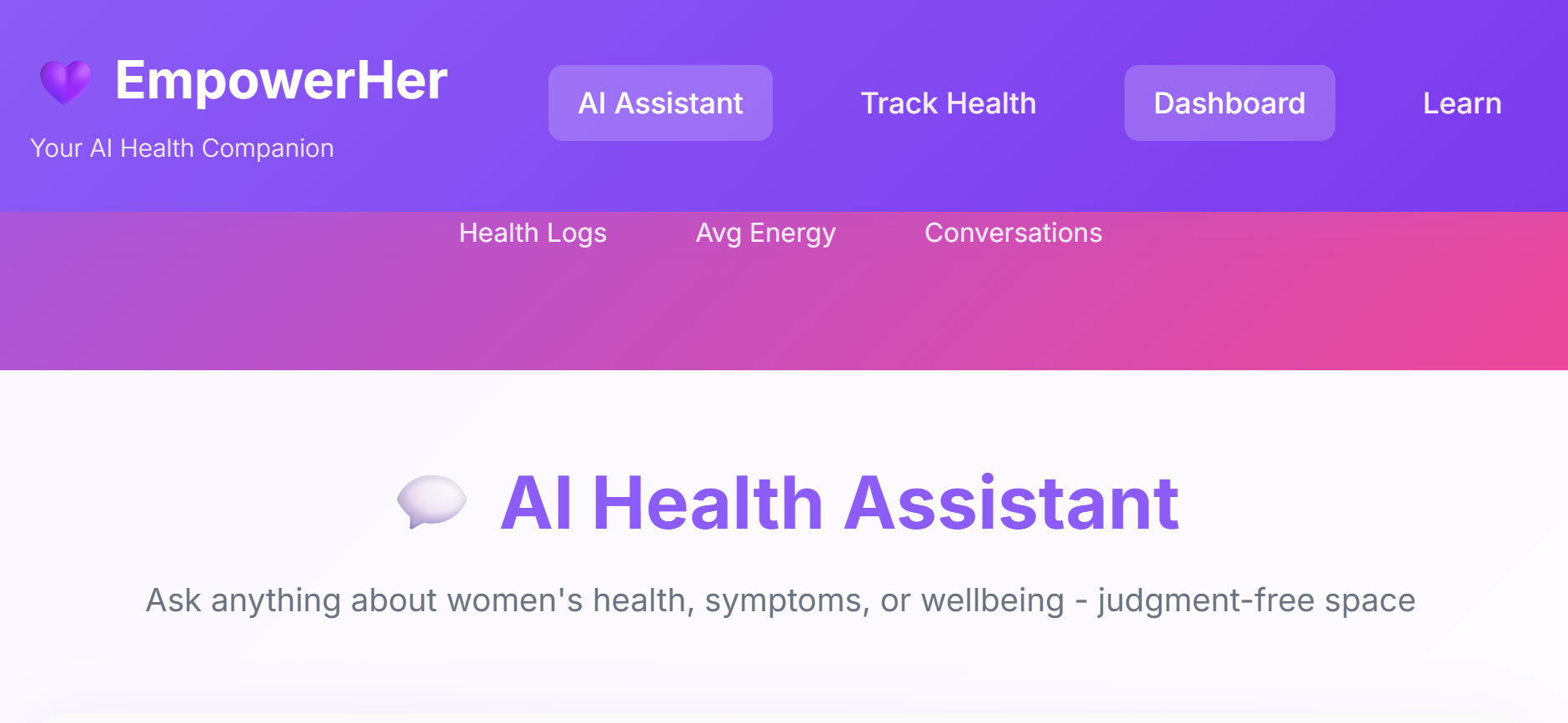
EmpowerHer is a comprehensive AI-powered platform that empowers women to understand their health and advocate for themselves. It combines four powerful features:
🤖 AI Health Companion
An intelligent chatbot that provides supportive, evidence-based responses to women's health questions. Ask about period cramps, mood changes, fatigue, or any health concern - get judgment-free, compassionate guidance backed by medical research.
Example interaction:
User: "I have really bad period cramps. Is this normal?"

AI: "Menstrual cramps are common, but severe pain that disrupts
     daily life is NOT normal and could indicate conditions like
     endometriosis or PCOS. Heat therapy and gentle movement can help,
     but don't hesitate to consult a healthcare provider - your pain
     deserves to be taken seriously."
The AI doesn't just answer questions - it validates feelings, provides context, and encourages self-advocacy.
📊 Smart Health Tracking
Log daily health data including:
- Energy levels (1-10 scale with visual slider)
- Mood (5 categories: Great, Good, Okay, Low, Struggling)
- Physical symptoms (8 common symptoms: cramps, bloating, headache, fatigue, mood swings, anxiety, back pain, breast tenderness)
- Personal notes (free-form observations)
- Date stamping (build historical records)
This creates a comprehensive health journal that reveals patterns over time.
📈 Visual Dashboard with AI Insights
Your tracked data transforms into actionable insights:
- Energy Trend Chart - Line graph showing energy fluctuations over 30 days
- Mood Distribution - Doughnut chart revealing emotional patterns
- Common Symptoms - Bar chart identifying most frequent issues
- Recent History - Chronological log of all entries
- Personalized AI Insights - Smart analysis like:
- "Your energy levels have been lower than average. Consider evaluating sleep, nutrition, and stress. Low iron is common in women - worth checking!"
- "You've logged 7 entries! Consistent tracking helps identify patterns and advocate with doctors."
📚 Women's Health Library
Curated articles addressing gaps in healthcare:
- Period Pain Is Not Normal - When to see a doctor
- Heart Disease in Women - Symptoms differ from men
- Mental Health Matters - Hormones, societal pressures, and support
- Bone Health & Osteoporosis - Women are 4x more likely
- Women in Medical Research - The 1993 turning point
- Thyroid Disorders - Women are 5-8x more likely
Each article is evidence-based and empowers women with knowledge to advocate for themselves.
🛠️ How We Built It
Technology Stack
Backend:
- Python 3.x - Core programming language
- Flask - Lightweight web framework for RESTful API
- Natural Language Processing - Keyword-based intent recognition for AI responses
Frontend:
- HTML5 - Semantic structure
- CSS3 - Modern styling with gradients, animations, and responsive design
- JavaScript (ES6+) - Interactive functionality and API calls
- Chart.js - Beautiful data visualizations (line charts, doughnut charts)
Architecture:
- RESTful API design with 4 main endpoints:
/api/chat- AI health assistant/api/log-health- Store health data/api/health-data- Retrieve and aggregate data/api/insights- Generate personalized insights
- In-memory data storage (easily upgradeable to PostgreSQL/MongoDB)
- Client-side rendering with dynamic updates
AI Implementation
The AI health companion uses a knowledge-based approach:
Intent Recognition - Keyword matching to identify health topics:
if any(word in message_lower for word in ["period", "menstrual", "cycle"]):
   return health_tips["period"]
Contextual Responses - Database of 20+ evidence-based health tips categorized by topic:
- Period/menstrual health
- Mood and emotional wellbeing
- Energy and fatigue
- General women's health
Symptom-Specific Information - Targeted responses for common symptoms:
SYMPTOM_RESPONSES = {
   "cramps": "Menstrual cramps are caused by uterine contractions...",
   "anxiety": "Anxiety can be hormonal, especially around your cycle...",
   # ... more symptoms
}
Empathetic Tone - Every response validates feelings and encourages professional consultation when appropriate
Data Visualization
Chart.js integration for real-time visualization:
// Energy trend over time
new Chart(ctx, {
    type: 'line',
    data: {
        labels: dates,
        datasets: [{
            label: 'Energy Level',
            data: energyValues,
            borderColor: '#8b5cf6',
            tension: 0.4
        }]
    }
});
Design Philosophy
Color Psychology:
- Primary purple (#8b5cf6) - Represents empowerment, dignity, and strength
- Gradient backgrounds - Modern, welcoming aesthetic
- Soft whites and grays - Professional, clean readability
User Experience:
- Mobile-first responsive design - Works on all devices
- Smooth animations - Fade-ins, transitions, hover effects
- Clear visual hierarchy - Important information stands out
- Accessibility - Semantic HTML, clear labels, high contrast
🚧 Challenges We Faced
1. Balancing Medical Accuracy with Accessibility
Challenge: Providing helpful health information without crossing into medical advice.
Solution:
- Clear disclaimers throughout the app
- Every AI response is evidence-based and sourced from medical research
- Consistent messaging encouraging professional consultation
- Positioning the tool as a complement to healthcare, not a replacement
Example implementation:
# Every response validates while encouraging professional help
"Severe cramps may indicate conditions like endometriosis -
 don't hesitate to consult a doctor."
2. Creating Empathetic AI Responses
Challenge: Making the chatbot feel supportive and human, not robotic or clinical.
Solution:
- Crafted every response with emotional intelligence
- Used validating language: "Your feelings are valid," "You deserve support"
- Avoided medical jargon in favor of clear, compassionate language
- Tested responses for tone and empathy
Before: "Dysmenorrhea is caused by prostaglandin-induced uterine contractions." After: "Menstrual cramps are caused by uterine contractions. Heat therapy, gentle movement, and over-the-counter pain relief can help."
3. Data Visualization Without Overwhelm
Challenge: Presenting health data in a way that's insightful but not anxiety-inducing.
Solution:
- Used trends over raw numbers (30-day windows, not every data point)
- Chose encouraging colors (purples and gradients, not reds and warnings)
- Focused on patterns rather than individual days
- Added AI insights to contextualize the data positively
4. Addressing Diverse Health Experiences
Challenge: Women's health is not one-size-fits-all - different bodies, different experiences.
Solution:
- Customizable tracking (pick your own symptoms)
- Open-ended notes fields for personal observations
- AI responses acknowledge individual variation
- Educational content emphasizes "normal varies by person"
5. Technical: Real-Time Dashboard Updates
Challenge: Updating charts and statistics immediately after logging data.
Solution:
// After form submission
fetch('/api/log-health', {method: 'POST', body: data})
    .then(() => {
        updateDashboard();  // Re-fetch and re-render
        updateStats();       // Update hero stats
        resetForm();         // Clear inputs
    });
6. Performance: Chart Rendering
Challenge: Chart.js can be slow with lots of data points.
Solution:
- Limit to 30-day windows
- Destroy and recreate charts on update (prevents memory leaks)
- Use canvas, not SVG (better performance)
if (energyChart) {
    energyChart.destroy();  // Clean up before recreating
}
energyChart = new Chart(ctx, config);
🎓 What We Learned
About Women's Health
The Research Gap is Worse Than We Thought
- Women weren't required in trials until 1993
- Many conditions are diagnosed 4+ years late
- Pain bias is documented and pervasive
Data Empowers Advocacy
- Doctors take concerns more seriously with data
- Patterns reveal issues single visits miss
- Historical records speed diagnosis
Mental and Physical Health Are Interconnected
- Hormonal cycles affect mood and energy
- Stress manifests physically
- Holistic tracking reveals connections
About Technology
AI Doesn't Need to Be Complex to Be Helpful
- Simple keyword matching works well for focused domains
- Curated responses beat generic AI for medical topics
- Empathy in tone matters more than technical sophistication
Data Visualization Transforms Understanding
- A chart reveals patterns invisible in raw data
- Visual feedback increases engagement
- Beautiful design builds trust
Responsive Design is Non-Negotiable
- Women check health info on phones
- Flexible layouts > fixed widths
- Mobile-first prevents desktop-only bias
About Design
Color Psychology Matters
- Purple = empowerment (perfect for our mission)
- Warm gradients feel welcoming
- High contrast ensures accessibility
Micro-Interactions Build Trust
- Smooth animations feel polished
- Hover effects provide feedback
- Loading states reduce anxiety
Less is More
- Clean layouts > feature overload
- White space improves readability
- Focus on core value proposition
About Development
Start Simple, Iterate
- MVP first, features later
- Working code beats perfect code
- Ship and improve
Documentation Saves Time
- Clear README accelerates onboarding
- API docs prevent confusion
- Comments explain "why," not "what"
User Testing is Critical
- Assumptions ≠ reality
- Watch people use your app
- Iterate based on feedback
🏆 Accomplishments We're Proud Of
1. Complete, Production-Ready Application
Not just slides or mockups - a fully functional web app with backend, frontend, database operations, and AI integration. You can use it right now.
2. Beautiful, Professional Design
Our UI rivals commercial health apps. The purple gradient theme, smooth animations, and responsive layout create a premium experience that builds trust.
3. Meaningful AI Integration
Our chatbot doesn't just parrot information - it validates feelings, provides context, and encourages advocacy. Every response is carefully crafted for empathy and accuracy.
4. Educational Impact
The health library addresses real gaps in women's healthcare knowledge. We're not just tracking - we're educating and empowering.
5. Technical Excellence
Clean, documented code. RESTful API design. Scalable architecture. Chart.js integration. Responsive CSS. We built this right.
6. Solving a Real Problem
This isn't a solution looking for a problem. Women's health research gaps are documented, pervasive, and harmful. EmpowerHer directly addresses this.
🔮 What's Next for EmpowerHer
Short-Term (Next 3 Months)
Database Integration
- PostgreSQL for production-grade data storage
- User accounts with authentication
- Secure data encryption
Enhanced AI
- Integration with GPT-4 or Claude API for deeper conversations
- Multi-turn dialogue context
- More nuanced response generation
Data Export
- PDF reports for doctor appointments
- CSV export for personal records
- Visual summaries optimized for healthcare providers
Medium-Term (6-12 Months)
Mobile Applications
- React Native app for iOS and Android
- Push notifications for logging reminders
- Offline functionality
Advanced Analytics
- Machine learning for cycle prediction
- Anomaly detection for concerning patterns
- Correlation analysis (e.g., energy vs. symptoms)
Community Features
- Anonymous forums for peer support
- Expert Q&A with healthcare providers
- User-generated health tips
Long-Term (1-2 Years)
Healthcare Provider Integration
- Dashboard for doctors to view patient data (with consent)
- Two-way communication platform
- Integration with electronic health records (EHR)
Wearable Device Integration
- Apple Watch, Fitbit, Oura Ring sync
- Automatic sleep and activity tracking
- Heart rate variability monitoring
Clinical Research Contribution
- Anonymized data for women's health research
- Partnerships with academic institutions
- Helping close the research gap we were built to address
Multilingual Support
- Translation into 10+ languages
- Cultural adaptation of health content
- Reaching women globally
Insurance Integration
- HSA/FSA eligible subscription
- Integration with health insurance portals
- Demonstrating value to reduce costs
💡 The Bigger Vision
EmpowerHer is more than an app - it's a movement.
For too long, women's health has been an afterthought in medical research. For too long, women's pain has been dismissed. For too long, women have been told to "calm down," "lose weight," or "it's just stress" when they knew something was wrong.
We're changing that.
By giving women tools to track, understand, and visualize their health, we're enabling a new kind of advocacy. Data-driven. Evidence-based. Impossible to dismiss.
When a woman walks into a doctor's office with three months of energy trends, symptom correlations, and AI-generated insights, she's not just a patient describing feelings. She's a partner in her healthcare journey presenting evidence.
That's power.
And that power - that ability to advocate for yourself with data and knowledge - that's what EmpowerHer provides.
Your health is your power.
🙏 Acknowledgments
This project was built for Hack For Her 2024, inspired by:
- All the women who have fought for better healthcare research
- Healthcare providers who listen, believe, and advocate for their patients
- The researchers working to close the women's health gap
- Every woman who has been dismissed and kept fighting for answers
Thank you for the opportunity to build something that matters.
📚 References & Research
Our platform is built on evidence-based research:
- Clinical Trial Inclusion: NIH Revitalization Act of 1993 requiring women in trials
- Diagnostic Delays: Journal of Women's Health, 2020 - "Gender Disparities in Time to Diagnosis"
- Pain Bias: Academic Medicine, 2019 - "The Girl Who Cried Pain"
- Heart Disease Symptoms: American Heart Association - "Women and Heart Disease"
- Mental Health Statistics: National Institute of Mental Health
- Endometriosis Research: World Endometriosis Society
Built with 💜 for women's health
EmpowerHer - Because your health is your power

Log in or sign up for Devpost to join the conversation.