-
Company Logo
Inspiration
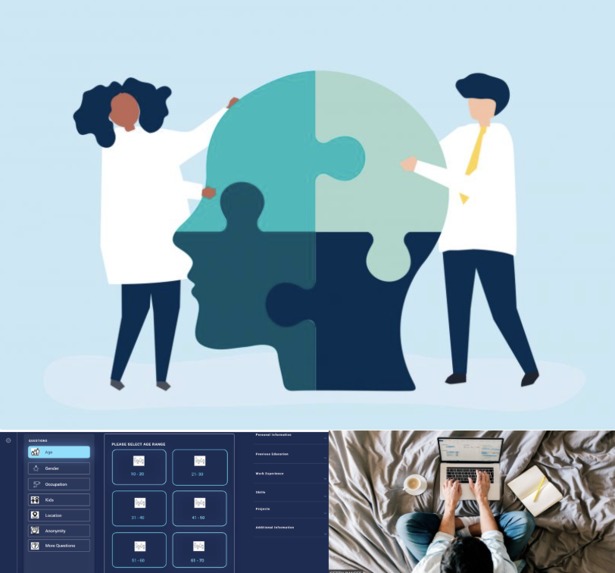
Mental Health plays an important role that affects the employee’s productivity. This is a tool for companies to support the Mental Health of their employees by predicting their work preference and productivity.
What it does
It allows employers to better understand the needs of their employees and helps them get valuable insights on the mental health of their employees all over the company. Some key questions it answers are-
- What is the preference of employees - work from home or work from the office?
- Will they be productive to the company?
- Do they need to enroll in a wellness program?
- Mental health of every age group?
- What features are important for an employee?
How we built it
We started with finding reliable and legitimate data sources. Apart from looking at the size of the datasets, we had to preprocess the data and analyze how good the features are using correlation matrices. We moved on to building different machine learning models to predict whether employees had good mental health, simply classifying it into non-fuzzy sets of 0 or 1, for good and below average respectively. We also built classifiers for targeting work from home and work from the office, with 0 or 1 respectively. After comparing accuracies of various models, we selected the Decision Tree for 2 main reasons-
- It gave us a better accuracy than other models.
- It allows the user to understand how the model was built, the classifications, the most important features, et al.
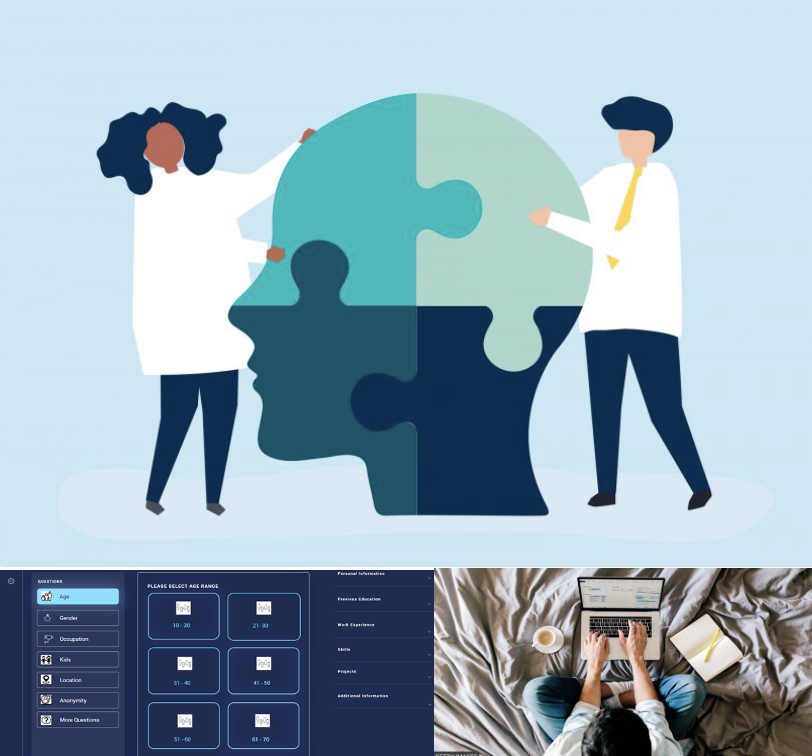
Once our algorithm was able to make correct decisions with a probability of 76%, we created various important visualizations next. These insights explained the model and data giving us more clarity of the dataset. We then moved on to creating WireFrames to design our GUI.
Challenges we ran into
We had some difficulty in finding the dataset that was needed for our analysis. We worked on two datasets from Kaggle, of which one was a small dataset than the other. With the smaller dataset, we faced the challenge of obtaining a higher accuracy for our model. It can be increased by adding more info to the data, i.e., having a larger dataset. After obtaining the data, we spent a lot of time figuring out the relationship between the various attributes and the attributes that will contribute to achieving each task.
Accomplishments that we're proud of
Despite a smaller dataset, our model was able to give an accuracy of 76%. We were able to gauge the final decision of the employee to work from home or office either of which would be beneficial.
What we learned
Various machine learning algorithms were implemented, compared, and contrasted. We learned to work with big and small datasets. To scale our analytics process depending on the size of the data. We learned how to automate tasks using excel, python, and command-line scripts. We taught ourselves how to create Wireframes for the first time, and used OpenSource applications available to create the design of our UI. Above all, we collaborated with new people and shared our expertise to develop this project.
What's next for EmployeeFit
EmployeeFit currently has a fully functional back end and creates visualizations. The next step would be to implement the GUI designs and host a website. The decision tree will be updated in real-time according to the input received from the GUI. This will then make the tool live for anyone to use.
In the future, it has a lot of scope in terms of adding features and plugins to it. The website can be made dynamic to update its decision over time and ensure the model changes with changing times.


Log in or sign up for Devpost to join the conversation.