Inspiration
Healthcare is supposed to be for everyone. But for the 253 million people worldwide living with visual impairment, the 430 million with disabling hearing loss, and the millions more navigating disabilities that make digital interfaces hostile — virtual care has quietly become one more place they're excluded.
A 2024 NIH study found that three of the most widely-used electronic health record systems fail basic screen reader and keyboard navigation standards. A 2025 systematic review across 22 studies confirmed that deaf and hard-of-hearing patients face consistent misdiagnoses, marginalisation, and discrimination due to communication barriers in healthcare settings. These aren't edge cases. They're people who need care the most, and get it the least.
At the same time, a 2025 meta-analysis in the British Medical Bulletin (Oxford Academic) found that across 13 of 15 studies, AI chatbots were rated more empathetic than human healthcare professionals in text-based scenarios (standardised mean difference = 0.87, p < .00001). Not less. More. We built Empathy because these two facts together point to something powerful: AI-assisted virtual care, done right, can be the most accessible and the most compassionate way to reach patients who've been left behind.
What it does
Empathy is a two-sided virtual care platform — one app for patients, one for clinicians — designed from the ground up around universal accessibility and zero wait time.
Patient App
Voice-first interface powered by ElevenLabs: a warm, natural AI voice guides patients through every step. Blind and low-vision users can navigate entirely without a screen. Accessible by design: high contrast mode, large text, full keyboard navigation, real-time captions for deaf and hard-of-hearing users. No timeouts — every patient gets as much time as they need. Compassionate AI intake: powered by Gemini, the assistant collects symptoms with empathy, asks thoughtful follow-up questions, and never rushes. The tone is scientifically grounded — not a marketing choice. Resolution, not routing: patients always know what happens next. No ambiguity, no waiting in the dark.
Provider App
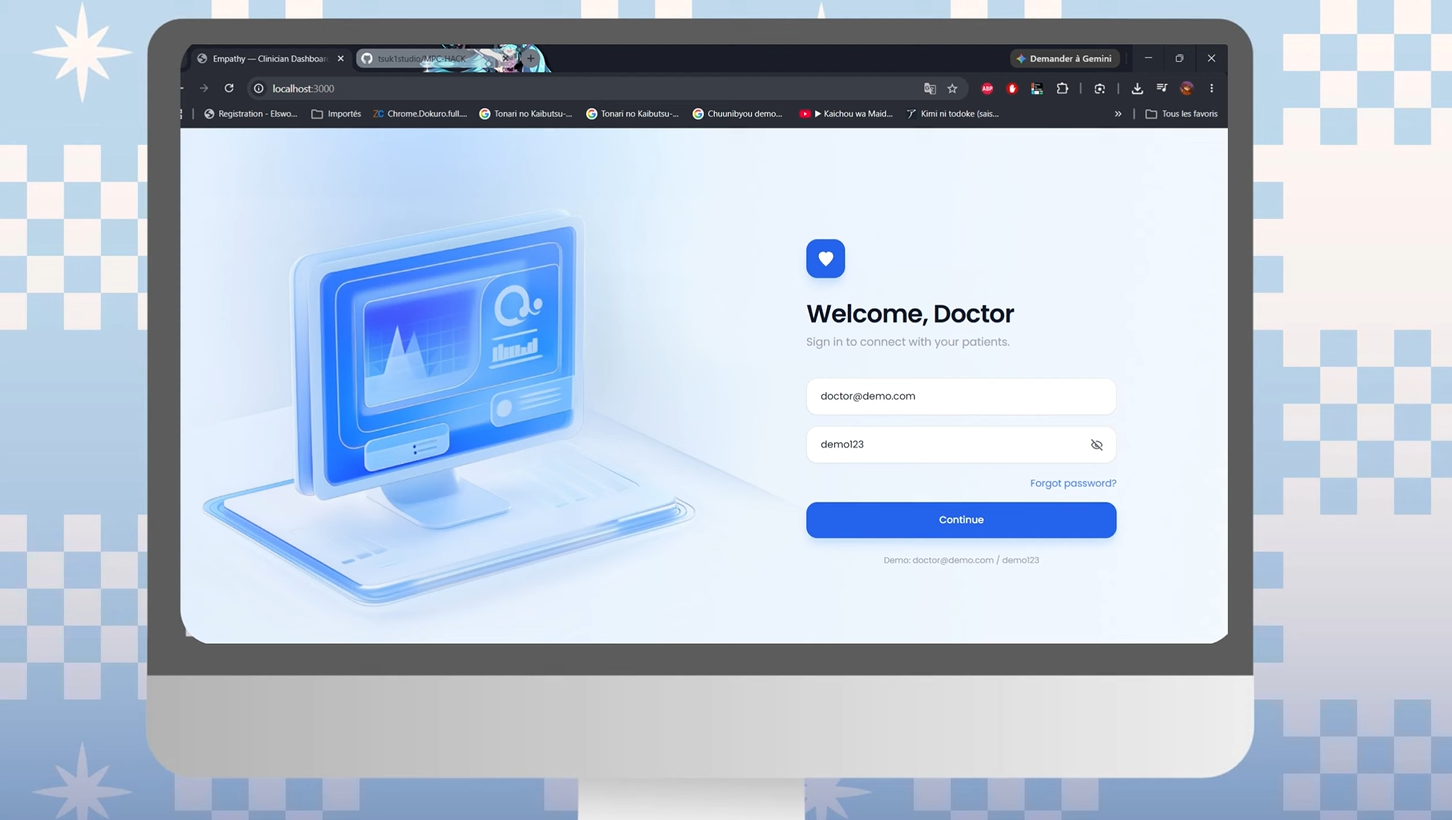
Pre-digested decision packets: the AI prepares a structured clinical summary before the clinician ever opens a case — symptoms, history, suggested action. One-click decisions for simple cases: medication renewals, normal lab follow-ups, and chronic condition check-ins are resolved in under 60 seconds. Patient cohorting: one clinician can approve a decision applied safely to a group of patients with similar presentations — scaling care without sacrificing judgment. Built-in escalation: complex or urgent cases are flagged automatically and routed to synchronous consultation. All regulated clinical decisions stay with licensed practitioners.
How we built it
Empathy is two connected Next.js apps sharing one MongoDB Atlas database. When a patient finishes talking to Em, their case appears on the doctor's dashboard in real time. Em runs on Google Gemini, prompted to write clinical summaries the way a physician would — using real medical shorthand and SOAP note structure that doctors immediately recognize. For accessibility, we used ElevenLabs for natural voice output, the Web Speech API for voice input, and built every component to meet WCAG 2.1 standards. Every design decision on the provider side had one goal: a doctor should understand a patient's full situation in under 10 seconds.
Challenges we ran into :
For most of our team, this was only our first or second hackathon. We came in as beginners — learning new technologies in real time, collaborating with people we'd just met, and trying to build something meaningful under a tight deadline. One of our hardest technical challenges was designing the doctor-side experience: figuring out how to present AI-generated information in a way that was fast, trustworthy, and legally responsible without overwhelming a physician.
Accomplishments that we're proud of :
We built something that actually works. For a team of first and second-time hackathon participants using technologies most of us had never touched before, shipping a functional, polished platform in this timeframe is something we're genuinely proud of. Beyond the code we had fun, and we walked away having met people we wouldn't have otherwise.
What we learned:
We learned that building for accessibility isn't a feature is a whole design concept and system. Designing for people with disabilities made every part of our product more thoughtful, more intentional, and ultimately better for everyone. We also learned what it means to use AI ethically: not to replace human judgment, but to reduce the friction around it. The doctor still decides in Empathy.
What's next for Empathy :
Testing with real physicians : Our immediate next step is putting Empathy in the hands of real family doctors to collect clinical feedback. We want to know: does the AI briefing actually save time? Does the 3-line summary have everything they need? What would they change? Real-world validation from licensed practitioners is the only feedback that matters.
Building the real product : What we built this weekend is a proof of concept. The next step is building Empathy as a production-grade platform with real authentication, HIPAA and PIPEDA compliance, proper data encryption, audit logs for every clinical decision, and infrastructure that scales to thousands of doctors and patients.
Research References
Wilson-Menzfeld et al. (2025). Communication Experiences of Deaf and Hard-of-Hearing Patients in Healthcare Settings. Health & Social Care in the Community. (Systematic review of 22 studies — misdiagnosis, marginalization, communication barriers)
Howcroft et al. (2025). AI chatbots versus human healthcare professionals: empathy meta-analysis. British Medical Bulletin, Oxford Academic. (13/15 studies favor AI empathy, SMD = 0.87)
NIH (2024). Accessibility of electronic health record systems for blind and low-vision users. Via Nolo Legal Encyclopedia. (3 major EHR systems fail basic screen reader standards)
Robertson et al. (2025). Dismantling barriers to research and clinical care for individuals with vision impairment. Medical Journal of Australia.
Frontiers in Psychology (2025). Empathy AI in healthcare — the Chatbot Compassion Quotient (CCQ). (Framework used to calibrate Em's tone)
JAMA (2024). Clinical documentation consumes 49% of physician workday.
University of Chicago (2024). For every hour of direct patient care, physicians spend nearly 2 hours on EHR documentation.
STAT News / AMA (2025–2026). Large-scale AI scribe study: 1,800 clinicians, documentation reduced by 60%.
CBC News (2024). 6 million Canadians without a family doctor.
Fraser Institute (2025). Median wait time from GP referral to treatment: 28.6 weeks in Canada.
Dialogue (2025). "AI in healthcare isn't about replacing humans — it's about reclaiming humanity." dialogue.co/resources
Built With
- elevenlabs
- gemini-api
- mongodb-atlas
- next.js
- react
- vultr
- wcag-2.1
- web-speech-api


Log in or sign up for Devpost to join the conversation.