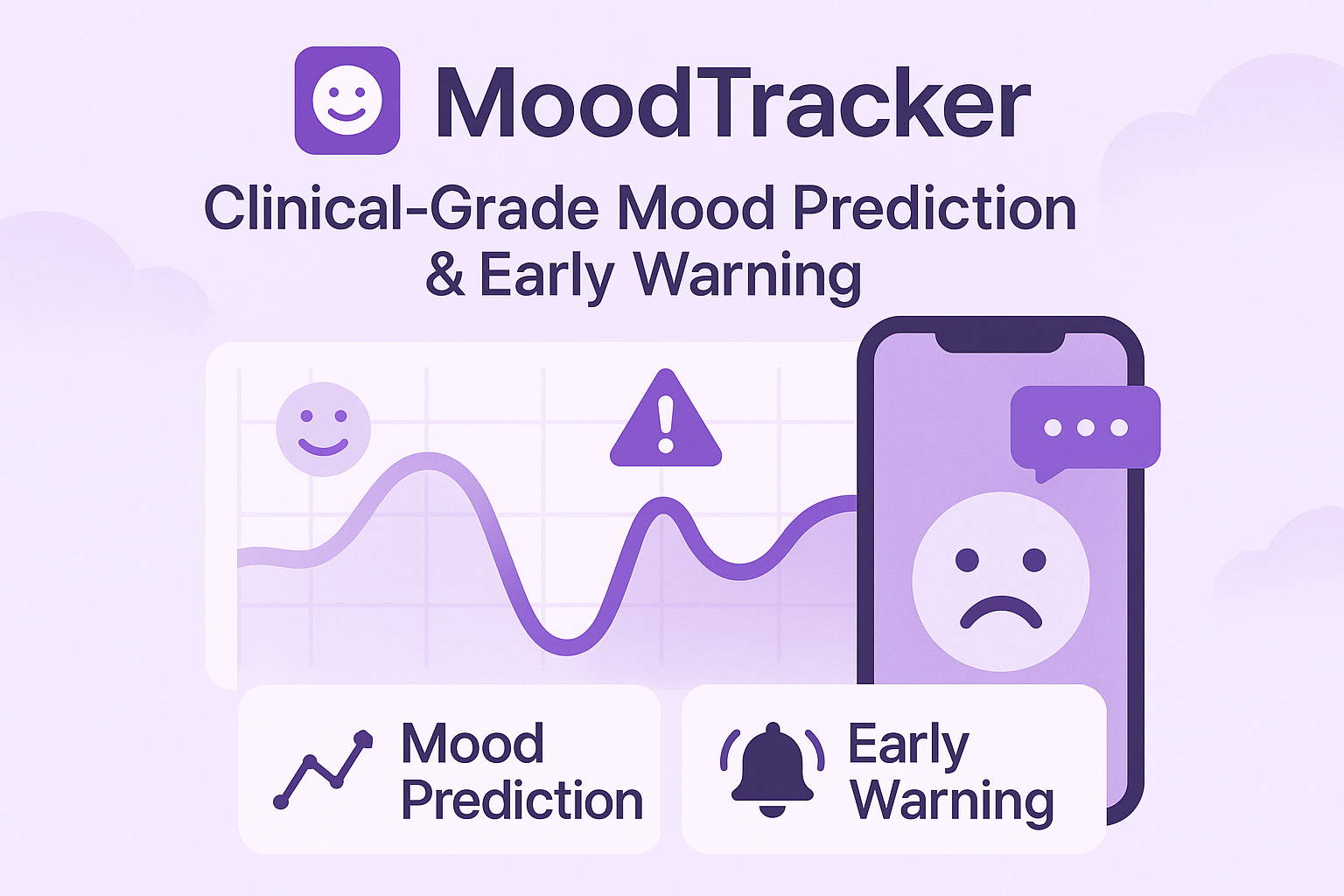
MoodTracker — Clinical-Grade Mood Prediction & Early Warning

Mental health apps love dashboards and charts, but most are useless outside academia or pitch decks. MoodTracker was born from frustration with pointless trackers and false promises. We set out to build a system that detects meaningful mood shifts, predicts risk windows, and actually supports intervention—not just another “wellness” data dump.

What Inspired Us

We’ve seen self-report apps flop in clinical settings and “AI-powered” platforms overpromise and underdeliver. Clinicians need actual signals. Users deserve something that works before a crisis, not after. MoodTracker is for both.

What We Learned

  • Passive data (wearables, phone use) is noisy; real signal requires ruthless filtering.
  • “Mood prediction” is worthless unless you predict change and risk, not just log feelings.
  • Nobody wants generic alerts—specific, actionable warnings are everything.
  • Explainability is a hard requirement for clinical adoption.
  • Integrating multi-source data is, frankly, a mess.

How We Built It

  • Combined active (questionnaires) and passive (wearable, behavioral) data streams.
  • Feature engineering focuses on change detection and risk forecasting.
  • Machine learning: ensemble models + Bayesian change point detection for event prediction.
  • Explainable AI: every alert has a rationale and a data audit trail.
  • Backend: Python (FastAPI), PostgreSQL (encrypted), modular API architecture.
  • Frontend: Flutter (iOS/Android cross-platform).
  • Privacy: Full encryption at rest/in transit; no third-party analytics, no ad tracking.

Challenges We Faced

  • Synchronizing garbage APIs and noisy data streams.
  • Reducing false positives (alert fatigue kills trust).
  • Getting clinicians to trust model outputs (auditable, transparent, defensible).
  • Regulatory red tape—proof for every metric.
  • Balancing sensitivity (early warning) against specificity (no spam).

Built With

Share this project:

Updates

posted an update

MoodTracker Executive Summary

Company Overview

MoodTracker is a clinical-grade mental health platform that leverages multi-source data integration and explainable AI to predict mood shifts, detect risk windows, and enable timely interventions. Unlike conventional mental health apps that merely track symptoms, MoodTracker's predictive capabilities transform passive and active data into actionable clinical insights, addressing the critical gap between data collection and meaningful intervention in mental healthcare.

The Problem

Mental health disorders affect 1 in 8 people globally, with mood disorders being particularly prevalent and costly. Current approaches to mental health monitoring suffer from critical limitations:

  1. Reactive Rather Than Predictive: Most solutions only track current states, not predict future deterioration
  2. High False Positive Rates: Existing alerts generate fatigue and diminish trust
  3. Limited Clinical Integration: Consumer apps rarely integrate with clinical workflows
  4. Black Box Algorithms: AI solutions lack transparency needed for clinical adoption
  5. Fragmented Data Sources: Single-source data provides incomplete insights

These limitations result in missed intervention opportunities, preventable crises, and billions in avoidable healthcare costs.

Our Solution

MoodTracker addresses these challenges through a comprehensive platform with five key components:

  1. Multi-Source Data Integration: Combines passive data (wearables, phone usage) with active inputs (validated questionnaires) for a complete picture of mental health status

  2. Advanced Signal Processing: Sophisticated algorithms filter noise and extract meaningful patterns from complex data streams

  3. Predictive Analytics Engine: Ensemble models combining statistical methods and machine learning to forecast mood shifts and identify risk windows

  4. Explainable AI Framework: Every alert includes clear rationale and data audit trail, building clinical trust

  5. Clinical Integration: Seamless workflow integration with healthcare systems and EHRs

Market Opportunity

The global mental health apps market, valued at $7.48 billion in 2024, is projected to reach $17.52 billion by 2030, growing at a CAGR of 14.6%. This growth is driven by:

  • Increasing prevalence of mental health disorders
  • Growing smartphone and wearable device adoption
  • Rising healthcare costs driving demand for preventive solutions
  • Shortage of mental health professionals
  • Increasing employer focus on workforce mental wellbeing

MoodTracker targets three primary market segments:

  1. Healthcare Providers: Mental health clinics, psychiatric practices, and integrated health systems seeking better patient monitoring tools

  2. Payers: Insurance companies and government payers looking to reduce costs through early intervention

  3. Employers: Organizations seeking to support employee mental health and reduce productivity losses

Competitive Advantage

MoodTracker differentiates itself in the crowded mental health technology landscape through:

  1. Predictive vs. Reactive: Focus on forecasting changes and risks, not just logging current states
  2. Clinical-Grade Accuracy: Rigorous signal filtering and validation
  3. Explainable AI: Transparent, auditable decision-making
  4. Multi-Source Integration: Comprehensive data fusion approach
  5. Actionable Insights: Specific, clinically relevant alerts

While thousands of mental health apps exist, only 6 have FDA approval, and none specifically for mood prediction with explainable AI. This represents a significant market gap that MoodTracker is uniquely positioned to fill.

Business Model

MoodTracker employs a B2B SaaS model with three primary revenue streams:

  1. Healthcare Provider Subscriptions:

    • Basic: $500/mo per clinic
    • Professional: $1,500/mo per clinic
    • Enterprise: Custom pricing
  2. Payer Partnerships:

    • Per-member-per-month fees
    • Value-based contracts with shared savings
    • Population health management tools
  3. Enterprise Wellness Programs:

    • Per-employee pricing
    • Workforce analytics
    • Integration with existing wellness programs

This model provides recurring revenue, scalability, and alignment with healthcare reimbursement trends toward value-based care.

Technology & Development

MoodTracker's technology stack includes:

  • Backend: Python (FastAPI), PostgreSQL (encrypted), modular API architecture
  • Frontend: Flutter (iOS/Android cross-platform), responsive web portal
  • Data Processing: Advanced signal processing, feature engineering pipeline
  • Machine Learning: Ensemble models + Bayesian change point detection
  • Security: Full encryption at rest/in transit, HIPAA compliance, zero third-party analytics

Our development roadmap includes:

  • Q3 2025: MVP Development
  • Q1 2026: Beta Testing
  • Q3 2026: Clinical Validation Study
  • Q1 2027: FDA Submission

Regulatory Strategy

MoodTracker will pursue FDA clearance as a Software as a Medical Device (SaMD) through the 510(k) pathway, with potential for Breakthrough Device Designation based on our novel approach to mental health monitoring.

Our regulatory strategy includes:

  1. Quality Management System: Implementation of ISO 13485 and IEC 62304 compliant processes
  2. Clinical Validation: Comprehensive studies demonstrating safety and effectiveness
  3. Cybersecurity Framework: Robust security measures aligned with FDA guidance
  4. Post-Market Surveillance: Continuous monitoring of real-world performance

This approach will create significant barriers to entry while establishing MoodTracker as a trusted, clinically validated solution.

Financial Projections

Metric Year 1 Year 3 Year 5
Revenue $1.2M $8.5M $32M
Gross Margin 65% 72% 78%
EBITDA ($2.9M) ($0.6M) $10.8M
Customers 23 217 1,032
CAC $15K $12K $10K
LTV $45K $60K $75K

Break-even is projected for Q4 of Year 3, with strong growth and improving unit economics thereafter.

Team

MoodTracker is led by a multidisciplinary team combining expertise in:

  • Healthcare technology and startup leadership
  • Machine learning and AI in healthcare applications
  • Clinical psychiatry and digital health
  • Product development and healthcare UX
  • Regulatory affairs and quality management

Our advisory board includes leading clinicians from academic medical centers and technical experts with experience in FDA-approved digital therapeutics.

Funding Request

MoodTracker is seeking $5 million in seed funding to:

  1. Complete Product Development (40%): Engineering team, MVP development, beta testing
  2. Conduct Clinical Validation (25%): Clinical studies, data collection, analysis
  3. Navigate Regulatory Process (15%): FDA submission preparation, quality management system
  4. Launch Initial Marketing & Sales (12%): Go-to-market strategy, healthcare provider outreach
  5. Support Operations (8%): General operations, legal, accounting

This funding will support the company through key milestones over the next 24 months, positioning us for Series A funding as we approach FDA submission.

Investment Highlights

  1. Addressing Critical Need: Mental health crisis with limited effective monitoring solutions
  2. Large, Growing Market: $7.48B market growing at 14.6% CAGR
  3. Differentiated Technology: Predictive capabilities with explainable AI
  4. Strong Unit Economics: High LTV:CAC ratio (3.0x Year 1, 7.5x Year 5)
  5. Regulatory Strategy: Clear pathway to FDA clearance
  6. Multiple Revenue Streams: Diversified B2B model with recurring revenue
  7. Experienced Team: Multidisciplinary expertise in healthcare, technology, and regulation

Contact Information

For more information, please contact:

Log in or sign up for Devpost to join the conversation.

posted an update

New Files

  • types/index.ts - Type definitions
  • contexts/AppContext.tsx - Global state management
  • services/dataService.ts - Data layer
  • utils/errorUtils.ts - Error handling utilities
  • hooks/useDataLoader.ts - Data loading hook
  • components/ErrorBoundary.tsx - Error boundary component
  • components/LoadingSpinner.tsx - Loading UI components

Modified Files

  • tsconfig.json - Enhanced TypeScript configuration
  • app/_layout.tsx - Added ErrorBoundary and AppProvider
  • app/(tabs)/index.tsx - Updated to use context and data service
  • components/MoodSlider.tsx - Added validation
  • components/ExplanationModal.tsx - Fixed type safety

Benefits Achieved

  1. Type Safety: Eliminated any types, added comprehensive interfaces
  2. Error Resilience: Components gracefully handle errors with recovery options
  3. State Management: Centralized, predictable state with Context API
  4. Data Layer: Clean separation between UI and data operations
  5. User Experience: Better loading states and error feedback
  6. Code Quality: Improved maintainability and debugging capabilities

Next Steps

  1. Testing: Add unit tests for utilities and components
  2. Performance: Optimize re-renders with React.memo
  3. Offline Support: Add data persistence and offline capabilities
  4. Authentication: Integrate user authentication system
  5. Real APIs: Replace mock data service with real backend integration

Log in or sign up for Devpost to join the conversation.