Inspiration
The inspiration for this project stemmed from a personal desire to contribute to mental health awareness. In today’s world, many people struggle with mental health challenges, often needing a safe space to express their emotions. I wanted to develop an application that uses AI to provide emotionally supportive responses, creating an experience that feels empathetic and human-like. By leveraging AI’s capabilities, this app aims to offer comfort and help users feel heard, whether they are seeking advice or simply need someone to talk to.
What it does
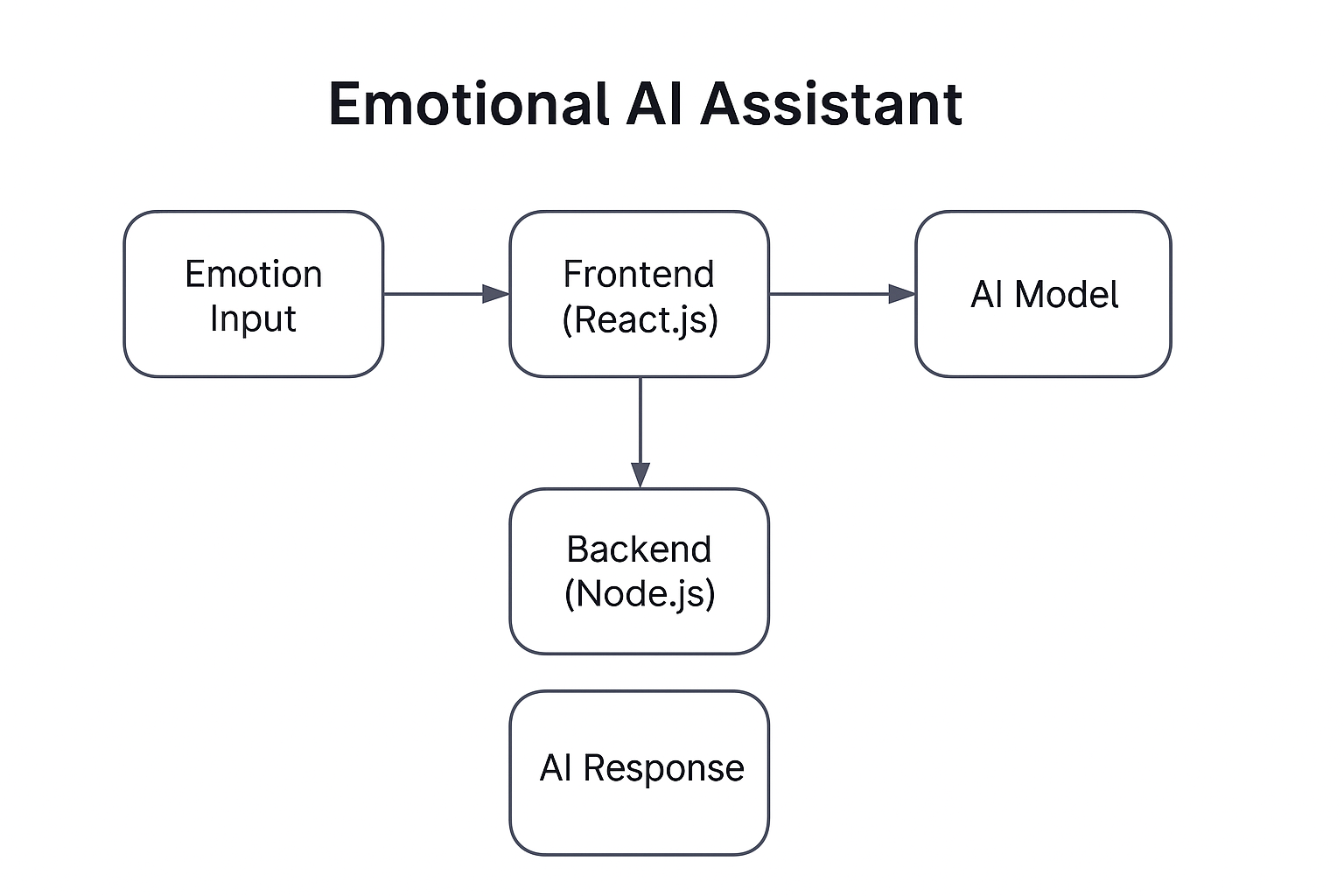
The Emotional AI Assistant is an empathetic web application built to provide emotionally intelligent responses to users. It helps people express their feelings and receive comforting, supportive replies, creating a digital space for emotional support. The app is powered by React.js for the frontend, Node.js for the backend, and AI models to generate human-like responses based on user input.
How we built it
Challenges we ran into
Integrating AI Models: Connecting the frontend with the AI API and ensuring the AI produced emotionally relevant responses was a complex task. Fine-tuning prompts to get the right emotional context was crucial.
Handling Emotional Sensitivity: Ensuring the AI responded with empathy was one of the biggest challenges. I had to carefully craft prompts to avoid robotic or impersonal replies.
Limited Access to AI Models: Access to OpenAI’s higher-tier models was restricted due to quota limits, and alternative models like DeepSeek faced connectivity issues.
Backend Communication: Managing API requests and ensuring smooth communication between the frontend and backend involved debugging asynchronous functions and handling server errors.
Accomplishments that we're proud of
The app was built using React.js for the frontend. I used Material-UI and Tailwind CSS for styling to ensure a clean, user-friendly interface. The frontend captures user emotions through text input and sends the data to a backend server. The backend, built with Node.js and Express, processes the input and communicates with the AI model to generate emotionally intelligent responses.
For AI integration, I initially explored OpenAI’s GPT models but faced limitations such as quota issues and model access. Despite this, I learned to handle API configurations and fine-tune the interaction between the frontend and the AI. The server uses Axios to send requests and handle responses efficiently.
What we learned
Throughout the development of this project, I gained valuable experience in multiple areas:
AI Interaction: Learning how to interact with AI models like OpenAI to generate emotionally aware responses helped me understand sentiment analysis and the importance of emotional intelligence in AI.
Frontend Development: Working with React.js provided me with hands-on experience in building dynamic, interactive user interfaces, while Material-UI and Tailwind CSS enabled me to create a responsive and visually appealing design.
Backend Integration: Setting up a Node.js backend and using Axios for API requests helped me gain practical knowledge in handling server-client communication and working with external services.
What's next for emotional-ai-app
Model Expansion: I plan to integrate other AI models or improve the existing AI to generate even more nuanced responses.
Personalized Experience: Implementing user profiles and custom preferences will enhance the AI's ability to respond empathetically based on individual needs.


Log in or sign up for Devpost to join the conversation.