-
-
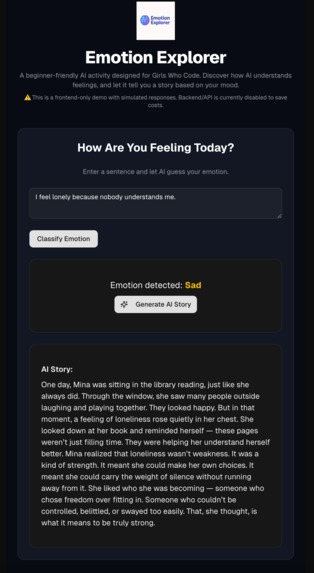
UI Screenshot
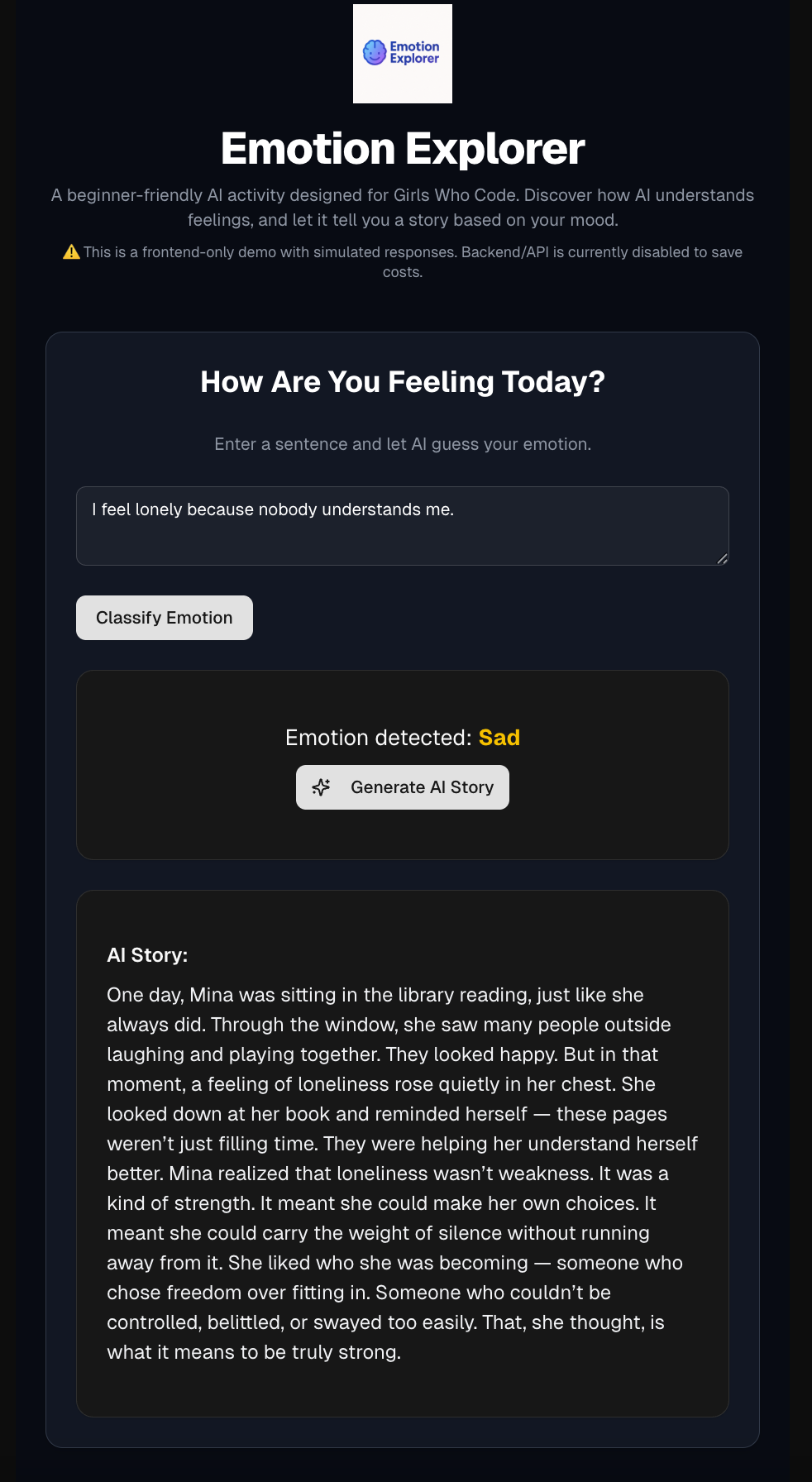
Inspiration
When children can’t name their emotions, they often can’t control them. Emotional literacy is rarely taught explicitly, especially in underserved communities. Inspired by students' struggles to express how they feel—and my own experience building mental health tools—I designed Emotion Explorer as an accessible, story-based entry point into emotional awareness.
What it does
Emotion Explorer allows students (ages 8–18) to write short journal entries. It detects their emotional tone using an NLP classifier and generates a metaphorical 3–5 sentence story using GPT that reflects their feelings and reframes their perspective. It empowers emotional self-understanding, not just labeling.
How we built it
The frontend was built in React and styled with Tailwind CSS, hosted on Vercel. The backend includes a lightweight DistilBERT emotion classifier (fine-tuned on public datasets) and a GPT-based story generator. The frontend and backend are decoupled to allow public preview access while conserving backend compute.
Challenges we ran into
The biggest challenge was designing an interface that felt simple enough for students but emotionally rich. We also faced compute cost issues with the GPT API, so we kept the backend offline during public demo. Building emotional classification that was nuanced but not overfitted took several iterations.
Accomplishments that we're proud of
- Fully functional prototype deployed on the web
- Designed a full classroom lesson plan + open-source GitHub repository
- Built end-to-end AI integration (NLP + GPT) as a solo developer
What we learned
We learned that emotional literacy needs more than just labeling—it needs narrative tools and reflection spaces. Students don’t just want to know how they feel, they want to make sense of it. Building this tool revealed how powerful generative AI can be when used for empathy and education.
What's next for Emotion Explorer – Building Emotional Literacy for Youth
We’re expanding Emotion Explorer into a multilingual, mobile-accessible version. We hope to launch pilot collaborations with educators and nonprofits serving underrepresented youth. Our goal is to scale it as a free, lightweight tool for emotional learning—especially where traditional support systems are missing.
SDG Alignment
- SDG 3: Good Health and Well-being
- SDG 4: Quality Education
- SDG 10: Reduced Inequality


Log in or sign up for Devpost to join the conversation.