
Here's a well-structured Markdown write-up for your project, EmotiCare.
EmotiCare: AI-Powered Mental Health Chatbot
Inspiration
Mental health is often stigmatized, and many people hesitate to talk about their struggles. We wanted to create a safe, AI-powered space where users can express their emotions anonymously, receive support, and access mental health resources. Inspired by the potential of AI in mental health care, we built EmotiCare—a chatbot that listens, understands, and guides users towards appropriate help.
What it does
EmotiCare is an AI-driven web application designed to:
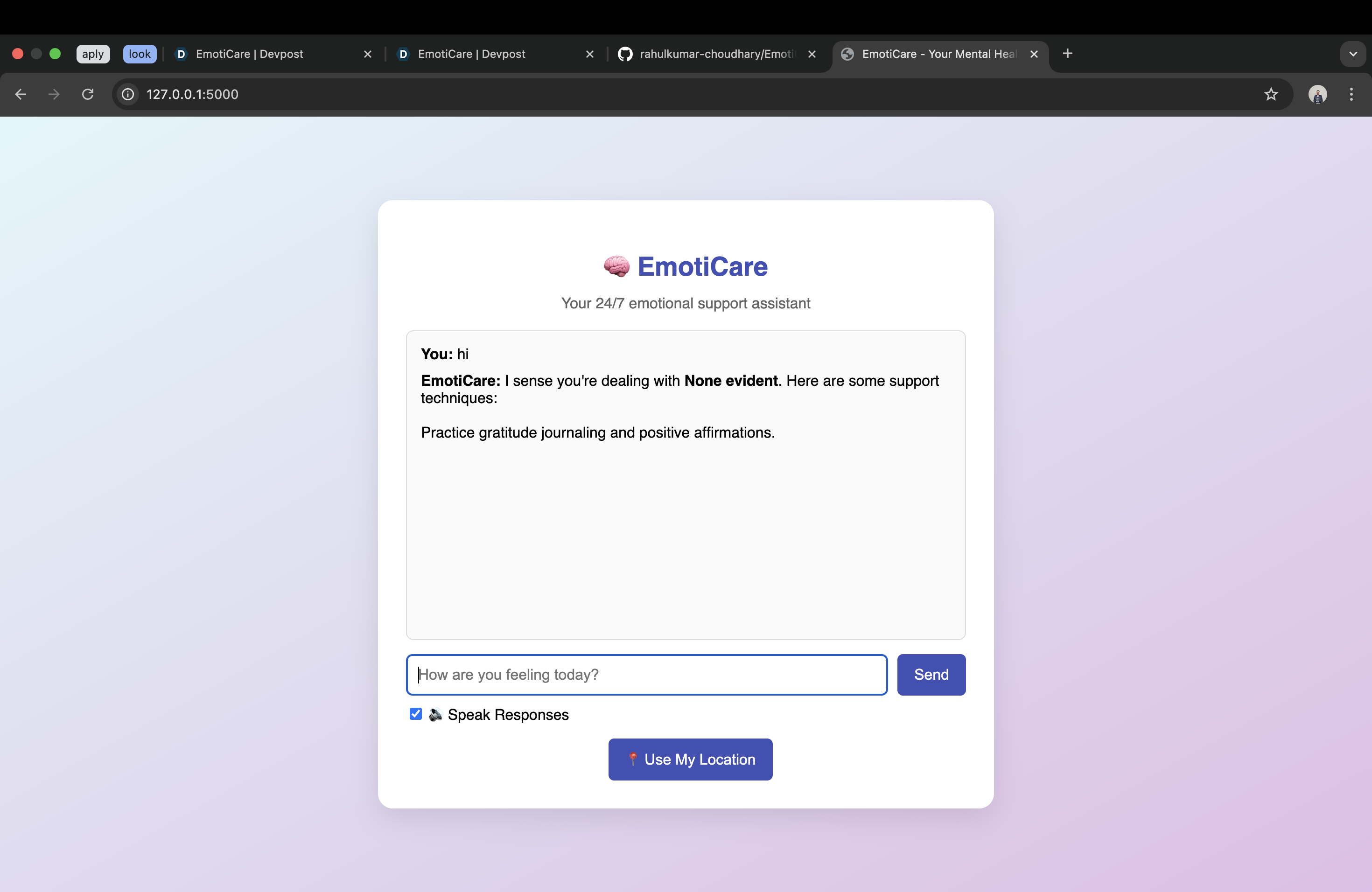
✅ Provide 24/7 emotional support through an AI chatbot powered by Google Gemini API.
✅ Detect emotional tone and adjust responses accordingly using NLP.
✅ Perform facial emotion detection to better understand user mood.
✅ Summarize the conversation and classify potential mental health concerns.
✅ Offer personalized coping techniques, mindfulness exercises, and self-help strategies.
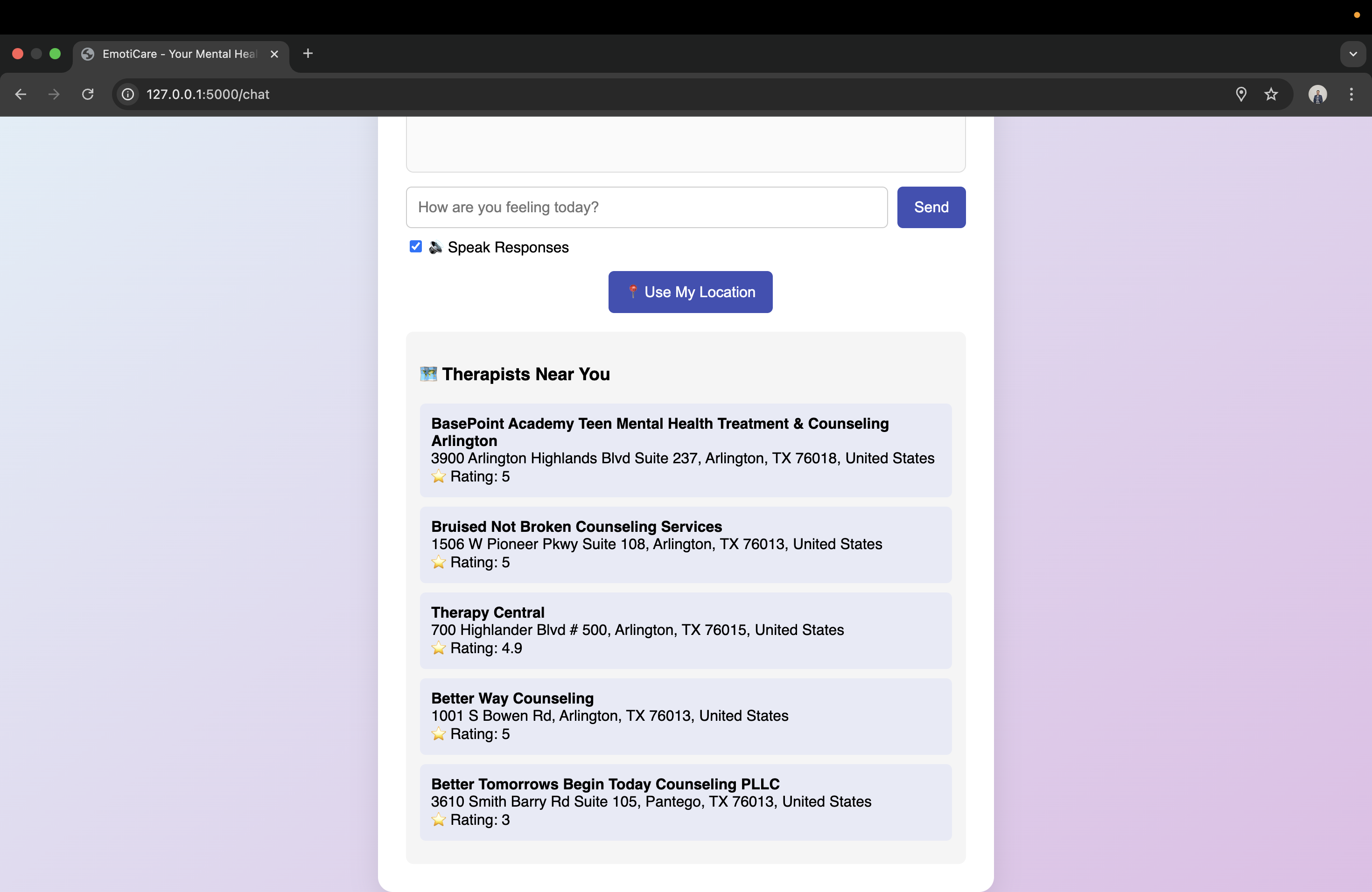
✅ Recommend nearby therapists, support groups, and helplines based on location.
✅ Allow users to book appointments or let the AI notify a mental health professional on their behalf.
✅ Redirect users to human counselors if severe distress is detected.
How we built it
🚀 Tech Stack:
- Frontend: Flask, HTML, CSS, JavaScript
- Backend: Flask (Python)
- AI Model: Google Gemini API for chatbot, OpenCV for facial emotion detection
- Database: SQLite (for storing conversations and user preferences)
- APIs: Google Maps API (for finding nearby therapists)
🔨 Development Steps:
- Integrated Google Gemini API to build an NLP-powered chatbot.
- Used OpenCV for facial emotion detection.
- Designed a Flask-based web interface with an intuitive UI.
- Developed a mental health resource finder using geolocation.
- Implemented a therapy booking system with user consent.
- Ensured privacy and security by anonymizing user data.
Challenges we ran into
😟 Fine-tuning AI responses – Ensuring that the chatbot provided empathetic and context-aware replies was challenging.
🤖 Facial emotion detection accuracy – Building a robust system to detect subtle emotions was difficult, as lighting and angles affected accuracy.
📍 Finding reliable mental health resources – We had to ensure that recommendations were accurate, relevant, and verified.
🛡 Privacy concerns – Since mental health is sensitive, we took extra steps to ensure user anonymity and data security.
Accomplishments that we're proud of
🎉 Successfully built a functional AI chatbot that provides emotional support.
🎉 Integrated real-time facial emotion detection with OpenCV.
🎉 Created a user-friendly web application accessible to anyone.
🎉 Ensured privacy-first design to maintain user trust.
🎉 Developed a therapy resource finder to connect users with professionals.
What we learned
💡 The power of AI in mental health – AI can be a valuable first step in mental health support.
💡 Ethical AI design – Ensuring unbiased, sensitive, and non-judgmental responses is crucial.
💡 Improving NLP models – We explored ways to fine-tune AI chatbots for more empathetic and accurate responses.
💡 Balancing automation with human support – AI can provide assistance, but human intervention is necessary in critical situations.
What's next for EmotiCare?
🚀 Enhancing AI capabilities – Improve chatbot responses with sentiment analysis and deep learning.
🚀 More emotion detection methods – Incorporate voice tone analysis alongside facial recognition.
🚀 Integration with teletherapy platforms – Partner with mental health professionals to offer direct therapy booking.
🚀 Multilingual support – Make EmotiCare accessible to more users globally.
🚀 Mobile App Version – Develop an iOS & Android app for greater accessibility.
Let me know if you need any modifications! 🚀😊
Built With
- cv2
- flask
- google.generativeai
- javascript
- numpy
- python


Log in or sign up for Devpost to join the conversation.