-
-
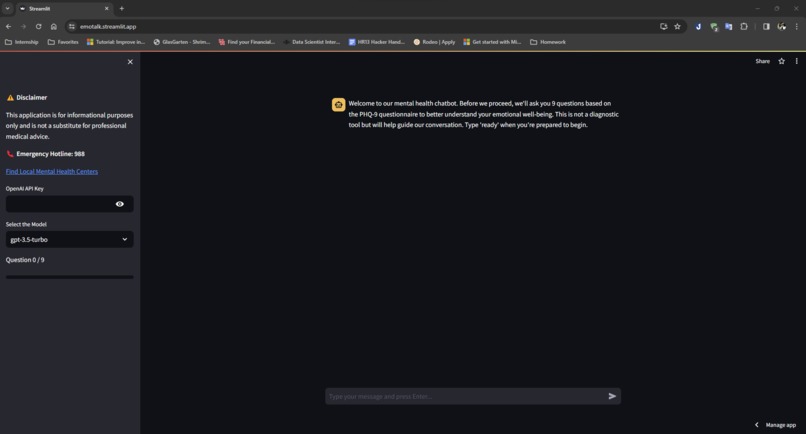
Homepage
Inspiration
My own journey through mental health struggles was the catalyst for EmoTalk. There were times when I needed someone to talk to, but barriers like fear, tight work schedules, and the stigma often associated with therapy made it incredibly hard. I knew I wasn't alone in this. That's when I realized a chatbot could serve as a non-judgmental, available-anytime companion that could help people like me take the first step toward addressing their emotional well-being.
What it does
EmoTalk is your AI-powered emotional wellness assistant. It starts by guiding you through a PHQ-9 questionnaire to gauge your emotional state. Then, based on the results, it offers you tailored conversations and actionable recommendations. Whether you're dealing with stress, looking to improve your mood, or just need someone to talk to, EmoTalk is here to help.
How we built it
I leveraged the OpenAI GPT-3.5 Turbo and GPT-4-0613 models to power the chatbot's conversational abilities. The user interface was designed using Streamlit, which provides an intuitive and user-friendly experience. The PHQ-9 questionnaire was integrated to guide the chatbot's responses and recommendations.
Challenges we ran into
Making the chatbot's responses emotionally sensitive and accurate. Integrating the PHQ-9 questionnaire without making the user experience cumbersome. Ensuring data privacy while using cloud-based NLP models. Handling various edge cases to make the conversation as natural as possible.
Accomplishments that we're proud of
The seamless integration of the PHQ-9 questionnaire. Achieving a natural conversation flow that feels human-like. Providing a wide range of emotional wellness resources and recommendations. Making the platform accessible 24/7, breaking down some of the barriers to traditional therapy.
What we learned
The importance of user experience in mental health applications. The capabilities and limitations of NLP models in understanding emotional context. How to integrate a medical questionnaire into a conversational AI model. The ethical considerations when dealing with sensitive user data.
What's next for EmoTalk
Implementing a wider range of psychological questionnaires to address various aspects of emotional well-being. Adding multi-language support to make EmoTalk accessible to a broader audience. Expanding the range of resources and recommendations based on user feedback and needs. Strengthening data privacy measures to comply with healthcare regulations.
Built With
- openai
- python

Log in or sign up for Devpost to join the conversation.