-
-
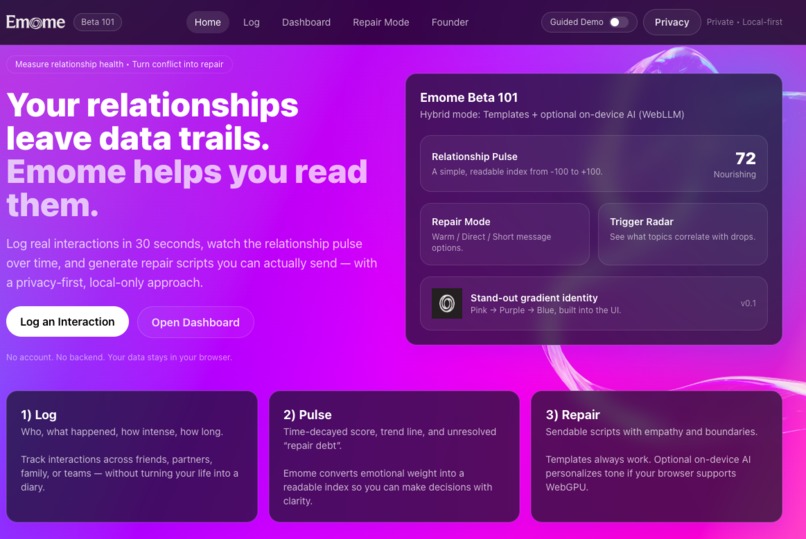
Main Emome interface
-
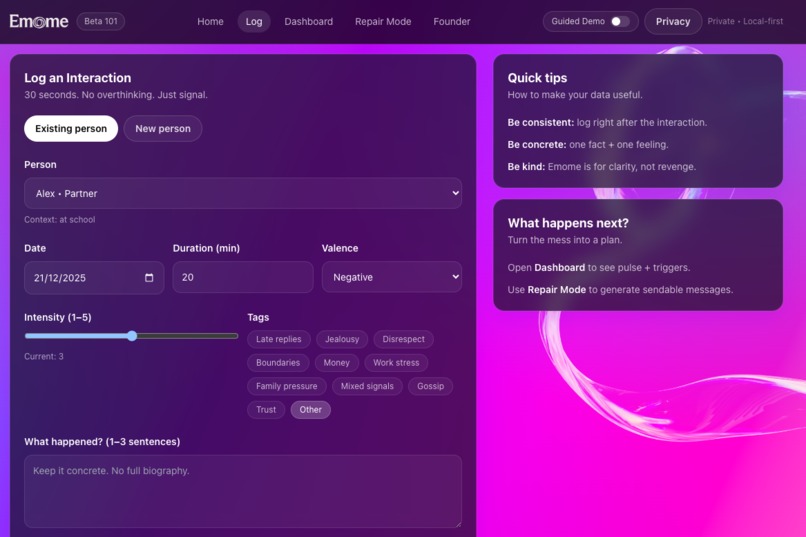
log interaction
-

Emome logo
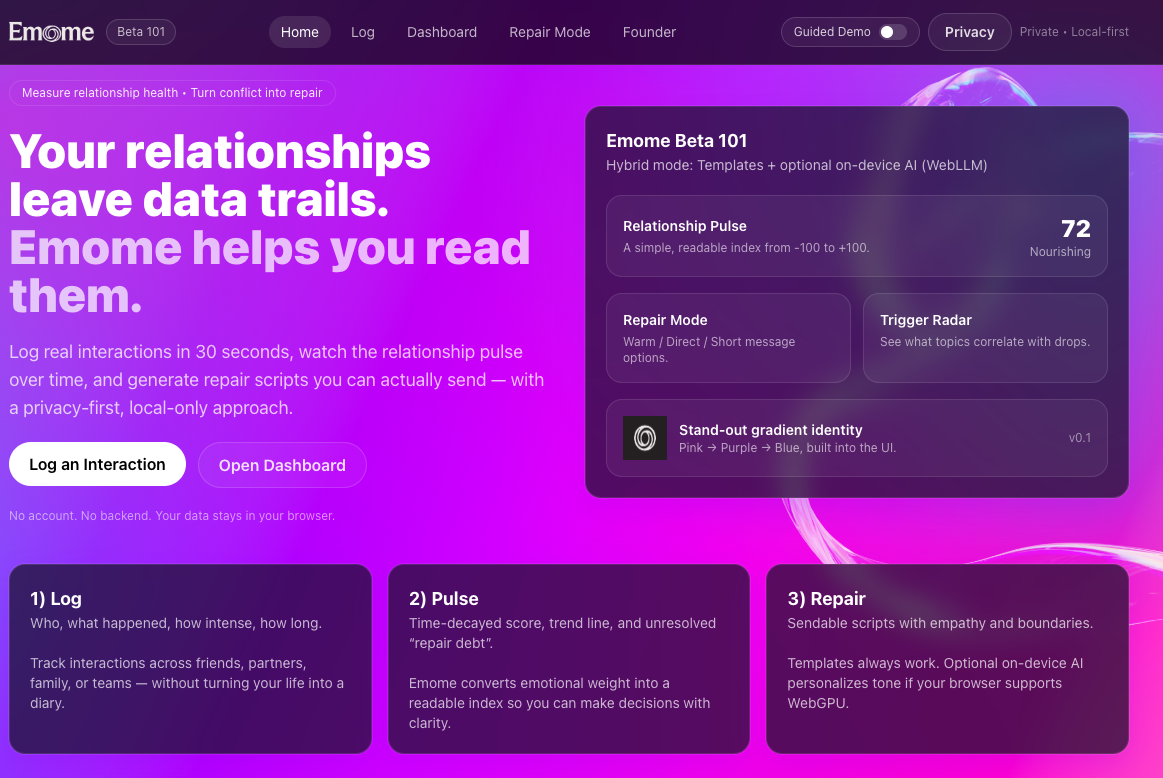
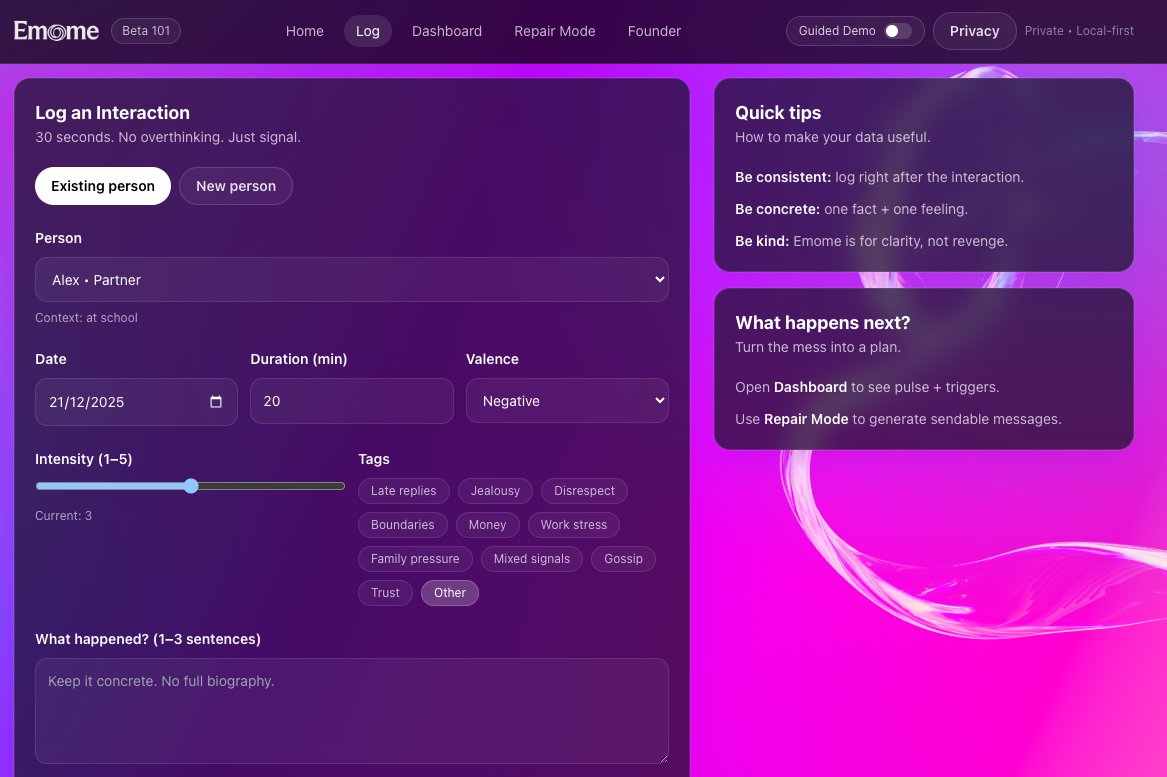
Inspiration
A lot of mental-health tools focus on how you feel today. But most anxiety, burnout, and spirals don’t come from a random bad day , they come from repeated patterns with people: a friend who drains you, a situationship that keeps you stuck, a teammate who triggers constant stress.
I wanted a way to answer a simple question with less bias:
“Which relationships consistently nourish me, and which ones consistently drain me, based on real interactions, not vibes?”
That became Emome: a relationship-first tracker that turns everyday interactions into readable signals, and when friction happens, helps you repair with better communication.
What it does
1) Relationship Pulse (Dashboard)
You log an interaction in ~30 seconds (who, what happened, intensity, duration, and whether it felt nourishing or draining). Emome converts those logs into a Relationship Pulse (a simple index from negative to positive over time) plus trend insights so you can spot patterns early.
2) Repair Mode
When tension exists, tracking alone isn’t enough. Emome generates sendable repair scripts (Warm / Direct / Short) that help you communicate clearly and reduce escalation. With one click, you can Copy a script and send it.
Privacy by design
No accounts. No servers. No data selling. Everything stays in your browser via LocalStorage, and you can reset anytime.
How we built it
Frontend: Next.js (App Router) + React + TypeScript + Tailwind UI: Glass / gradient theme inspired by the pitch visuals; reusable component system (Card / Button / Nav) Charts: Recharts for clean, readable trend visuals Data: LocalStorage persistence with a small state layer so the app works instantly and offline-like Hackathon features:
Guided Demo toggle that auto-loads demo data and shows step hints (Log → Dashboard → Repair)
One-click Copy buttons for scripts and outputs
Privacy modal for transparency and trust
Challenges we ran into
Emome uses a lightweight scoring approach to summarize interactions without pretending to diagnose:
Each interaction contributes a signed “impact” (nourishing vs draining)
Impact is weighted by intensity and duration
Recent events matter more than old ones (time decay) so the Pulse reflects the current dynamic
The goal is clarity, not clinical judgment.
Accomplishments that we're proud of
Making it feel safe: relationship + mental health is sensitive, so we built local-first by default and kept language non-clinical (“not therapy, not medical advice”).
Turning logs into something meaningful: we iterated on the Pulse so it’s simple enough to understand instantly but still captures trends.
Hackathon “demo readiness”: we focused heavily on frictionless demo flows (Guided Demo, demo data, copy buttons, clean navigation) so judges can “get it” in under 60 seconds.
What we learned
People don’t need more tracking, they need interpretation and action.
The strongest mental-health UX is often privacy + speed + clarity.
A tool can be supportive without over-claiming: Emome helps users notice patterns and communicate better, not replace therapy.
What's next for Emome
If we continue Emome after the hackathon:
Add better personalization (custom thresholds, interaction tags, and more nuanced trend signals)
Optional encrypted export/import for user-owned backups
Research-backed categories and wording with psychology advisors
Expand Repair Mode with context-aware scripts and healthier boundary prompts
Built With
- backend-or-api]
- cloud/hosting]
- database]
- framework(s)/library]
- other
- programming-language(s)]


Log in or sign up for Devpost to join the conversation.