Inspiration
The idea started with my love for creating interactive, educational games. I initially drew inspiration from Fun with Flags, a segment from The Big Bang Theory where Sheldon challenges his audience to guess flags before revealing their details. I thought it would be fun to recreate something similar. However, during early testing, a friend suggested expanding beyond just flags to make the game more engaging and versatile. That feedback sparked the idea for Emoji Guesser, transforming it into a broader game with multiple levels and themes.
What it does
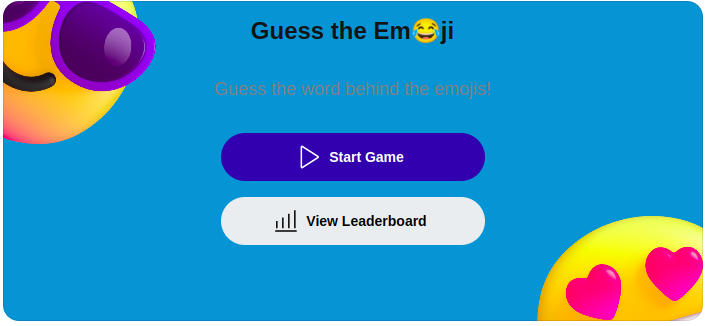
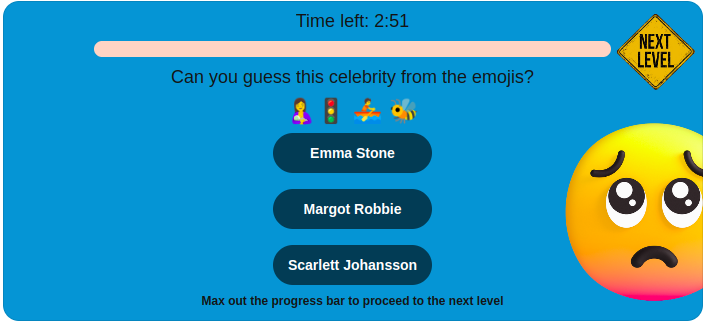
Emoji Guesser is a simple yet addictive guessing game that challenges players to identify the meaning of emojis. In Level One, players are presented with an emoji and must guess its meaning from a list of options. Each correct answer earns the player 500 points. Once they accumulate enough points, they advance to Level Two, where the gameplay shifts: players match a list of emojis to a specific word or concept. The game keeps evolving with higher levels introducing new challenges and themes.
How we built it
I built Emoji Guesser using the Devvit API, which served as the backbone for its integration and functionality. For real-time performance and quick data retrieval, we utilized Redis as a key-value store, enabling efficient tracking of player progress, scores, and level states. The combination of these technologies ensured a smooth and responsive gameplay experience.
Challenges we ran into
Developing a multi-level game posed several challenges. Designing and structuring the progression system between levels required careful thought to maintain a balanced difficulty curve. Another challenge was navigating how users would interact with different parts of the game seamlessly, ensuring that transitions between levels were intuitive and engaging. Additionally, optimizing the use of Redis for storing and retrieving user data in real time was a learning curve.
Accomplishments that we're proud of
I am particularly proud of completing a fully functional game within the limited timeframe. Building a game with multiple levels, user interactivity, and seamless gameplay progression was a rewarding experience. Seeing the game go from an idea to something playable and enjoyable has been incredibly fulfilling.
What we learned
This project taught us a lot, especially about:
Using Redis: It was our first time integrating Redis, and we learned how to efficiently store and manage real-time data for gameplay state and user progress. Game mechanics design: Creating a multi-level system with increasing complexity required us to think critically about user experience and pacing. Seamless navigation: We learned how to handle transitions between different parts of the game in a way that felt natural and engaging for players.
What's next for Emoji Guesser
The game has plenty of room for expansion, and we’re excited about its future. Planned features include:
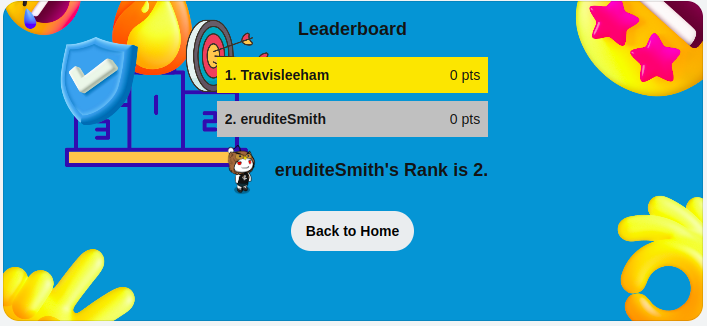
New levels and themes: Each level will introduce unique challenges and gameplay styles, such as trivia, puzzles, or matching games. Multiplayer mode: Adding a competitive or cooperative mode where players can challenge friends. Custom emoji sets: Players can unlock or select themes like pop culture, holidays, or flags to tailor the game to their interests. Global leaderboards: Introduce leaderboards to encourage competition and track high scores.


Log in or sign up for Devpost to join the conversation.