Inspiration
The inspiration for this project came from the urgent need for fast, reliable communication during emergencies. In critical moments—such as accidents, health issues, or safety threats—people often don’t have the time or ability to call or explain their situation. I wanted to build something simple yet effective that could instantly notify a trusted contact with one click.
What it does
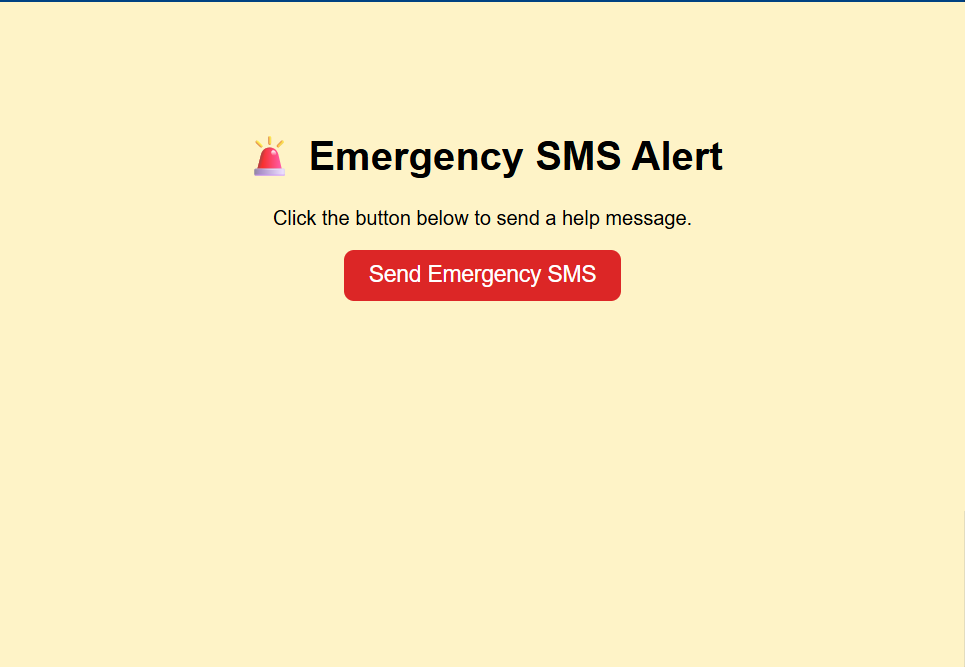
The Emergency SMS Alert System allows a user to send a predefined emergency message via SMS to a trusted contact with the click of a button. The message can include an alert and optionally the user’s location. It provides a quick and accessible way to get help in an emergency, especially when calling or texting manually isn't possible.
How we built it
I used Replit as the online development and hosting platform.
The backend was written in Node.js using Express.js to handle HTTP requests.
Twilio API was used to send SMS messages.
A .env file was used to securely store environment variables such as the Twilio SID, Auth Token, and phone numbers.
The project was kept lightweight and focused, with a clean UI and a single-purpose function—sending an emergency SMS alert.
Challenges we ran into
Replit limitations made it tough to test continuously due to usage restrictions.
Understanding how Twilio works, including number verification and API usage, was initially confusing.
Setting up environment variables correctly and securely took some trial and error.
Making sure the SMS delivery worked with valid, verified phone numbers was a key challenge.
Accomplishments that we're proud of
Successfully sending a real SMS from my own backend code using Twilio.
Integrating multiple tools—Replit, Node.js, and Twilio—to create a functional, meaningful app.
Learning how to protect API keys and work with environment variables.
Completing a project that can genuinely help in emergency situations.
What we learned
How to use the Twilio API to send SMS messages.
How to build a simple backend with Express.js.
How to securely handle .env files and sensitive information.
How APIs work and how to integrate third-party services into a Node.js project.
The importance of simplicity and clarity when designing apps for urgent situations.
What's next for Emergency SMS Alert System
Add user authentication to allow storing multiple emergency contacts.
Integrate geolocation to include the user's current location in the alert.
Add alternative triggers like voice commands or a wearable panic button.
Store message logs and basic analytics using a database.
Improve the UI/UX for mobile users.
⚠️ Note: This version of the Emergency SMS Alert System is a working prototype designed for testing purposes during the hackathon. It demonstrates how Twilio can be used to send emergency alerts, but requires users to input their own credentials manually.
If selected or awarded, I plan to fully develop this into a user-friendly web or mobile application with secure authentication, stored settings, and real-time alerts.
Built With
- dotenv
- express.js
- html/css
- node.js
- replit
- twilio

Log in or sign up for Devpost to join the conversation.