Inspiration
Living in Uttarakhand, I've witnessed the incredible dedication of our emergency response teams and government initiatives like the Uttarakhand State Disaster Management Authority (USDMA) working tirelessly to protect our communities. With Uttarakhand's current population estimated at approximately 1.25 crores and our state's challenging mountainous terrain, there's always room to enhance coordination and response capabilities.
Recent events like the helicopter incident near Gaurikund in June 2025 remind us that even with existing emergency infrastructure, technology can serve as a powerful bridge to enhance coordination between available resources and optimal response outcomes.
What inspired me was the opportunity to complement existing emergency response efforts with intelligent coordination tools. Rather than replacing current systems, my vision is to create a technological bridge that amplifies the effectiveness of dedicated emergency personnel and government infrastructure already in place. The Global Next Generation Emergency Response System Market is projected to reach $3.6 billion by 2030, growing at 6.4% CAGR, while the AI in Disaster Response and Emergency Management Market was valued at $115.4 billion in 2022 and is expected to reach $195.20 billion by 2030. Even more compelling, the Blockchain AI Market reached $8.3 billion in 2022 and is expected to reach $335.8 billion by 2030, exhibiting a remarkable 58.9% CAGR. The future potential is extraordinary: by 2030, intelligent emergency systems could be managing millions of incidents globally, with AI predicting and preventing disasters before they occur, and blockchain ensuring absolute trust in critical response infrastructure. This isn't just about building an app – it's about positioning at the forefront of a technological revolution that will define emergency response for the next decade.
What it does
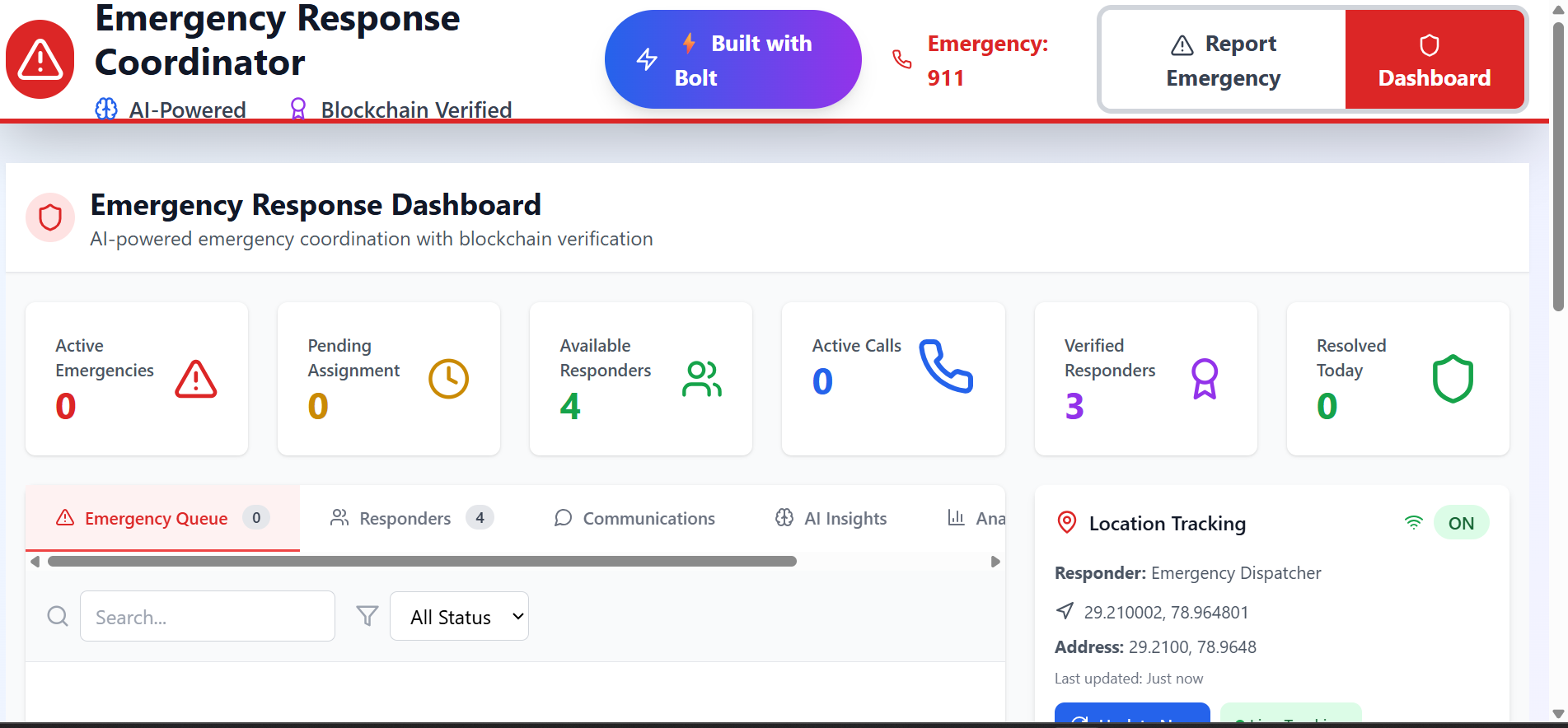
Emergency Response Coordinator is an AI-powered, blockchain-verified emergency management platform that transforms crisis response through intelligent coordination. The system features:
- AI-Enhanced Emergency Classification: Automatically categorizes and prioritizes incidents by type and severity
- Blockchain-Verified Responders: Uses ALGORAND TESTNET to ensure authentic, trusted emergency personnel
- Real-Time Coordination Dashboard: Provides live tracking of emergencies, responders, and resource allocation
- Intelligent Emergency Reporting: Citizens can report emergencies with automatic GPS location and AI-assisted categorization
- Live Analytics & Insights: Tracks response patterns, performance metrics, and optimization opportunities
- Secure Communications: Encrypted messaging between coordinators and field responders
The platform bridges the gap between emergency reporting and response coordination, ensuring faster, more efficient crisis management.
How I built it
I built this project using modern web technologies optimized for rapid development and deployment:
- Frontend Development: Leveraged Bolt.new AI-powered development platform for rapid prototyping and implementation
- Blockchain Integration: Implemented smart contracts on Algorand Testnet for responder verification and incident logging
- AI Classification System: Developed machine learning algorithms for emergency categorization and priority assignment
- Real-Time Features: Integrated GPS tracking, live status updates, and instant messaging capabilities
- Deployment: Utilized Netlify for seamless hosting and continuous deployment
- Database Architecture: Designed efficient data structures for handling emergency incidents, responder management, and analytics
The entire system was architected to be scalable, secure, and user-friendly while maintaining enterprise-grade reliability.
Challenges I ran into
The main challenges encountered were:
- Blockchain Integration Complexity: Implementing Algorand Testnet verification while maintaining fast response times required careful optimization
- Real-Time Synchronization: Ensuring GPS coordinates and status updates sync accurately across multiple users simultaneously
- AI Model Training: Developing an emergency classification system that accurately categorizes diverse incident types with limited training data
These challenges were resolved through iterative testing, code optimization, and leveraging Bolt.new's rapid development capabilities.
Accomplishments that I'm proud of
- Successfully integrated AI classification with blockchain verification in a single cohesive platform
- Created an intuitive, professional interface that emergency coordinators can use effectively under pressure
- Implemented real-time tracking and coordination features that work seamlessly across devices
- Built a scalable system architecture that can handle multiple concurrent emergencies
- Developed a solution addressing a critical global problem with measurable life-saving potential
What I learned
This project deepened my understanding of:
- Blockchain Integration: Practical implementation of distributed ledger technology for real-world applications
- AI/ML in Critical Systems: Building reliable machine learning systems for time-sensitive, life-critical decisions
- Emergency Response Workflows: Understanding the complex coordination requirements in crisis management
- Rapid Development: Leveraging modern tools like Bolt.new for efficient full-stack development
- User Experience Design: Creating interfaces that remain functional under high-stress emergency situations
What's next for Emergency Response Coordinator
Future development roadmap includes:
- Mobile Application: Native iOS and Android apps for field responders
- Advanced AI Analytics: Predictive modeling for resource allocation and response optimization
- Multi-Language Support: Expanding accessibility for global deployment
- Integration APIs: Connecting with existing emergency service infrastructure
- IoT Sensor Integration: Automatic incident detection through connected devices
- Compliance Certification: Meeting regulatory requirements for official emergency service adoption
Built With
- algorandtestnet
- boltai
- csss3
- html5
- javascript
- netlify
- react
- web3

Log in or sign up for Devpost to join the conversation.