-
-
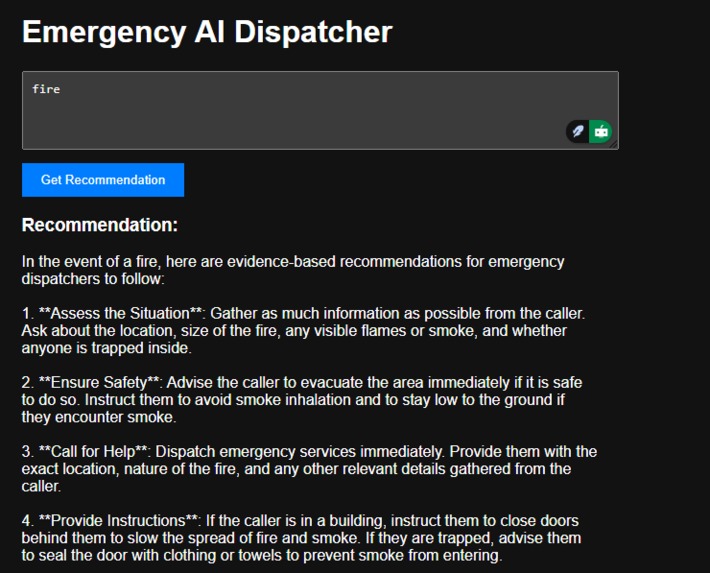
interface
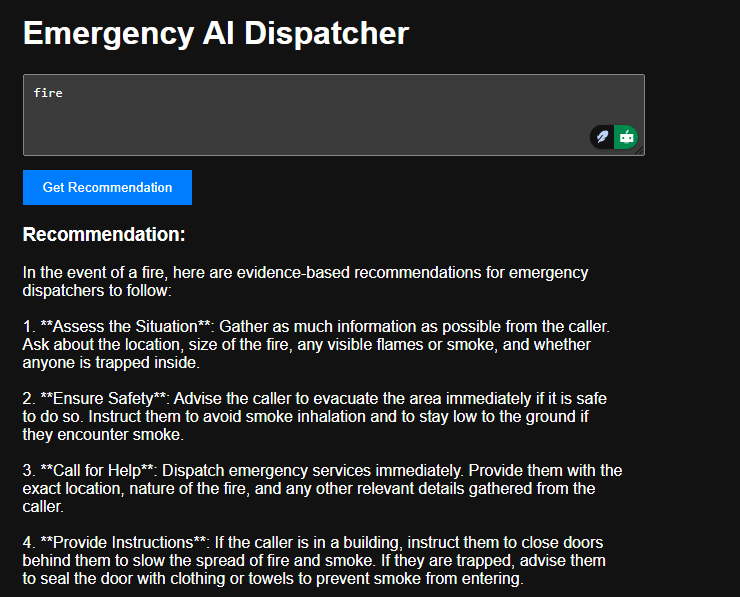
Inspiration Emergency response dispatchers play a critical role in saving lives, but they often face challenges in terms of outdated training, high-stress situations, and the need for rapid decision-making. We were inspired by the idea of using AI to bridge this gap, allowing dispatchers to access real-time evidence-based recommendations for critical emergencies. Our aim was to use conversational AI in order to provide faster, more accurate responses in life-threatening situations.
What We Learned AI Integration: Understanding how conversational AI models can process natural language inputs and generate accurate, actionable recommendations. Emergency Protocols: Researching and learning about various emergency scenarios and the protocols followed by first responders. Human-Centric Design: Designing a user interface that is intuitive, fast, and easy to use in high-pressure environments. API Usage: Implementing OpenAI's API to deliver seamless responses while customizing it for specific emergency contexts. How We Built It Technology Stack:
Backend: Flask for handling API integration and routing Front-end: HTML, CSS, and JavaScript AI Models: Custom conversational AI model with the OpenAI API (CHATGPT-4O-LATEST) for live recommendations and natural language understanding Audio Transcription: Using Whisper API for the live transcription of emergency calls Features Conversational AI interface that would allow dispatchers to input emergency scenarios and receive evidence-based recommendations Audio-to-text transcription for live handling of emergency calls. A predefined knowledge base for quick responses to common emergency scenarios. Development Process:
Phase 1: researching emergency protocols and brainstorming user needs. Phase 2: Developing the backend with Flask and integrating OpenAI’s API for conversational AI. Phase 3: Building the user interface and ensuring smooth communication between the frontend and backend. Phase 4: Testing the prototype with predefined scenarios and edge cases. Challenges Faced Customizing AI in Emergencies: Customizing the AI for prompt, contextually appropriate replies to emergency protocols Constraints of API: Getting out of the limitations and bugs of the API integration model that include deprecation issues along with compatibility issues. Audio Processing: Real-time correct transcription using Whisper API amidst background noise Time-Sensitive: The whole process should be completed in several seconds to be usable for real-time applications.


Log in or sign up for Devpost to join the conversation.