-
-
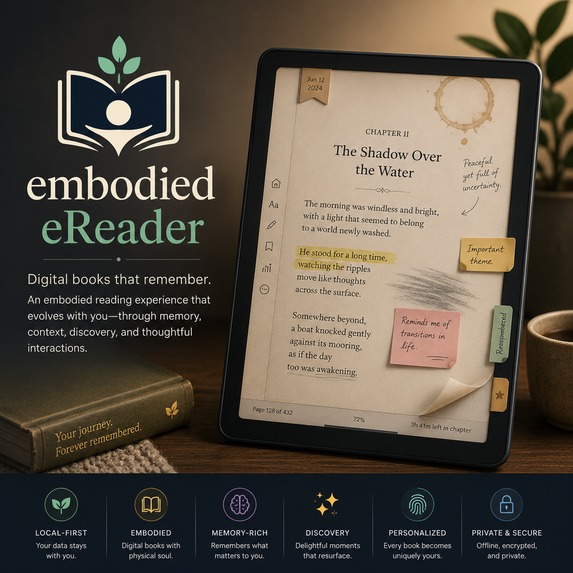
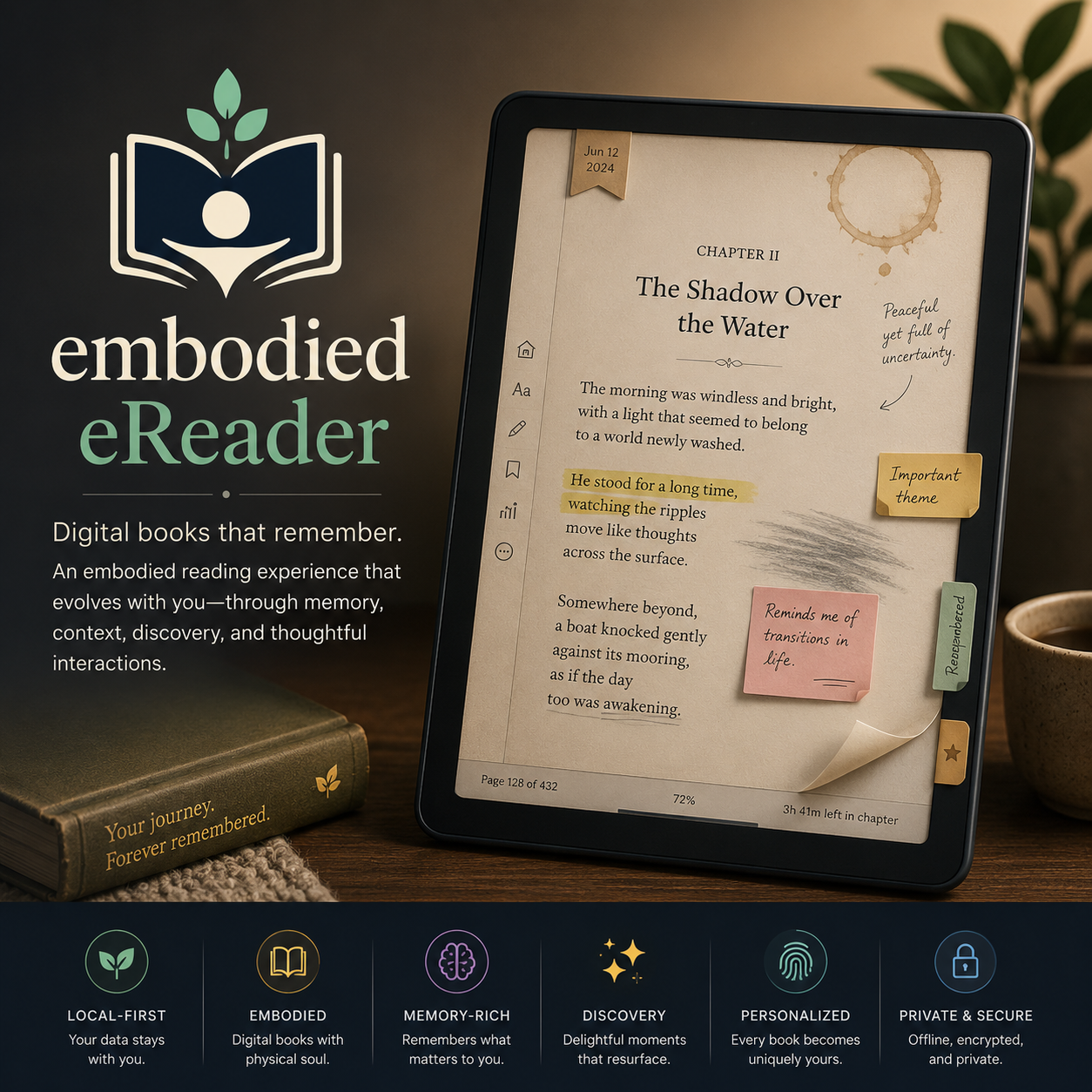
Embodied eReader concept
-
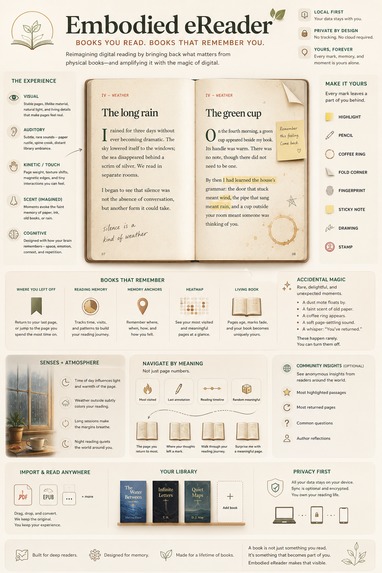
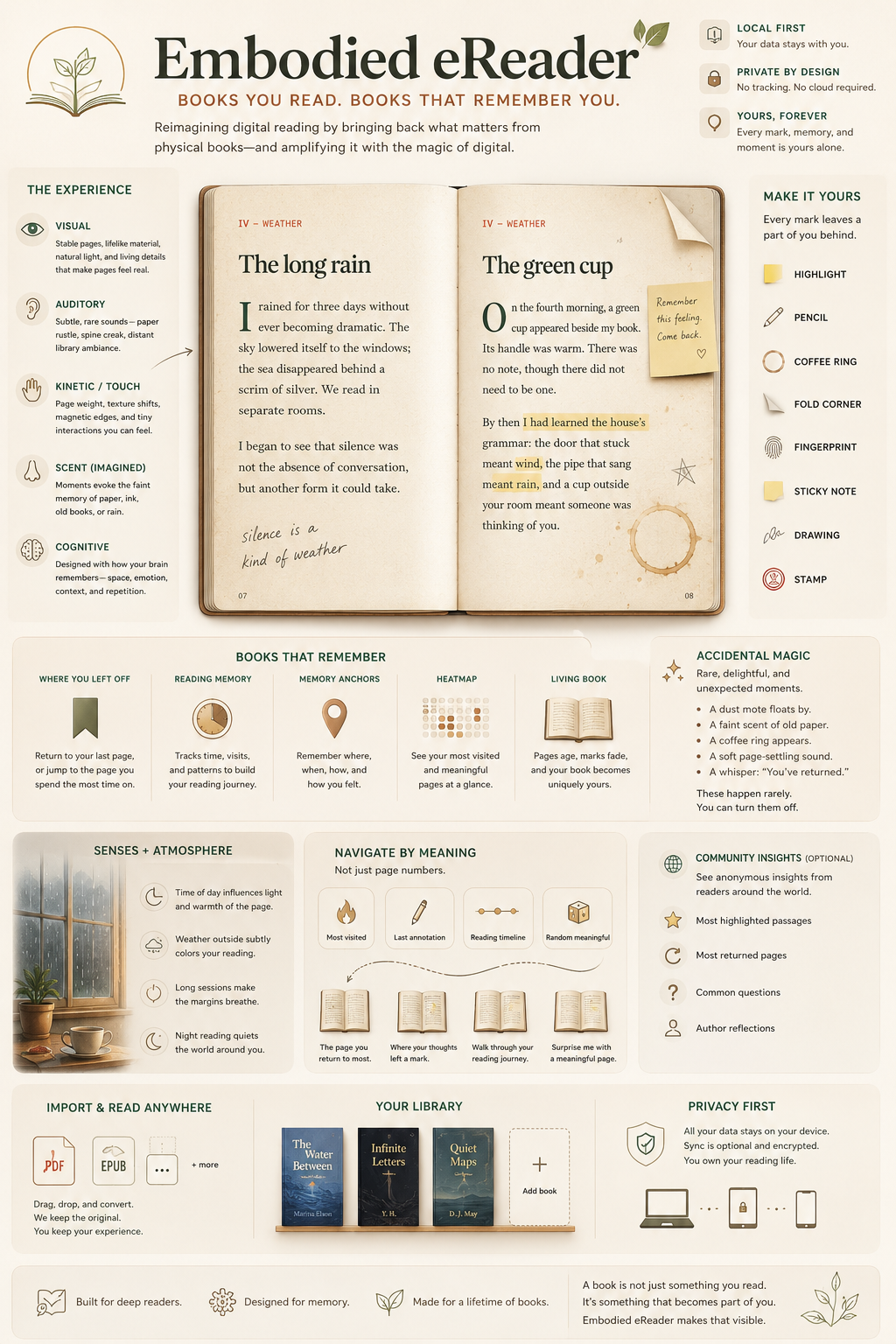
Embodied eReader infographic
-
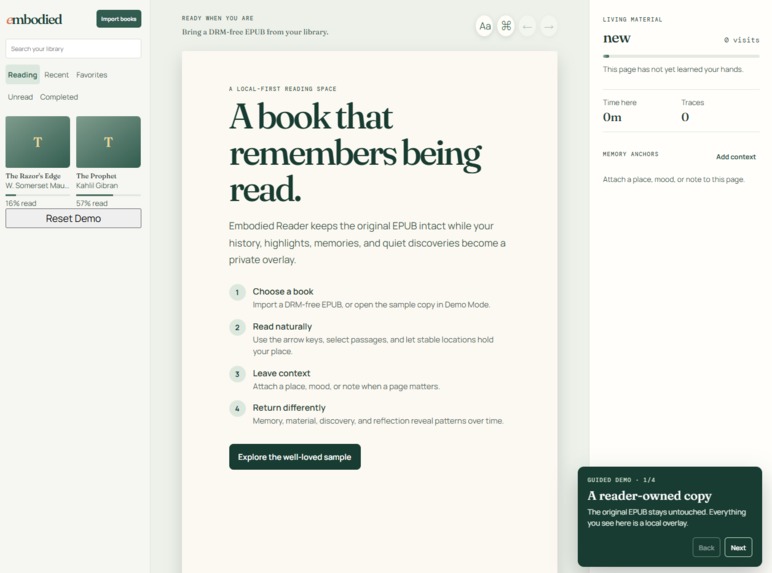
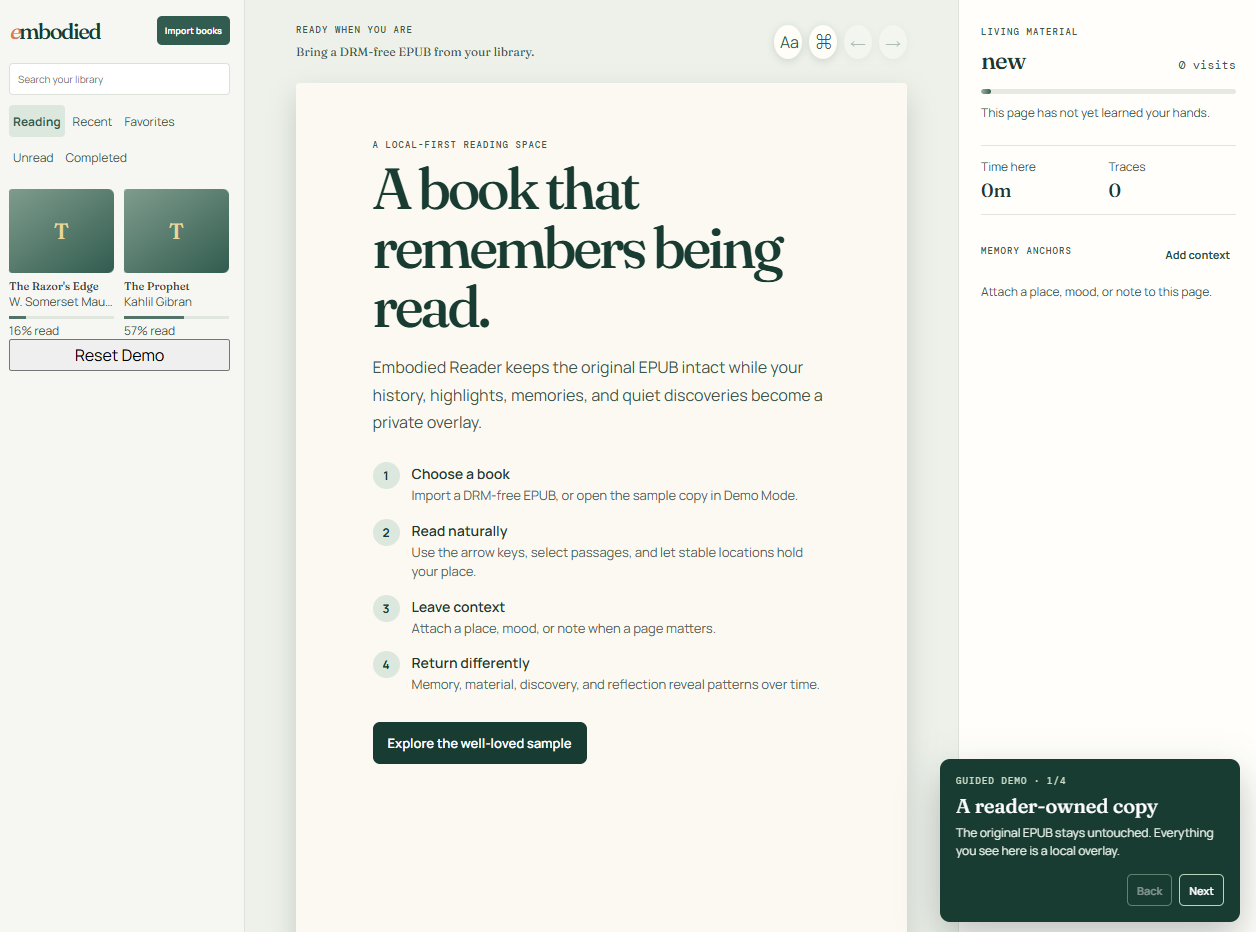
Library view Menu
-
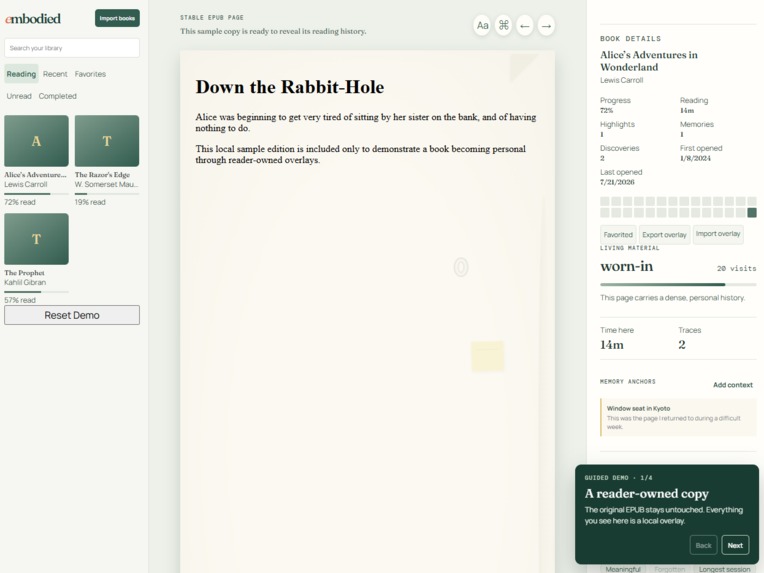
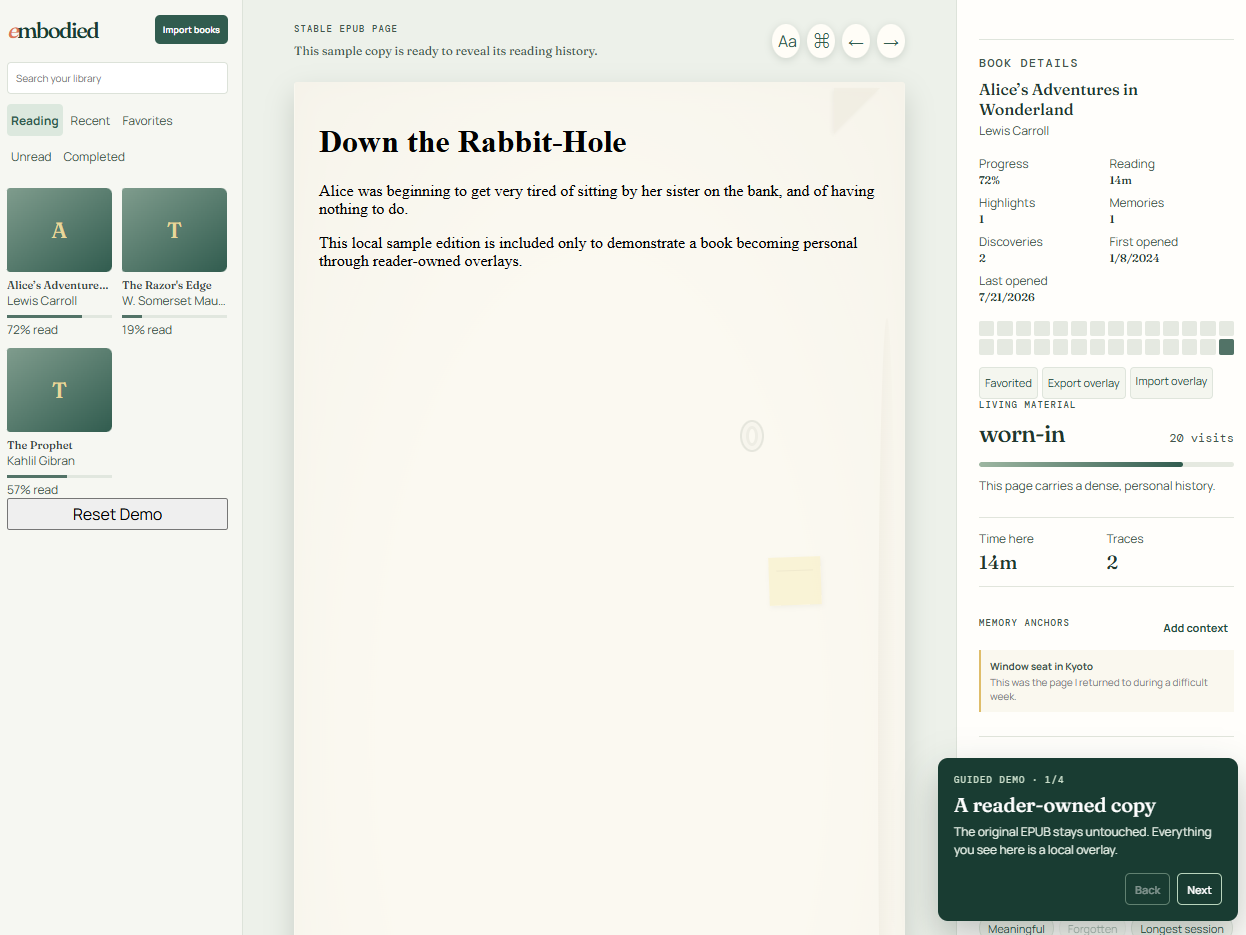
Coffee stain and other artifacts samples
Inspiration
Reading a physical book is a multisensory experience. Over time, a book becomes uniquely yours through folded corners, handwritten notes, coffee stains, favorite passages, and the memories attached to where and when you read it. Those subtle cues help us remember ideas long after we've finished the book.
Modern eReaders excel at displaying text, yet they largely discard these memory cues. They remember the last page you opened, but they rarely remember your journey through a book.
Embodied eReader began with a simple question:
What if digital books could become more memorable than physical books?
Rather than imitating paper, the goal is to rethink digital reading from first principles by combining cognitive science, embodied cognition, human-computer interaction, and AI-ready architecture to create books that gradually become personal artifacts.
What it does
Embodied eReader is a local-first reading platform that separates the original book from the reader's evolving experience.
The original EPUB always remains unchanged.
Instead, the application builds an overlay that stores:
Reading history Stable page identities Highlights and annotations Memory anchors Material state Meaningful page rankings Discovery events Library metadata
As readers spend time with a book, the system derives subtle experiences from their interaction history.
Examples include:
Coffee rings Folded page corners Fingerprint wear Pencil traces Sticky notes Reading heatmaps Familiar pages Rediscovered notes Quiet bookmarks Reading anniversaries Hidden page connections
These are deterministic, local-only overlays generated from reading history. The original EPUB is never modified.
How we built it
The project was designed as a modular architecture rather than a collection of features.
Current stack:
React TypeScript Vite EPUB.js IndexedDB Vitest
The system is organized into independent engines:
Reader Engine for EPUB rendering and stable page identities. Material Engine for persistent physical-like wear derived from reading history. Memory Engine that transforms reading events into meaningful memories. Discovery Engine that reveals rare, deterministic moments instead of relying on randomness. Library Engine that creates a local-first bookshelf with reading history and Book DNA.
Everything is designed around one principle:
The book remains immutable. The reader's experience evolves.
Challenges we ran into
The biggest challenge was resisting the temptation to build "another AI reader."
Instead of adding chat, summaries, or recommendations, the project focused on creating a fundamentally different reading experience.
Another challenge was designing every feature to be:
deterministic local-first privacy-preserving computationally lightweight
Many visual effects that appear spontaneous are actually derived entirely from reading history, making them reproducible without storing arbitrary visual edits.
Balancing subtlety was equally important. The interface should never distract from reading. Every interaction exists to support memory, not compete with it.
Accomplishments that we're proud of
We built a working local-first embodied eReader that goes beyond displaying text. By combining persistent memory, material interactions, discovery, and cognitive design, we created a new reading experience while keeping the original EPUB completely unchanged.
What we learned
Building Embodied eReader reinforced that digital experiences do not need to imitate physical ones to feel human.
Instead, digital systems can create entirely new forms of memory by combining persistent context, gentle sensory cues, and long-term interaction history.
We also learned the value of treating architecture as a foundation. Separating rendering, overlays, memory, discovery, and material simulation made it possible to extend the platform without changing the underlying book format.
What's next for embodied eReader
Our vision extends well beyond the current MVP.
Future milestones include:
PDF support using the same overlay architecture Ambient sensory engine with lightweight procedural sound and visual cues AI-powered personal knowledge graph connecting ideas across books Cross-book memory retrieval Import/export of personal overlay data Optional synchronization while remaining local-first by default Plugin architecture for new reading experiences
Ultimately, we hope to create a reading platform that remembers not only what you read, but also why it mattered.
Embodied eReader transforms digital books into living memories.
Built With
- api
- audio
- codex
- cognition
- css3
- epub
- epub.js
- ereader
- github
- html5
- indexeddb
- javascript
- local-first
- memory
- npm
- offline-first
- openai
- react
- typescript
- ux
- vite
- vitest
- web

Log in or sign up for Devpost to join the conversation.