Inspiration
After a fire, crews still have to reconstruct an incident from memory while the details already exist across helmet cameras, radio traffic, scene photos, dispatch records, and follow-up notes. EmberTrace explores a safer way to reduce that administrative burden without asking an AI to make operational, medical, or legal decisions.
What it does
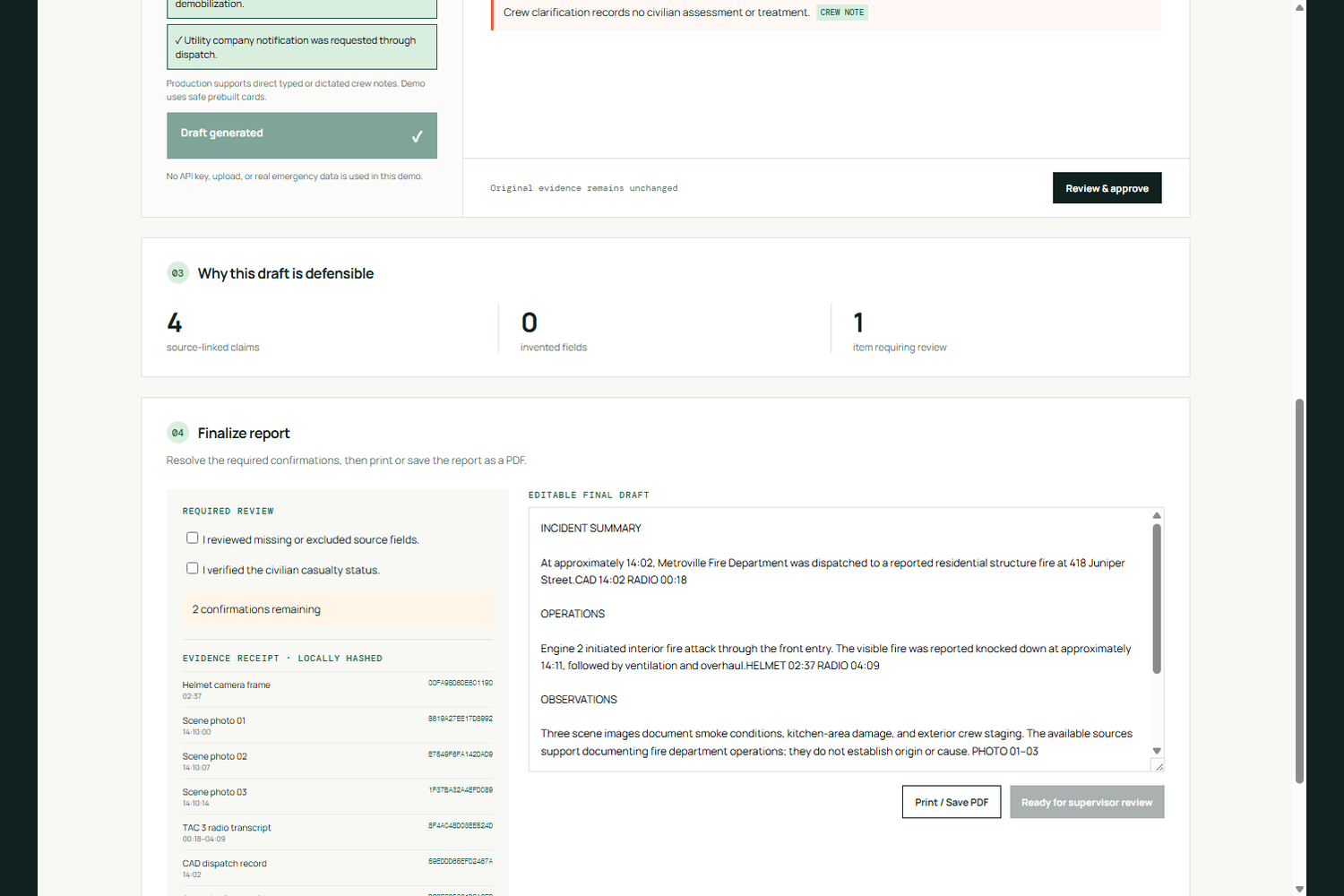
EmberTrace cross-checks a simulated, de-identified structure-fire case and creates a reviewable incident-report draft. Every supported claim is linked back to the source that supports it. If a fact is not supported, it remains visibly marked REVIEW REQUIRED instead of being guessed.
A reviewer can inspect the underlying evidence, add attributed crew clarifications, and generate a local SHA-256 evidence receipt. Two human confirmation checks are required before the draft is marked ready for supervisor review. The prototype never auto-submits, determines origin or cause, or replaces agency policy.
How we built it
The demo is a dependency-free Node.js static application. Local JavaScript drives evidence selection, rule-based drafting, citations, review states, and browser-side SHA-256 fingerprints. Simulated camera, radio, photo, and CAD assets are bundled so judges can run the workflow offline with no account, API key, upload, external model call, or real emergency-service data.
Codex with GPT-5.6 accelerated the workflow design, evidence-first interaction model, safety boundaries, guided demo, test coverage, and submission package. The key product decision was to optimize for defensibility rather than fluent text generation: evidence in, human judgment out.
Challenges
The hard part was making uncertainty useful. A polished report that silently fills gaps is dangerous in a public-safety workflow. We designed the draft to preserve unknowns, keep sources inspectable, and make approval impossible to bypass.
What we learned
AI assistance is most credible when its limits are as visible as its output. For safety-critical documentation, traceability and human review are product features, not disclaimers.
AI adapter and test path
The complete workflow is testable without money or an API key: the AI-adapter control runs a visibly labelled local simulation, never presented as a GPT response. It accepts selected simulated evidence and a redacted crew clarification, then preserves source links and mandatory human review. When an agency configures an OpenAI key only on its server, the same adapter uses GPT-5.6 Terra for structured drafts. The browser never receives the key, and model output cannot bypass citation or approval gates.
Built With
- codex
- gpt-5.6
- javascript
- node.js
- sha-256

Log in or sign up for Devpost to join the conversation.