Inspiration
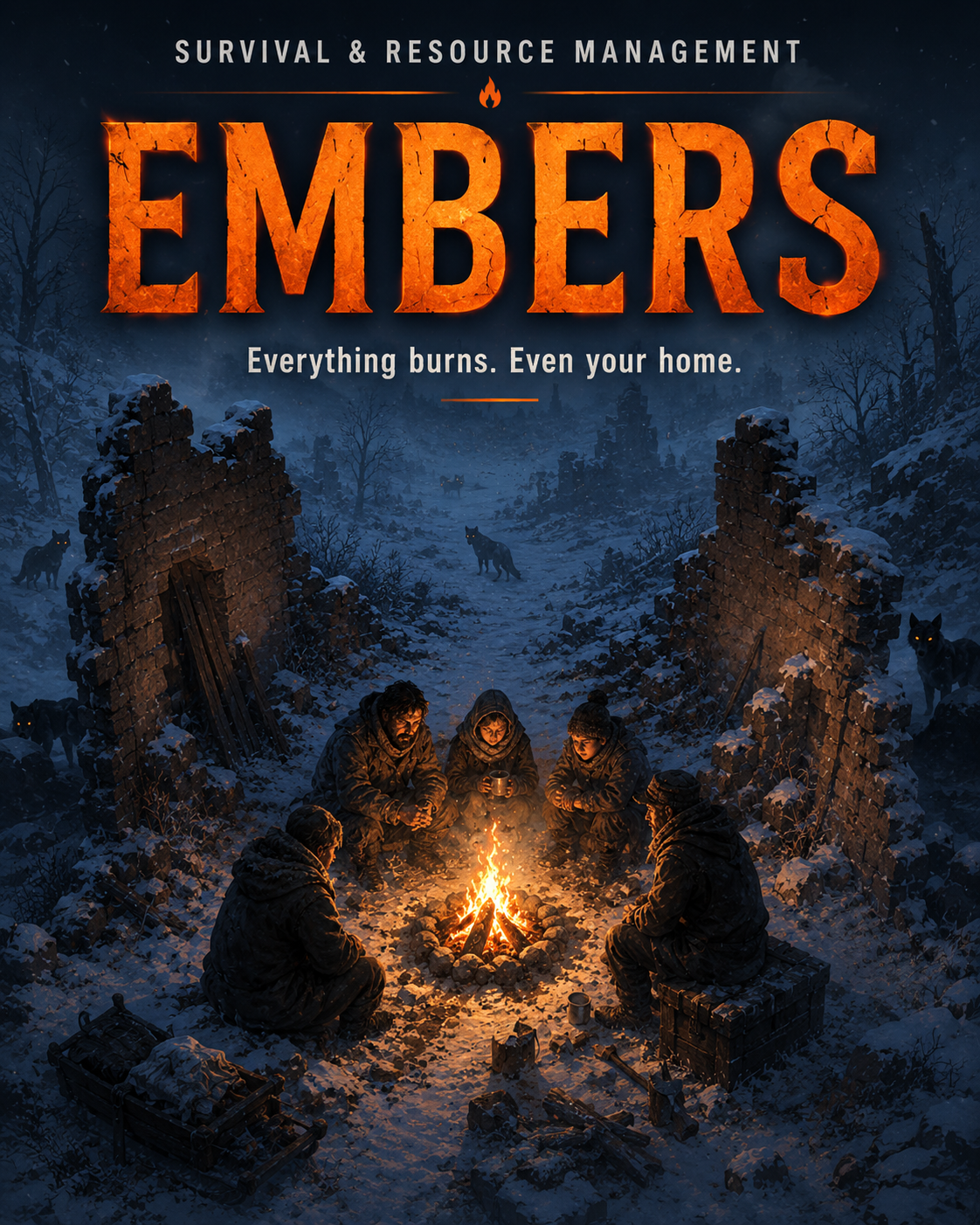
Everything burns. Even your home.
Most survival games ask what you will build next. I wanted one that asks what you can stand to lose.
EMBERS began with a single image: a small fire in a freezing dark, and the moment you realize the only fuel left is something you care about. It treats survival as a human, emotional experience, where the pressure comes from the people around the fire and the choices you make for them, not from a depleting stat bar.
What it does
EMBERS is a real-time, top-down survival game built on one rule: every item has a use value and a burn value, and burning it costs you that use forever.
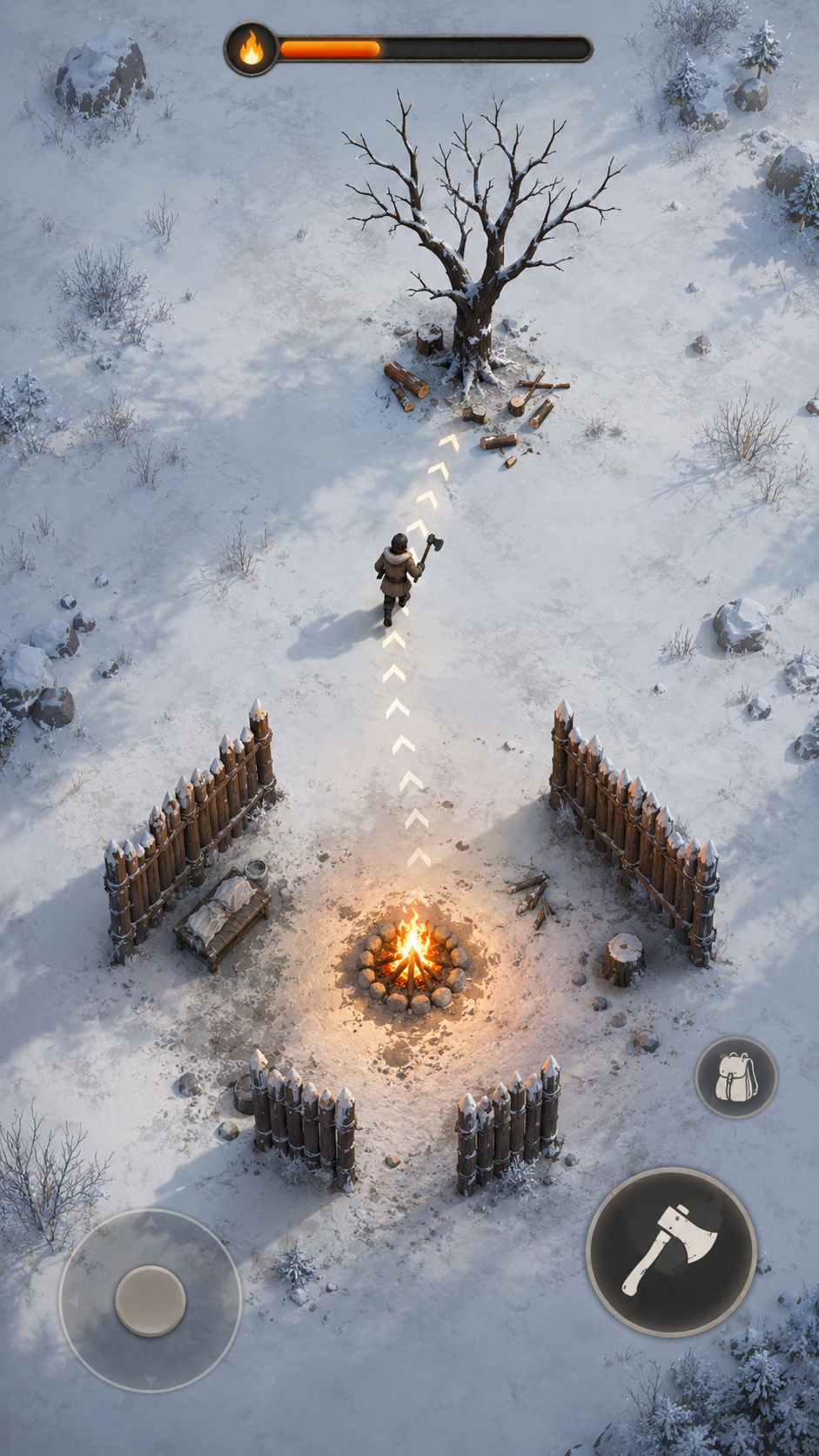
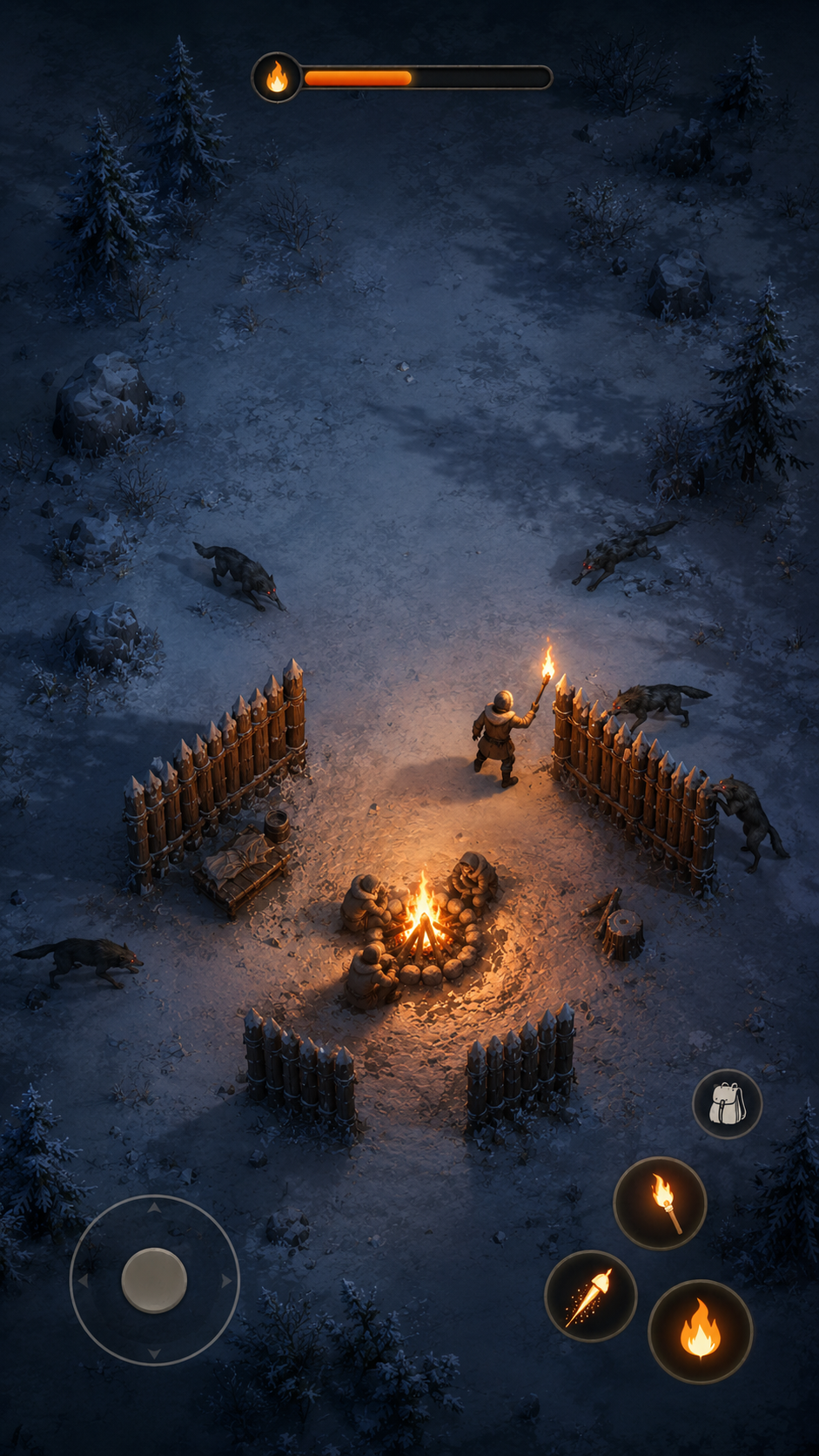
By day you move your survivors, gather wood, craft, and reinforce the walls. By night the camp huddles at the fire while the cold drains it and wolves press in from the dark. When the wood runs out, you decide what to feed the flames:
- 🪓 A tool · the whole camp gathers slower for the rest of the run.
- 🧱 A wall · a side of the camp stays open for good.
- 📦 A supply part · the help you signaled for slips further away.
- 🧑 A survivor's keepsake · that named person walks into the dark and does not return.
Difficulty comes from your own choices, not from random events.
How we built it
This is a design-first submission: a Game Design Document, a Player Journey Map, a Visual Concept Package, and a Production Plan, backed by a playable browser prototype of the core loop.
It is designed for Meta Horizon's mobile client as a real-time, top-down, single-player 3D experience, with every system mapped to a mechanism the engine provides:
- A small 3D scene with a tap-to-move avatar and a fixed top-down camera.
- A dynamic point light for the fire, whose reach and warmth track the heat.
- A deterministic simulation on a fixed tick for heat, wolves, and walls.
- A Custom UI overlay for the HUD and the burn confirm.
The Production Plan lays out build sequencing, MVP scope, dependencies, and how the core loop is tested before full production.
Challenges we ran into
The hardest balance was keeping a loss-heavy loop tense without making it feel punishing. The answer is fair, authored failure: nothing bad happens that you did not let happen, paired with the relief of a wall held or a survivor kept.
As the game grew to include crafting, a supply objective, and escalating nights, the real challenge became adding depth without diluting the core. Every new system had to give the player one more meaningful thing to burn, never a separate game to manage. Tuning the night, the wolf pressure, the heat decay, and the true cost of burning, took the most iteration.
Accomplishments that we're proud of
A premise that fits in one line, backed by a single mechanic that ties the resource economy to an emotional one.
Restraint did the heavy lifting: one currency, one gesture to move, and one light source produced deeper decisions than a wall of systems would have. The documents and the prototype share one rule, one palette, and one voice, so the whole submission reads as a single game rather than a stack of separate files.
What we learned
Designing EMBERS taught us more about how to design a game than about any single feature:
- 🎯 Start from a question, not a feature list. "What can you stand to lose?" guided every decision, and kept the scope honest.
- 🧱 One strong rule can carry a whole game. The use-versus-burn rule grew the economy, the tension, and the story on its own, with no extra systems bolted on.
- ✂️ Design by subtraction. We judged each new idea by one test: does it give the player one more meaningful thing to burn? If not, we cut it.
- 💡 Decide the feeling first, then the numbers. We chose how a moment should feel (loss should hurt, a wall held should feel earned), then tuned the mechanics to deliver it.
- 🛠️ Prototype the core early. A rough, playable loop taught us more in a day than another page of design notes could.
What's next for Embers
Next, EMBERS becomes a fully remixable Meta Horizon world. The goal is to ship it not only as a game to play, but as an open, documented template that other creators can clone, reskin, and build on directly inside Meta Horizon Studio:
- 🧩 Remixable by design. The burn rule, survivor roles, escalation curve, and craft set are exposed as clean, reusable building blocks. A creator can drop in their own setting, a sinking ship, a dying space station, a haunted house, and keep the core dilemma intact.
- 🧑🤝🧑 A growing camp. Up to eight named survivors, each with a role and a keepsake the fire can take.
- ❄️ Eternal Winter mode. A pure endless run where the only score that matters is how many nights you lasted, and what you burned to last them.
- 🐺 Meaner nights. Alpha wolves and blinding whiteouts that shrink your light.
- 🤝 Up to eight-player co-op. Each player takes one of the camp's named survivors, so the whole story cast can share a single fire and face the same impossible choices together, deciding as a group what (and who) to burn.
Single-player stays the heart. Everything new, including the remixable toolkit for Meta Horizon creators, exists to let more people feel the burn, and to let them make their own version of it.
Built With
- horizon
- meta
- metaai
- typescript


Log in or sign up for Devpost to join the conversation.