🔥 Embero: Autonomous AI & IoT System for Early Wildfire and Industrial Fire Detection 🌲 1. Inspiration: A Systemic Blind Spot Costing Millions Every summer in Montenegro, I watch helplessly as fires consume thousands of hectares of forest around my home in Donji Kokoti — one of the most chronically fire-affected areas near the capital, Podgorica. For me, this was never abstract statistics; it was smoke in my lungs and ash in my yard.
The numbers tell a devastating story: Montenegro loses over €100 million annually to forest fires, and between 2011 and 2023, 190,348 hectares of land were destroyed. To put this in perspective, Serbia, which is seven times larger, suffers ten times fewer fires — proving that Montenegro's vulnerability is a systemic failure, not a geographic inevitability.
But what truly sparked Embero was a conversation I had while conducting field research for the BIT Problem First startup validation program (IPC Tehnopolis). Talking directly with firefighters, forest rangers, and local residents revealed something no statistic could capture: the system is completely blind until someone happens to see smoke near their house.
Fires that start deep in forests or on industrial storage yards go unreported for 30 to 60 minutes or more. By the time emergency services are called, firefighters arrive to find an already massive blaze — without knowing its size, direction of spread, or how many resources to deploy. The head of a local fire station told me directly, without any prompting: "The single biggest thing that would help us is an early fire detection system."
Embero was built to solve exactly this.
🤖 2. What Embero Does: From Reactive to Proactive Embero is a multi-tiered hardware-software ecosystem that shifts wildfire management from reactive disaster response to proactive early detection. It operates through four interconnected pillars:
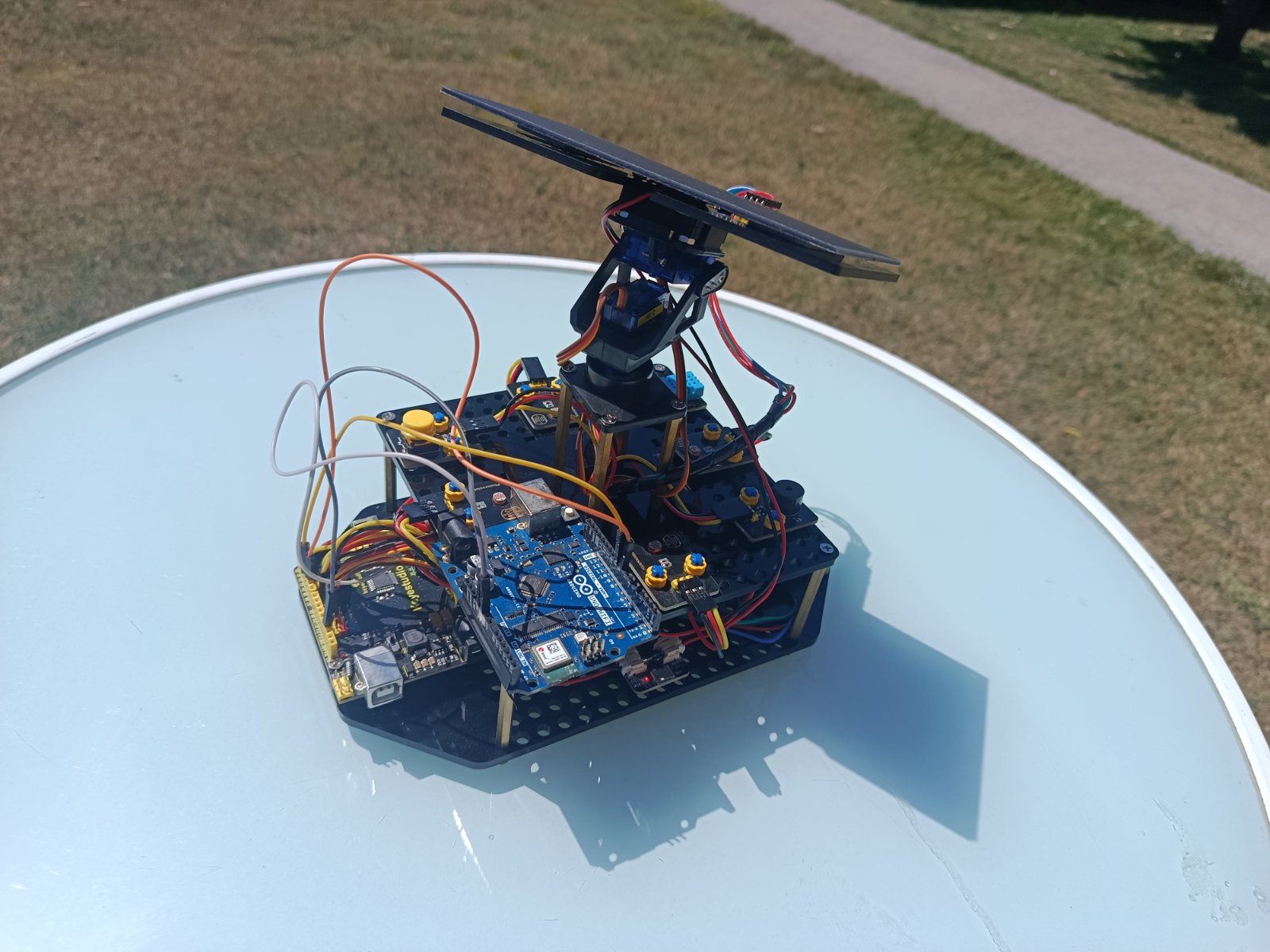
- Solar-Powered Smart Sensor Stations (24/7 Ground Grid) Decentralized physical stations deployed in high-risk zones continuously monitor environmental micro-climates. They track sharp spikes in temperature, drops in humidity, and anomalous increases in CO 2
and smoke particulates — even under dense forest canopy where visual detection is impossible.
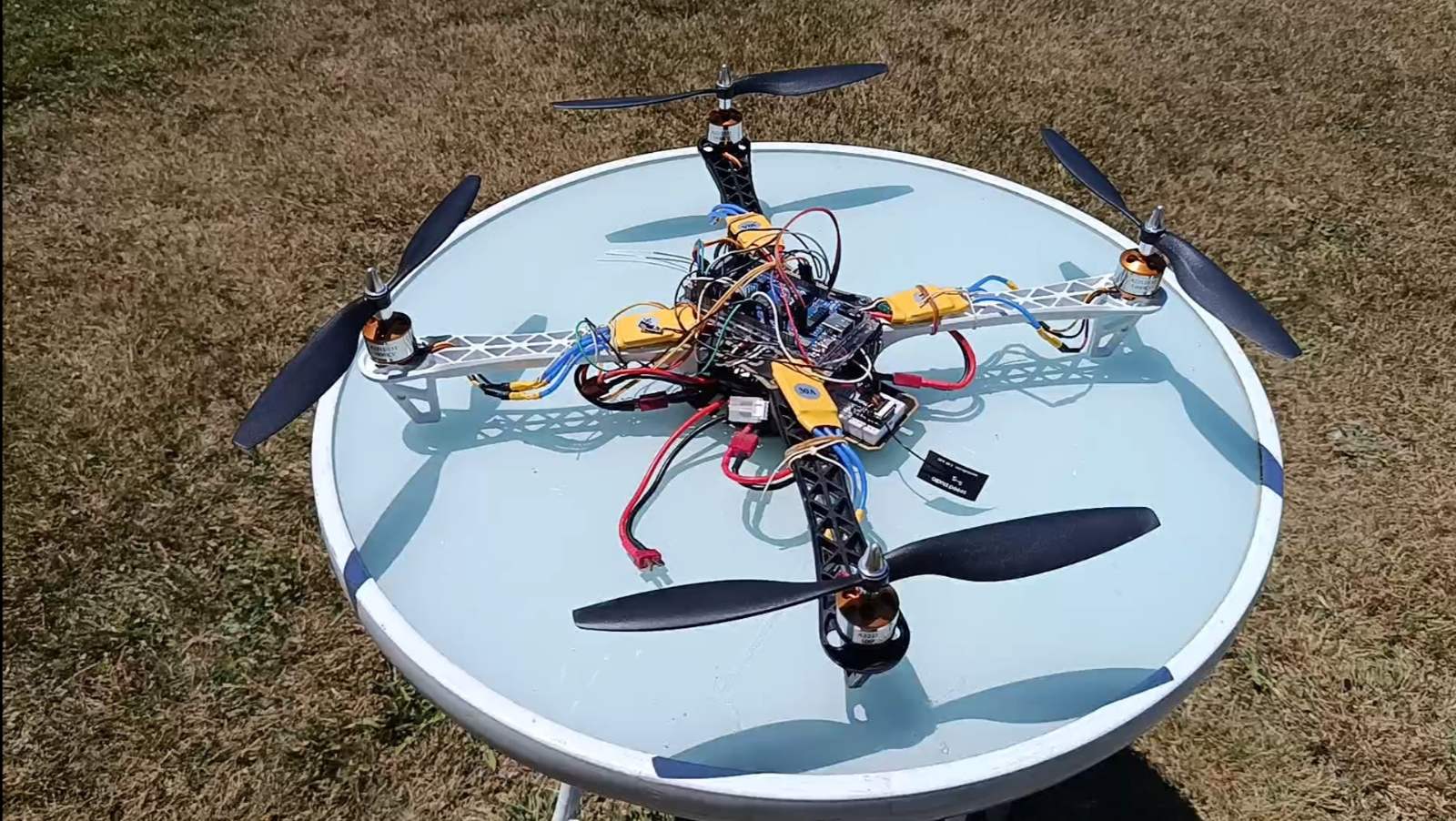
Multi-Tiered Autonomous Drone Fleet (Aerial Shield) When ground sensors log anomalies, the system triggers targeted drone missions to visually verify risks before escalating alerts — eliminating costly false alarms that drain public trust and emergency resources. The fleet includes "tethered" drones for continuous factory perimeter monitoring, small drones for rapid reconnaissance, and large drones for missions in harsh weather.
YOLOv8 Edge & Server AI Vision Pipeline Video feeds from drone RGB and thermal cameras pass through a custom-trained YOLOv8 model on a Jetson Nano edge computer. The AI distinguishes actual smoke and flame patterns from mountain fog, clouds, and road dust. Temporal persistence validation requires detection across 5 sequential frames over a 5-second window before triggering alerts.
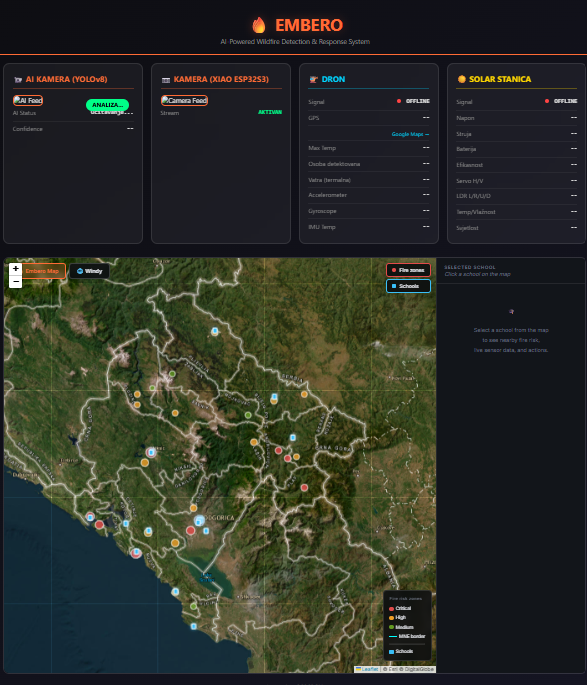
Human-in-the-Loop Dashboard All data flows into an interactive dashboard for authorized operators (fire coordinators, forest rangers). The AI handles heavy cognitive processing — mapping fire vectors, tracking GIS propagation, calculating required resources — but a human expert confirms and escalates every alert. No automated evacuations. No public panic. Just precise, actionable intelligence delivered at the right moment.
🛠️ 3. Technical Architecture: Built for Harsh Realities The technology is designed to survive and function where state infrastructure does not.
Ground Sensor Station Core: ESP32-S3 microcontroller with a LoRaWAN RN2483 868MHz transceiver for long-range data transmission completely independent of cellular networks — critical in Montenegro's mountainous north where 4G/5G coverage does not exist. Sensors: SHT31 (temp/humidity), Senseair S8 NDIR ( CO 2
), Sharp GP2Y1010AU0F (optical dust/smoke), MLX90640 (thermal array). Power System: LiFePO 4
batteries paired with a 20–30W solar panel. This chemistry was chosen for thermal stability in extreme summer heat (+60°C). Smart Sampling Algorithm: During stable conditions, the station enters deep sleep, transmitting once every 15 minutes. If a CO 2
delta spike exceeding 50 ppm/min is detected, it switches to Emergency Power State with 30-second transmission loops. Cost: €138–€208 per station. Drone Fleet & Autonomy The reference implementation uses a Titan Hornet VTOL (Vertical Take-Off and Landing) airframe with a Pixhawk flight controller running ArduPilot. The drone is housed in an automated, all-weather roof enclosure. Upon cross-validated ground risk confirmation, the bay opens, and the drone executes an autonomous flight path (via MAVSDK/DroneKit) to the suspect GPS coordinates, hovers to capture visual/thermal data, and automatically returns to base (RTL).
AI Server & Backend The operations center backend is built in Python (FastAPI), with a real-time PostgreSQL + PostGIS database for geospatial fire tracking. The system utilizes multimodal data fusion — combining ground chemical sensor data with visual AI detection — to reduce the false positive rate to under 2%.
💼 4. Business Plan: Dual-Track Market Strategy Embero is designed to be financially self-sustainable from day one, without relying solely on slow government procurement cycles.
B2B Sector (Primary Revenue Driver) Wood processors, pellet plants, and luxury resorts (e.g., Porto Montenegro, Luštica Bay) face massive risks. Incidents like the fire at the "DOO Jasen" pellet plant (Pljevlja, 2026) caused over €1,000,000 in damages.
Model: One-time hardware sale ("Perimeter Shield" package) + mandatory monthly SaaS subscription for AI monitoring. Pricing (Embero Full Perimeter): 20 stations + 1 tethered drone + 2 small drones = €8,000–€12,000 (CapEx) + €400–€600/month (SaaS). ROI Argument: A SaaS subscription of ~€400/month is negligible compared to the cost of a night guard (~€1,100/month) or the potential 20-30% reduction in annual insurance premiums. B2G Sector (Secondary, Stabilizing Revenue) Instead of selling expensive hardware to the government, we offer state institutions (Forest Administration, Emergency Services) an annual software license to access the dashboard and data from the privately funded sensor network (€2,000–€5,000/year per municipality).
Geographical & Sectoral Expansion Beyond the hardware, Embero offers a pure SaaS platform (API and Dashboard) for clients who already possess their own hardware (meteo stations, energy companies, insurance firms). The strategy expands from the Western Balkans (Serbia, BiH, Albania) by 2028, with projected SaaS-only revenues reaching €960,000 by Year 5.
📊 5. Competitive Advantage & Financial Justification Traditional outdoor fire protection requires expensive thermal cameras on poles (over €20,000 to cover a 5,000 m² industrial yard) and extensive trenching for cables. Embero’s wireless LoRaWAN system costs €5,000–€12,000 for the same area and operates entirely off-grid.
On a macro level, a complete national network of 4,000 sensor stations would cost approximately €725,000. This investment represents less than three days of Montenegro's average annual wildfire damage (€100M) and is exponentially cheaper than renting a single firefighting aircraft for a month.
📚 6. Challenges & Lessons Learned False alarm elimination was the single hardest technical challenge. Mountain fog, campfire smoke, and certain cloud formations produce visual signatures similar to wildfire smoke. I solved this through a multimodal fusion approach: requiring simultaneous confirmation from ground chemical sensors ( CO 2
- particulates), RGB visual detection, and thermal anomalies.
Through customer discovery interviews (e.g., with the "DOO Trudbenik" sawmill in Mojkovac), I learned that companies do not resist technology due to distrust, but because they don't know it exists or what it costs. The director spontaneously told me: "I agree with you about the system... We need more fire alarms in Podgorica for storage yards." This confirmed that Embero fills a recognized gap.
I also learned the critical importance of designing for human trust. Early versions of the alert logic were fully automated. After conversations with fire station operators, I redesigned the entire pipeline to require human confirmation at every escalation point. An AI that operators do not trust is an AI that gets turned off.
🌍 7. Real-World Impact Embero is not a theoretical concept. The hardware prototype is functional and tested. The problem has been validated through official reports from Montenegro's State Audit Institution (DRI) and direct interviews with firefighters and the wood-processing industry.
The system is designed to integrate directly into existing emergency response infrastructure, not replace it. Fire coordinators keep full control. Firefighters get better information faster. Residents in fire-prone communities get a layer of protection that currently does not exist.
Montenegro lost 190,348 hectares of forest in 12 years. Embero's goal is to make that number smaller — one early alert at a time.
Built by Luka Paderni | Montenegro | BIT Problem First 2026 Tech Stack: ESP32, LoRaWAN, ArduPilot (C++), Python FastAPI, PostgreSQL/PostGIS, YOLOv8 (AI/ML)
Built With
- 868mhz
- ai
- amg8833
- backend
- battery
- computer
- dashboard
- embedded
- esp32-s3
- fastapi
- flight
- flir
- frontend
- github
- gp2y1010au0f
- hardware
- html/css/javascript
- jetson
- leaflet.js
- lepton
- lifepo?
- lorawan
- mapbox
- nano
- ndir
- opencv
- panel
- pixhawk
- postgis
- postgresql
- python
- rn2483
- runcam
- s8
- senseair
- sharp
- sht31
- solar
- vision
- yolov8

Log in or sign up for Devpost to join the conversation.