-
-
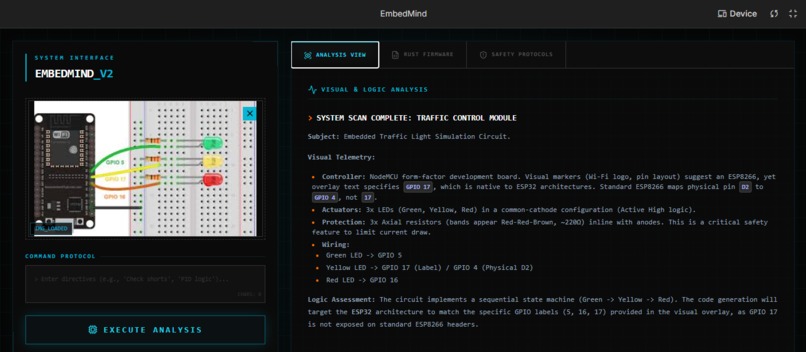
This shows the analysis view menu where the app analyses your prompt and/or picture to determine the the type of circuit
-
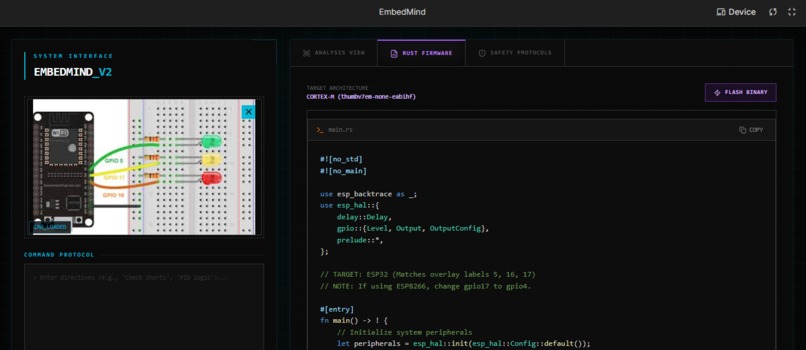
This is the menu that displays the rust code generated based on your prompt and/or image
-
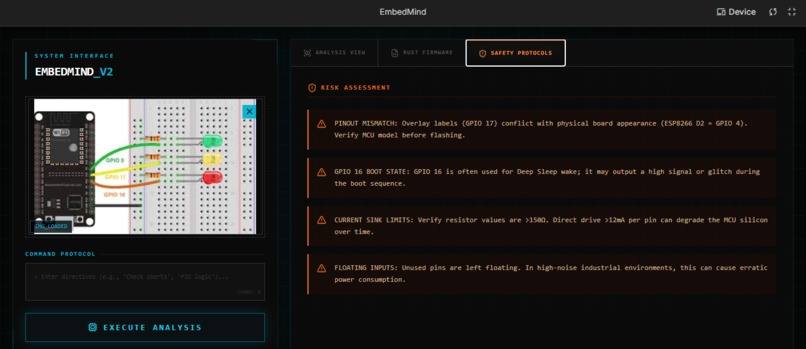
This is the menu that shows suggestions on safety protocols to take in relation to your circuit
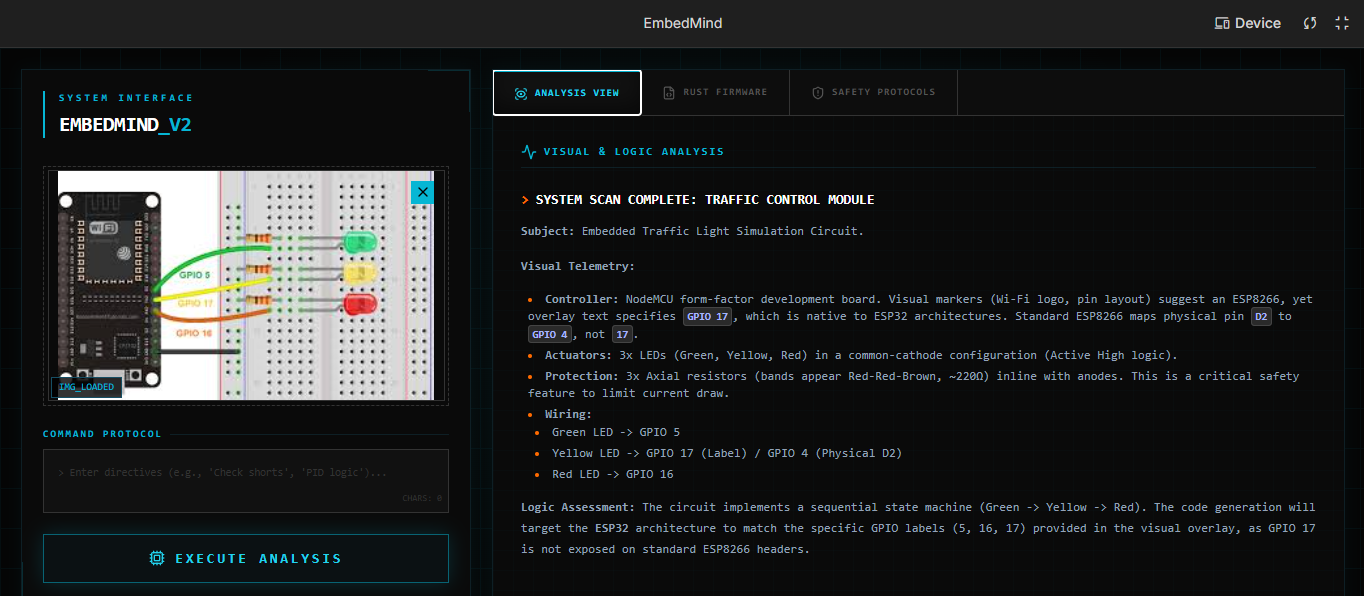
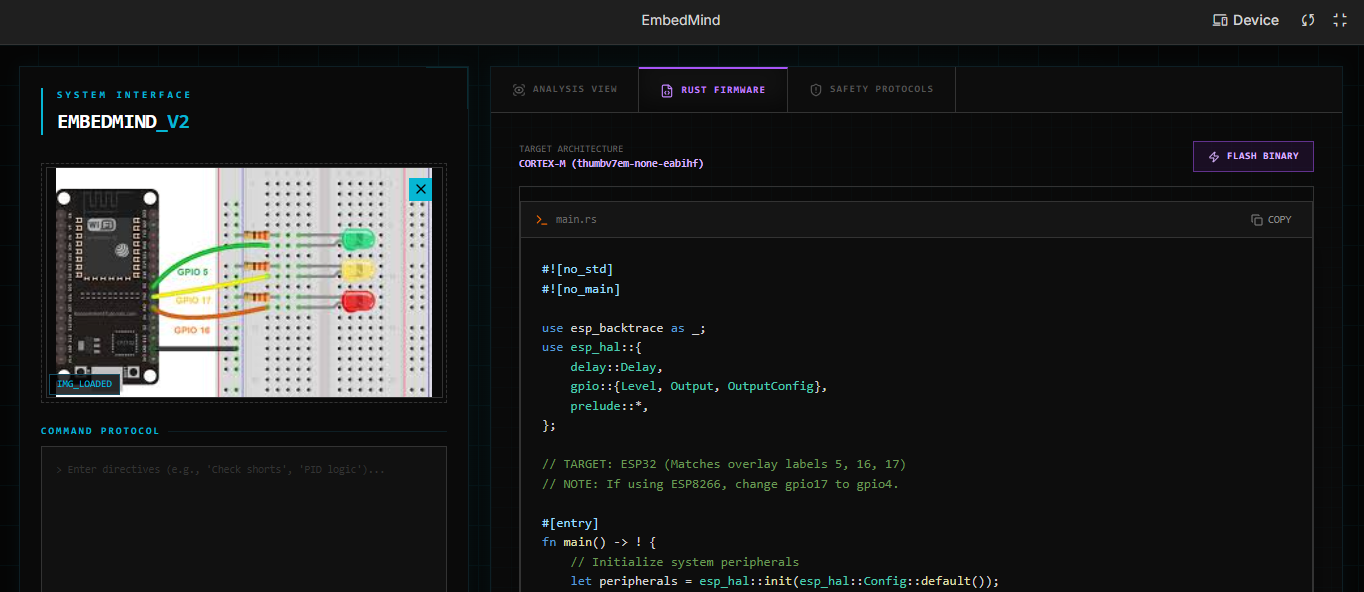
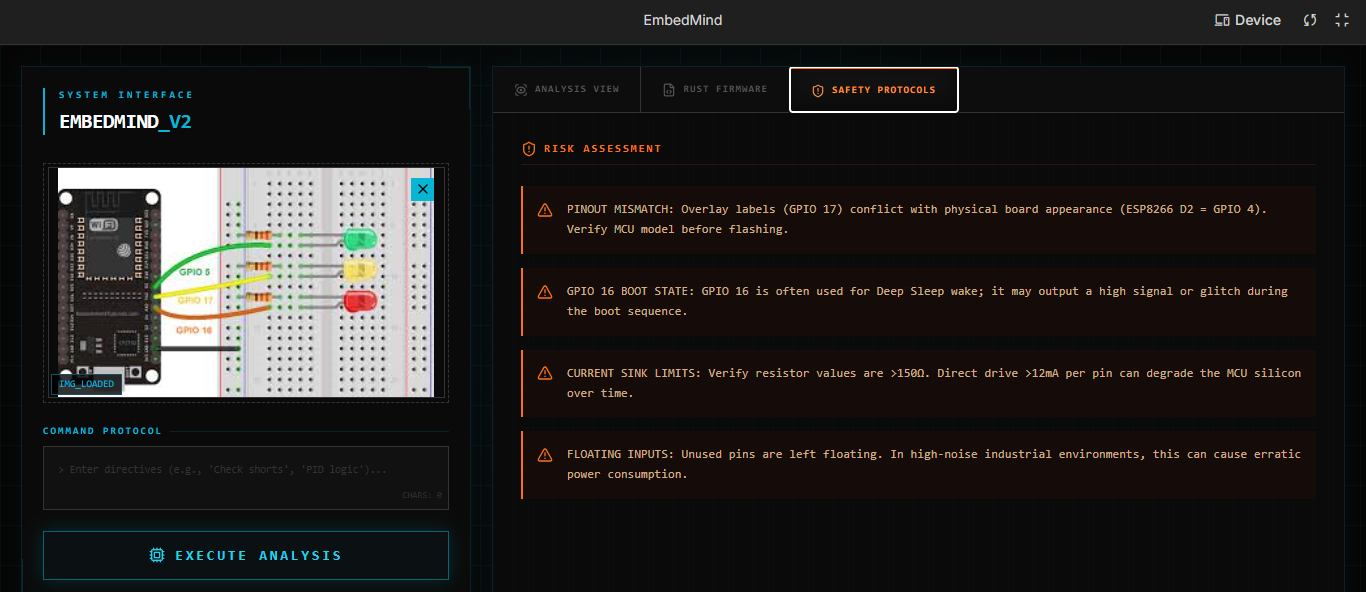
EmbedMind: Visual Circuit Intelligence to Safe Rust Firmware Inspiration💡 As a Mechatronics Engineer, I live by a simple rule: Hardware is hard. Unlike software, where a bug just means an error message, a bug in embedded development means magic smoke. I’ve spent countless hours debugging circuits only to realize I missed a pull-up resistor or inverted a logic level. And while Rust is the future of safe embedded systems (guaranteeing memory safety at compile time), the learning curve for no_std development is brutally steep. I asked myself: What if I had a Senior Engineer looking over my shoulder 24/7? Someone who could look at my messy breadboard, spot the missing base resistor on a BJT, and write the boilerplate Rust drivers for me? That is why I built EmbedMind. 🏗️ What it does EmbedMind is a Multimodal AI Architect for embedded systems. It doesn't just "write code"; it understands the physics of the hardware it sees. 1) Visual Circuit Analysis: You upload a photo of your schematic, breadboard, or even a hand-drawn diagram. 2)Safety Verification Layer: Before writing a single line of code, EmbedMind analyzes the circuit for electrical flaws using Gemini 3 Pro's reasoning capabilities. It checks for: i) Missing current-limiting resistors (calculating $R = \frac{V_{cc} - V_{f}}{I_{max}}$). ii) Inductive kickback risks (missing flyback diodes). iii) Logic level mismatches (e.g., 3.3V ESP32 driving 5V logic). 3)Safe Firmware Generation: It generates production-ready, no_std Rust code using the esp-hal ecosystem. It handles ownership, lifetimes, and peripheral access safely by default. ⚙️ How I built it I built EmbedMind entirely using Google AI Studio and the new Gemini 3 Pro model.
- The "Vibe Coding" Frontend: I used the "Build" mode in AI Studio to generate a React + Tailwind dashboard. I wanted a specific "Industrial Sci-Fi" aesthetic dark mode, neon accents, and monospaced typography—to feel like a professional engineering tool. I iterated on the UI simply by describing the "vibe" I wanted, and Gemini generated the code instantly.
- The "Brain" (System Instructions): The core of the project is a highly tuned System Instruction that forces Gemini to adopt the persona of a Senior Embedded Rustacean. I conditioned the model to prioritize no_std crates (embedded-hal, cortex-m) and to refuse to generate code if the hardware setup is dangerous.
- The Math Layer: I instructed the model to use mathematical verification for control systems. For example, if I ask for a PID controller, it formats the control loop using discrete time steps:u(t) = Kp e(t) + Ki \int0^t e(\tau)d\tau + Kd \frac{de(t)}{dt} and implements it using fixed-point arithmetic to avoid floating-point overhead on the MCU. 🚧 Challenges I faced
- The "Hallucination" Trap: Early versions of the model would happily write code for pins that didn't exist on the ESP32. I had to refine the system prompt to force it to "Reason first, code second," verifying the pinout against known hardware definitions before generating the firmware.
- Rust is Strict: Generating C++ for Arduino is easy because it's forgiving. Generating Rust is hard because the Borrow Checker is merciless. I spent a lot of time tweaking the prompt to ensure the AI used RefCell and Mutex correctly for shared state in interrupt handlers.
- Visual Nuance: getting the model to distinguish between a TIP31c transistor and a generic BJT from a low-res image was difficult. I learned that providing context ("This is a motor driver circuit") dramatically improved the visual recognition accuracy. 🏆 Accomplishments that I'm proud of I am most proud of the Safety Warning feature. In one test, I uploaded a picture of an LED connected directly to a battery without a resistor. Instead of just writing code to flash it, EmbedMind stopped and warned me: "CRITICAL: Missing Current Limiting Resistor. Risk of immediate component failure." That moment proved this isn't just a chatbot it's an engineering tool. 🧠 What I learned This project taught me that Multimodality is the killer feature for engineering tools. Text alone isn't enough when you are building physical things. By combining visual reasoning with the strict safety guarantees of Rust, we can lower the barrier to entry for embedded engineering without sacrificing quality. 🚀 What's next for EmbedMind
- IDE Integration: turning this into a VS Code extension that "watches" your desk via webcam.
- Schematic Export: adding a feature to generate a KiCad file from the breadboard photo.
- More Architectures: expanding support to STM32 and RISC-V boards.
Built With
- built-with:-ai-core:-google-ai-studio
- discrete-electronics-(transistors
- embedded-hal-traits-hardware-targets:-esp32
- esp-hal
- esp8266
- gemini-3-pro-(multimodal)-frontend:-react
- logic
- tailwind-css
- typescript-(generated-via-vibe-coding)-firmware-engine:-rust-(no-std)

Log in or sign up for Devpost to join the conversation.