Team Introduction
Beijing Jiaotong University software evaluation laboratory is a software product quality evaluation institution with CNAs certificate and CMA certificate qualification of national recognized laboratory. The laboratory has established a complete quality management system of testing laboratory in accordance with ISO / IEC17025, and is committed to providing scientific and fair product testing services and professional and efficient product testing tools for the industry. The testing capabilities include functionality, performance efficiency, reliability, information security, etc, It can provide third-party evaluation services for software products and information systems for users of government, industry, enterprises and scientific research institutions. The laboratory has accumulated more than ten years of experience in embedded software testing such as national rail transit and military industry, and can complete software and hardware testing tasks under various complex working conditions.
Project introduction
Due to the complexity of embedded operating system test conditions, the preparation of test cases requires a lot of human resources, and it is easy to have incomplete coverage of scenarios. In order to improve test efficiency and test scenario coverage of use cases, we seek to use tigergraph to establish a perfect test system knowledge map to help us understand test scenarios and build more comprehensive test cases.
How we build it
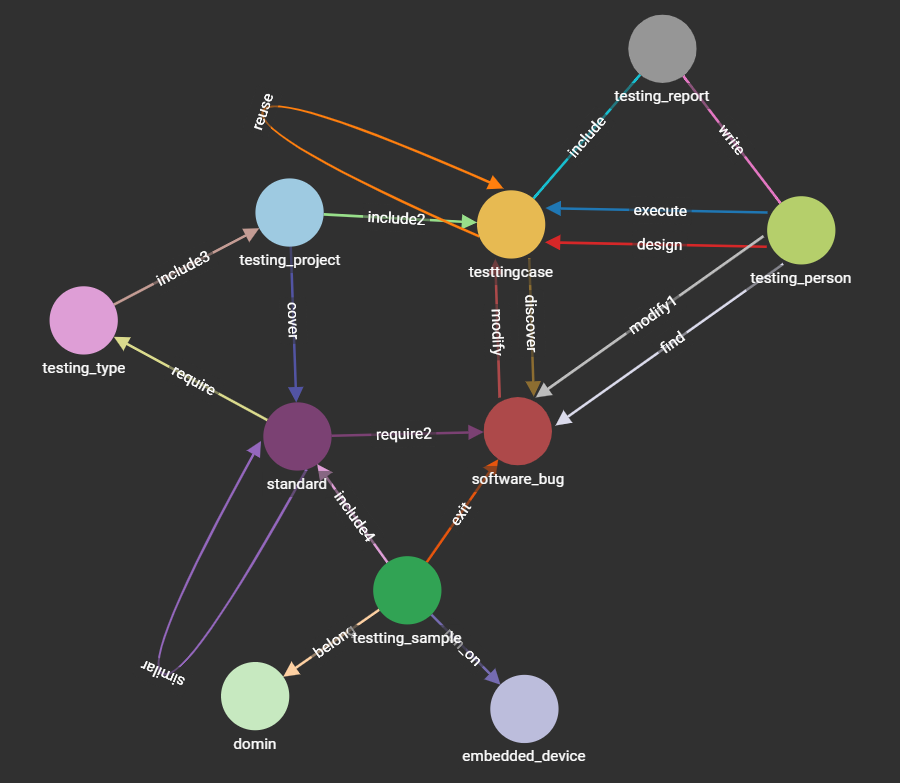
We collected all the test cases related to embedded operating system in the software evaluation laboratory of Beijing Jiaotong University in the past ten years. Summarize the test types, test items and application examples, and construct the test knowledge map with the help of tigergraph tool. The whole map constructs the whole process test process map from test demand analysis, test item classification and induction, test case design and software defect discovery. In the whole construction process, we also encountered some challenges, such as how to classify these use cases into reasonable test items. Due to the large number of test cases, it is almost impossible to rely on manual classification. Here, we use machine learning classification algorithm to automatically classify and label the use cases, and quickly complete the whole classification process in combination with manual verification. Through the construction of test knowledge map, we have systematically combed our complex test cases for more than ten years, so that there is a relationship between use cases and all links of testing and personnel. This relationship can make it convenient for us to find use cases and other information related to use cases, and solve the following problems: 1、 Junior testers do not have a thorough understanding of test scenarios, slow use case construction and easy to miss test items;
2、 After the test case is written, it cannot be quickly found and reused by others;
Benefits: 1. The test case system constructed by knowledge atlas can recommend comprehensive test cases to testers according to the project test items, and testers do not need to rewrite the test cases. The actual test process in the laboratory shows that through this method, the preparation time of test cases is shortened by half and the test efficiency is greatly improved.
- Through the test case map, we can quickly find the key test cases, let testers directly reference them, reduce the workload of case writing, and improve the reuse rate of use cases. In the actual test process, the reuse rate of key use cases has reached more than 90%;

Log in or sign up for Devpost to join the conversation.