I built Embassy because I have spent most of my life noticing what is present before there is language for it.
My background is in art and curation, but the deeper work has always been human. I have worked across rooms of artists, founders, investors, family offices, spiritual teachers, scientists, and people standing at moments of real transition. On the surface, their worlds look very different. Underneath, they are often wrestling with the same questions:
What is actually happening here?
What can I trust?
What do I know that I have not yet been able to say?
What is the next coherent move?
I have built a career by sensing patterns across people, language, power, timing, and context—and then helping those patterns become visible enough to act on. But that kind of intelligence is usually treated as intuition, taste, or something that lives only inside one person.
I wanted to know whether it could become a system without losing its humanity.
That is why I built Embassy.
What Embassy is
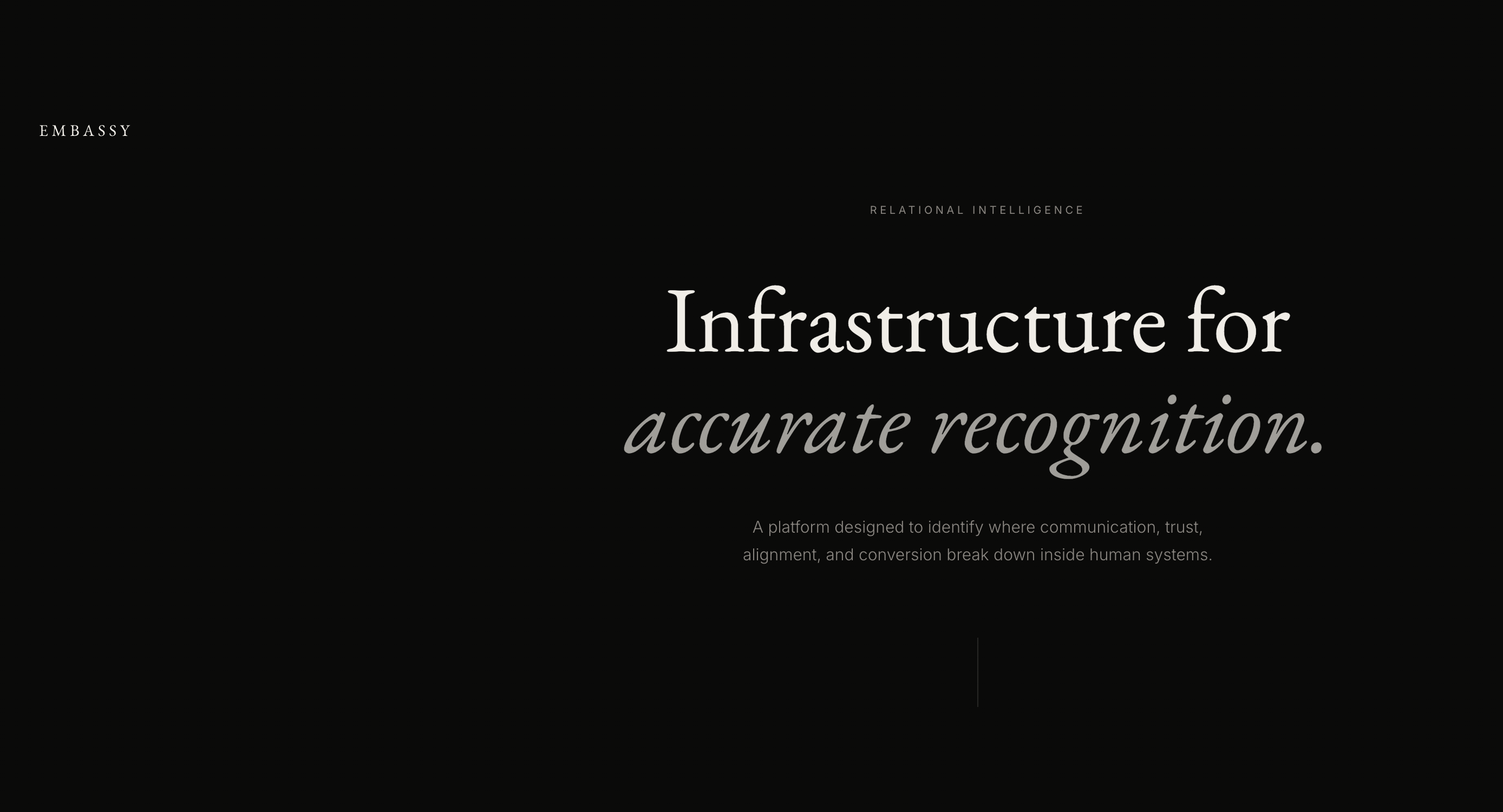
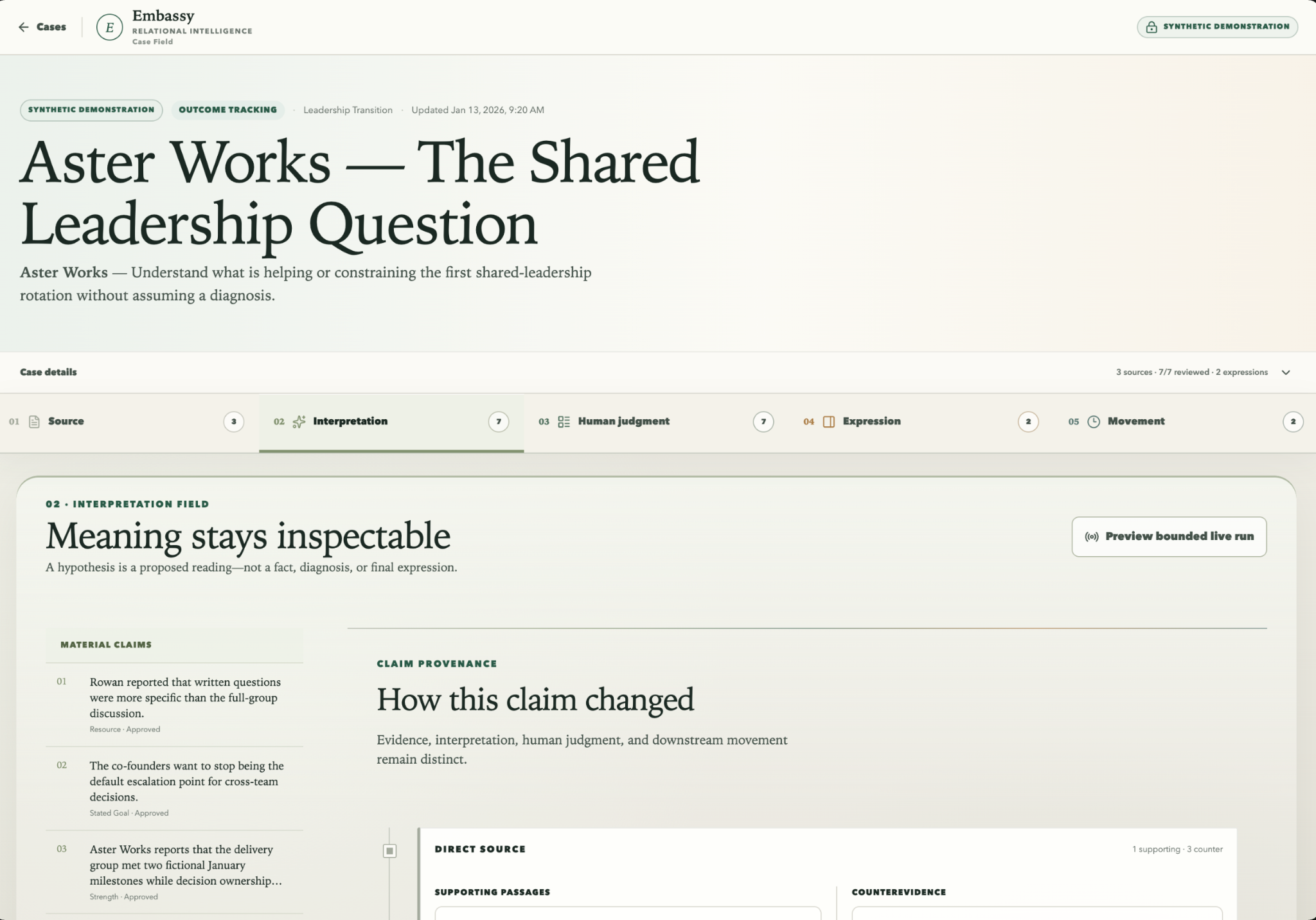
Embassy is a private workspace for Relational Intelligence—making human judgment inspectable.
Important human understanding is usually fragmented across transcripts, notes, documents, AI drafts, memory, and one person’s intuition. Most AI products collapse that complexity into a polished answer. The answer may sound coherent, but it often hides:
- what the person actually said;
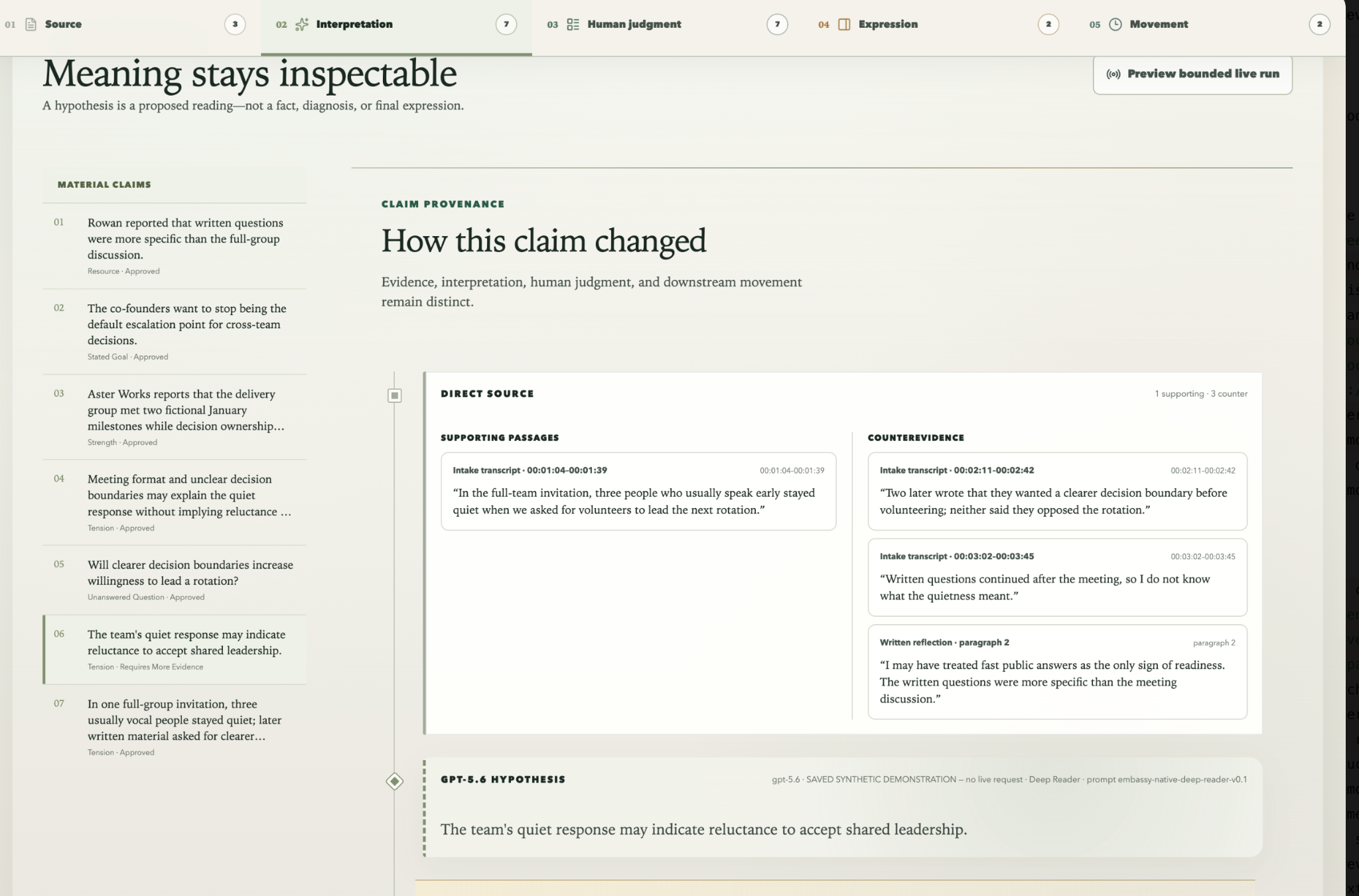
- what the model inferred;
- what evidence contradicts the interpretation;
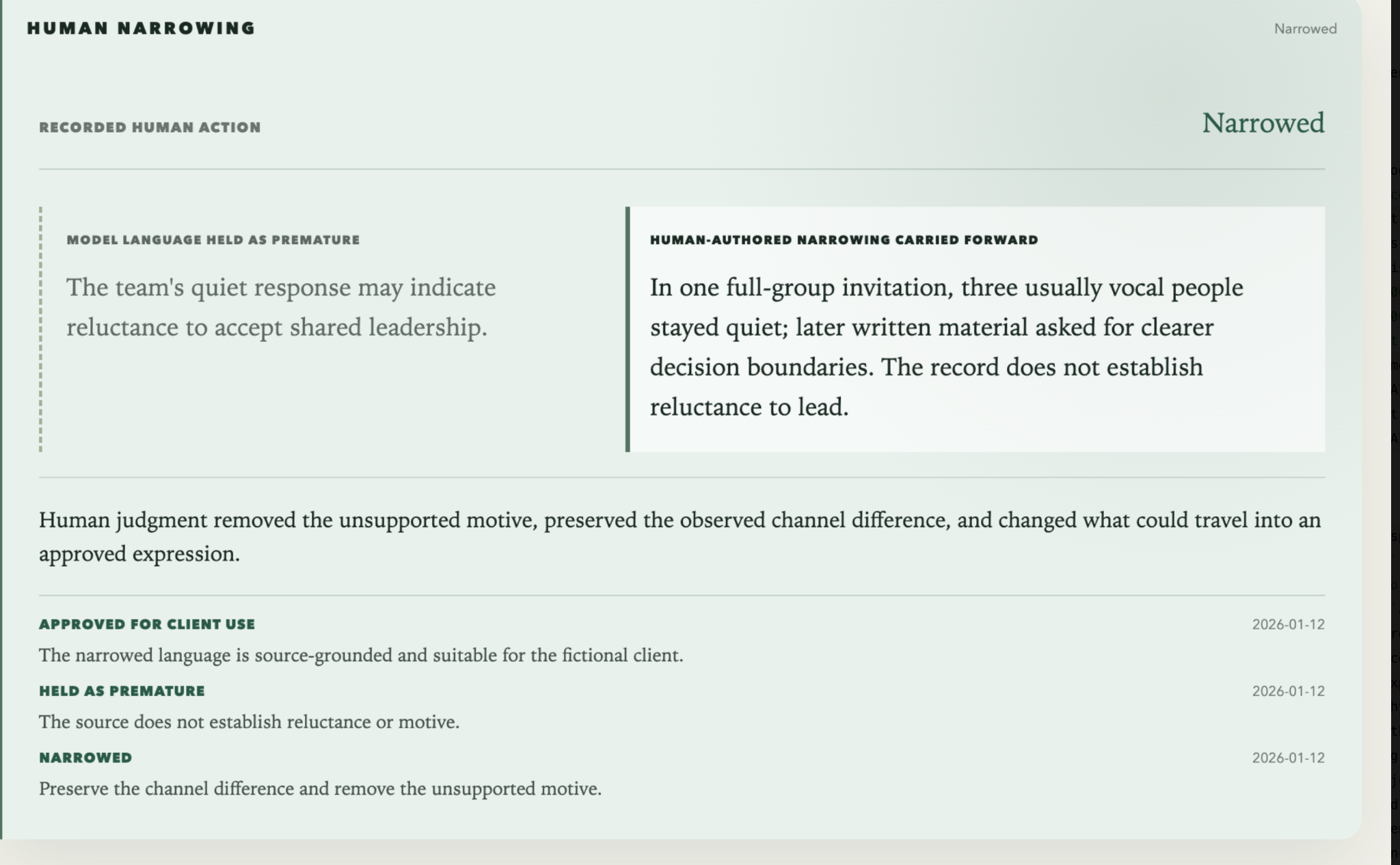
- what a human changed;
- what was ultimately expressed;
- and what remains genuinely unknown.
Embassy preserves that formation of understanding as a visible chain:
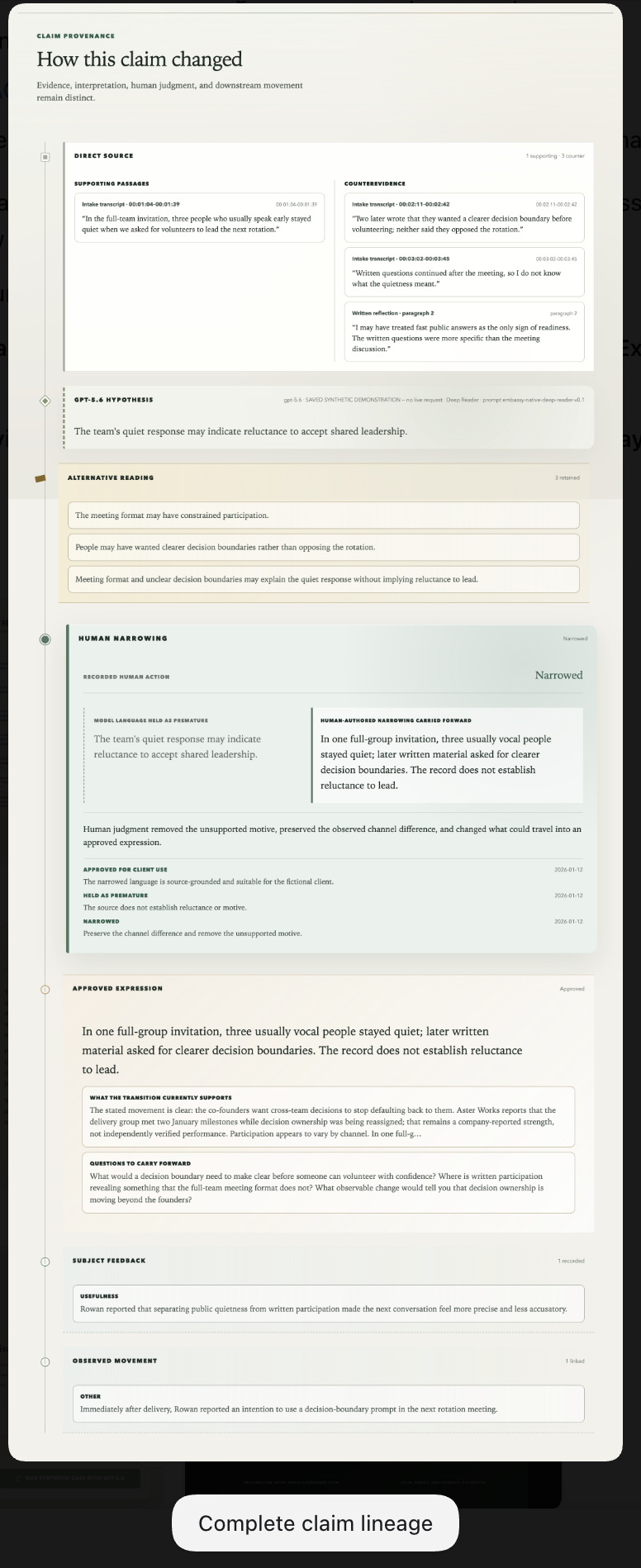
source → model hypothesis → alternative reading → human judgment → client-ready language → feedback → movement
A material claim can be traced backward to its source and forward through interpretation, counter-reading, human revision, approved expression, feedback, and later development.
The goal is not to automate judgment.
The goal is to make judgment more rigorous, accountable, and capable of learning.
Why this matters to me personally
I believe coherence is a strategic asset.
It is what allows capital to move, leaders to make decisions, partnerships to form, and people to act from what they actually know instead of performing certainty.
I also believe beauty is a form of authentic code. When something is truly coherent, we often feel it before we can fully explain it. Its form and meaning agree.
That shaped the product itself. I did not want Embassy to feel like another AI dashboard. I wanted the experience to move from fragmentation toward clarity—to let evidence, interpretation, human judgment, and action occupy different perceptual spaces.
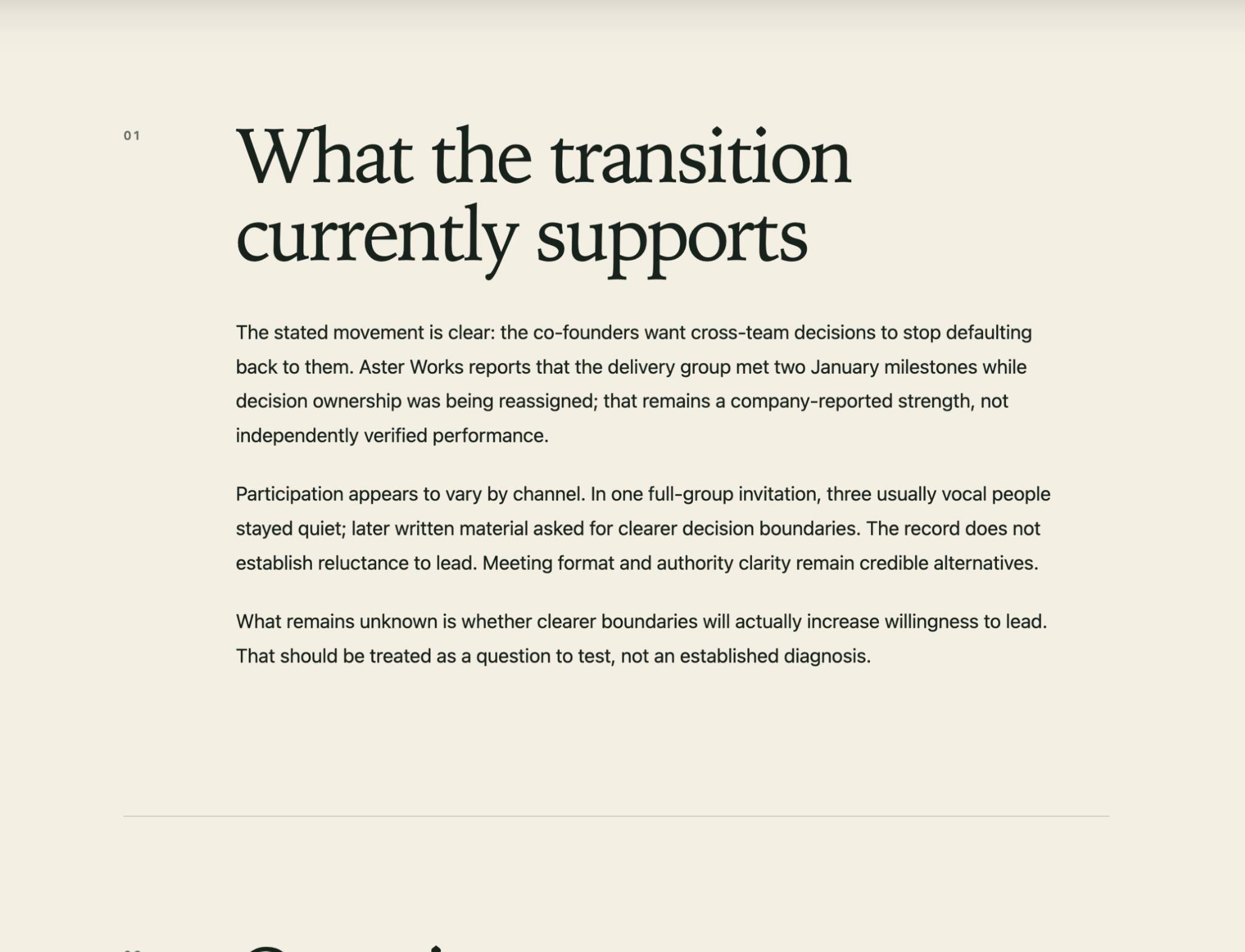
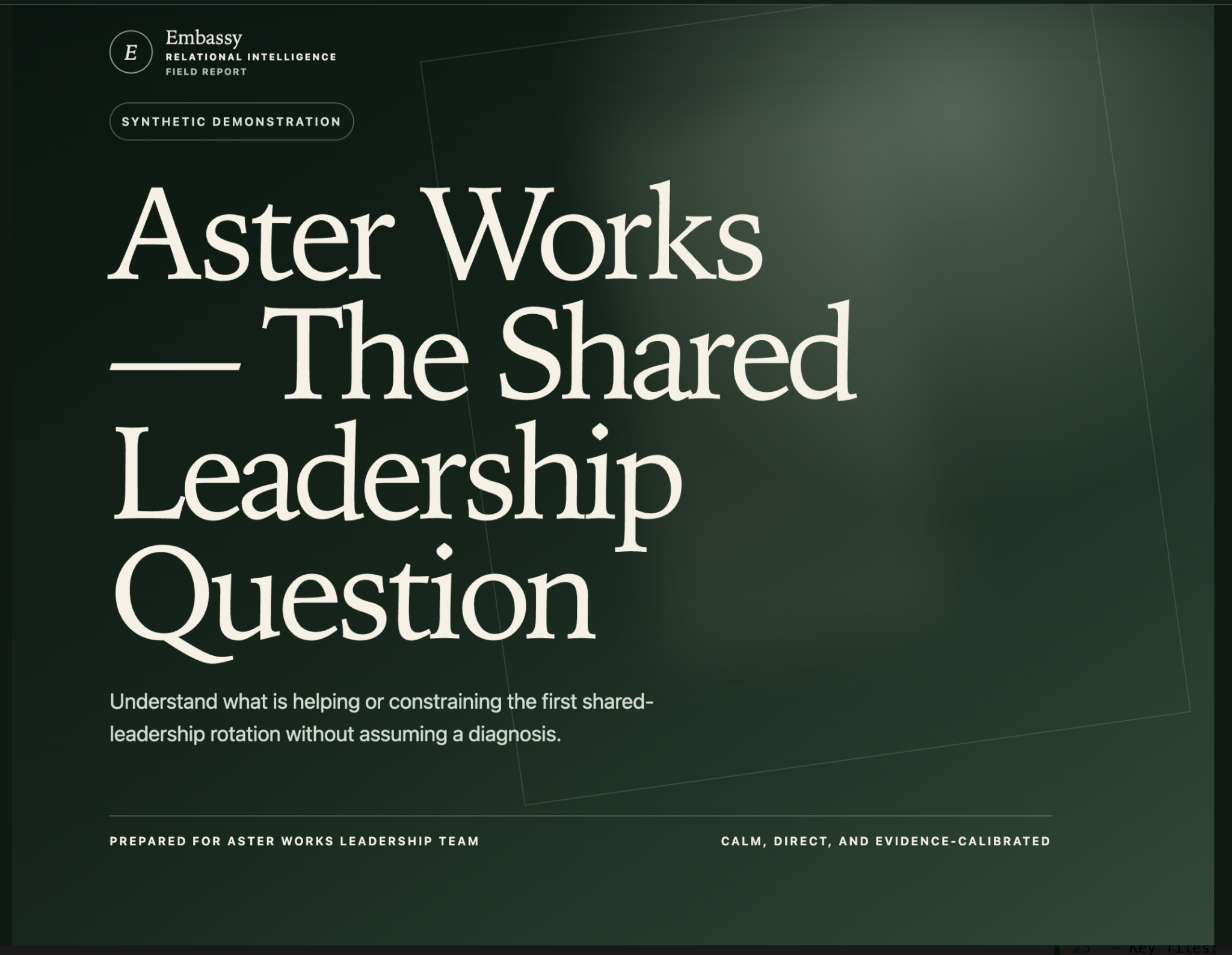
The final output is the Embassy Field Report: not a dump of model output, but an authored artifact designed to create the moment of recognition:
Oh. That is what has actually been happening.
How I built it
Embassy existed before Build Week as an emerging ontology, advisory methodology, and body of real-world casework.
During Build Week, I used Codex to help turn that thinking into a working product.
Codex helped me:
- audit the existing provenance and privacy boundaries;
- design a server-enforced AI egress policy;
- implement four bounded GPT-5.6 roles;
- create immutable source revision and claim lineage;
- build case archive, restore, and deletion workflows;
- preserve append-only human judgment history;
- create a synthetic demonstration case;
- build the Embassy Field Report in immersive and print modes;
- implement privacy filtering and structured exports;
- and validate the system with 164 automated tests.
GPT-5.6 has four defined roles:
- Extractor — separates direct statements and reported information from verified fact.
- Deep Reader — proposes a small number of evidence-linked hypotheses.
- Counter-Reader — challenges the strongest interpretation and offers simpler explanations.
- Writer — composes only human-reviewed, audience-eligible material.
A model cannot approve its own conclusion. Human judgment remains authoritative.
The hardest challenges
The hardest problem was not generating insight. Models are already remarkably capable of that.
The harder questions were:
- How do you prevent a perceptive inference from becoming an unsupported truth claim?
- How do you preserve uncertainty without producing timid, unreadable prose?
- How do you let a human revise a model interpretation without erasing the original?
- How do you make privacy a server-enforced boundary rather than a promise in the interface?
- How do you make epistemic rigor feel beautiful rather than bureaucratic?
The product now distinguishes direct evidence, model hypothesis, alternative reading, human narrowing, approved expression, reported feedback, and observed movement as separate records.
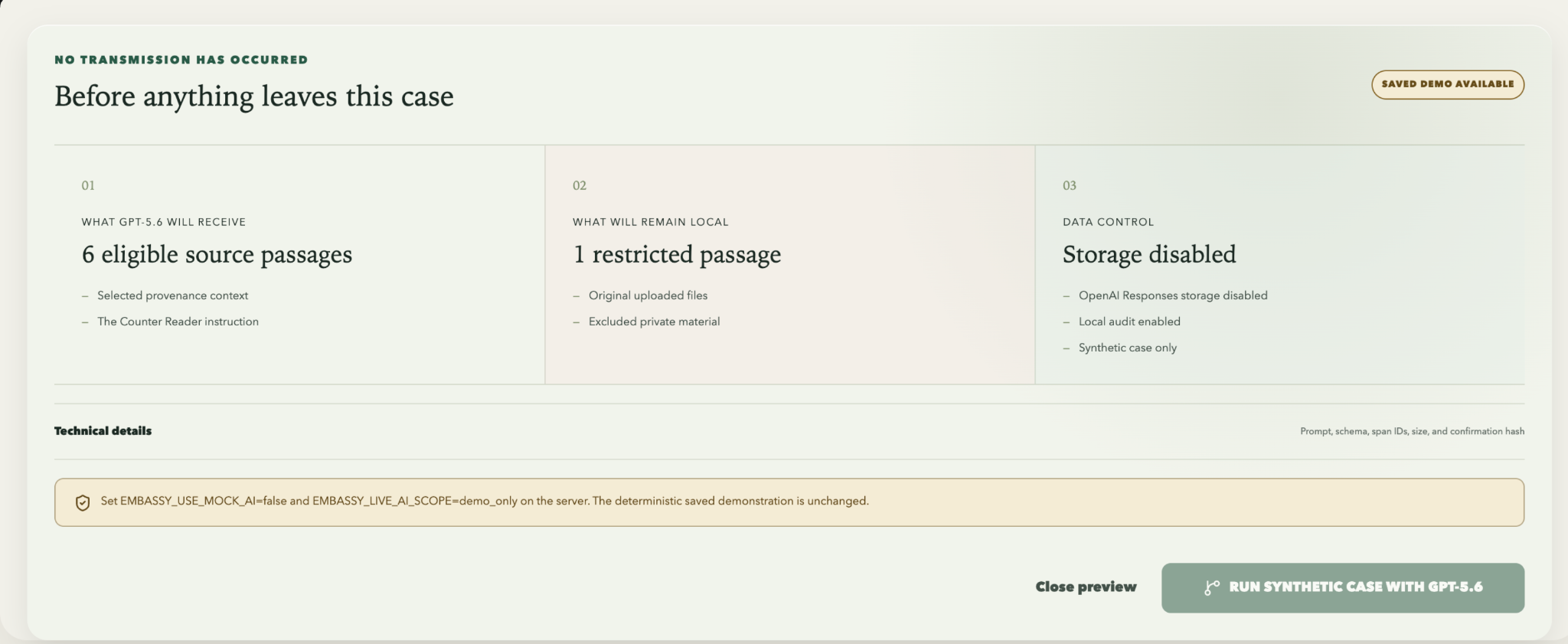
For the Build Week demonstration, only a designated synthetic case may use the bounded OpenAI path. Restricted material remains local, the operator previews exactly what will be transmitted, and every Responses API call is configured with storage disabled.
What I learned
I began this sprint thinking the central product was the analysis.
I now think the central product is the visible transformation of interpretation into judgment.
The most important moment in Embassy is not when GPT-5.6 produces a smart hypothesis. It is when a human can say:
This part is insightful.
This part reaches too far.
This is what the evidence actually allows us to say.
That act changes what is permitted to become consequential.
I also learned that coherence cannot only be described in the product’s language. It has to be enacted by the product’s structure, privacy model, visual design, and behavior.
What comes next
Embassy is currently a single-operator prototype, not yet a production multi-user system.
Future work can add:
- explicit client-consent workflows;
- controlled approved-case model access;
- multi-operator review;
- longitudinal outcome evidence;
- additional artifact formats;
- and secure client collaboration.
But the central principle will remain the same:
Most AI systems generate answers. Embassy preserves how understanding was formed.
Built With
- api
- chatgpt
- codex
- d1
- drizzle
- gpt-5.6
- next.js
- openai
- orm
- r2
- react
- responses
- sqlite
- typescript
- workers
- zod

Log in or sign up for Devpost to join the conversation.