-
-

detect fake news agent
-

find fake news function
-
Fake News Filter LLM App – AI-Powered Content Verification"


Inspiration
Social media platforms have transformed the way information spreads, but they have also become breeding grounds for fake news and toxicity. A small group of bad actors can have disproportionate influence, shaping narratives with misinformation campaigns. Our team recognized the correlation between online toxicity and misinformation. Having previously worked on toxicity detection and classifier models, we wanted to expand the scope to include fake news filtering using LLMs. Due to the time constraints of the hackathon, we chose GPT-4o as our primary model but plan to integrate additional LLMs, such as Gemini and Grok, for broader validation.
What it does
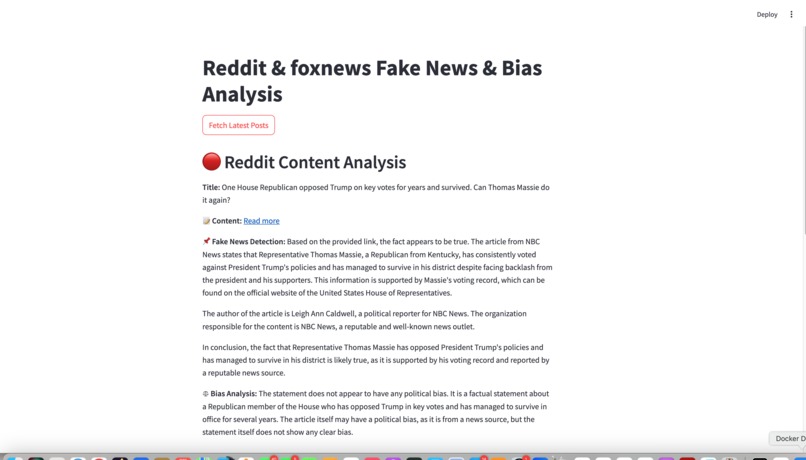
Detect misinformation trends across multiple platforms. Analyze political bias and coordinated disinformation campaigns. Provide source attribution to help journalists trace information origins. Enhance content moderation by identifying potentially misleading narratives. It is built as a visual dashboard, empowering journalists and researchers with real-time insights into fake news propagation.
How we built it
Our development process included several key steps: Data Collection: Extracted data from Reddit, Facebook, and news websites to analyze misinformation patterns. LLM Integration: Used GPT-4o for NLP-based filtering while planning future integration of Gemini and Grok. Backend & API Development: Built a FastAPI backend for scalability and efficiency. Frontend Dashboard: Developed an interactive Streamlit UI for data visualization. Automated Deployment: Implemented Docker & CI/CD pipelines with CircleCI for seamless cloud deployment.
Challenges we ran into
Developing a reliable fake news detection system posed several difficulties: Time constraints limited advanced validation techniques. Data reliability issues made source verification a critical challenge. Scalability concerns when processing large amounts of misinformation-related content. API restrictions with social media platforms required strategic workarounds. Despite these challenges, we successfully built an initial working version of our tool.
Accomplishments that we're proud of
Developed a functional LLM-powered fake news detection dashboard. Successfully integrated FastAPI, Streamlit, and CI/CD tools for deployment. Improved reference validation and author attribution techniques. Built scalable cloud-based infrastructure using Docker and automated pipelines. These advancements bring us closer to creating a production-ready misinformation filtering solution.
What we learned
LLMs are effective for misinformation detection but require multi-source validation for improved accuracy. Combining NLP filtering with classifier-based validation enhances credibility. Automated CI/CD pipelines and cloud deployment streamline development and scaling. Fact-checking AI models need extensive human oversight to avoid biases and misinformation pitfalls.
What's next for Emakia Fake News
Filtering with LLM Enhancing detection models with Gemini and Grok alongside GPT-4o. Improving source validation techniques using publication dates and cross-referencing. Deploying to scalable platforms like AWS, Vercel, or Render for broader accessibility. Exploring monetization strategies, such as SaaS API licensing for news organizations. Expanding real-time misinformation tracking using additional data sources and platforms. Emakia aims to provide journalists, researchers, and content moderators with an AI-powered toolkit for identifying and combating misinformation more effectively.
Built With
- gemine
- gpt
- model
- openai
- python


Log in or sign up for Devpost to join the conversation.