-
-

-
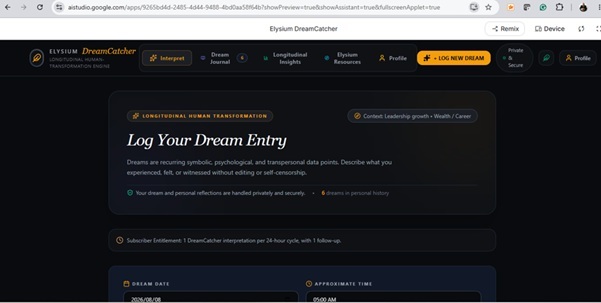
1. Elysium DreamCatcher From Google AI Studio
-
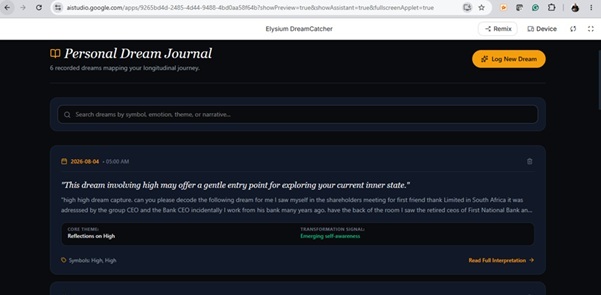
2. Elysium DreamCatcher From Google AI Studio
-
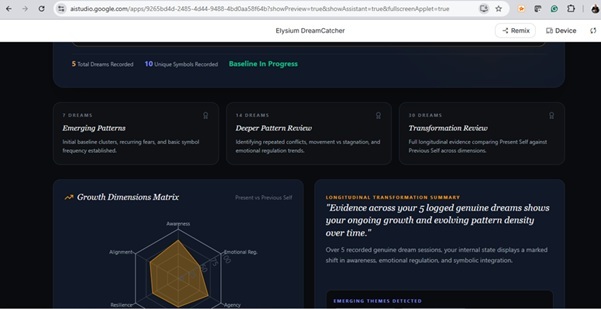
3. Elysium DreamCatcher From Google AI Studio
-
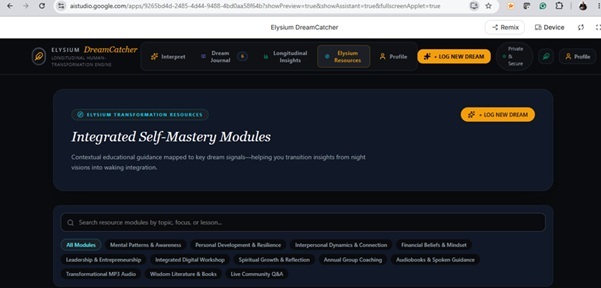
4. Elysium DreamCatcher From Google AI Studio
-
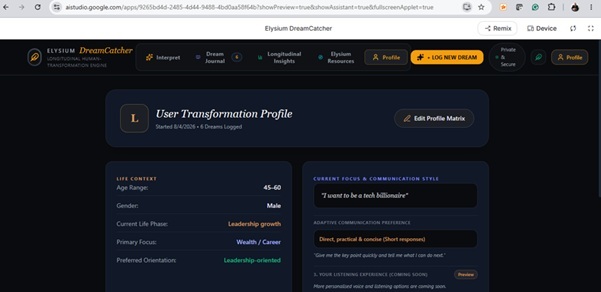
5. Elysium DreamCatcher From Google AI Studio
-
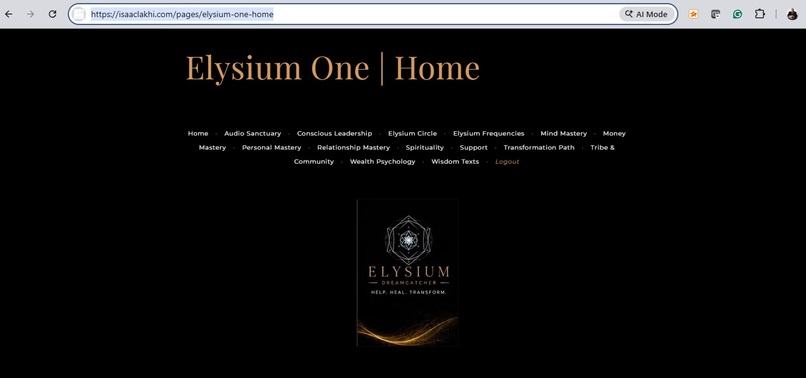
Elysium One Home

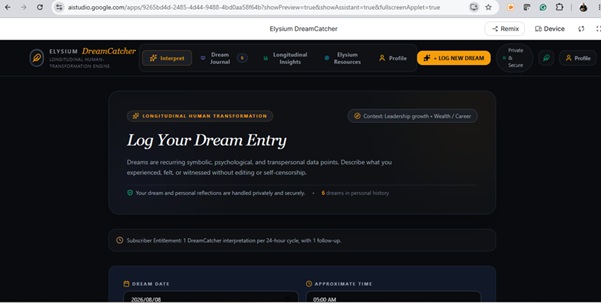
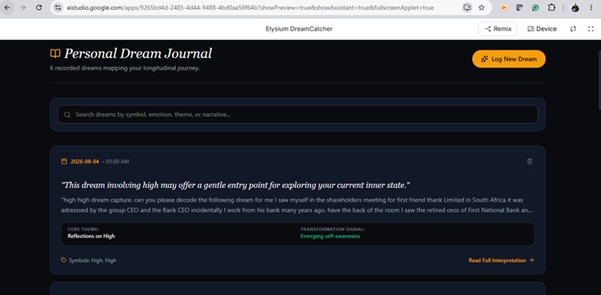
ELYSIUM DREAMCATCHER
From lived experience to personalised action: Dreams are the doorway. Transformation is the destination.
Elysium DreamCatcher is a live AI-powered personal-growth platform that uses a person's dreams and lived experience as a starting point for personalised reflection, insight and action.
Built using Google Gemini as its intelligence layer, DreamCatcher combines AI with the proprietary Elysium DreamCatcher Interpretation Taxonomy, Elysium's human-potential methodology and the broader Elysium One resource ecosystem.
The result is a different approach to personal development.
Instead of asking people to search for the solution they need, DreamCatcher begins with what their own experience may already be revealing — and uses AI to help identify what may be useful next.
The DreamCatcher architecture
Dream → Pattern → Insight → Need → Personalised Resource → Action → Longitudinal Learning → Transformation
DreamCatcher analyses the elements of a dream — including symbols, emotions, relationships, locations, movement and recurring patterns — while incorporating personal context and previous dreams.
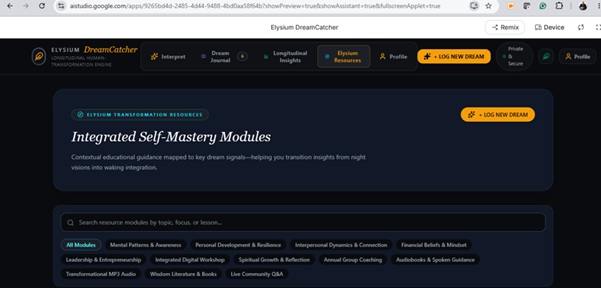
It can then connect emerging needs to relevant Elysium One resources across areas such as personal mastery, mind mastery, emotional resilience, relationships and communication, spirituality and grounding, purpose, wealth and money psychology, entrepreneurship and leadership.
As a person's dreams accumulate, DreamCatcher can identify longitudinal patterns and help the individual explore how those patterns evolve over time.
Five strategic differentiators
1 — Real business: DreamCatcher was not created as a standalone hackathon experiment. It sits on an existing Elysium business, methodology, content ecosystem and customer proposition.
2 — Real users and commercial validation: The product has been brought into a real operating environment, with customers and a commercial model rather than existing solely as a technology demonstration.
3 — Distinctive intellectual property: The underlying value is not simply Gemini. Elysium has developed a proprietary DreamCatcher Interpretation Taxonomy, human-potential methodology and resource-mapping framework around the model.
4 — A different category proposition: Traditional personal development largely asks people to find content and determine what they need.
DreamCatcher reverses that relationship: The person's lived experience becomes the input. AI helps identify the potential need. The ecosystem provides the destination.
5 — A founder who built beyond his original discipline: At 50, founder Eshaak “Isaac” Lakhi used AI to turn years of domain knowledge, methodology and intellectual property into a functioning AI product — despite not coming from a conventional software-development background.
His journey followed a serious motor-vehicle accident in which doctors described an 80% brain disability, followed by rebuilding his life, earning two degrees and spending 17 years across investment banking, commercial banking and financial planning before returning to human potential, leadership and transformation.
What DreamCatcher already does
The current product combines a number of capabilities into a single personalised experience:
- AI dream interpretation built around the Elysium taxonomy.
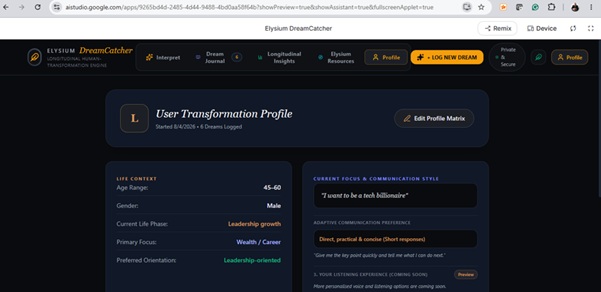
- Personalised onboarding and context, rather than generic dream-dictionary responses
- Voice / speech interaction and dictation
- Dream journaling
- Longitudinal dream intelligence
- Recurring-pattern recognition
- Personalised Elysium One resource mapping
- Practical integration and ritual exercises
- Follow-up dialogue and deeper exploration
- A transformation-oriented journey rather than a one-off interpretation
The strategic asset is the combination: The acquisition opportunity is therefore not simply an AI dream chatbot. It is a working vertical AI application, proprietary methodology and taxonomy, human-potential IP and a demonstrated bridge between lived experience and personalised resources.
FROM DREAMCATCHER TO ELYSIUM
The first vertical proof point for a much larger thesis. DreamCatcher began with a focused question:
Can AI understand something meaningful about a person's underlying needs from their own lived signals — and then connect those needs to an appropriate solution?
Dreams provided the first signal.
Elysium now sees the opportunity as much larger.
The broader thesis is:
Human signal → Understand need → Match solution → Enable action → Measure progress → Learn → Recommend what comes next
DreamCatcher is therefore the first vertical proof point, not the final destination. The broader horizontal Elysium opportunity remains a future development direction.
Where we're going next
The next phase is to deepen DreamCatcher while validating whether the underlying Elysium architecture can travel beyond dreams and personal development.
DreamCatcher — next-generation capabilities that are currently in development
- WhatsApp DreamCatcher: Bring DreamCatcher into a channel where customers already communicate, reducing friction and removing the need to download another application.
- 7 / 21 / 30-day transformation journeys: Move from episodic dream interpretation toward structured, repeatable personal-development journeys.
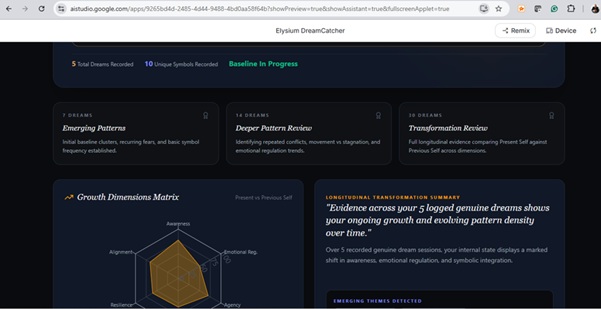
- Transformation Scorecard: Create a meaningful longitudinal view of progress across relevant transformation dimensions.
- Shareable Dream Signals: Turn selected insights into privacy-conscious, shareable experiences that can also create organic discovery.
- Ask Someone Who Knows You: Allow a user to invite a trusted person to contribute a perspective, creating a social layer around self-discovery.
- Dream Map / Visualisation: Make recurring people, places, emotions, themes and patterns visually understandable across time.
- Multi-Perspective Interpretation: Explore a dream through multiple structured lenses before producing a synthesised DreamCatcher interpretation.
- Proactive DreamCatcher: Move from a system that waits for the user to a system capable of recognising meaningful patterns and initiating appropriate check-ins.
- AI Next-Best Action: Develop the intelligence that determines the most useful next intervention based on the person's accumulated context.
- Anonymous Pattern Intelligence: Explore privacy-preserving aggregate insight from recurring patterns across users, subject to appropriate consent, privacy and governance.
Why WhatsApp matters
DreamCatcher currently operates through its web and Android experiences. The next distribution step is to bring the experience closer to where people already communicate.
With more than 3 billion monthly users globally, WhatsApp represents a particularly significant opportunity to reduce friction between discovery, engagement and continued use.
The objective is not to turn DreamCatcher into an always-on chatbot. It is to create a simple, guided experience:
Open WhatsApp → choose what you want to explore → share your dream → receive your Dream Signal → decide what to do next.
This creates a potential new interface for DreamCatcher while retaining the underlying Elysium intelligence and methodology.
The larger Elysium opportunity
The long-term opportunity is to take the architecture proven in DreamCatcher and validate it across other ecosystems where organisations already have:
- large customer bases;
- multiple products and services;
- substantial content or knowledge;
- fragmented customer needs;
- and a problem of knowing what each customer needs next.
Potential future verticals include:
Elysium Finance: Understand customer circumstances and needs and connect them to the most relevant financial solutions within an existing financial-services ecosystem.
Elysium Logistics: Identify operational needs and connect organisations to the appropriate services, capabilities or interventions.
Elysium Retail: Understand customer signals and intent and intelligently connect customers to relevant products, services and experiences.
Elysium Education & Human Potential: Continue developing the original DreamCatcher thesis around personalised human development.
The point is not to build another bank, logistics company, retailer or education provider.
It is to build the intelligence bridge between what a person or organisation needs and what its existing ecosystem can provide.
The Elysium thesis
“Given what we now understand about this person or organisation, what is the most valuable thing we can provide them next?”
That is the question Elysium ultimately wants its intelligence architecture to answer.
DreamCatcher is where we began.
Dreams were the doorway. Human needs are the map. Solutions are the destination.
ENDS
Media / Strategic / Commercial Enquiries
Isaac Lakhi Founder and CEO: Elysium Technologies
Email: [email protected] Web: www.elysium-one.app WhatsApp: +27 82 860 6179
Built With
- chatgpt
- google-ai-studio
- google-cloud
- invideo
- sidekick


Log in or sign up for Devpost to join the conversation.