-
-
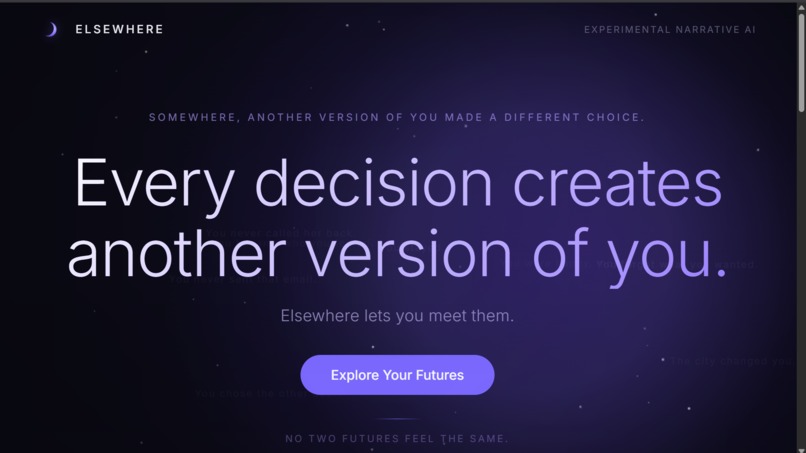
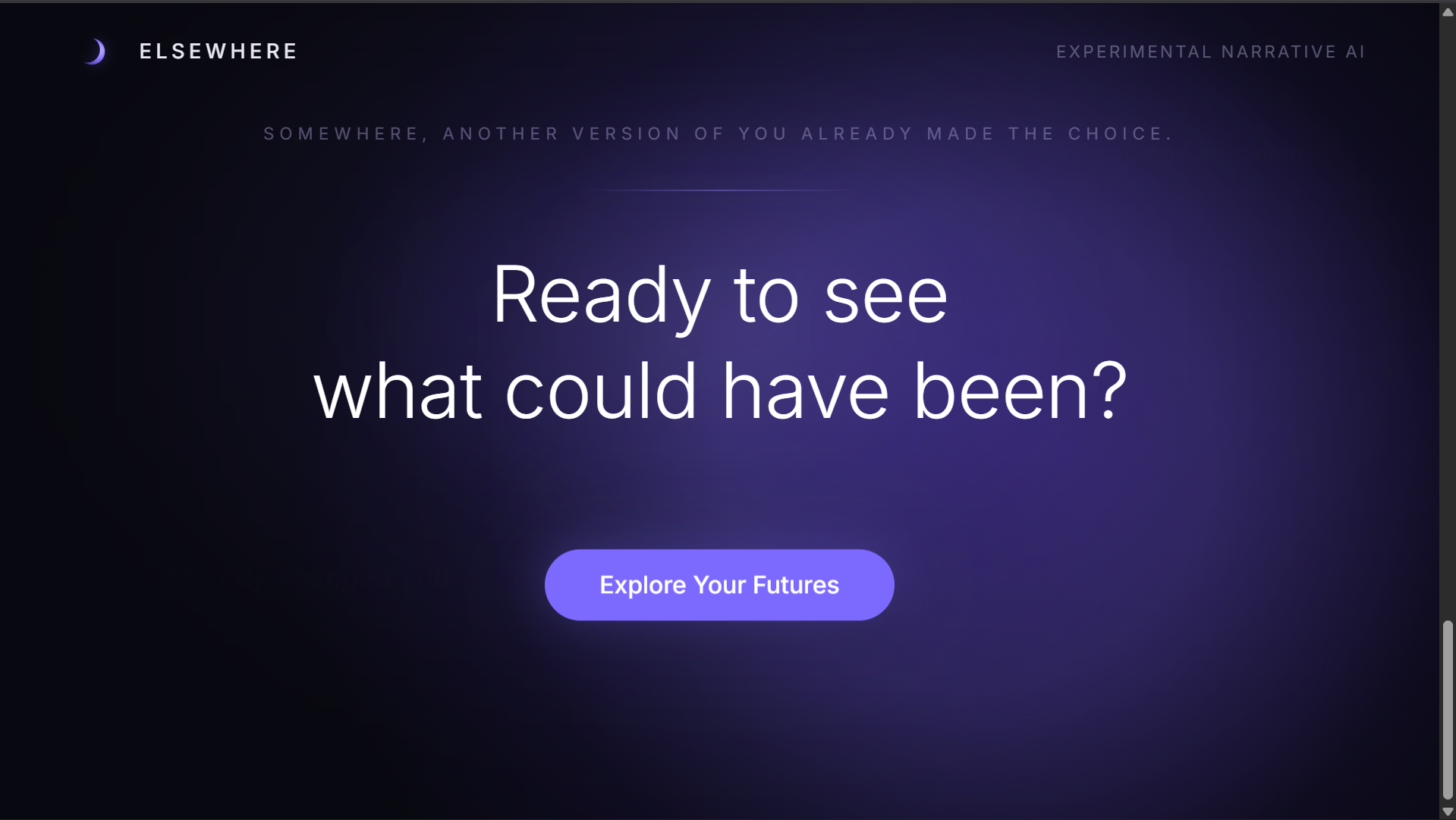
Landing page
-
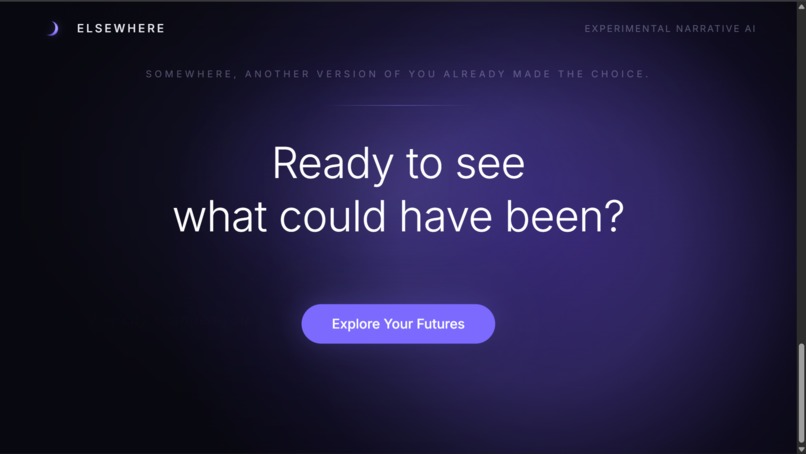
Redirecting page
-
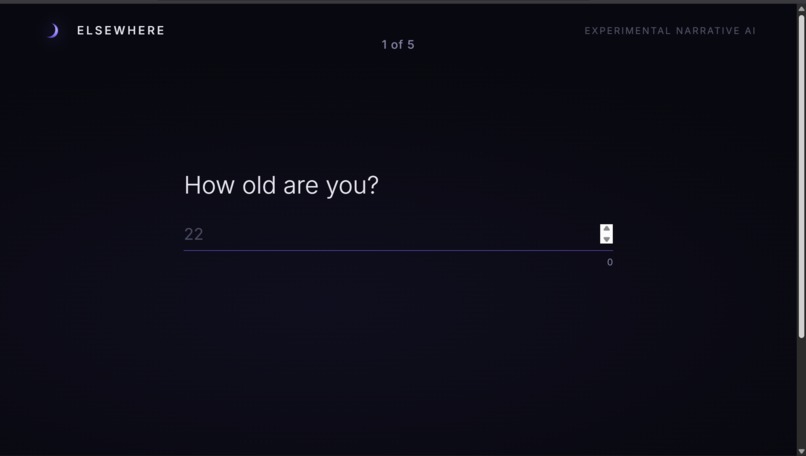
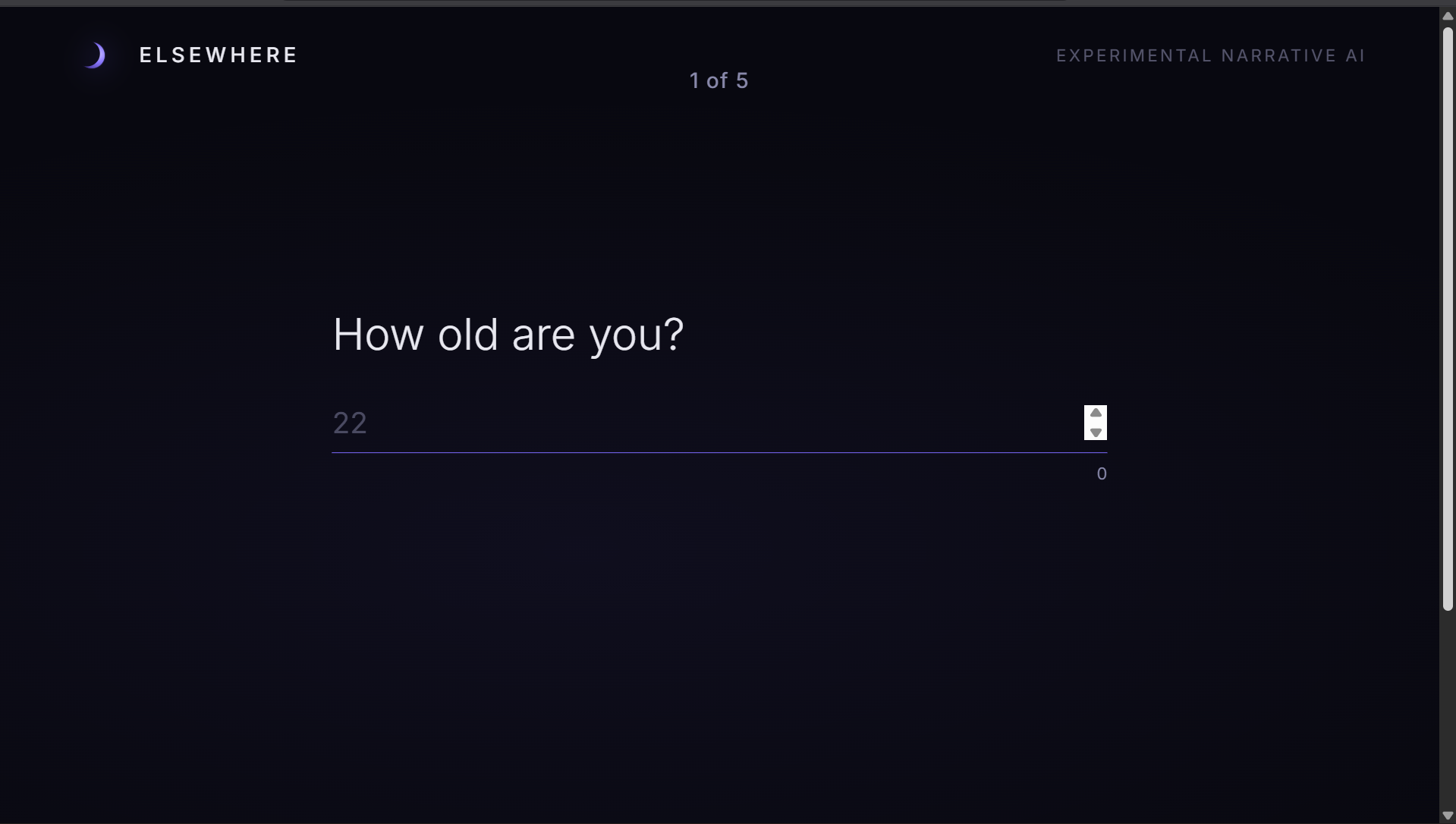
Questions
-
Loading orb
-
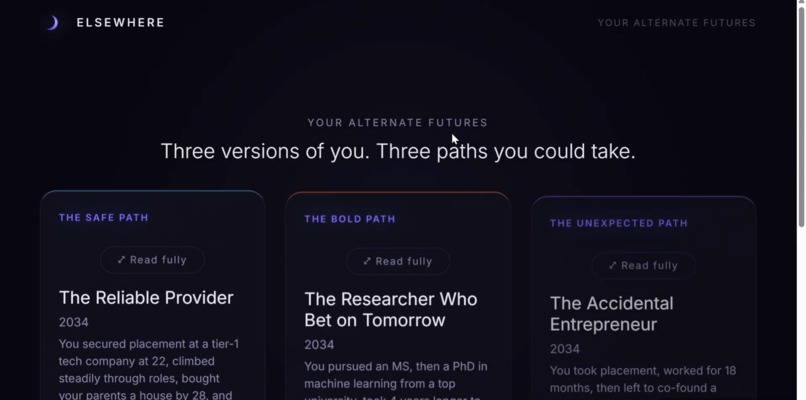
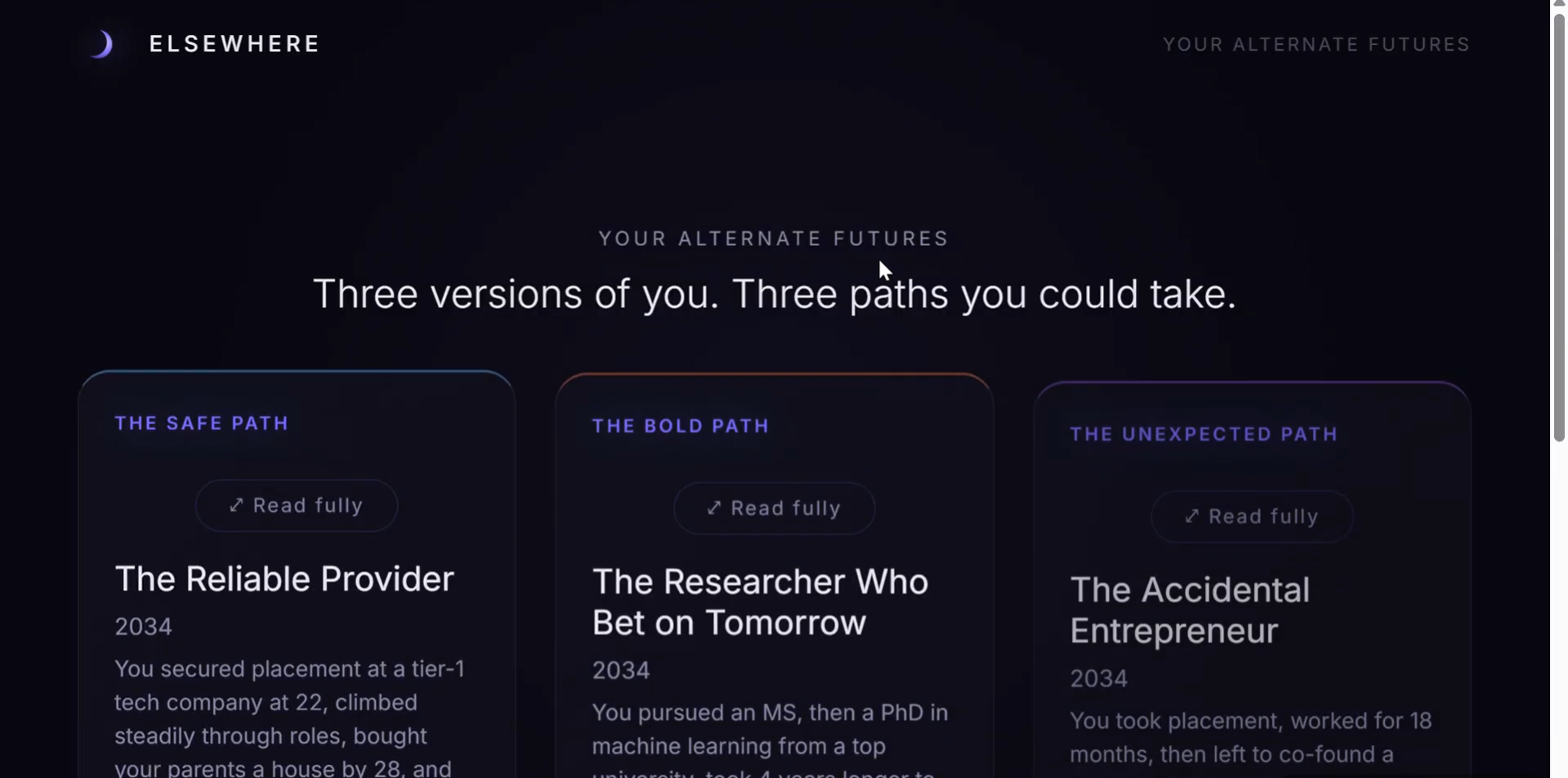
AI response based on answers
-
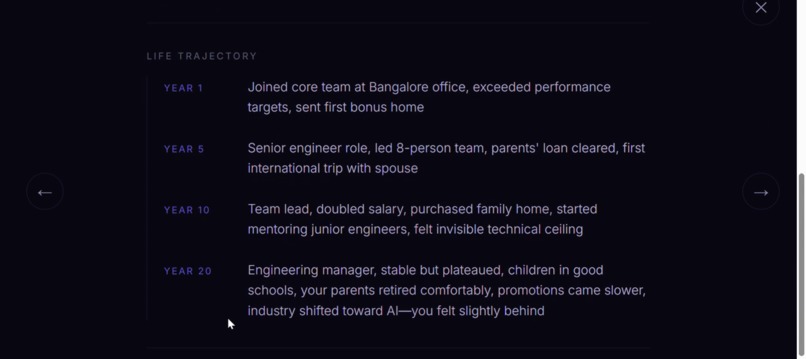
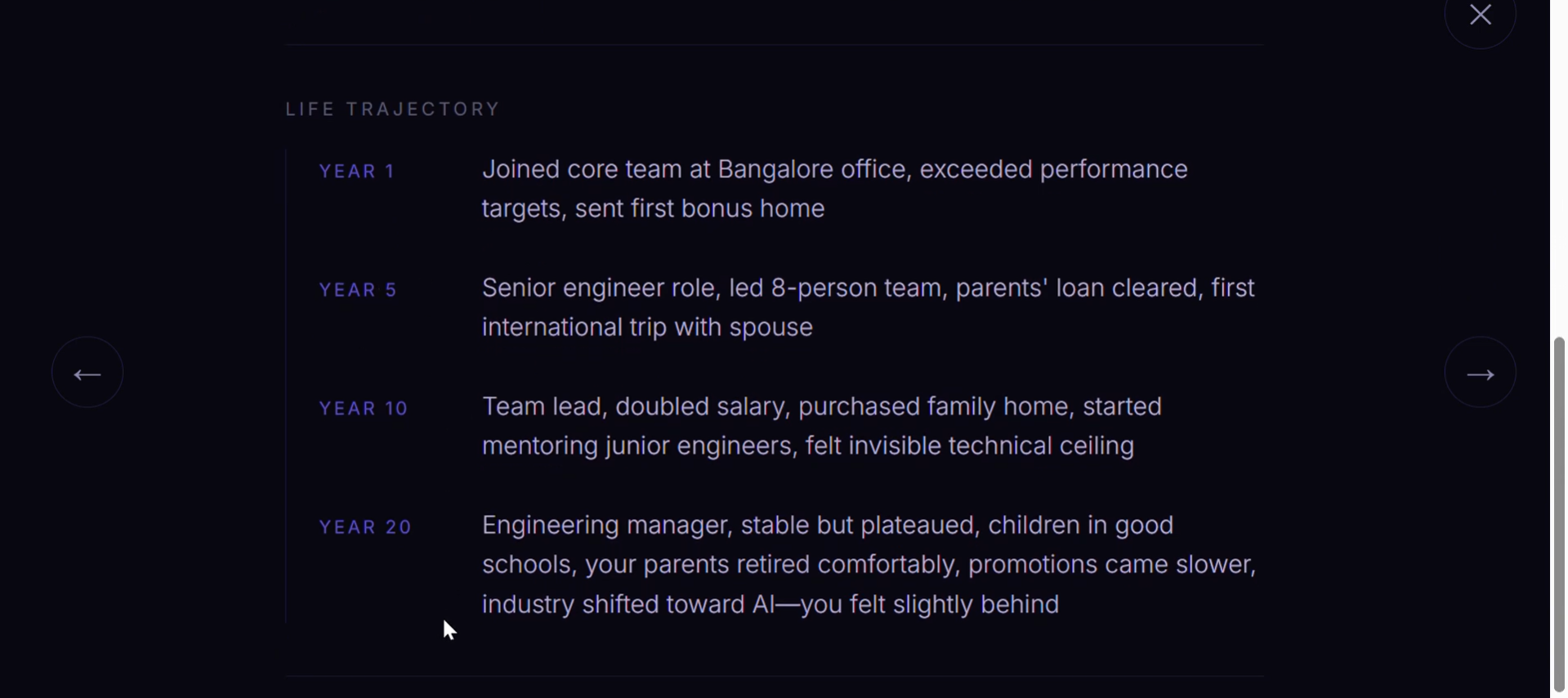
Year Trajectory
-
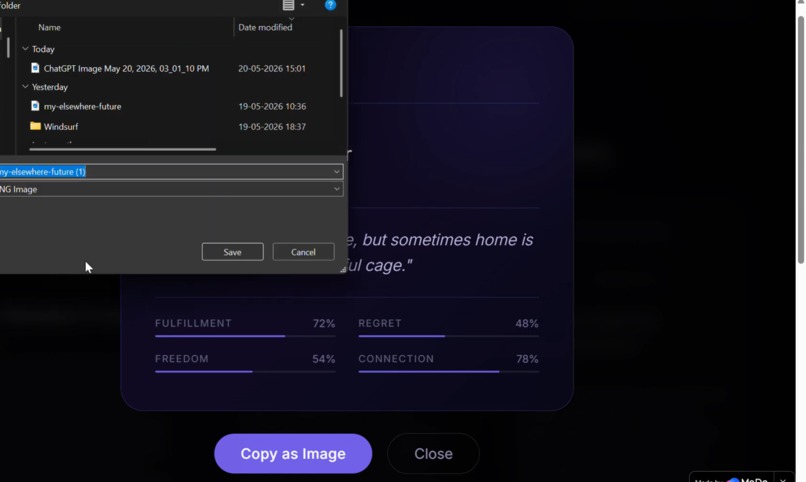
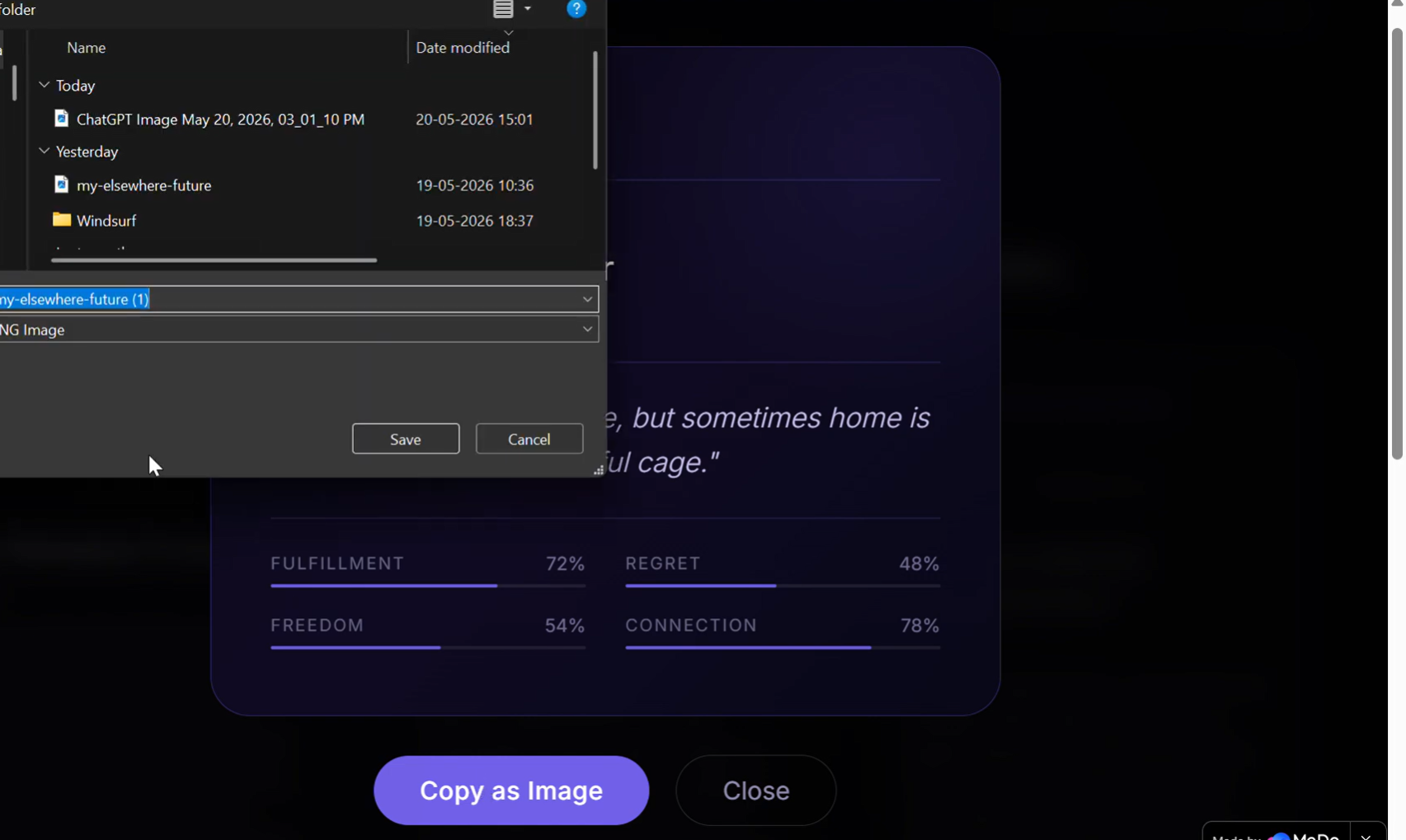
Saving response as image
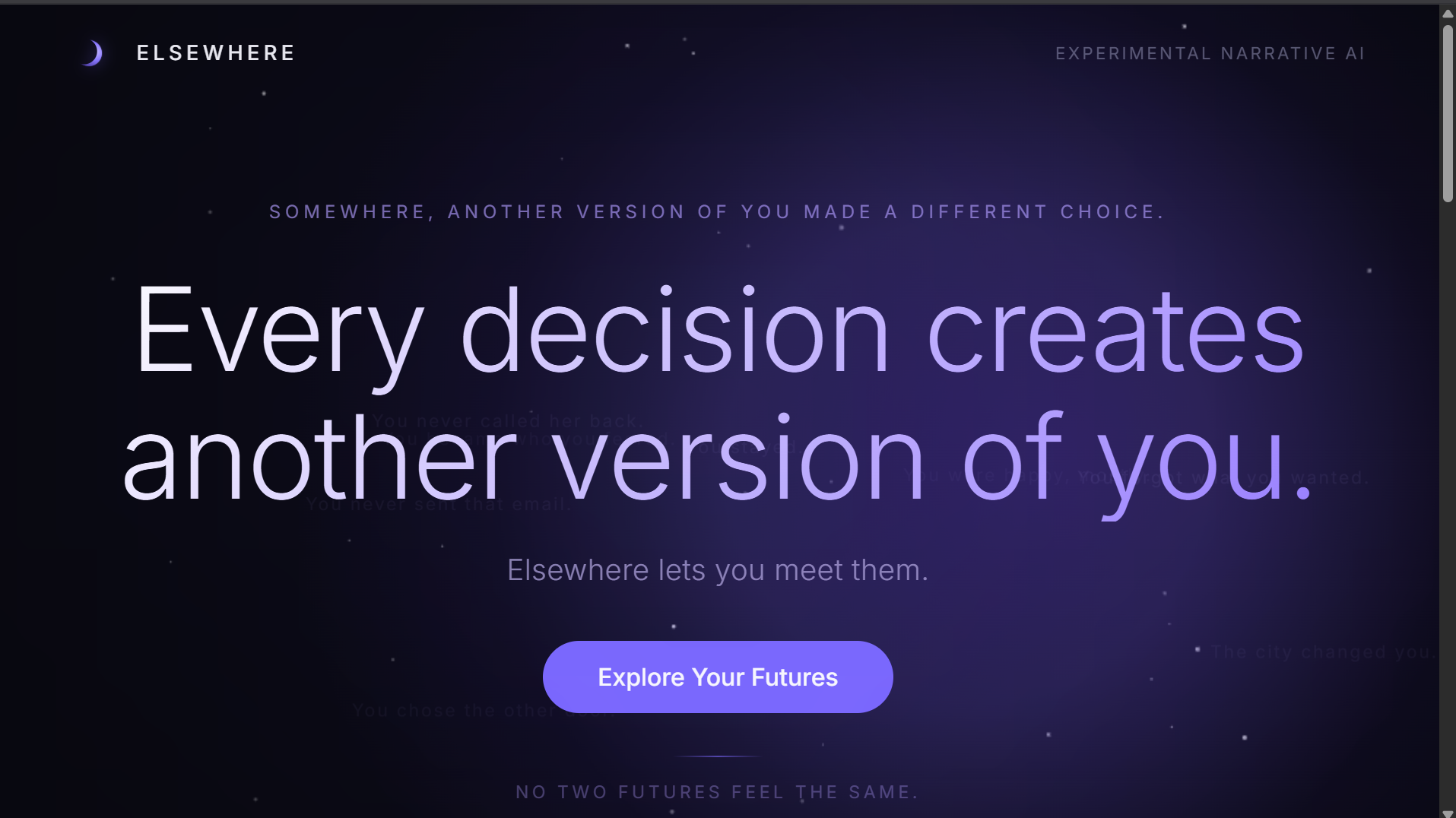
What is Elsewhere?
Most AI tools answer questions. Elsewhere asks a different one:
Who would you have become — if you'd chosen differently?
Elsewhere is a cinematic AI experience that doesn't predict your future. It narrates the lives you never lived.
You answer 5 questions about who you are and the decision you're facing right now. Elsewhere generates 3 alternate future versions of you — the version who stayed, the version who took the risk, and the version that surprises even you.
What Each Alternate Self Contains
For each future version of you, Elsewhere generates:
- An identity title — "The Version of You Who Never Left"
- A cinematic future diary entry — a first-person narrative written by who you could have become, set on a specific morning years from now
- An emotional landscape — Fulfillment, Regret, Freedom, Connection visualised as elegant meters
- A life trajectory — Year 1 → Year 5 → Year 10 → Year 20 snapshots
- A closing quote — one sentence from that version of you to your present self
- A shareable future card — a downloadable PNG designed to be posted
What Inspired This
I kept noticing that every AI tool that simulates futures gives you data. Probability scores. Financial projections. Decision trees.
None of them make you feel anything.
The closest thing I found was MIT's 2024 "Future You" research — a chatbot session with your 60-year-old self. Powerful concept. But a single chatbot. No narrative depth. No branching selves. No emotional consequence.
The gap was clear: nobody had built alternate future storytelling grounded in your real life decisions. Not prediction. Not planning. Pure speculative emotional narrative.
That's what Elsewhere is.
How I Built It
The intake is built natively on MeDo — 5 questions collected through a dark cinematic form, deployed as a MeDo web app. On submit, MeDo passes the 5 answers as URL parameters to the generation engine.
The generation engine is powered by the Claude API. The system prompt was the hardest part — getting diary entries to feel eerily specific and human rather than generic AI text required extensive prompt engineering around literary tone, psychological realism, sensory detail, and explicit anti-cliché rules.
The cinematic experience — the atmospheric landing page, generating screen, alternate selves reveal with expand modals, and shareable PNG cards — is built in HTML, CSS, and vanilla JavaScript, deployed on Netlify.
The full architecture:
Challenges I Faced
The biggest challenge was the AI output quality. Claude kept producing generic motivational text — "you found success and grew as a person." That's not what Elsewhere needed. The diary entries had to feel haunting and specific. It took many prompt iterations to get output that genuinely made me stop and think that version of me felt real.
The second challenge was layout. Building a desktop-first cinematic experience required fighting against mobile-first defaults at every step — card sizing, viewport centring, scrollbar containment, fixed vs sticky positioning across 4 pages.
The third challenge was the MeDo integration — connecting MeDo's intake to an external generation engine via URL parameters while keeping the experience seamless for the user.
What I Learned
- Prompt engineering for emotional output is a completely different discipline from prompt engineering for factual output
- Cinematic UI is 20% visual design and 80% motion, atmosphere, and breathing room
- The shareable output is not a feature — it is the product. Everything else exists to produce that one downloadable card
Tech Stack
| Layer | Tool | What it does |
|---|---|---|
| Intake experience | MeDo | 5-question cinematic form, deployed as live web app |
| Code generation | Antigravity IDE | Built the full cinematic HTML/CSS/JS experience |
| AI generation | Claude API (Anthropic) | Generates the 3 alternate selves, diary entries, timelines |
| Hosting | Netlify | Hosts the generation engine and cinematic reveal pages |
The experience is a seamless handoff: MeDo captures your story → Claude API generates your alternate selves → Netlify delivers the cinematic reveal.
Built With
- claude-api
- css
- html
- javascript
- medo

Log in or sign up for Devpost to join the conversation.