-
-
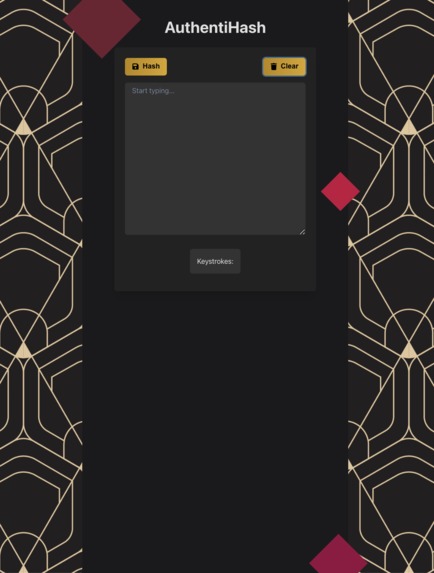
Art deco inspired UI
-
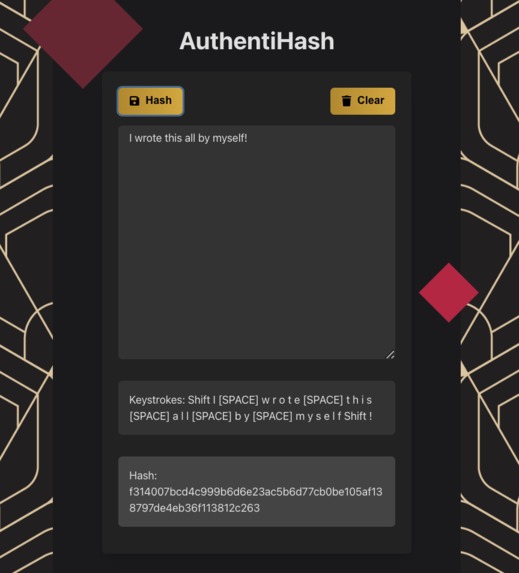
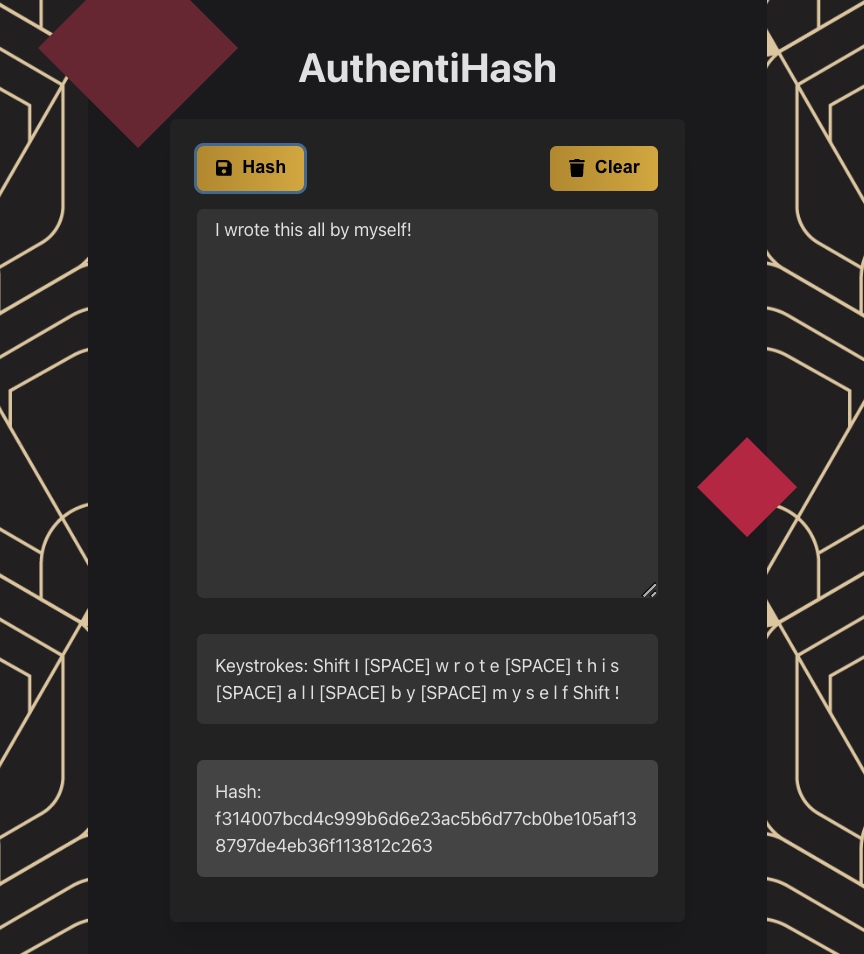
Example of creating a hash with user input and date-time
-
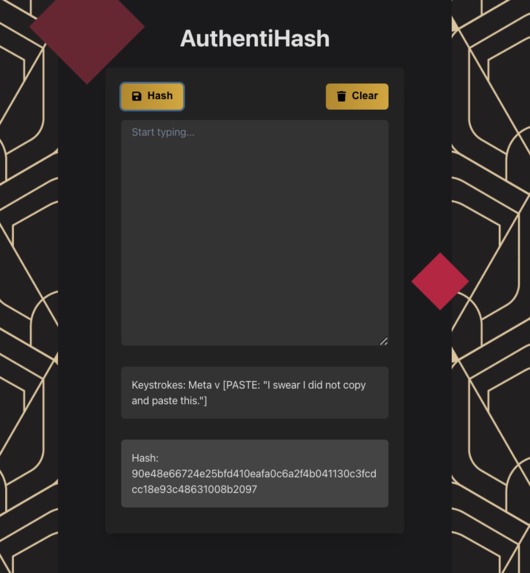
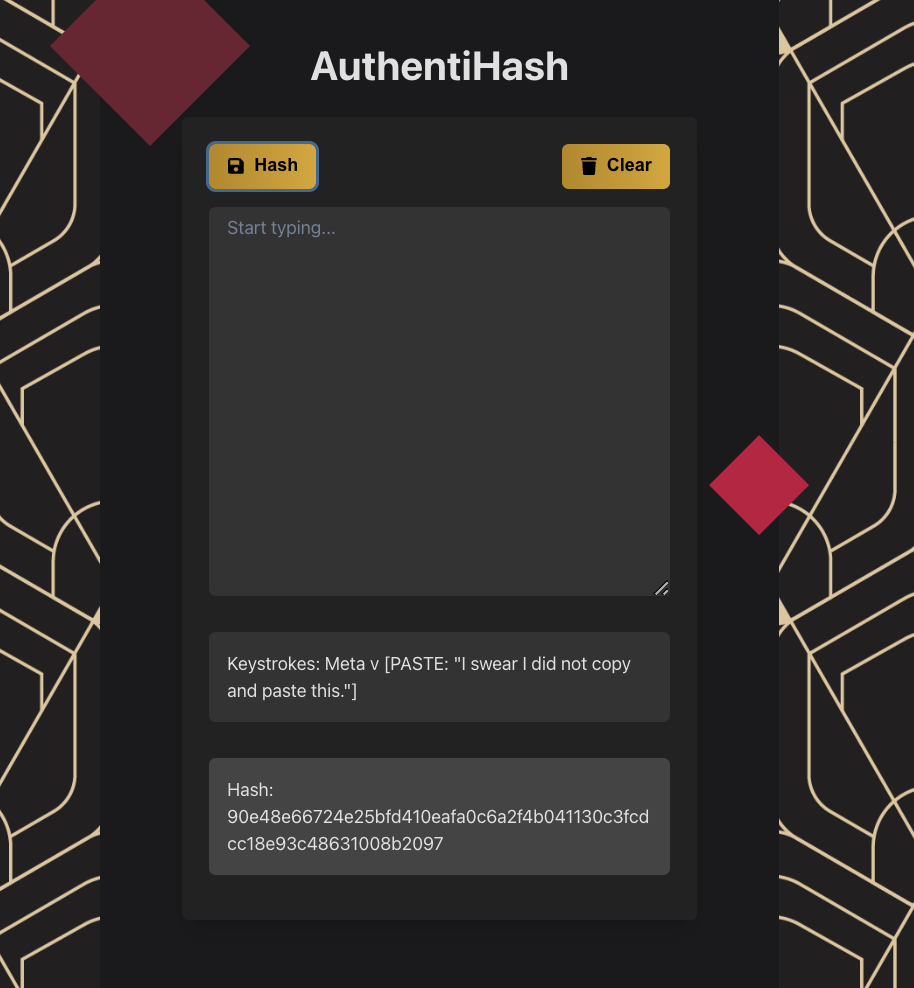
A thwarted attempt to copy and paste!
Inspiration
With the rise of AI generated content in academic and commercial settings, consumers want to know that the content that they encounter is authentic. Creators also want to protect their work against accusations of it being AI-generated, especially when any work that is created using AI does not have the ability to be protected by copyright law. In addition, AI generated text can create a greater risk for misleading information, bias, and quality control when an author copies and pastes directly from a language model. There needs to be a way to verify whether content you produce and consume has been created by a human.
What it does
This project creates a text editor where, upon clicking into the text box, the user's keystrokes are tracked. The keystroke logger has the ability to detect the keys "backspace", "delete", "enter", and "space", and also will log if a command is used to copy and paste content into the text box. After clicking 'save' the keystrokes, along with a date-time stamp, are hashed to create a unique fingerprint for the document.
Challenges we ran into
A blockchain-agnostic contract written with Solidity was deployed to Sepolia for testing. The user also has the ability to log into their MetaMask wallet upon loading into the page. However, these two were not integrated in order to use the wallet address to log a hash on a blockchain. This would be a crucial next step for this project.
Accomplishments that we're proud of
This project contained a lot of firsts as I learned how blockchain technology works and used blockchain development tools like Hardhat, Remix, Truffle, and Ganache. I also learned how to use cryptographic function SHA-256 to hash user input.
Future roadmap
I believe that one application of this tool would be an integration with academic platforms like TurnItIn and Canvas to show a student's proof of process to graders. However, to be widely used, it would need to be much more accessible, possibly through a browser plugin that integrates with popular text editors such as Google Docs and Microsoft Docs. Learning to develop a Chrome extension would be a great skill to add to my toolbox. Other proposed features include:
- Add a better way of mapping identity to the writing, such as biometric authentication with face-id or a fingerprint, or multi-factor authentication.
- Ability to download document with added metadata to show authorship
- Storing the original document in a decentralized way via InterPlanetary File System
- Retrieve version history via a UI and restore previous version of document for further editing
- Add way of sharing proof of authenticity that is easily accessible
- Integrate with plagiarism detection tool
- When a document is shared, show alerts from when text is copied and pasted
- Detect citations to clear alerts automatically
- Capability to support multiple authors and delineate between individual's contributions
Research and further reading
Appel, Gil, et al. “Generative AI Has an Intellectual Property Problem.” Harvard Business Review, 11 Apr. 2023, hbr.org/2023/04/generative-ai-has-an-intellectual-property-problem
“Libguides: Author’s Rights and Copyright: Author’s Rights.” Author’s Rights - Author’s Rights and Copyright - LibGuides at University of Illinois at Urbana-Champaign, guides.library.illinois.edu/AuthorsRights
Brittain, Blake. “AI-Generated Art Cannot Receive Copyrights, US Court Says | Reuters.” Reuters, 21 Aug. 2023. https://www.reuters.com/legal/ai-generated-art-cannot-receive-copyrights-us-court-says-2023-08-21/
Hyken, Shep. “Half of People Who Encounter Artificial Intelligence Don’t Even Realize It.” Forbes, Forbes Magazine, 12 June 2017, www.forbes.com/sites/
Built With
- css
- javascript
- metamask
- react.js
- sepolia
- typescript



Log in or sign up for Devpost to join the conversation.