Inspiration
Football is not just a sport; it is a global language spoken by approximately 5 billion people. From the die-hard fans in local pubs to the hundreds of millions tuning in globally for a single match, the passion is unmatched. The data source I used, football-data.co.uk, supports over 22 major European leagues—including the English Premier League, Spanish La Liga, German Bundesliga, Italian Serie A, and even worldwide divisions like the MLS and Brazil’s Serie A.
What inspired me was the inherent unpredictability of the game. In the Premier League, often cited as the most competitive in the world, human logic often fails. You see a giant like Liverpool, who might spend over $400 million in a single transfer window to bolster their squad, yet they can be humbled by a team like Sunderland or Crystal Palace that operates on a fraction of that budget.
As humans, we are biased. we factor in money, past trophies, the size of the fanbase, or "club history". These emotions cloud our judgment. I realized that while fans and analysts are constantly searching for an edge, their predictions are often just "gut feelings." I wanted to build an agent that ignores the hype and focuses purely on raw, unbiased data. I wanted to create a tool that serves the billions of fans and analysts who crave objective truth in a game defined by emotion.
What it does
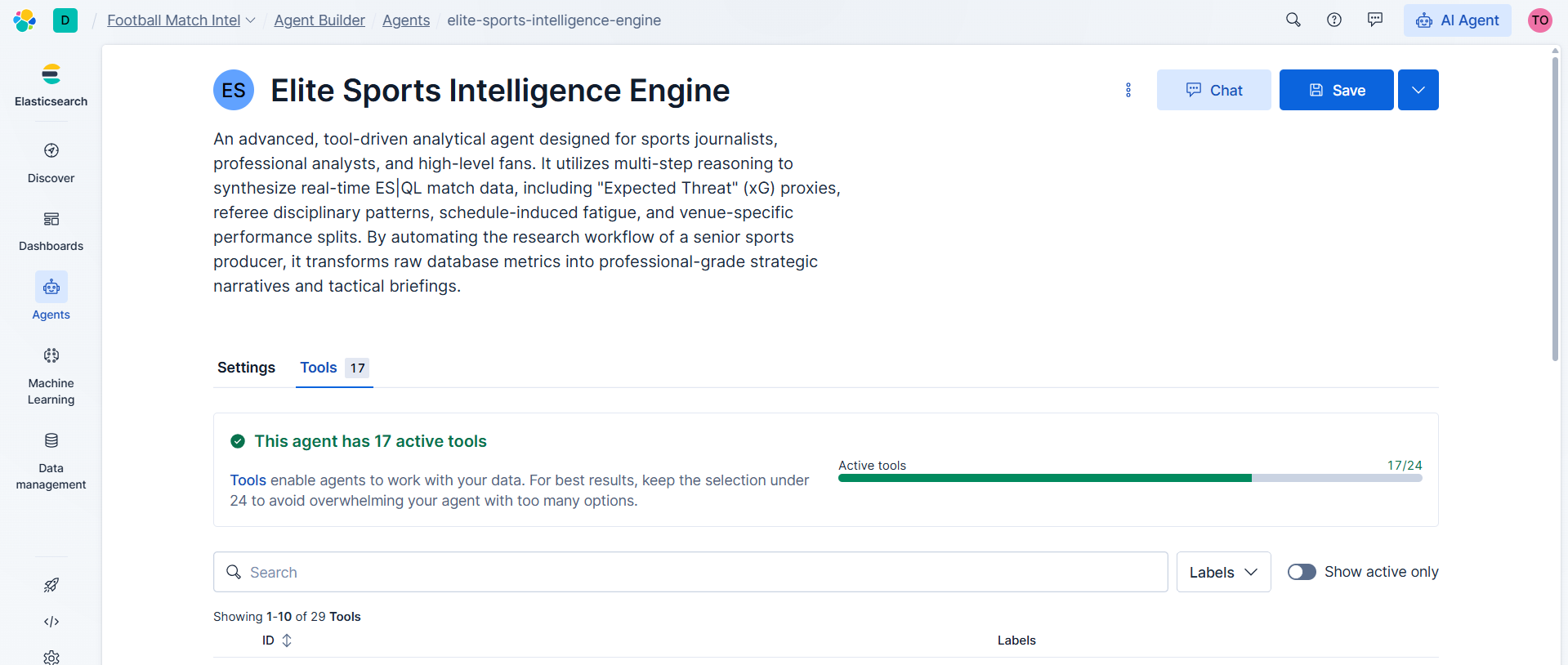
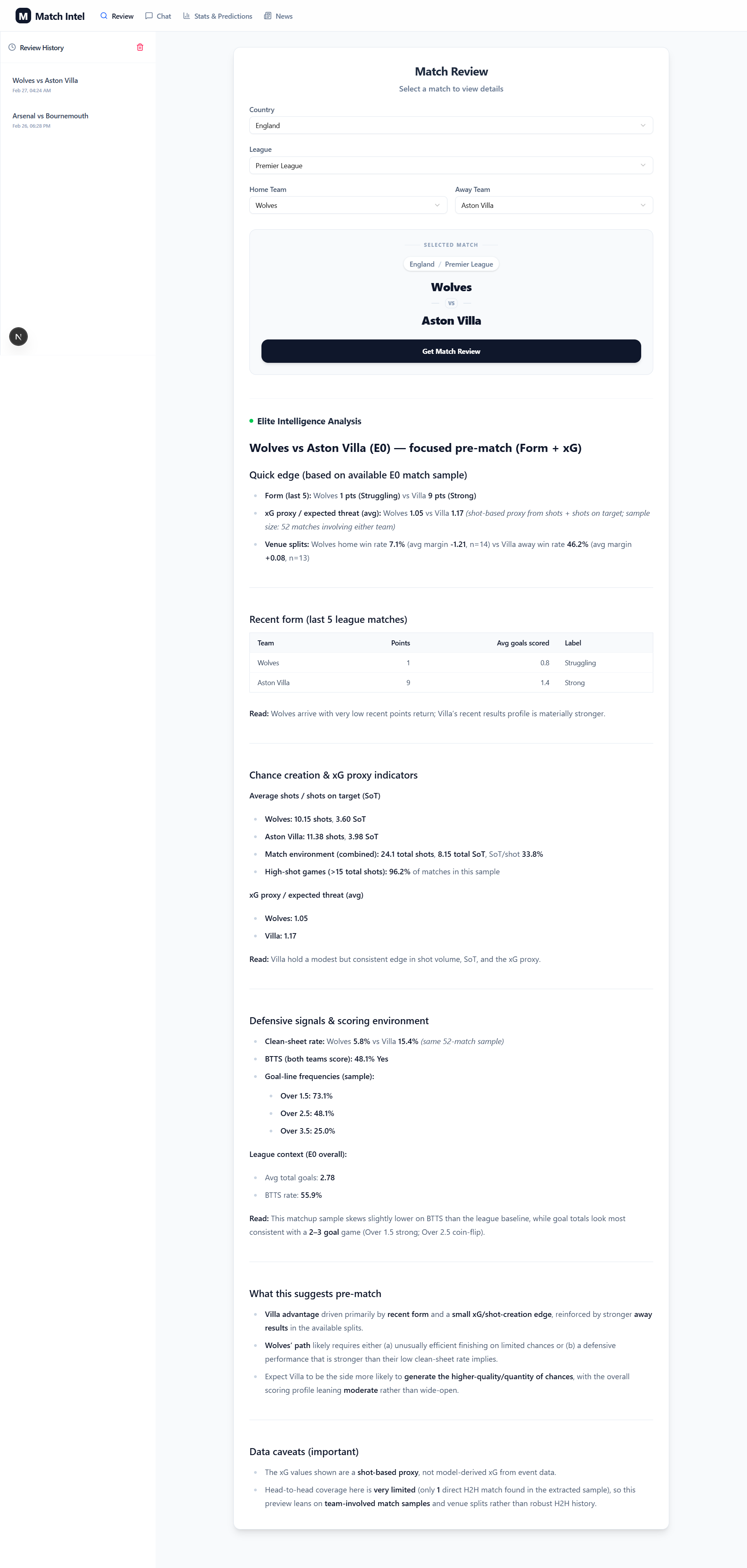
The Elite Sports Intelligence Engine is a specialized, tool-driven AI agent that acts as an automated "Chief Sports Scientist." It lets users select any supported league, home team, and away team. The agent then uses 14+ specialized ES|QL tools to deliver a comprehensive, neutral match analysis including:
- Recent form and performance trends
- Head-to-head history
- Goal, corner, and card patterns
- Shots, clean sheets, and defensive insights
- Home/away splits and referee tendencies
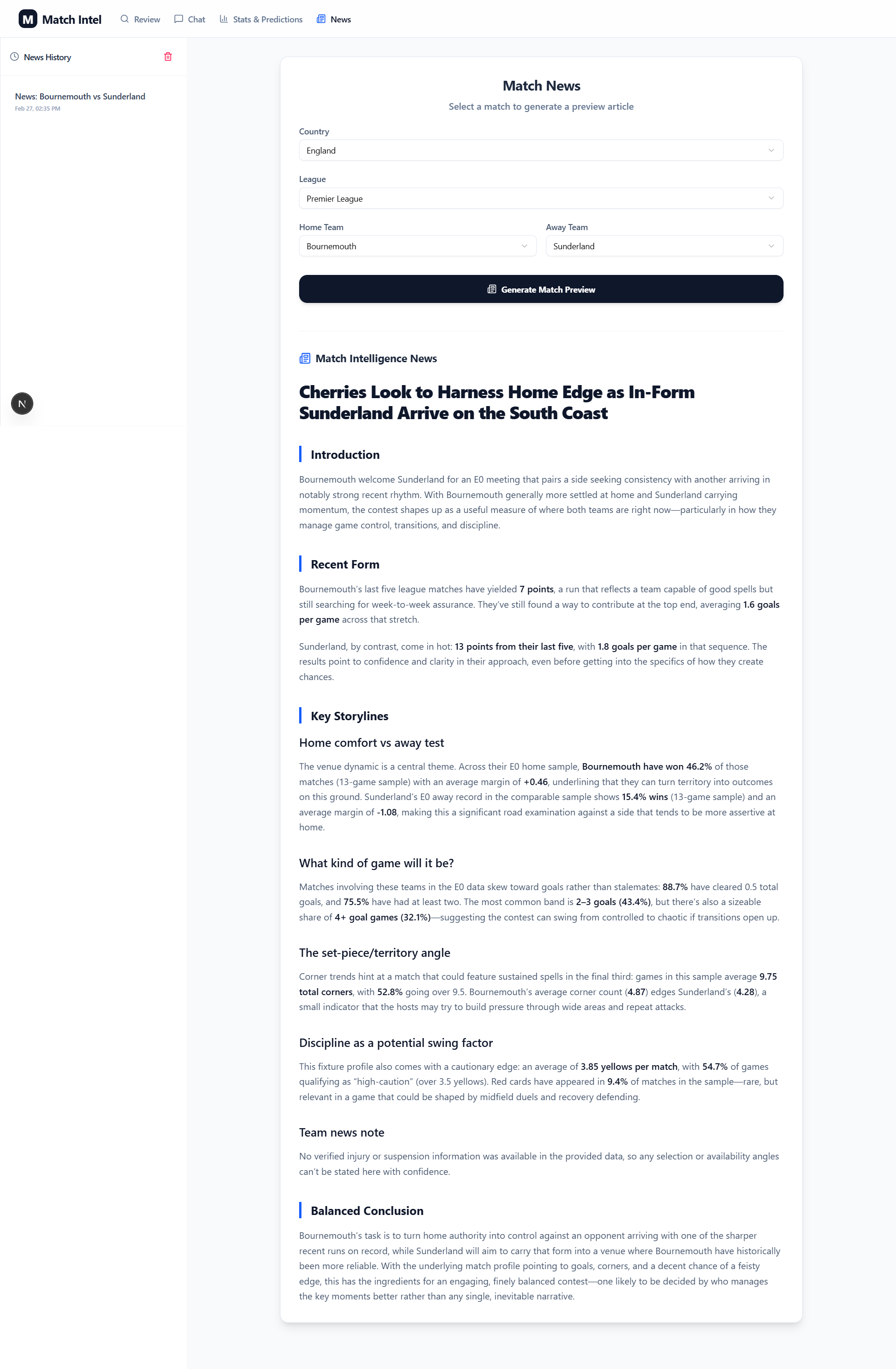
It presents everything in clear, structured sections with tables and reasoned insights — helping users understand likely patterns without any betting language or guarantees.
How I built it
I built the Elite Sports Intelligence Engine by creating a seamless data pipeline that flows from raw statistics to AI-driven narratives. The technical architecture is centered on the Elasticsearch Agent Builder as the core orchestrator.
The Data Foundation
The process begins with an automated ingestion layer. I developed a Next.js cron job hosted on Vercel that daily fetches and ingests CSV data from football-data.co.uk directly into Elasticsearch. This ensures that the agent is always operating on the freshest possible match data across all supported European leagues.
The Analytical Backbone: ES|QL
To transform raw rows into insights, I refactored and optimized a library of over 14 custom ES|QL (Elasticsearch Query Language) tools. These tools are engineered to perform high-performance, on-the-fly aggregations. Instead of simple lookups, they calculate complex, derived metrics such as:
- Form Momentum Scores: A weighted analysis of recent match outcomes.
- Win-to-Nil Percentages: Measuring defensive dominance combined with clinical finishing.
- Advanced Trends: Real-time analysis of corners, cards, shots, and "Expected Threat" (xG) proxies.
The Intelligence Layer
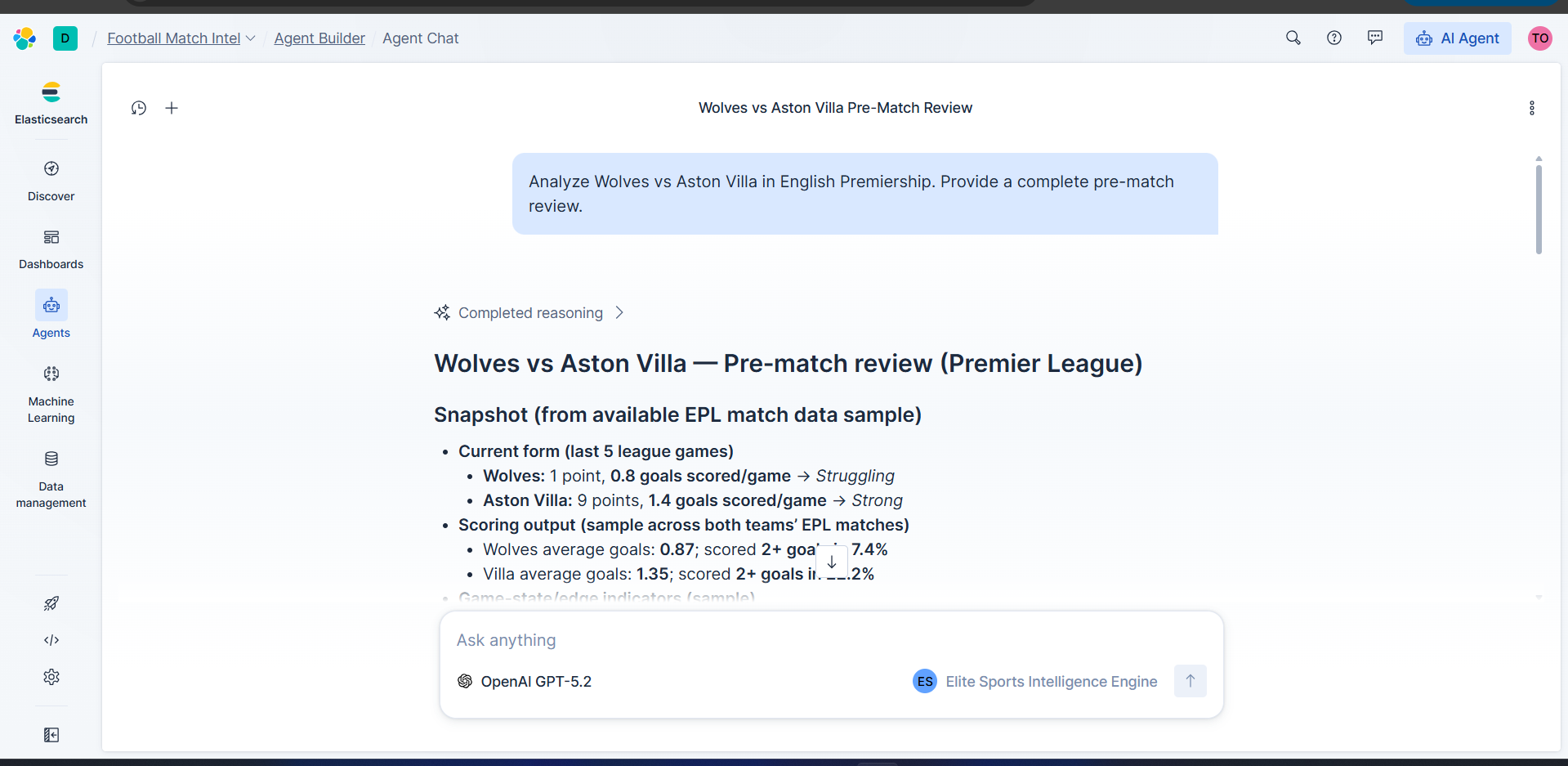
The reasoning capabilities are powered by a high-performance GPT-5.2 model, which acts as the agent's brain. I utilized sophisticated Prompt Engineering to develop a "Master System Prompt." This prompt defines the agent's persona as an elite, unbiased analyst and provides the logic required for multi-step reasoning.
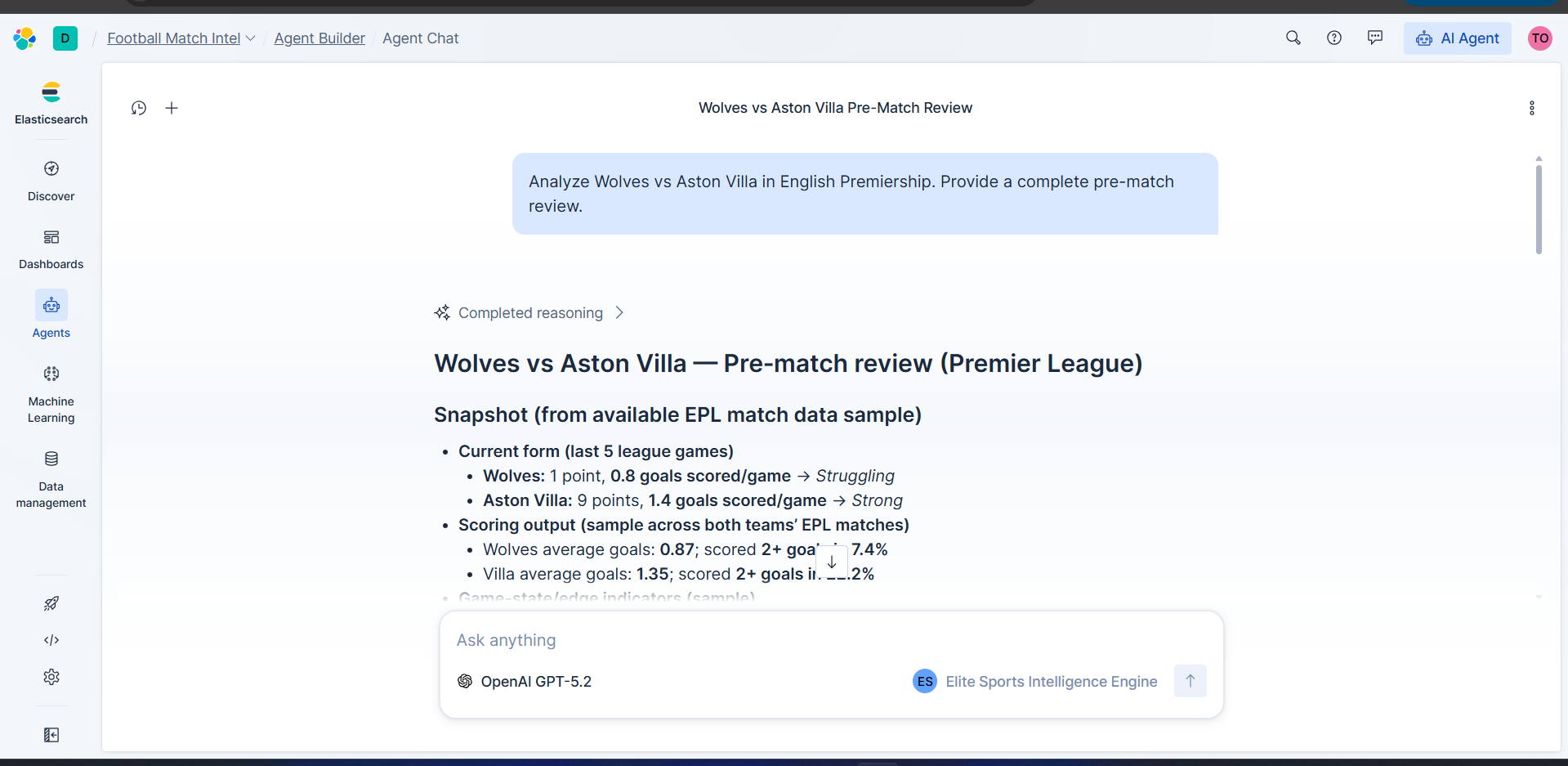
When a user asks a question, the agent doesn't just run a single query; it chains these tools intelligently. For example, it might simultaneously analyze a team’s offensive shot volume, the opponent’s defensive shutout rate, and the specific referee’s disciplinary tendencies to provide a 360-degree match briefing. This ensures the output is always professional, highly structured, and entirely free of the human biases that typically plague sports predictions.
Challenges I ran into
Building a high-fidelity intelligence engine meant navigating the "messy" reality of sports data. Here are the primary obstacles I overcame:
1. The API Latency Gap & Optimization
A significant hurdle was the performance disparity between environments. While the agent was lightning-fast when tested directly within the Elasticsearch Agent Builder UI, the response times slowed down considerably when making API requests from the Next.js frontend.
To solve this, I performed a "Performance Audit" on my agent:
- Selective Tooling: I identified and disabled lower-priority tools to reduce the computational overhead for the LLM during the reasoning phase.
- Prompt De-ambiguation: I refactored the system instructions to be less ambiguous, providing a "Master Command" that tells the agent to prioritize efficiency and only select the most critical tools for the specific frontend request.
- Frontend Resilience: While it is still not as instantaneous as the native Elastic environment, these optimizations, combined with AbortControllers in my code resulted in a much more responsive and stable application.
2. The ES|QL Learning Curve & Strict Typing
As a new user of ES|QL, I encountered several verification_exceptions that stalled development. The most common was the Data Type Mismatch error; because ES|QL is strictly typed, it refused to perform date math on fields stored as keywords. I had to learn to implement explicit casting using the TO_DATETIME function to transform the data mid-query:
| EVAL last_date = TO_DATETIME(last_match_str)
| EVAL days_between_fixtures = DATE_DIFF("day", prev_date, last_date)
3. The "Brittle Data" and Entity Mapping Problem
The most significant hurdle was the inconsistency between user intent and database records. While the football-data.co.uk dataset is structurally consistent, human language is not. A user might type "Manchester United," "Man Utd," or "The Red Devils," but the underlying Elasticsearch index strictly recognizes "Man United".
Initially, this caused my agent to report "0% performance" or "null" results for major clubs. It perceived a world-class team as having a "competitive crisis" simply because the strings didn't match. To solve this, I benchmarked several LLMs on their "Entity Mapping" capabilities:
- Gemini 2.5 & Claude Sonnet 4.5: During my testing, these models frequently struggled to bridge the gap between natural language and brittle database keys without returning errors.
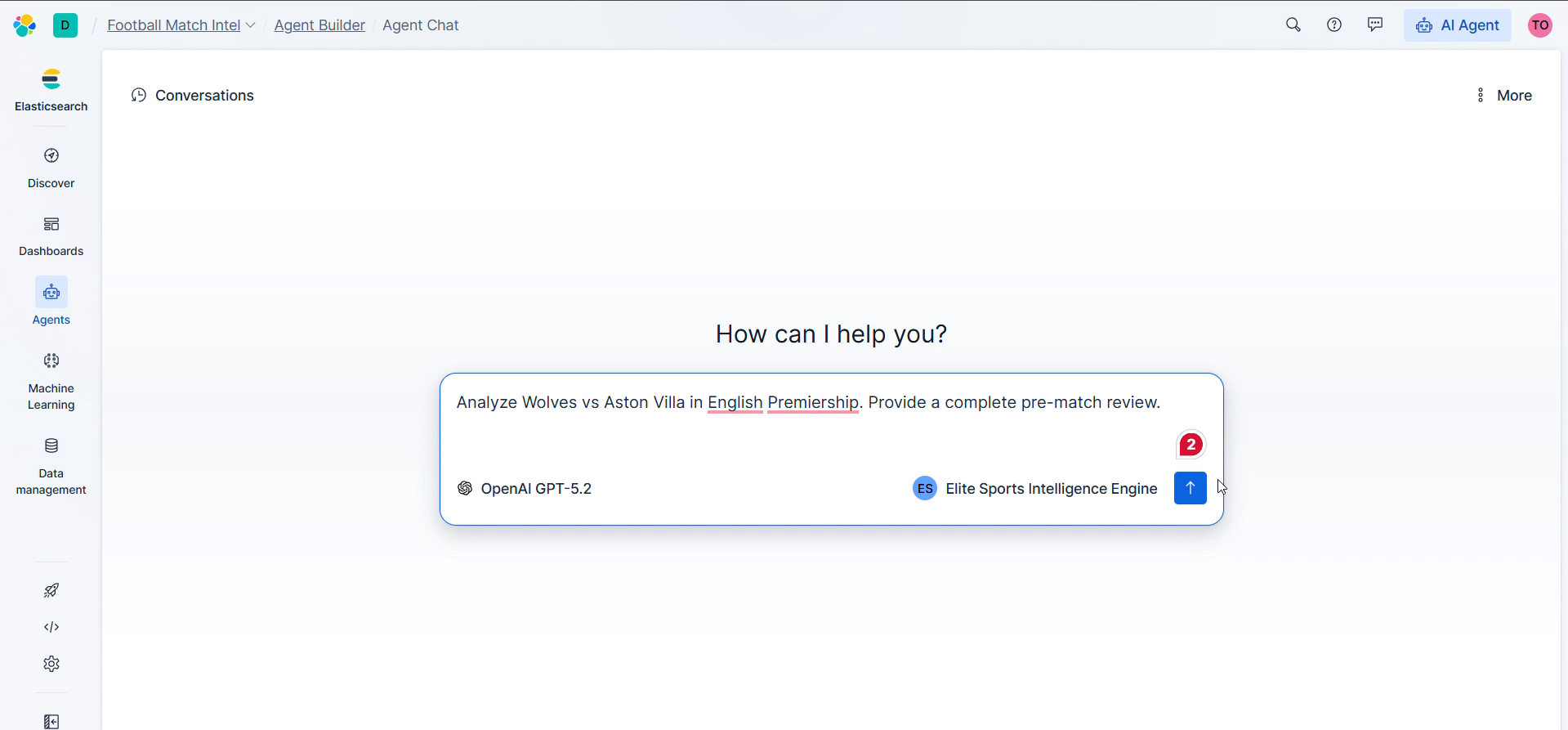
- OpenAI GPT-5.2: I discovered that GPT-5.2 demonstrated superior zero-shot normalization. After switching to this model, the agent successfully mapped clubs like "Manchester United" to "Man United" autonomously, ensuring 100% data reliability.
Accomplishments that I'm proud of
I successfully built 14+ robust ES|QL tools that cover almost every major statistical angle in football. The agent intelligently chains them for deep analysis, and the daily automated sync keeps the data fresh. I also created a fully functional frontend apps that connect to the agent via API, turning raw data into beautiful, usable insights.
Features Used
- Elastic Agent Builder: Acts as the core orchestrator, connecting a high-performance LLM (GPT-5.2) to private indices.
- 19 Custom ES|QL Tools: Specialized "skills" performing on-the-fly aggregations for metrics like Form Momentum Scores and Expected Threat (xG).
- Automated Ingestion Pipeline: A Next.js and Vercel-powered cron job that daily syncs CSV data directly into Elasticsearch Serverless.
- Agentic RAG: The agent utilizes Multi-Step Reasoning to chain tools—analyzing offensive volume, defensive shutout rates, and referee disciplinary patterns in a single workflow.
What I Loved Most About Elastic Agent Builder
- UI-Driven Development: It was incredibly easy to create and test custom ES|QL tools directly in the UI without needing complex code.
- Natural Chaining: The agent intelligently decides the tool order and synthesizes results like a real analyst, creating a "Strategic Narrative" effortlessly.
- Data Isolation: My football index stays completely isolated and secure while the agent queries it in real time, ensuring a safe, private data integration.
What I Learned
Building the Elite Sports Intelligence Engine was as much a journey of technical discovery as it was an exploration of analytical philosophy. Here are my key takeaways:
1. The Power of Specialized Querying
I learned how incredibly powerful ES|QL is for real-time statistical analysis. Coming into this, I was new to the language, but I quickly realized its ability to handle complex, multi-dimensional aggregations on the fly is a game-changer for sports tech. Being able to pipe data through EVAL and STATS allowed me to create high-level metrics like "Expected Threat" and "Schedule Density" without pre-calculating them in the database.
2. The "Bias Gap" in Sports Analysis
Most importantly, I discovered that removing human bias through data-driven tools creates far more consistent and valuable insights than traditional analysis. Humans are hard-wired to factor in history, transfer fees, and emotional narratives—like expecting a $400M+ Liverpool squad to always dominate based on prestige. By building an engine that ignores these "vanity metrics" and focuses strictly on raw performance data, I’ve created a tool that finds the truth in the numbers rather than the hype in the headlines.
3. Model Benchmarking and Schema Awareness
I learned that not all LLMs are created equal when it comes to "Schema Awareness." My experimentation showed that while some models struggle to map "Manchester United" to "Man United," others like GPT-5.2 excel at it. This taught me that the choice of the "Reasoning Brain" is just as important as the data it's querying.
What's next for Elite Sports Intelligence Engine
The current version is a strong foundation — daily CSV sync, 14+ ES|QL tools, multi-step chaining, and a frontend app — but I want to push it toward real-time, in-game intelligence.
My top priorities are:
Real-Time API Integration
Connect to live match-day APIs (e.g., football-data.org, Sportmonks, or Opta) to deliver "In-Game Intelligence" as the match unfolds: updated stats, momentum shifts, xG flow, and revised outcome probabilities minute-by-minute.Injury, Fatigue & Weather Factors
Pull real-time injury updates, squad rotation hints, travel fatigue (miles flown, time zones), and local weather conditions (rain, heat, wind) from external APIs (e.g., OpenWeatherMap, injury trackers like PhysioRoom). These will feed into a new weighted "context modifier" layer so the agent can reason: "Heavy rain + long midweek travel may reduce high pressing — expect lower goals."Player-Level Granularity
Add player-specific stats (minutes played, key passes, duels won, expected assists) once I integrate richer data sources. This will allow deeper tactical breakdowns like "midfield battle" or "set-piece threat".Multi-Sport Expansion
Start with basketball or tennis (similar structured data) to prove the engine is truly "Elite Sports" — not just football.
Built With
- elasticsearch
- es|ql
- next.js

Log in or sign up for Devpost to join the conversation.