The problem
People miss opportunities they could potentially benefit from because the information is fragmented.
Government schemes, scholarships, grants, subsidies, startup programs, fellowships, and other opportunities are spread across different portals, departments, PDFs, and websites. Even when someone finds a program, determining whether they actually qualify can require manually reading complicated eligibility criteria and comparing them against their own circumstances.
The problem isn't simply a lack of information.
It's the lack of personalized opportunity intelligence.
A person shouldn't have to repeatedly search hundreds of websites and manually determine which opportunities are relevant to them.
Inspiration
We were inspired by a simple question:
What if you had an AI agent that actually knew you and continuously looked for opportunities that mattered to you?
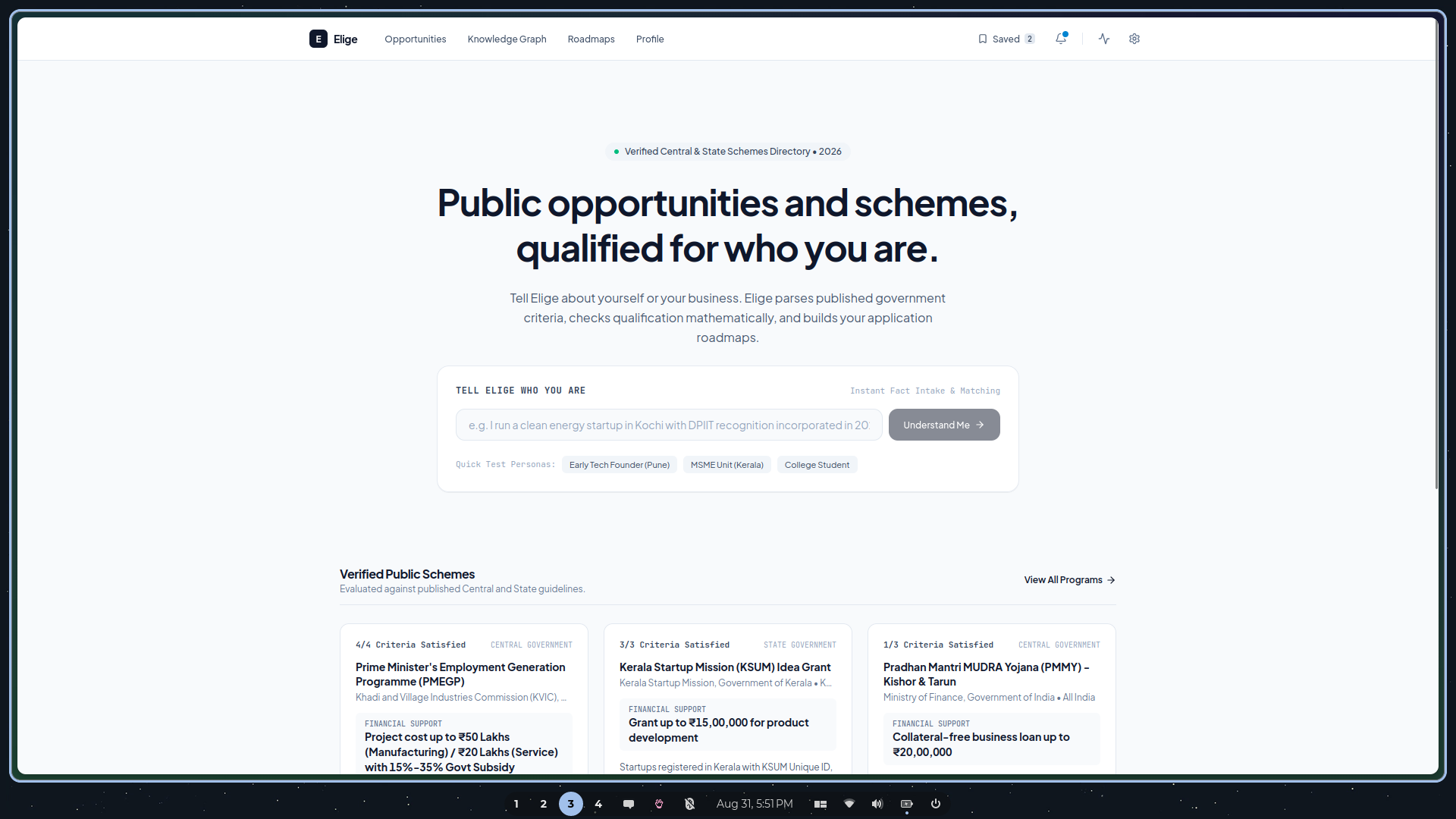
Instead of starting every search with a generic query, Elige starts with the person.
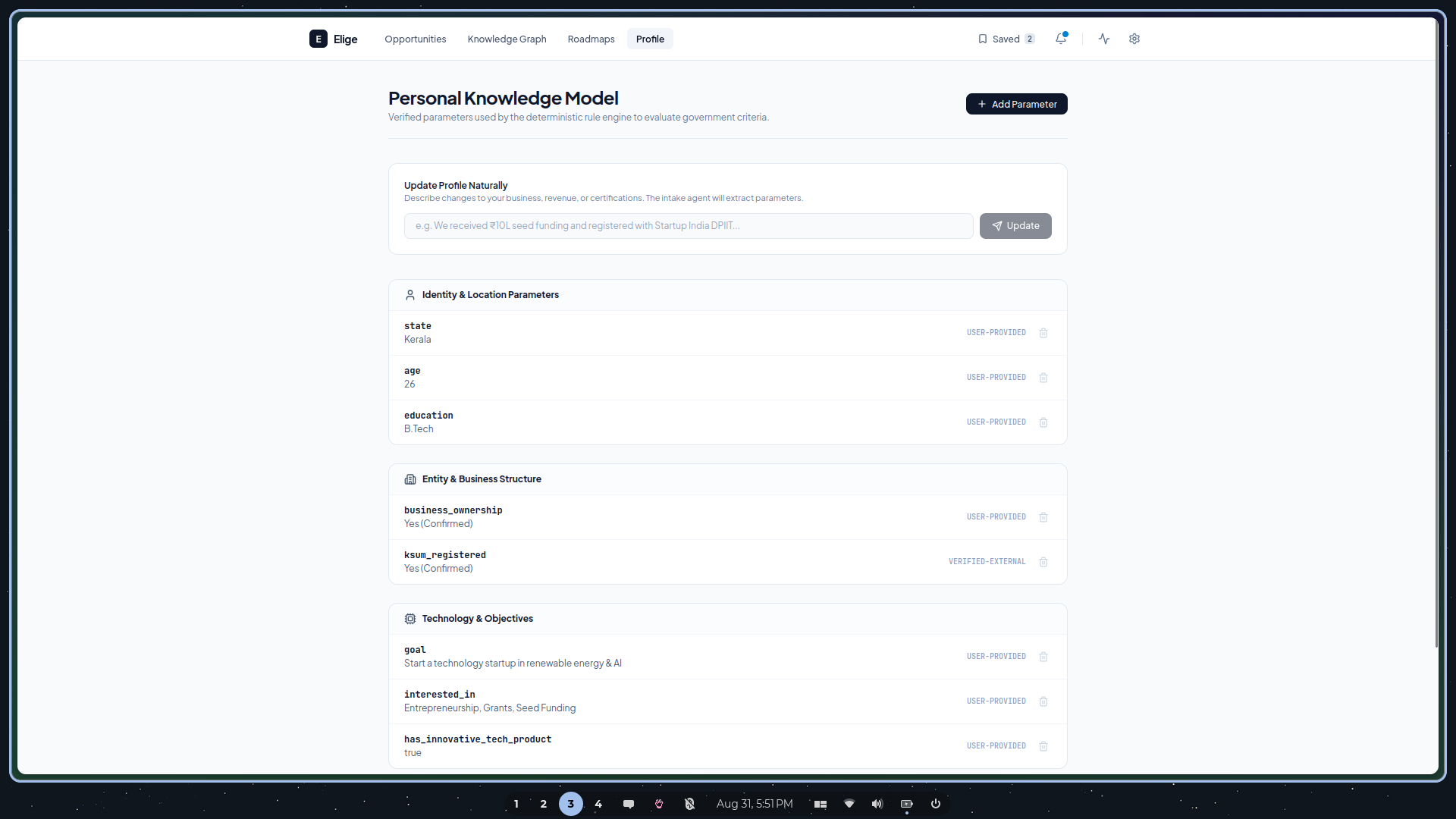
It builds an evolving understanding of the user's education, location, goals, occupation, skills, interests, and other relevant information. It then uses that knowledge to discover and evaluate opportunities specifically for that person.
We wanted to move from:
"Search for opportunities."
to:
"Find opportunities for me."
What it does
Elige is a personal opportunity intelligence agent.
A user provides information about themselves through a conversational interface. Elige builds a structured knowledge model of the user and uses it to research relevant opportunities.
It can:
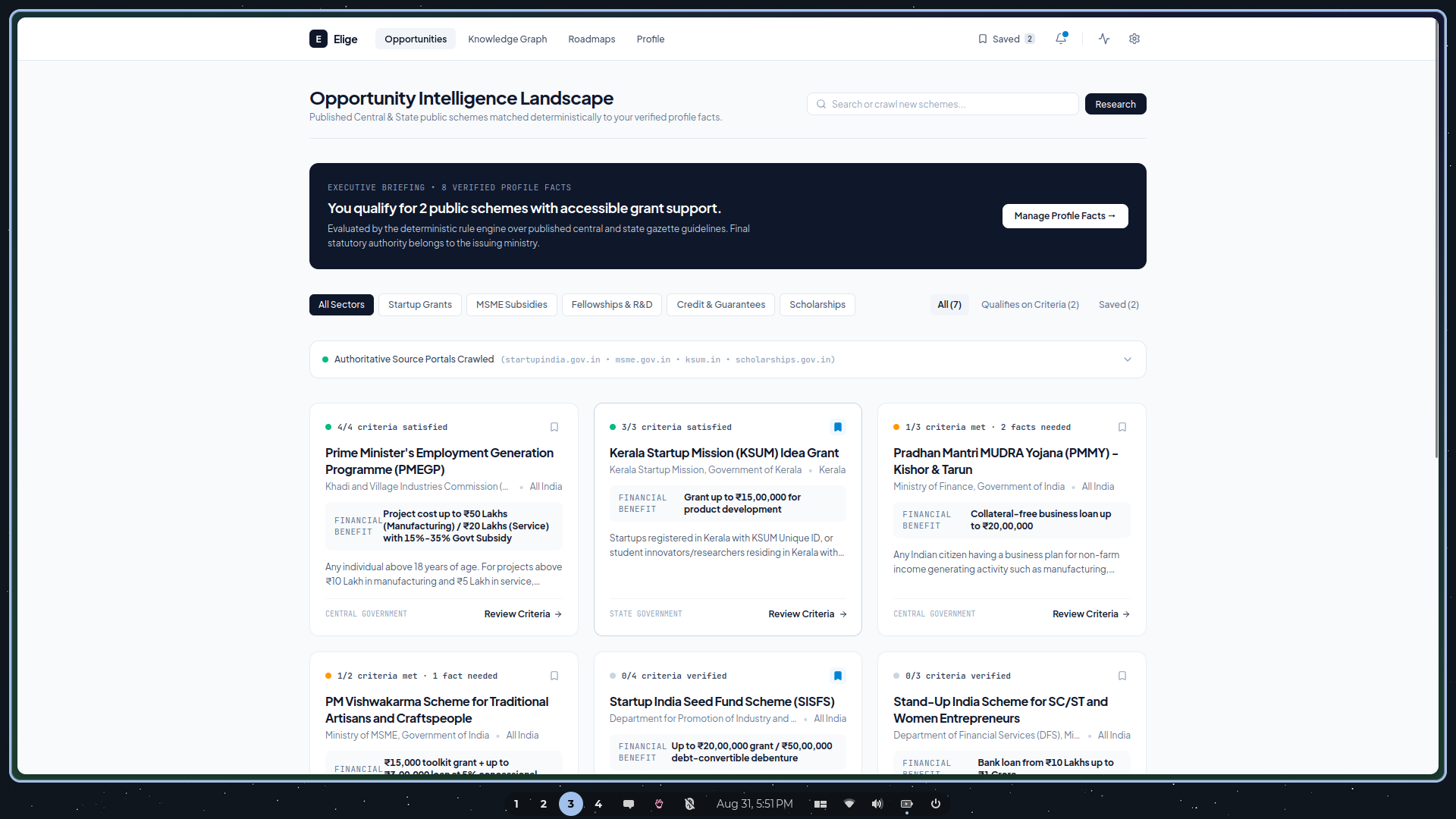
- Discover relevant government schemes, grants, scholarships, subsidies, startup programs, and other opportunities.
- Research authoritative sources rather than relying only on generic web content.
- Extract eligibility requirements from unstructured information.
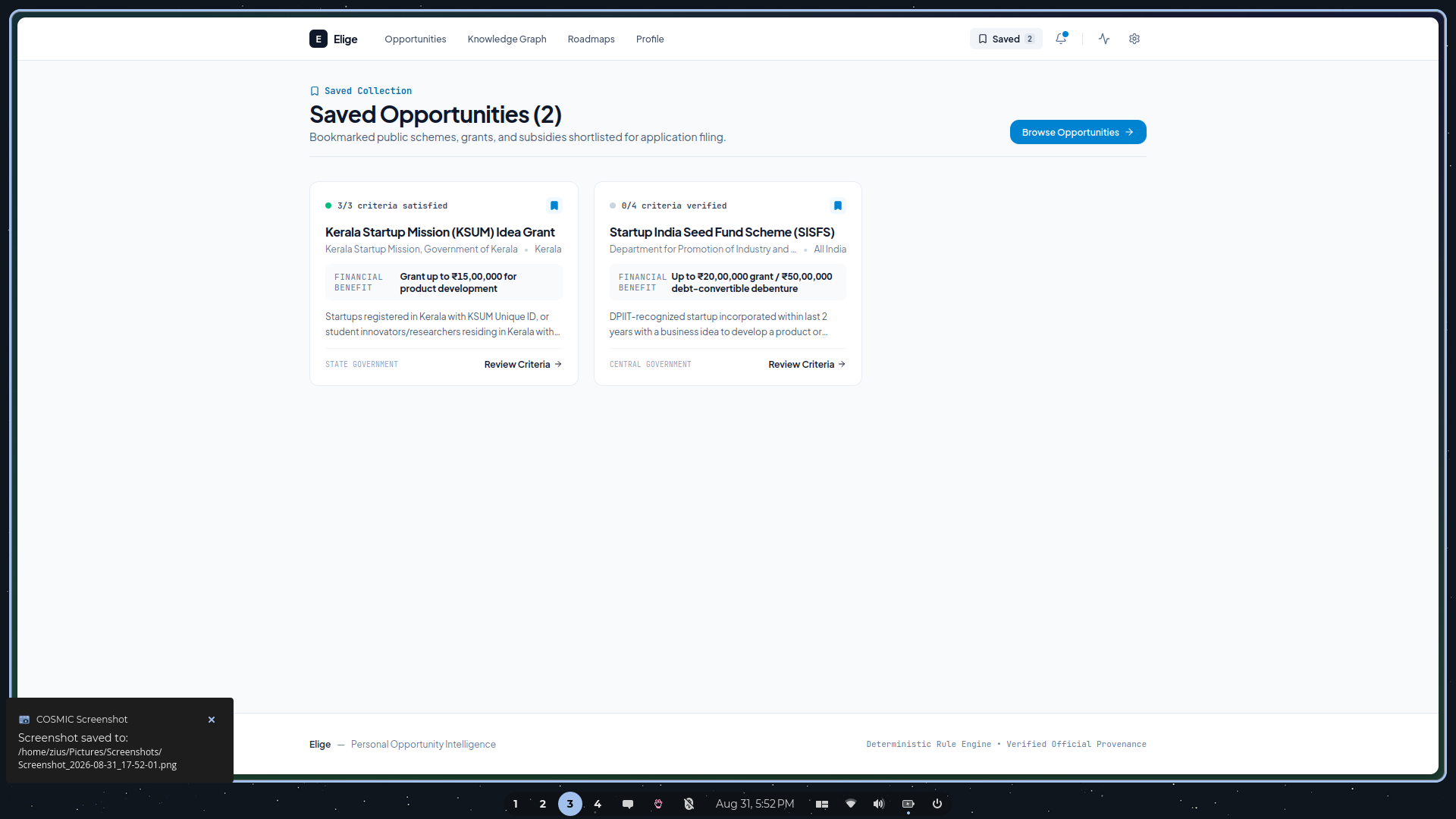
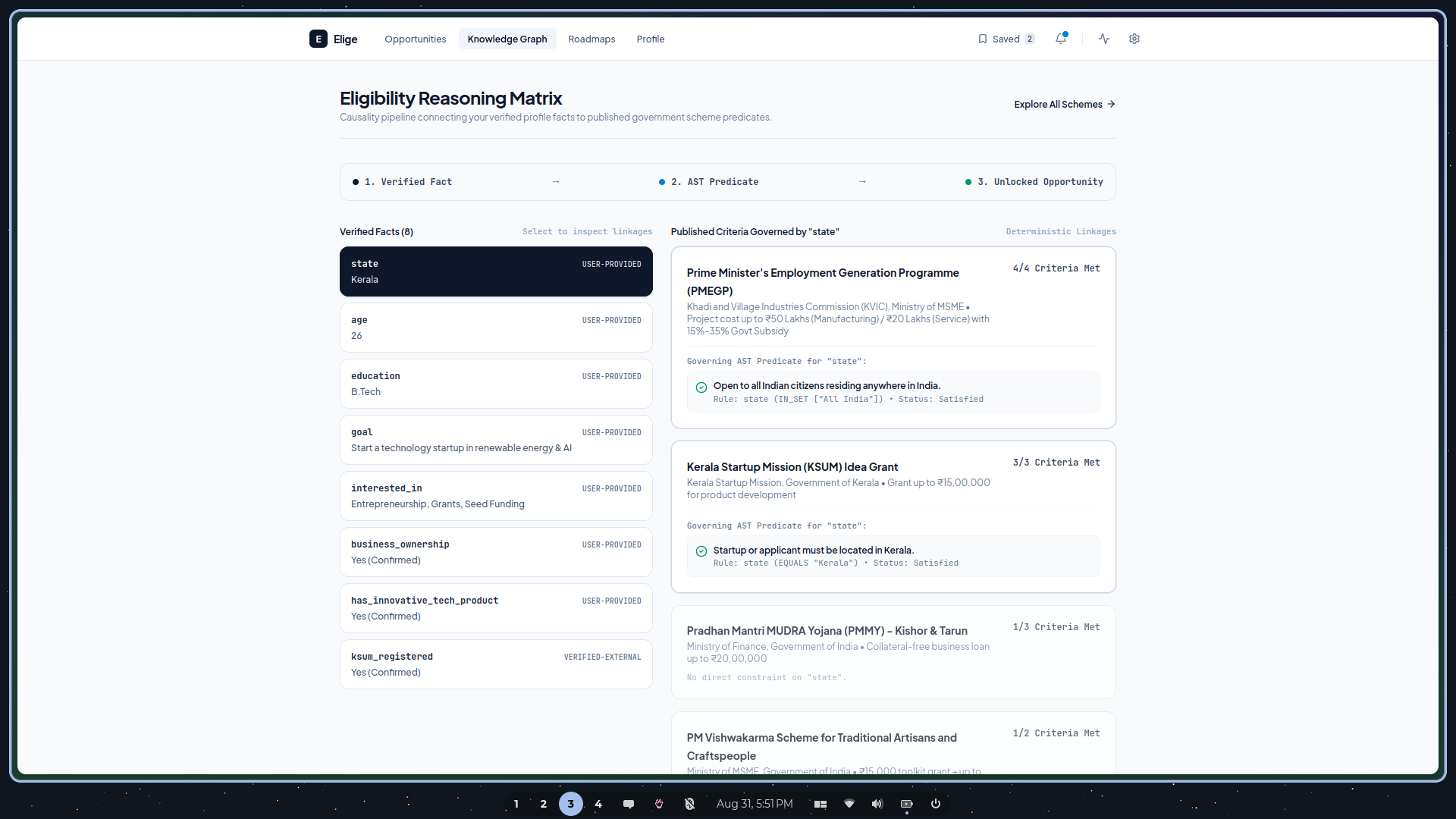
- Compare those requirements against the user's profile.
- Explain why an opportunity matches the user.
- Distinguish between eligible, likely eligible, possibly eligible, not eligible, and unknown.
- Identify missing information or requirements.
- Create actionable next steps.
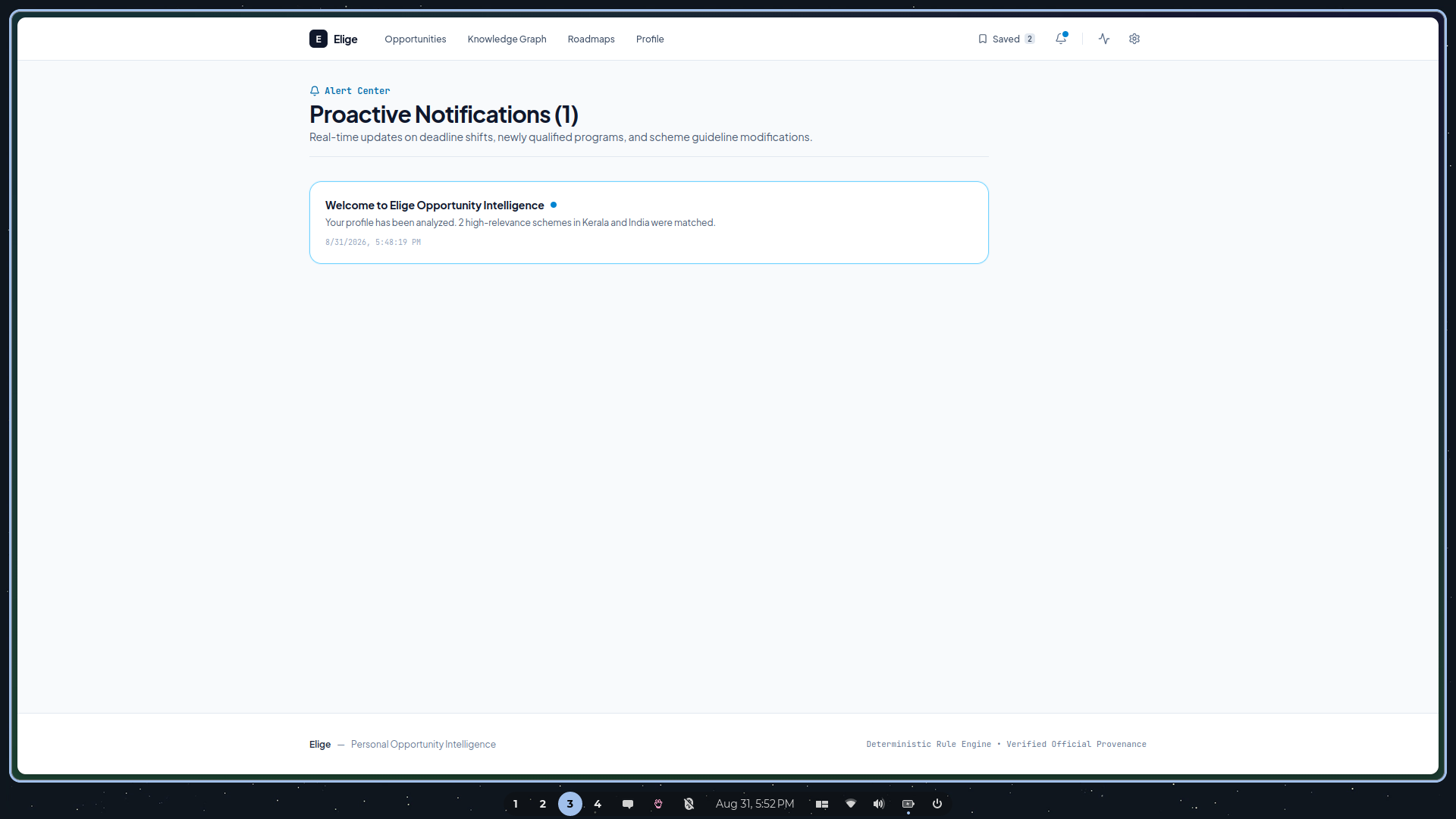
- Track important opportunities and detect changes such as deadlines or eligibility updates.
For example, instead of simply showing:
Startup Support Scheme
Elige can explain:
Why it matches: ✓ Your location matches ✓ Your business profile matches ✓ Your stated goal matches
Unknown: ? Required registration status
Next step: Complete the registration and Elige will re-evaluate the opportunity.
Elige is designed to make opportunity discovery personal, explainable, and actionable.
How we built it
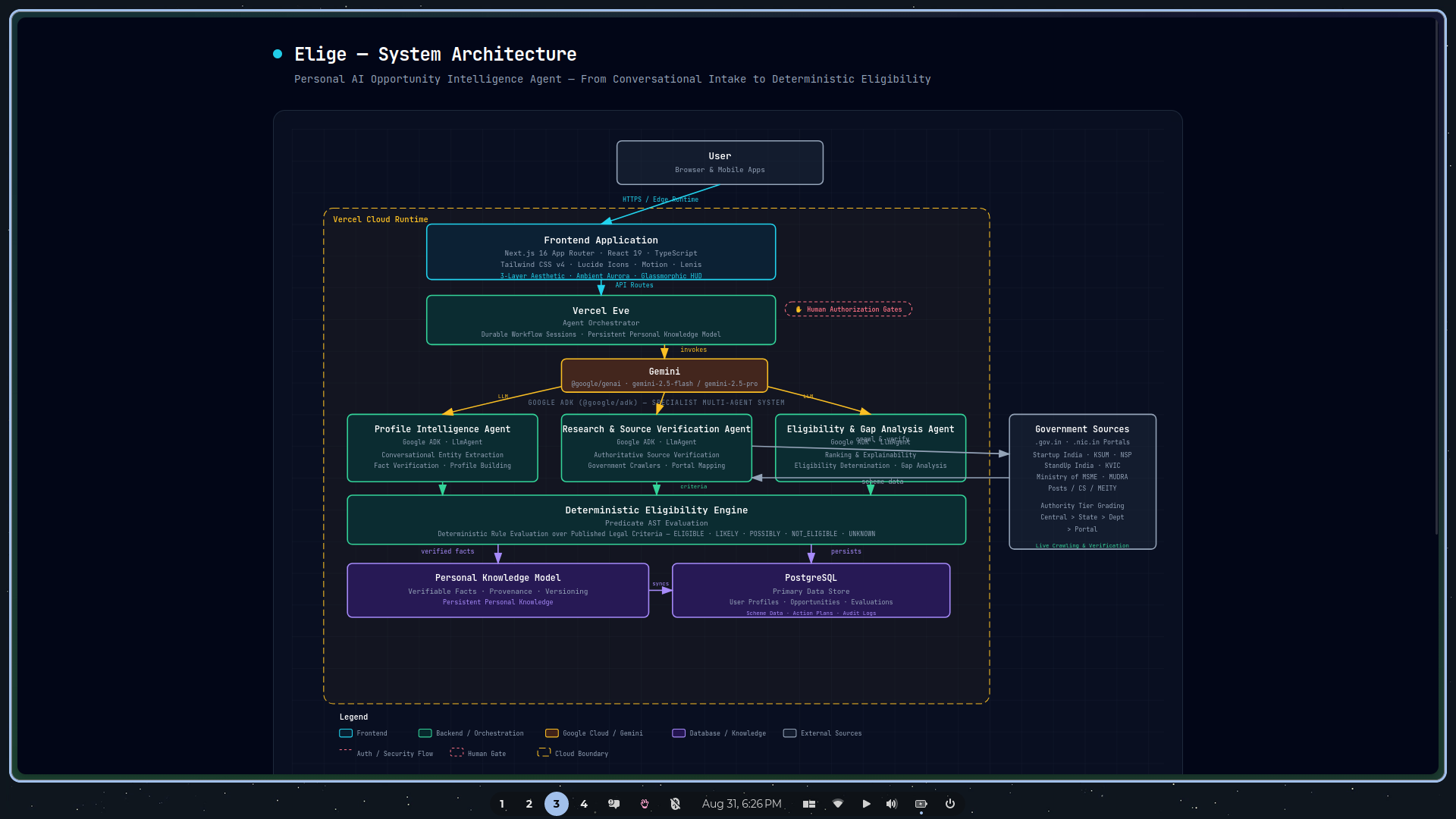
Elige is built as a multi-agent system combining Vercel's agent infrastructure with Google's agent and AI ecosystem.
The application uses Vercel Eve as the primary application-level orchestration layer and Google ADK for specialized agents.
Specialist agents handle distinct responsibilities such as:
- Profile Intelligence — understands and structures user information.
- Opportunity Research — discovers relevant opportunities.
- Eligibility Analysis — extracts and evaluates eligibility requirements.
- Source Verification — checks provenance and information freshness.
- Ranking — prioritizes opportunities based on relevance and confidence.
Gemini provides the reasoning and language intelligence behind these agents.
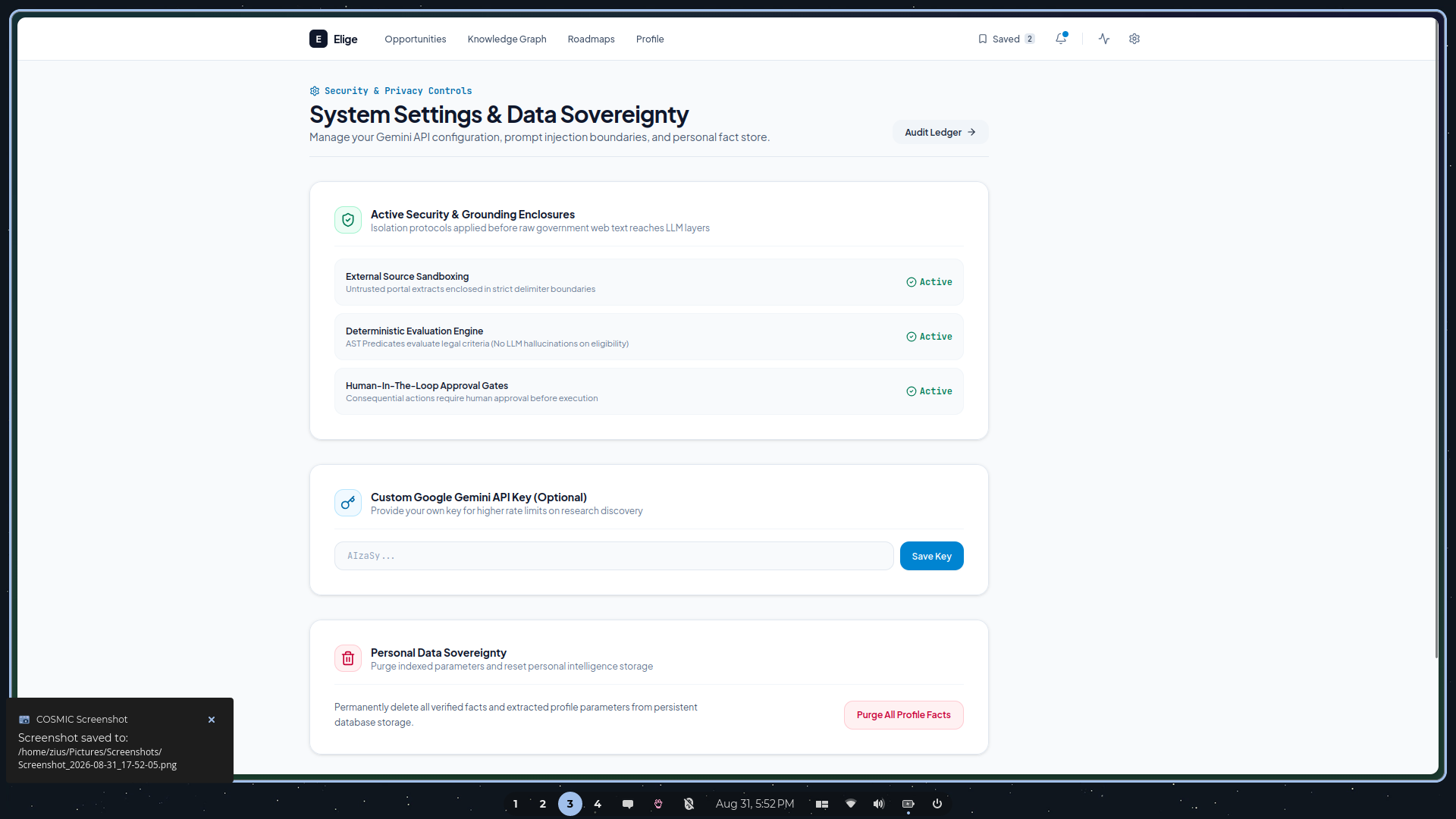
We also designed the eligibility system so that the LLM does not simply make arbitrary eligibility decisions. Where requirements can be represented deterministically, structured rules evaluate them and the AI explains the result.
The architecture is designed for persistent workflows, background research, source tracking, and re-evaluation when either the user's information or an opportunity changes.
Challenges we ran into
The biggest challenge was trust.
Eligibility information is often written in natural language and distributed across different sources. A system that confidently gives the wrong answer is worse than a system that admits uncertainty.
We therefore had to think carefully about:
- Source reliability and provenance.
- Converting natural-language eligibility requirements into structured rules.
- Distinguishing "not eligible" from "we don't have enough information."
- Keeping opportunity information fresh.
- Preventing retrieved webpages from manipulating the agent through prompt injection.
- Deciding which tasks should be handled by AI agents and which should remain deterministic software.
- Building useful autonomy without creating uncontrolled or expensive agent loops.
Another challenge was avoiding unnecessary complexity. A multi-agent architecture can easily become over-engineered, so each agent was given a specific responsibility rather than creating agents simply for the sake of having more agents.
Accomplishments that we're proud of
We're proud that Elige goes beyond being another conversational AI interface.
The system is designed around a persistent personal knowledge model rather than isolated conversations.
We built the foundation for an agent that can:
- Understand an individual over time.
- Research opportunities autonomously.
- Preserve source provenance.
- Evaluate eligibility systematically.
- Explain its recommendations.
- Identify what information is missing.
- Turn recommendations into actionable plans.
- Monitor opportunities for meaningful changes.
We're particularly proud of the separation between AI reasoning and deterministic eligibility evaluation.
This makes the system more transparent and reduces the risk of treating an LLM's guess as an official eligibility decision.
What we learned
We learned that building an agentic application is fundamentally different from building a chatbot.
A chatbot answers a question.
An agent needs to perform a workflow.
For Elige, that workflow involves understanding the user, deciding what information is needed, researching external sources, extracting structured information, evaluating it, preserving evidence, and potentially continuing the work later.
We also learned that more autonomy does not necessarily mean a better system.
The strongest architecture is a combination of:
AI for ambiguity and reasoning + deterministic software for rules + authoritative data for facts.
We also learned that uncertainty needs to be treated as a first-class state. Saying "we don't know yet" is much more useful than confidently presenting an unsupported answer.
What's next for Elige
Our initial focus is on government and public-sector opportunities in India.
The long-term vision is much broader.
Elige could become a personal opportunity intelligence layer covering:
- Jobs
- Internships
- Scholarships
- Fellowships
- Grants
- Startup funding
- Accelerators
- Competitions
- Research programs
- Education opportunities
- Certifications
- International programs
We also want Elige to become increasingly proactive.
Instead of waiting for a user to ask:
"What's available for me?"
Elige should already know what matters to them, continuously monitor the relevant opportunity landscape, and tell them when something important changes.
The ultimate goal is simple:
You shouldn't have to search the world for opportunities that fit you. Elige should find them for you.
Built With
- adk
- cloud
- eve
- gemini
- next.js
- postgresql
- typescript
- vercel

Log in or sign up for Devpost to join the conversation.