-
-
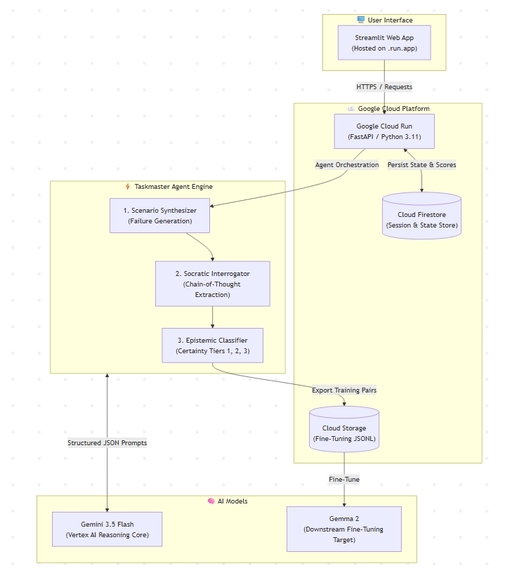
Architecture diagram
⚡ Elicitation — Autonomous SRE & Cloud Architecture Data Foundry
Track 1: The Taskmaster | Powered by Gemini 3.5 Flash, Google Cloud Run, Cloud Firestore, and Gemma 2
💡 Inspiration: Overcoming the SRE "Data Wall"
The frontier of Artificial Intelligence is hitting a severe bottleneck: the data wall. In high-stakes engineering domains like Site Reliability Engineering (SRE) and Cloud Architecture, foundation models struggle because they are trained on public documentation. They regurgitate textbook fixes (e.g., "restart the pod" or "check logs") instead of reasoning through cascading distributed failures (e.g., etcd split-brain conditions during BGP route flaps).
The world’s most valuable SRE insights are trapped in post-mortems, war rooms, and the minds of senior architects. Traditional data collection requires expensive human project managers to write prompts, review answers, and clean datasets.
We built Elicitation as an autonomous Taskmaster Agent that replaces this entire data-ops pipeline. It autonomously synthesizes complex failure drills, interrogates human SREs with adversarial Socratic probing, audits responses for epistemic certainty, and compiles fine-tuning datasets for next-generation models like Gemma 2—with zero human management.
🛠️ What It Does (The Autonomous Taskmaster Workflow)
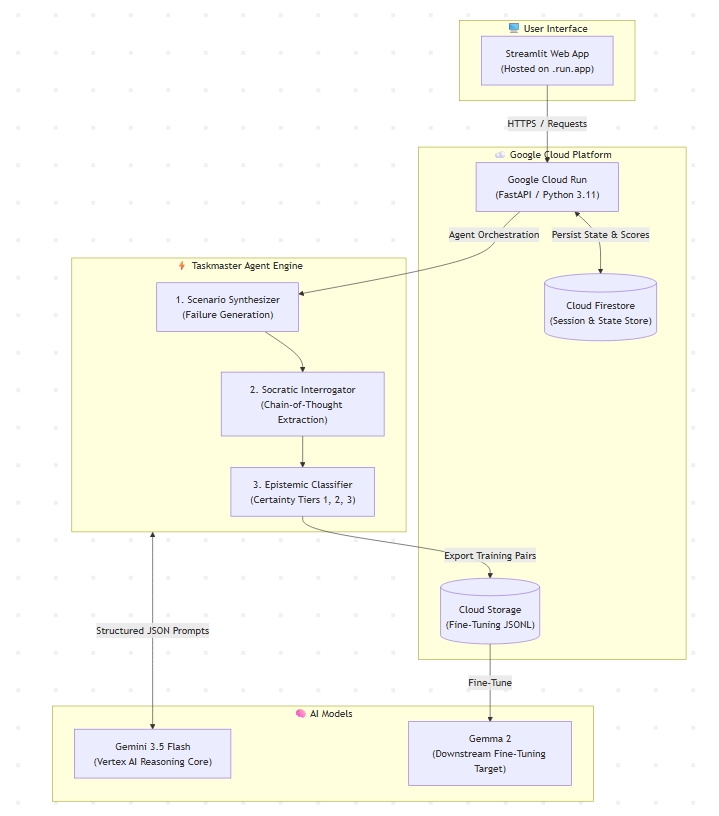
Elicitation manages the end-to-end knowledge harvesting lifecycle through a four-stage autonomous pipeline:
- Scenario Synthesizer: Given an enterprise training goal (e.g., "GKE Ingress 504 Timeouts under Cross-Region Failover"), the agent uses Gemini 3.5 Flash to generate an ambiguous incident post-mortem with conflicting telemetry metrics (e.g., healthy health checks, low CPU utilization, but spiking 15-second gateway timeouts).
- Socratic Interrogator (CoT Extraction): When a human engineer proposes an initial mitigation, the agent acts as an adversarial lead architect. It challenges assumptions, probes rollback plans, and demands deep kernel/networking Chain-of-Thought (CoT) reasoning.
- Epistemic Classifier (Certainty Tiers): Rather than treating technical advice as binary (true/false), the agent parses the transcript and classifies insights into Three Certainty Tiers:
- 🟢 Tier 1 — Deterministic ($C \ge 0.90$): Immutable protocol, kernel, and network specifications.
- 🟡 Tier 2 — Empirical Best Practice ($0.75 \le C < 0.90$): Battle-tested production mitigations that depend on prerequisites.
- 🟠 Tier 3 — Heuristic Hypothesis ($0.50 \le C < 0.75$): Situational rules-of-thumb and architectural trade-offs.
- Autonomous Dataset Compiler: Formats accepted reasoning traces into structured Direct Preference Optimization (DPO) and fine-tuning pairs $(x, y_w, y_l)$, exporting clean JSONL archives directly to Google Cloud Storage to fine-tune Gemma 2.
🏗️ How We Built It (Google Cloud & AI Stack)
- Reasoning Core: Gemini 3.5 Flash (via Vertex AI / Google GenAI SDK) driving multi-step task planning, adversarial Socratic dialogue, and structured Pydantic JSON schema generation.
- Backend & Hosting: Google Cloud Run running a containerized Python 3.11 service hosting the FastAPI orchestration engine and Streamlit interface.
- State & Persistence: Google Cloud Firestore (
elicitation_sessions) storing live conversation states, epistemic scores, and anti-AI contamination audits. - Storage & Downstream Model: Google Cloud Storage housing the curated
.jsonldatasets, designed to fine-tune Gemma 2 as our specialized SRE student model.
🧗 Challenges We Faced
- Asynchronous State on Stateless Infrastructure: Cloud Run is serverless and stateless, while human SREs take time to formulate deep technical answers. We designed an event-driven state machine where every turn re-hydrates conversation context from Cloud Firestore, allowing the agent to execute instantly without holding long-polling connections open.
- Preventing "Regression to the Mean": Generic crowd-validation averages out outlier expertise. We engineered the Socratic Interrogator to look for deterministic underlying mechanisms, penalizing shallow, LLM-generated generic responses with our built-in AI Contamination scoring.
- Formalizing Epistemic Certainty: SRE advice is rarely absolute. Modeling certainty mathematically into discrete tiers ensures downstream models learn appropriate epistemic humility rather than hallucinating heuristics as immutable facts.
🎓 What We Learned
- Socratic Probing Unlocks 10x Deeper Reasoning: Standard prompt-response interfaces capture surface-level answers. By having the agent push back adversarially (e.g., "Why assume the NEG controller syncs instantly?"), the engineer is forced to externalize deep mental models that would otherwise never be documented.
- Serverless Agentic Workflows: Combining Google GenAI SDK's structured outputs with Cloud Run and Firestore provides an enterprise-ready architecture that scales to zero while handling complex multi-turn workflows.
🔮 What's Next for Elicitation
This hackathon MVP is the first building block in an end-to-end collective intelligence pipeline. Next, we will:
- Multi-Expert Elicitation & Cross-Evaluation: Enable the Taskmaster agent to distribute parts of a catastrophic failure to multiple domain specialists and have them peer-review each other's reasoning traces to achieve decentralized consensus.
- Automated Synthetic Testing: Hook the agent into ephemeral GKE sandboxes to test and benchmark the human-provided remediation commands in real time.
- End-to-End Gemma 2 Fine-Tuning Pipeline: Automate automated Vertex AI custom training jobs as soon as a Firestore collection reaches 1,000 verified traces.
Built With
- ai-agents
- autonomous-agents
- chain-of-thought
- cloud-architecture
- distributed-systems
- docker
- dpo
- fastapi
- fine-tuning
- gemini-3.5-flash
- gemini-api
- gemma
- gemma-2
- google-cloud
- google-cloud-firestore
- google-cloud-run
- google-genai-sdk
- kubernetes
- pydantic
- python
- rlhf
- sre
- streamlit
- vertex-ai

Log in or sign up for Devpost to join the conversation.