Inspiration
I had this idea while volunteering for Tukuze Afrika, an organisation that encourages kids to pursue STEM. We were asked to talk to children aged 5–13 about our professions. After explaining my work as a software engineer and data scientist, I was met with confused faces and an awkward silence.
That moment stuck with me. If I couldn't explain what I do to a 5-year-old, did I really understand it? Richard Feynman famously said:
"If you can't explain it simply, you don't understand it well enough."
ELI5 Arena was born from that realisation.
What it does
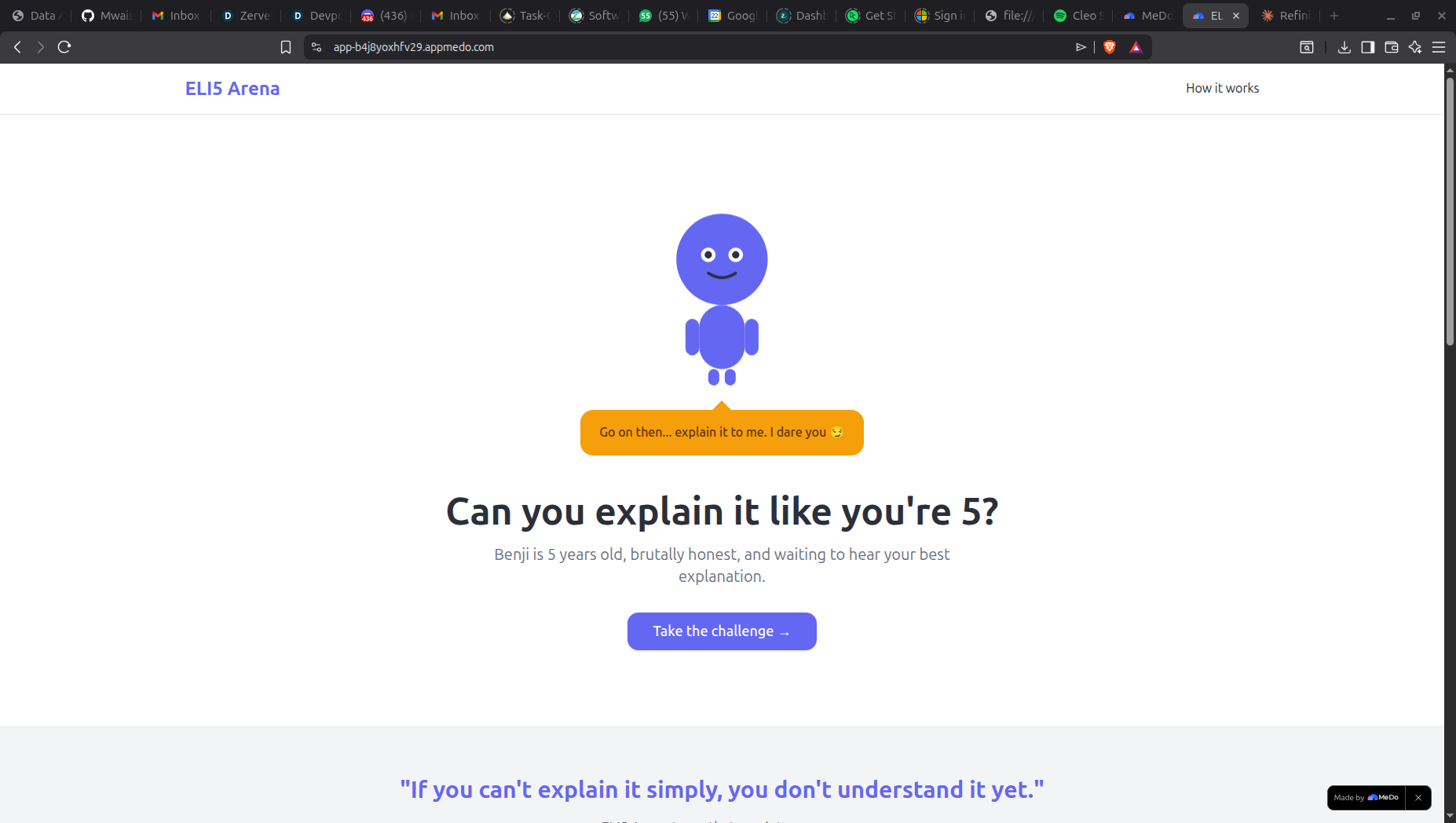
ELI5 Arena gives you a space to practice explaining things simply — in a way that's fun, not intimidating.
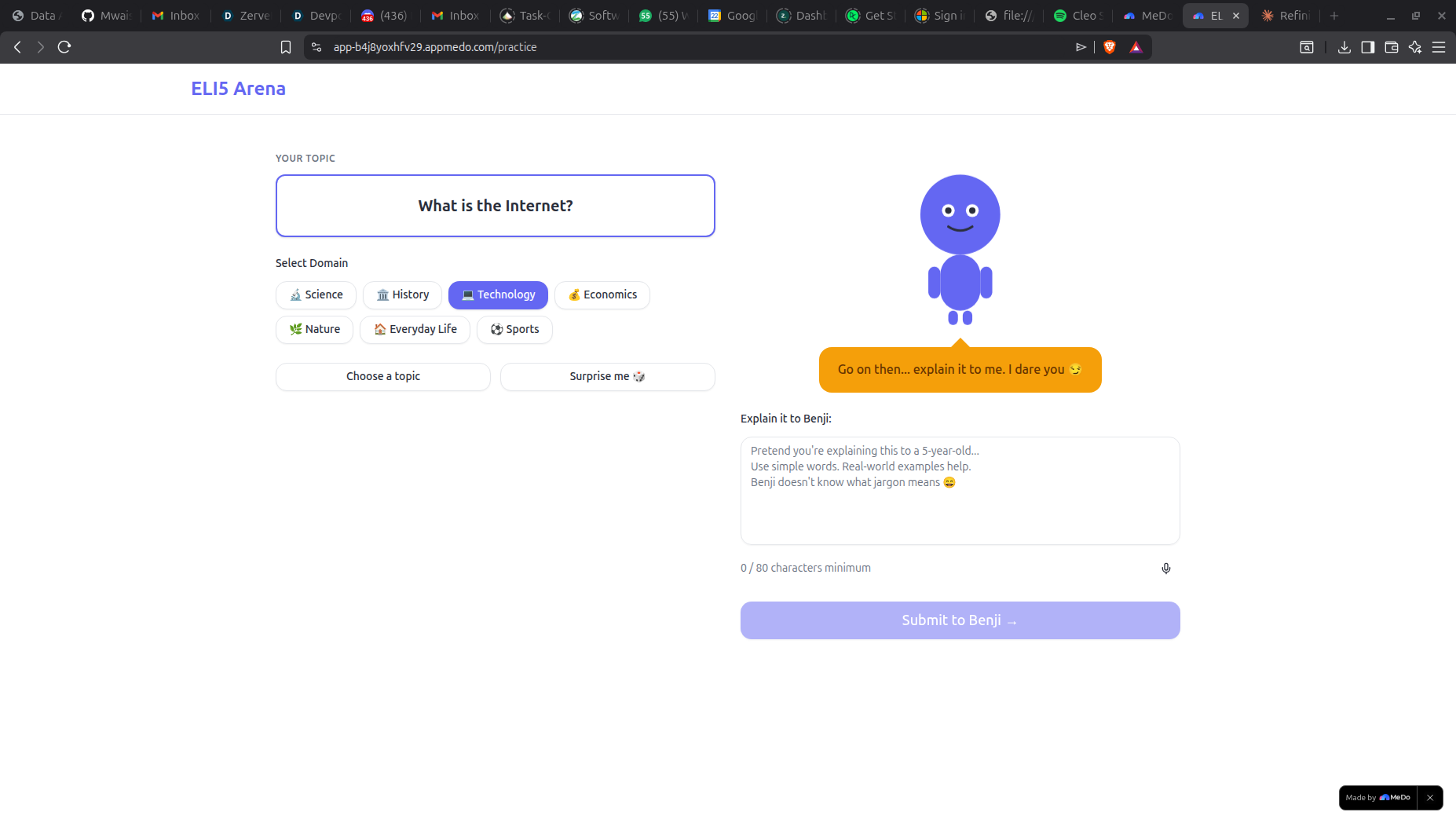
- Pick a topic from domains like Science, History, Economics, Sports, Technology and more — or let Benji surprise you with a random one
- Explain it by typing or speaking out loud
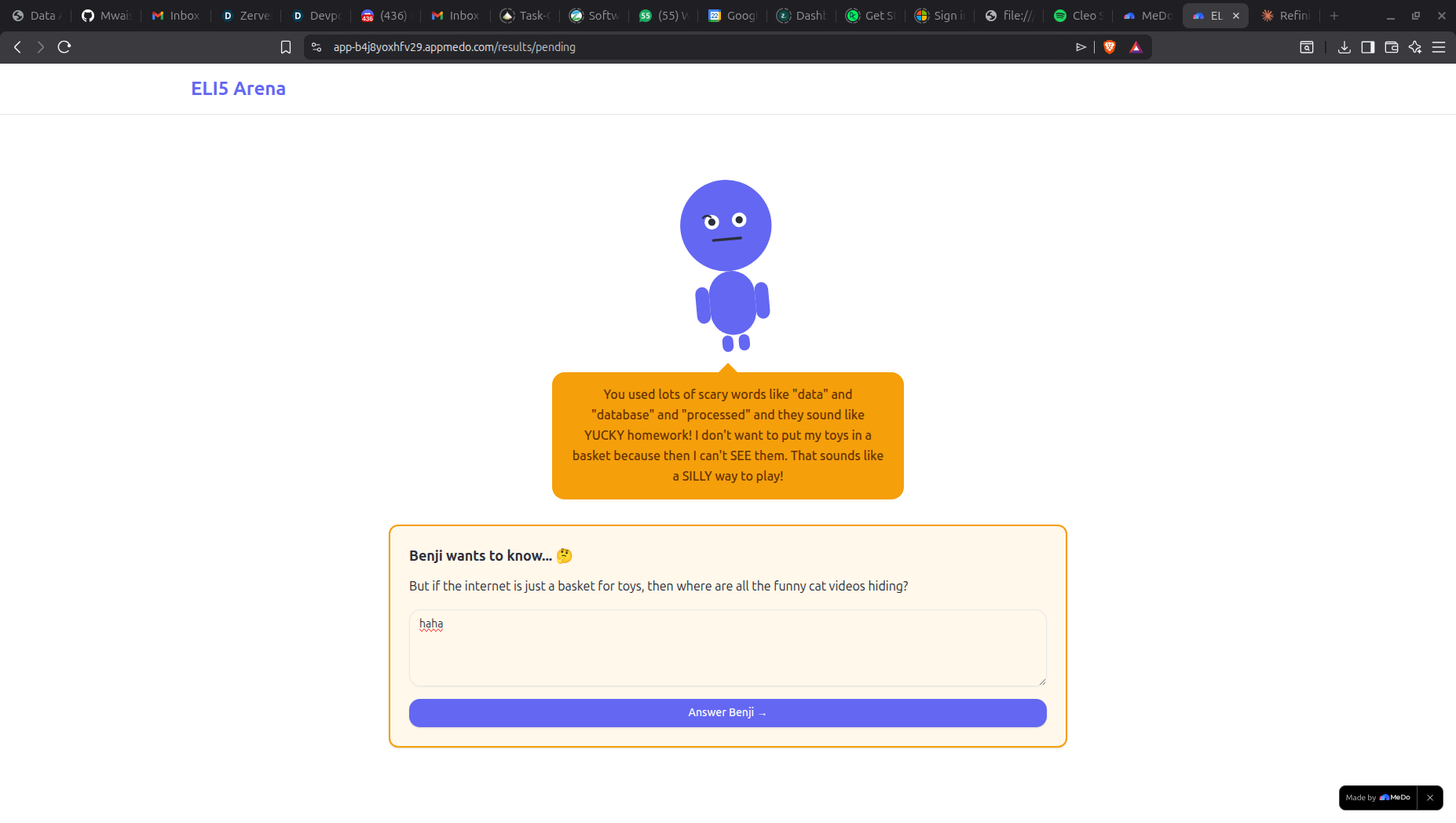
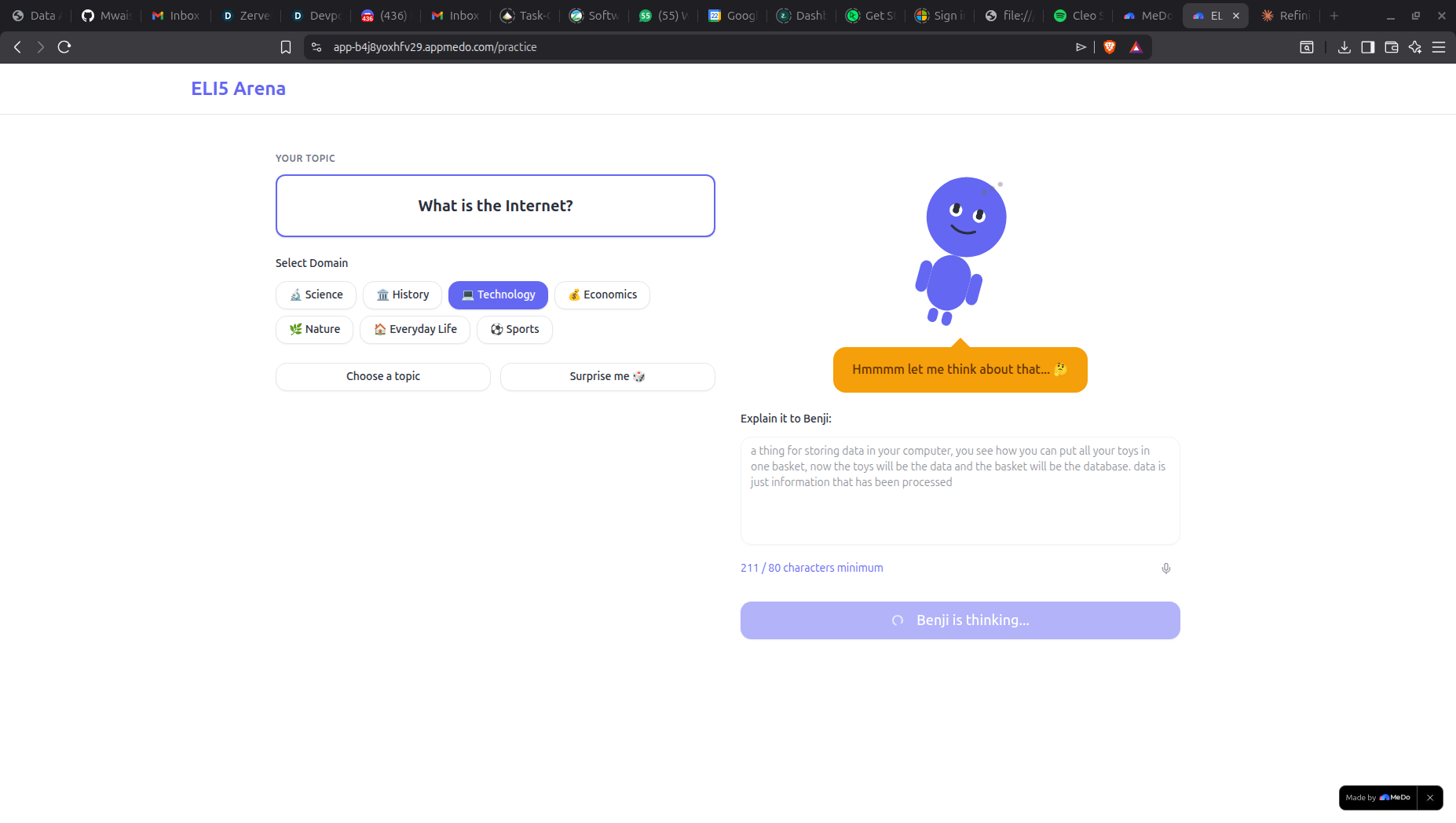
- Benji — a curious, slightly cheeky AI 5-year-old — listens, reacts honestly, and asks a follow-up question to probe your understanding
- You get scored across three dimensions:
- 🧹 Simplicity — did you avoid jargon?
- 💡 Clarity — was it easy to follow?
- 🎨 Analogy Quality — did you use relatable comparisons?
- Share your result with friends, who can react with emojis and leave a one-line comment — online or in person
How we built it
I built ELI5 Arena entirely using MeDo.
Before discovering MeDo, I had started building this manually — it would have worked, but it would have taken significantly longer to get to a working prototype. With MeDo, I described the idea conversationally, iterated on the prompts, and MeDo handled the full-stack generation — React frontend, backend, database, routing, and AI integration.
The key was being very specific and structured in how I described each feature to MeDo, treating each prompt like a mini product requirements document rather than a casual request.
Challenges we ran into
Feature creep almost killed the prototype. My initial version included user accounts, dashboards, team sessions, settings pages, and recurring community events. The result was a cluttered prototype that didn't feel good to use. I made the decision to strip everything back to the core loop — pick a topic, explain it, get scored, share it — and that was the right call.
Credits. Watching the credit counter go down with each generation attempt was genuinely stressful. Every prompt had to count.
Getting the AI evaluator working. Wiring Benji's in-character responses and structured JSON scoring through MeDo's native AI took several iterations to get right. The key was being extremely explicit in the prompt about output format and character rules.
Accomplishments that we're proud of
- Benji actually works — the AI responds in character, asks real follow-up questions, and scores explanations meaningfully
- The app is live in production and handles the full explanation loop end to end
- Tested with friends across different backgrounds (not just tech people) and the feedback was genuinely positive
- The shareable result page with friend reactions adds a social layer without requiring any login
What we learned
Go for it. If you have an idea that could be genuinely useful to people, build it. MeDo removes the excuse of "I don't have time" or "it's too complex." The hardest part is clarity of thought — knowing exactly what you want to build and why.
Also: less is more. The best version of ELI5 Arena is the focused one, not the one with every feature imaginable.
What's next for ELI5 Arena
- Launching properly and integrating it into tech communities, alumni programs, and learning groups like Kenya JUG
- Adding a community session mode for live group events — where an organiser runs a session, participants explain concepts on the spot, and an audience votes on the best explanation
- Expanding the topic library with community contributions
- Giving Benji a voice.
Built With
- medo


Log in or sign up for Devpost to join the conversation.