-
-
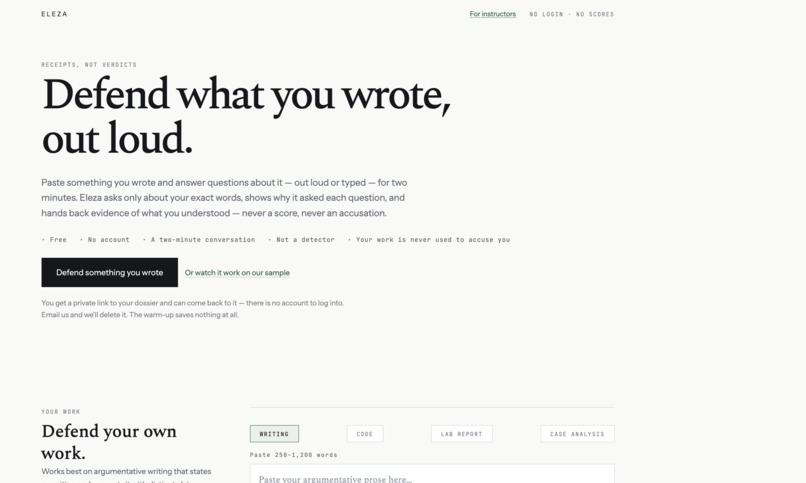
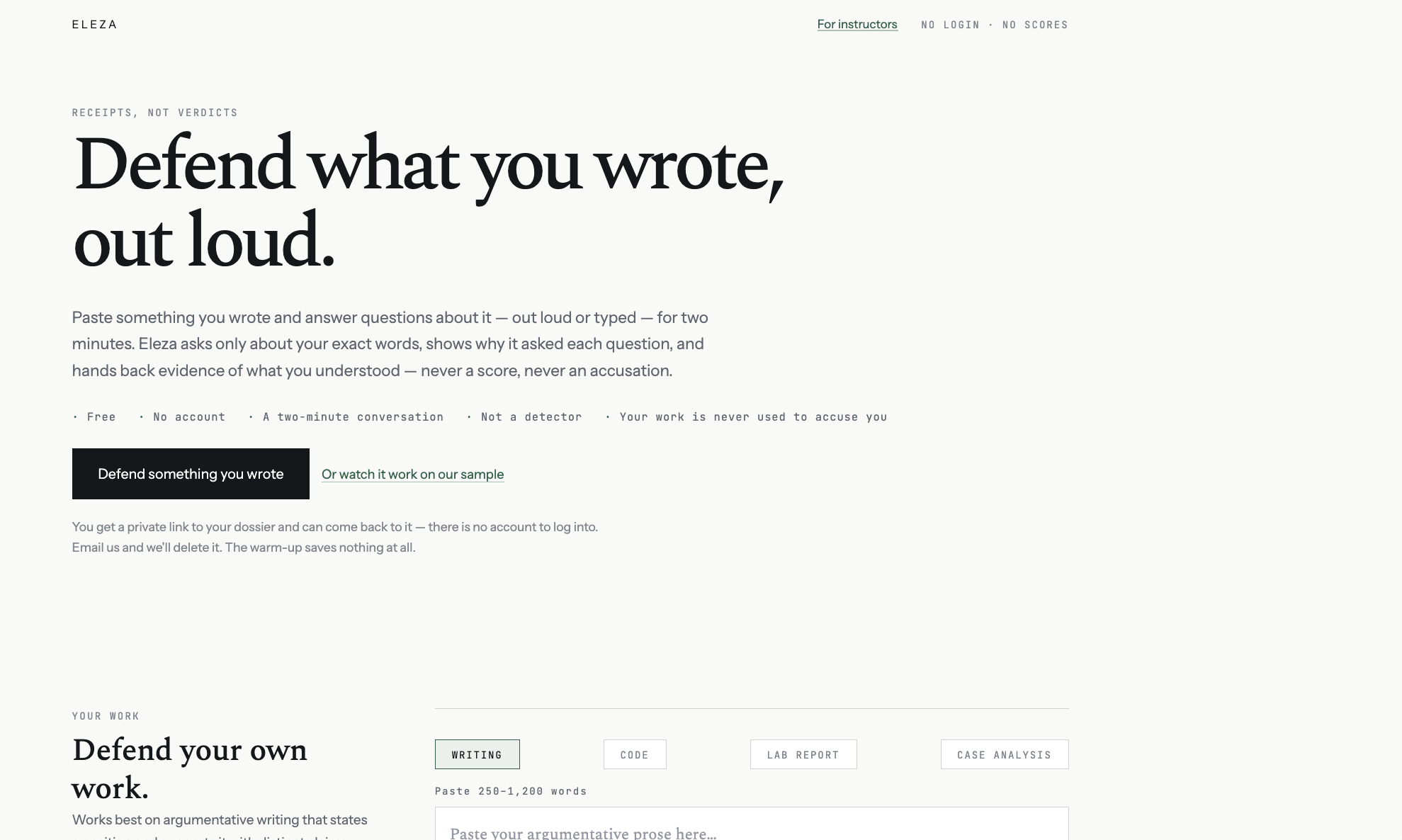
Eleza Landing
-
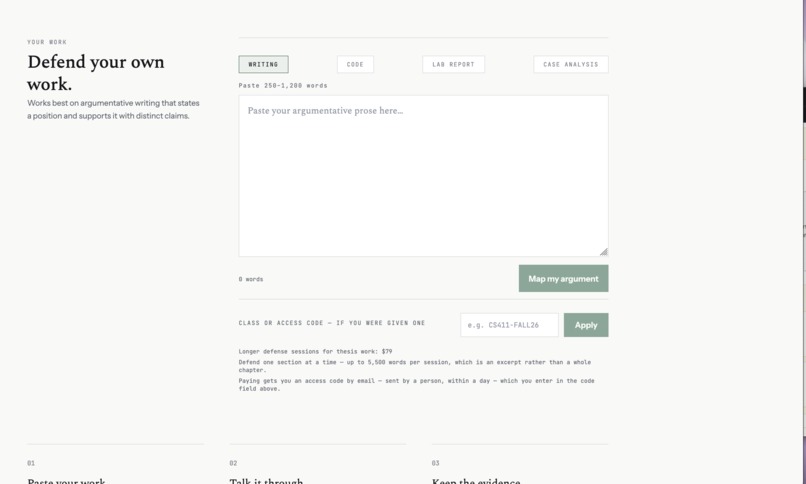
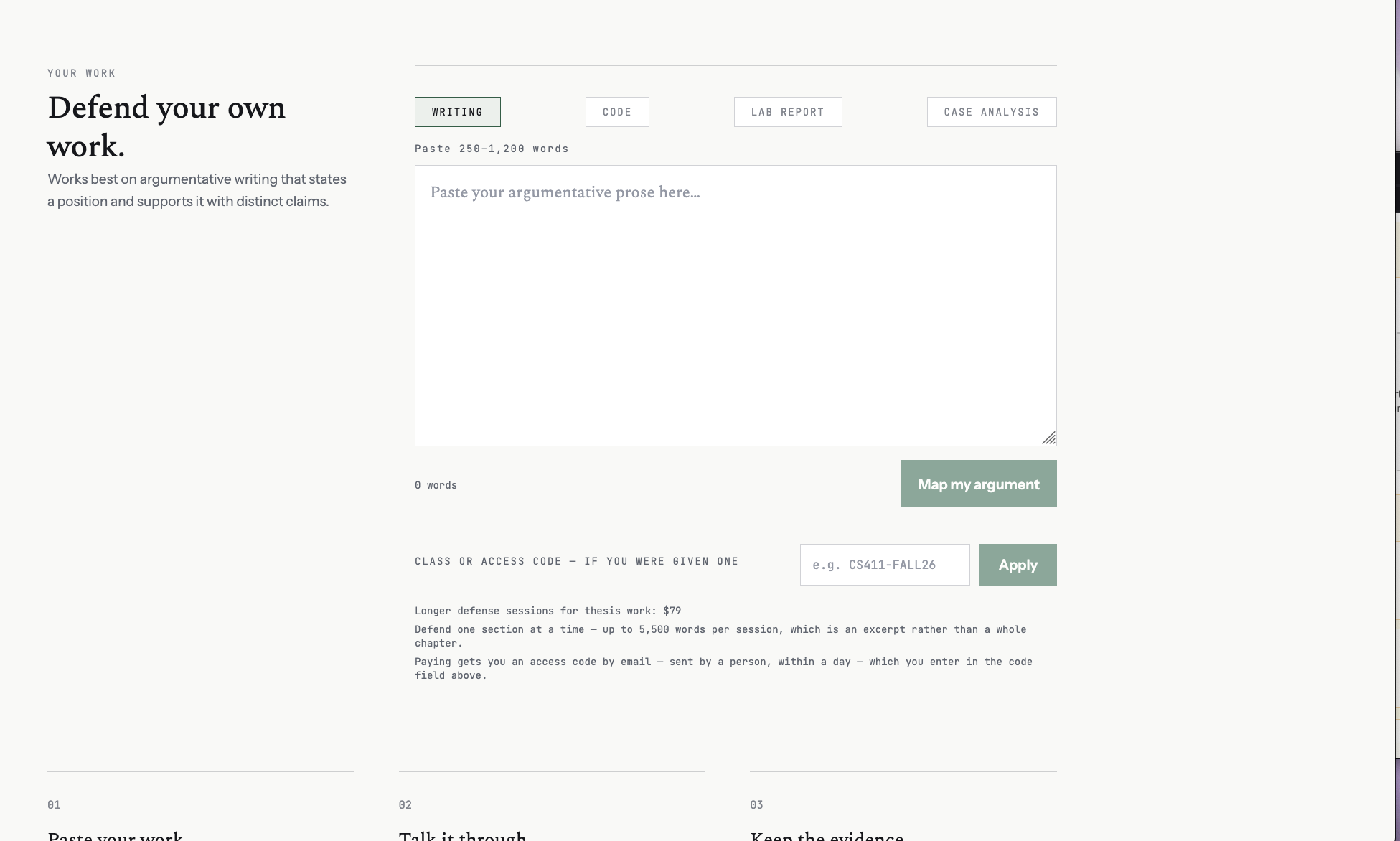
Student UI
-
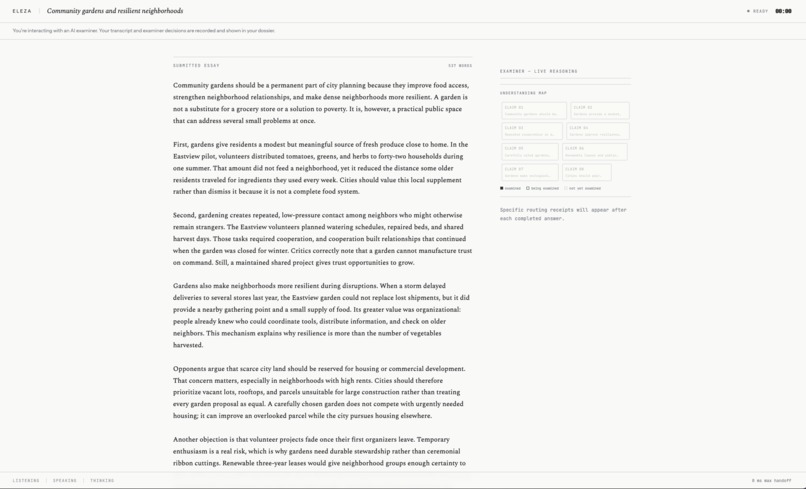
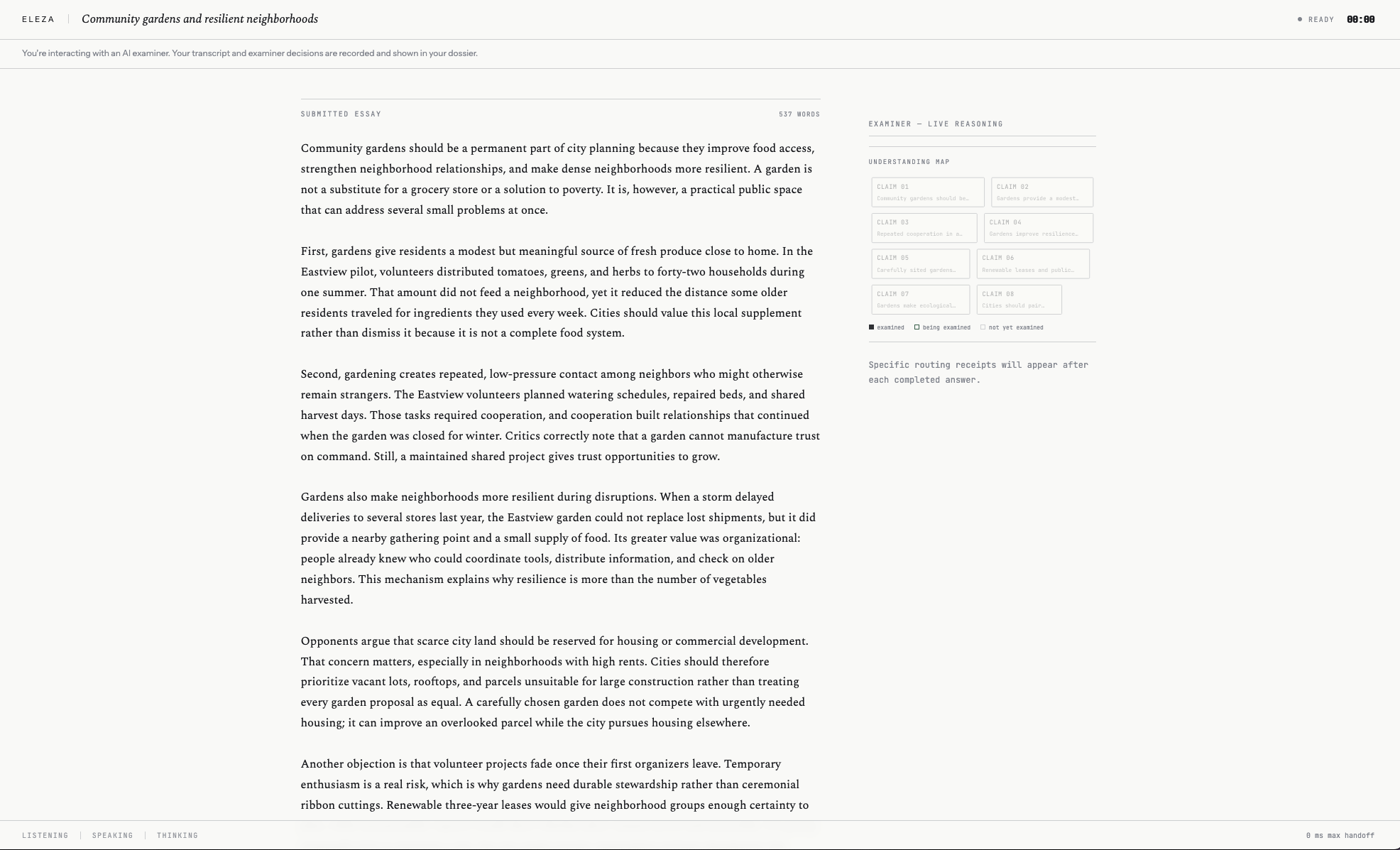
Demo example essay
-
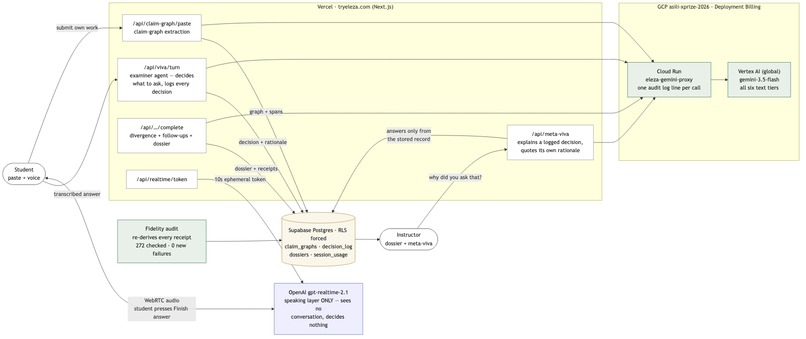
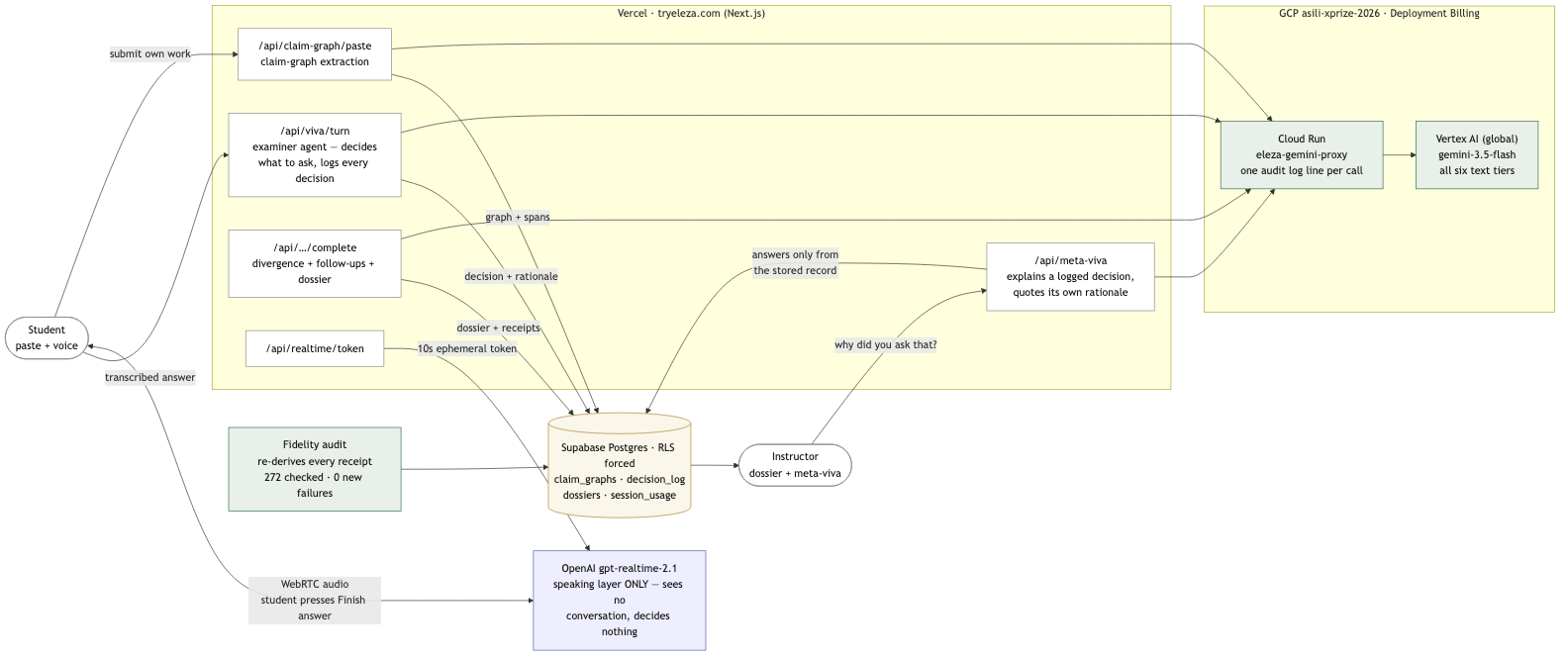
Architecture diagram
-
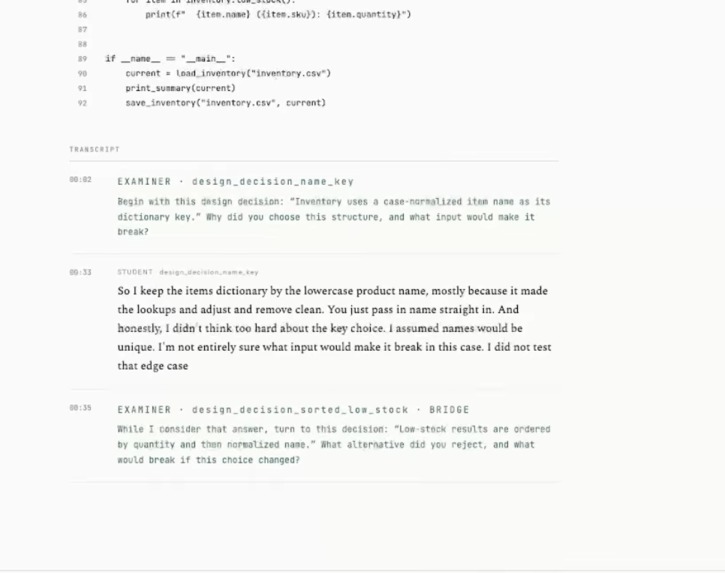
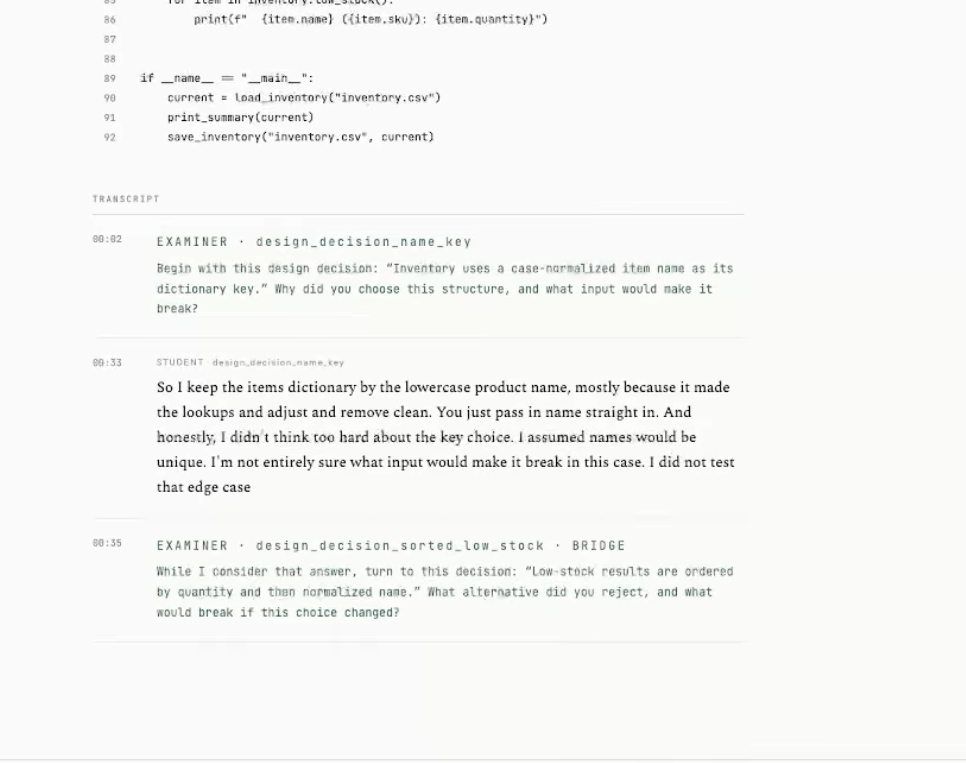
Traige finding: explanation sufficient
-
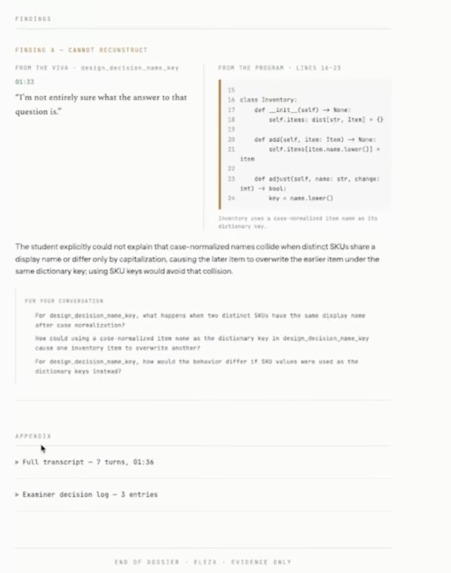
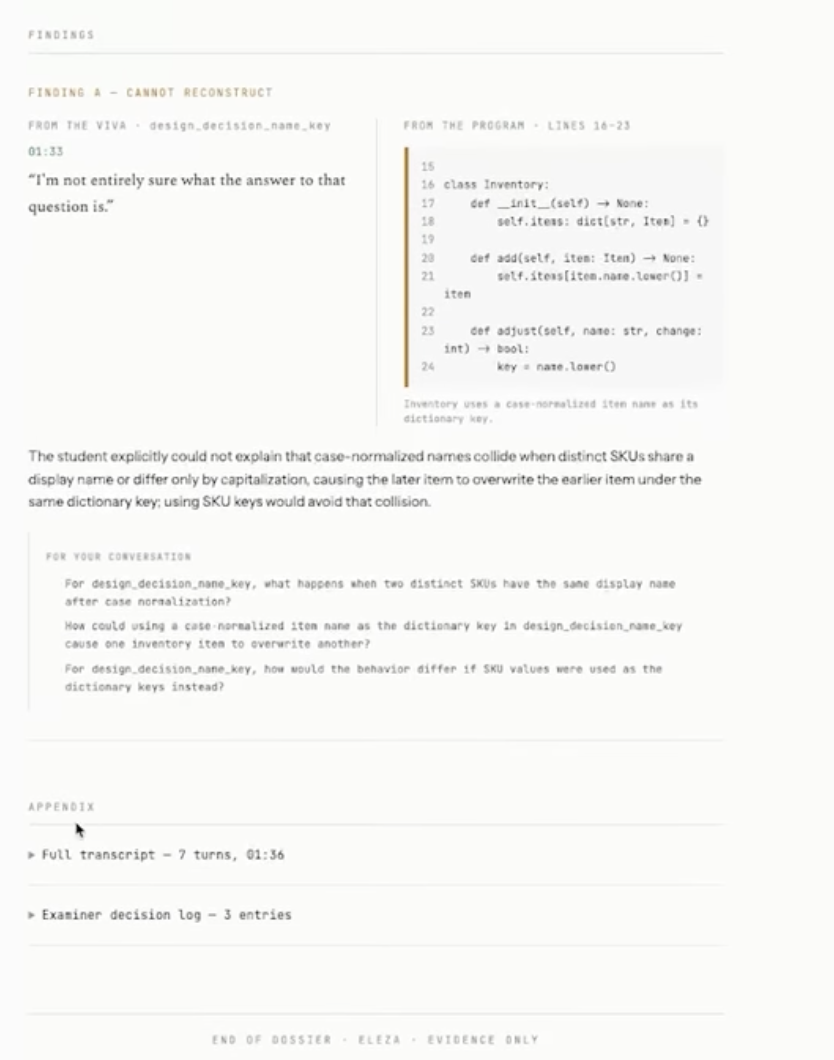
Triage finding: couldn't verify
The proxy broke
For as long as school has existed, a submitted document was a fair stand-in for what its author understood. AI ended that. An essay, a lab report, a pull request: any of them can now be produced in one prompt by someone who could not explain a line of it. Every institution that certifies understanding is now certifying documents instead, and the two are no longer the same thing.
The industry's answer is detection: authenticity scores that are unreliable and that disproportionately flag multilingual writers. Regulation is now finishing that argument for me: watermarking arrived by law this month under the EU AI Act, and it answers the wrong question. Provenance tells you who wrote a document. It cannot tell you whether the person understands it. In a world where students legitimately use AI, "did AI touch this" stops being the question, and "can you defend this" becomes the only one left.
There is an older, better verification method, the oral defense, and its only problem was that it never scaled past a seminar.
What Eleza does
A student submits work they already wrote. Eleza maps the claims in their exact text and how they depend on each other, then runs a short spoken defense: a voice model interviews the student about their own reasoning, while a separate examiner agent routes every question against the claim graph. The instructor receives a dossier: moments in the conversation linked to the exact passages they concern, a coverage map of which claims were examined and which were not, and the examiner's own logged reasoning, which can be challenged mid-session ("why did you ask that?").
Eleza never issues a verdict. No authenticity score, no cheating flag, no understanding rating, enforced at the schema level. The instructor stays the sole judge, because a vendor's confident score is a liability a professor has to defend to a student or a dean, and evidence is something they can stand behind. Every competitor sells the score. The refusal is the product.
AI-native by architecture, not by garnish
AI runs every operational decision in this business. In production, per session: the claim-graph extraction (Gemini 2.5 Flash via a Cloud Run service), the examiner's routing of every question, the post-session divergence analysis (Gemini), the follow-up generation, and the meta-viva that explains the examiner's own choices. Hundreds of autonomous decisions per session, every one logged to an append-only decision log. A nightly audit agent re-verifies every stored citation mechanically and reports what it finds.
A human owns exactly one decision, deliberately: the judgment.
The company operates the same way. I am a solo founder; the engineering runs through AI agent pipelines under an evidence-demanding reporting standard (every claim ships with the command that proves it). Three sprints of production hardening, a security audit that caught and locked down a fully-open database before any student data existed, per-session cost attribution accurate to the cent, and a consent architecture with versioned wording and fail-closed handling of minors: all shipped in under five weeks by one person and a pipeline.
Designed fair, tested by the people it protects
Two exclusions were made on purpose. Eleza never compares how a student writes to how they speak, and never characterizes delivery: transcripts preserve what was said as plain fact, because the same hesitation means different things in different students, and only an instructor who knows the student can read it in context. There is no pause detection; students end answers with a button, so they can stop and think.
Faculty shaped this product in three weeks
I built Eleza for OpenAI's Build Week on July 13 and shipped it on the 21st. On July 25 I started emailing professors. What happened next is the only evidence that matters at this stage: strangers with no reason to help me gave me hours of their time, and the product changed because of it.
The Associate Director of ELL Writing at Boston University told me the gap between how a student writes and how they speak runs in both directions, depending on how they learned English. I had already refused to build register comparison on fairness grounds. She gave me a better reason than the one I had: any such comparison misfires in two different directions on two different populations. That exclusion is now permanent and documented in the product. She also drew the market line I had not drawn myself: in a fifteen-person seminar, an instructor can feel who understands. At scale, faculty want a check. Large courses are the market.
The Associate Director for Writing in the Disciplines arrived with a concern I had not prepared for: that a tool like this could let faculty offload the feedback work entirely and step back from their students. That objection changed how the product is presented everywhere. The instructor-facing framing now leads, because he asked why it should. He then referred me to three faculty, including a program director, and proposed a joint demo with both Associate Directors, now proposed for the week of August 17.
A security researcher in ECE asked the question every buyer eventually asks: what stops a student from having an AI answer through an earpiece? The honest answer is the product's boundary. Eleza verifies understanding; it assumes the person. It raises the cost of not-understanding from zero to a live performance under contingent questioning, and preserves what was said so the instructor can judge. It is not identity verification and never claims to be.
Where the pipeline stands, plainly: 11 faculty threads across Boston University and Tufts. 6 engaged. Two Associate Directors, three referred faculty including a program director, one second institution. Free fall pilots start with the semester on September 2, and the pilot memo carries spring conversion terms with a named price and date, signed up front.
Revenue during the hackathon period: $0. Universities close in July, the buyers I want were unreachable for most of the window, and I chose not to manufacture a number from people who know me. What exists instead is a pipeline of named institutions, a priced instrument, and unit economics measured to the cent.
The business, measured to the cent
Most pre-revenue submissions estimate their costs. Mine are instrumented: every model call in production records its token counts and computes cost per session, stored on the session row and reportable per course.
Per defense: $0.42 to $0.69 all-in, measured across real production sessions. The breakdown is not what I expected. Claim-graph extraction is 69% of the cost, because the model's private reasoning is 94% of every billed output token. The examiner conversation is 16%. Voice, which I assumed would dominate, is under 20 cents, because each question ships without conversation history and student audio is never billed back. Cost scales with turns taken, not minutes elapsed: a student who pauses to think costs nothing extra, which is exactly the behavior the product is designed to permit.
Per pilot course: a typical fall pilot is 30 students defending one assignment three times, with a server-enforced 10-minute cap per session. That is 90 defenses, roughly $50 in provider cost for an entire course-semester pilot. A 60-student course with four defenses each runs about $165. Both are bounded by design: per-course session allowances and duration caps are set in the memo before the pilot starts, so cost per course is known in advance rather than discovered in a bill.
Against price: spring conversion is $500 per course per semester. At pilot scale that is roughly 70 to 90 percent gross margin, with the dominant cost line (extraction reasoning tokens) falling as models get cheaper, not rising with usage.
How the business earns money. Free fall pilots, faculty-led, with paid spring conversion terms signed at the start rather than negotiated at the end. The entry point is a single instructor's discretionary decision rather than institutional procurement, which is the difference between a semester-long sales cycle and a one-page memo. Institutional licensing is the second stage, priced per enrolled student, once enough courses inside one institution make a site license cheaper than the sum of its parts. The volume side, students defending their own writing, is free forever; the liable side pays.
Where this goes. Education is the demand shock, not the destination. Certification bodies, licensure boards, and compliance programs already spend on the same question, "did this person earn it," against surveillance incumbents that candidates litigate against and that cheat tooling has already defeated. Receipts are the only format a board can defend in a hearing. Proctoring is roughly a $900M market growing 15% annually with about a quarter in certification; compliance training is a $6B market whose own literature names outcome measurement as its unsolved problem. Same product, different buyer, and the buyer has a budget line already.
Threats, honestly. Two. Competitors selling confident scores are easier to buy: a number requires no reading. My bet is that buyers with real adjudication duty cannot accept a vendor's verdict, and the fact that two Writing Program directors engaged specifically because of the refusal is early evidence. And extraction cost is the whole cost structure, so a model price change hits margin directly; the provider abstraction exists for exactly that, and text tiers moved across providers in production twice this month without an application code change.
Challenges worth telling
The best bug of the build: extraction failures that never persisted. A 160-character label cap threw before validation, failed graphs were never stored, and the stored data therefore looked perfect. Survivorship bias hid the product's most expensive recurring event. It was found only by running live extractions and watching one fail; the fix shipped with a regression test the same day. Same lesson twice: the cost instrumentation had a fire-and-forget race that undercounted spend, caught only when a degraded network changed timing. The reporting standard exists because green dashboards lie.
What's next
Fall pilots start with the semester in September. A two-stage validity study (first, do cited spans support their claims; second, do independent instructors converge reading the same dossiers) is designed, with IRB determination in progress. The corpus question, whether the examiner compounds with volume, gets its first real data. Students aren't anti-technology; they're anti-technology-without-solution. This is the solution half.
Built With
- gemini
- google-cloud-run
- next.js
- node.js
- openai
- postgresql
- supabase
- tailwindcss
- typescript
- vercel
- vertex-ai
- webrtc

Log in or sign up for Devpost to join the conversation.