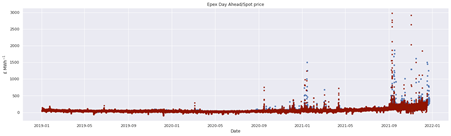
Electricity price prediction using simple LSTM-based deep learning models and market interconnection For accurate forecasts, we require accurate day-ahead electricity prices for a given market. Accurate price forecasts are difficult for electricity market makers and participants to obtain. Forecasting requires an appreciation of features from partially related data such as weather temperature. This report explores the influence of implicit markets on the price of Electricity through long short-term memory (LSTM) deep neural networks. This could be improved using more precise feature selection algorithms for electricity price prediction. LSTM models handle nonlinear and complex problems. We required processing of time series data. Our study of the UK market showed us that seasonality and feature selection is essential to achieving accurate predictions. Our analysis also implied that EPEX lead the SPOT price. In the UK, the price of electricity changes every 30 minutes. We were provided with some time series data sets which describe this power price over the last few years. Explanation of EPEX data The EPEX price is the price of energy, £/MWh, which is auctioned at 9am the day before delivery. Explanation of SPOT data The SPOT price describes the cost of power as bought and sold on the intraday market (as opposed to at day ahead). This matches supply and demand closer than EPEX Explanation of System Price Electricity price prediction using simple LSTM-based deep learning models and market interconnection System price is rapid and very important. This is the closest of our time series data to real time. Method: Training the LSTM with scaled inputs of : Time of day, Day in the week, EPEX price, Spot price, Day in the year, We sliced the data we were provided and seeked to train, test and predict our own model. Cleaning: We first cleaned the model by putting it all into the same date format. We then ensured all the nan values were removed and replaced with 0s. Programming method: We used tensorflow and keras primarily We trained a single LSTM-RNN model over a subset of the available time series. We show how, after an appropriate training and parameter tuning, the resulting model can accurately predict future days of electricity prices, even if these were not included in the original training set.Once the single network is trained, accurate individual forecast can be obtained at almost no computational cost. We test the validity of our approach under an extensive set of numerical experiments based on a real-world dataset that includes a several thousand load time series. Results indicate that the proposed methodology can improve the forecasting accuracy of relevant benchmarks in different predictive architectures. MSE of hour-ahead electricity price LSTM forecast: 24.681 RMSE of hour-ahead electricity price multivariate Stacked LSTM forecast: 26.538
Elevctricity
LSTM for electricity
Updates

Leave feedback in the comments!
Log in or sign up for Devpost to join the conversation.