Inspiration
I'm a first-semester electronics student. I learn by practising, but chatbots can't be trusted to mark numeric answers. I wanted a tutor where the maths is always exact. I also wanted to build it on my phone, because I don't own a laptop.
What it does
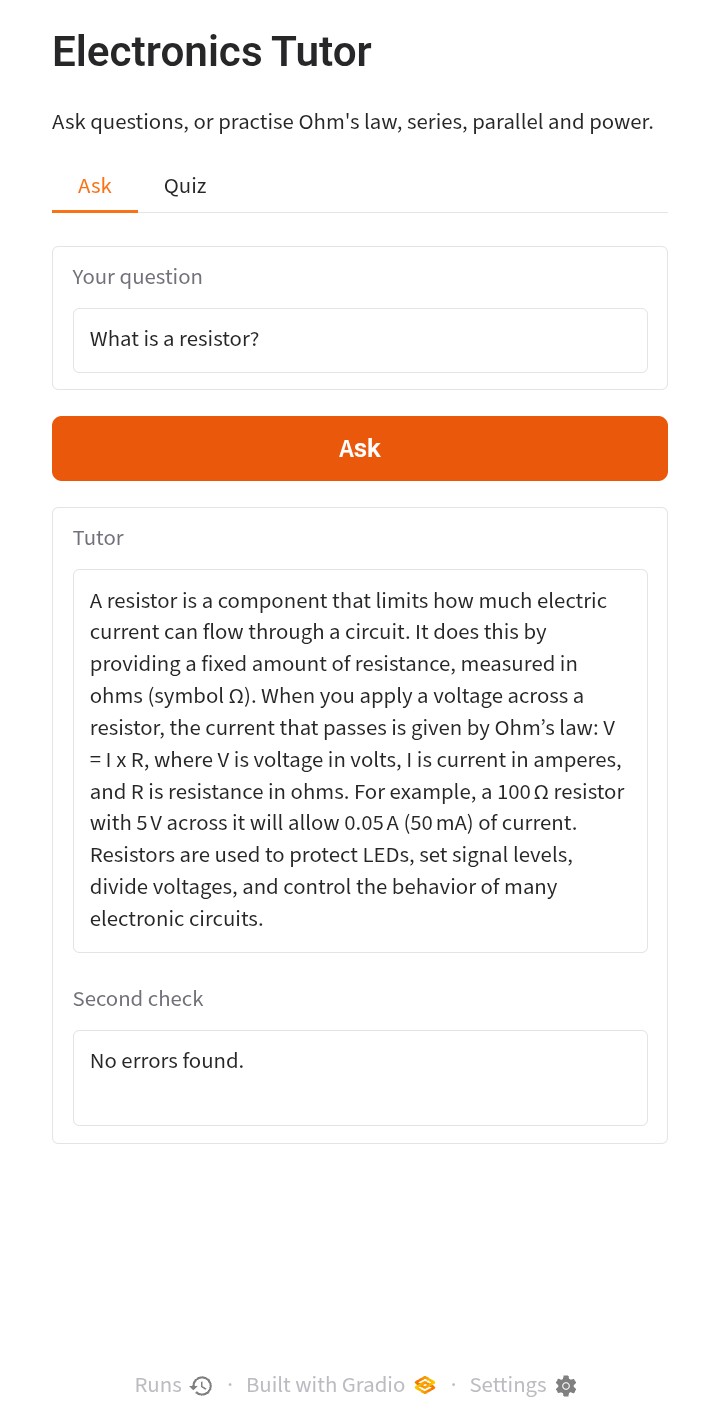
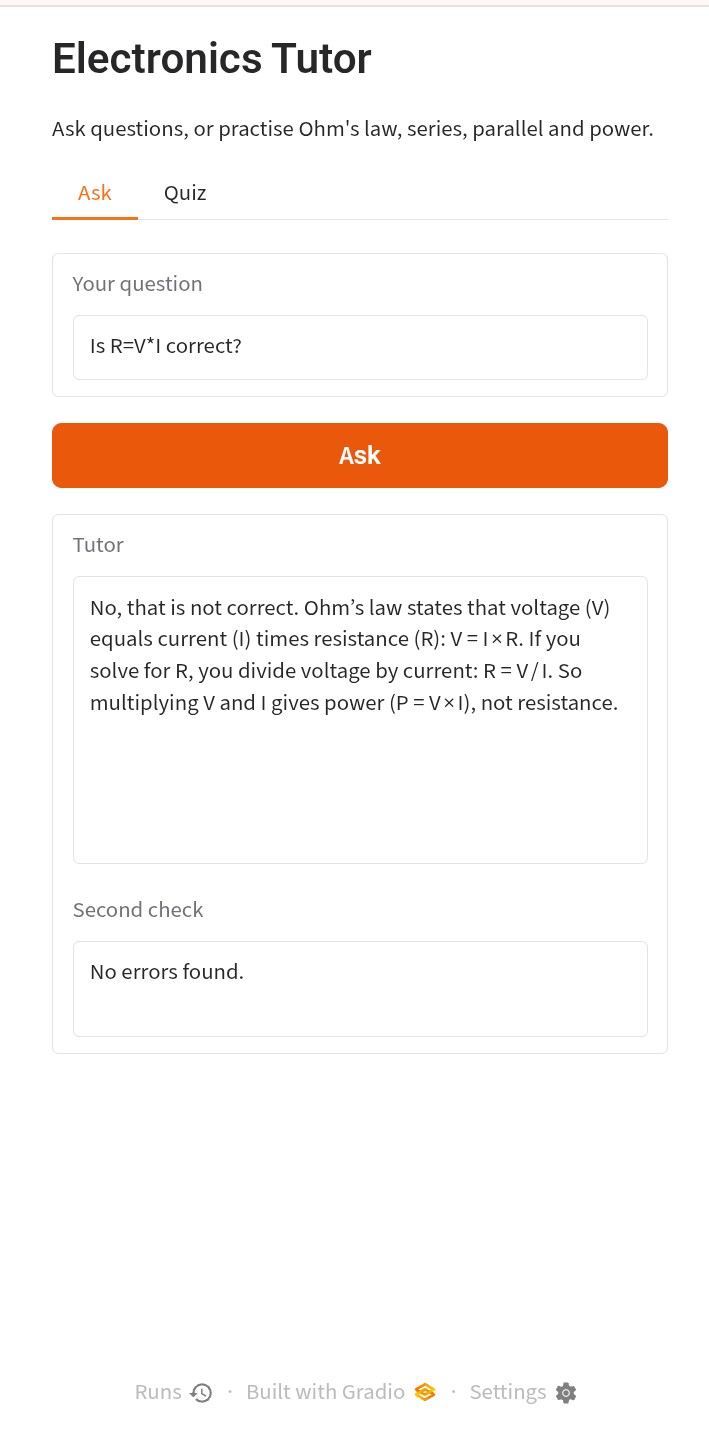
Electronics Tutor is a phone-friendly web app with two tabs.
- Ask: answers electronics questions in simple English. A second AI call reviews each answer and shows the result in a "Second check" box.
- Quiz: practice questions on Ohm's law, series resistors, parallel resistors and power. After a wrong answer, it shows the correct working and explains the likely mistake.
How I built it
- Python makes each quiz question from random numbers and works out the correct answer itself. It checks your number with a small tolerance, so marking never depends on an AI's opinion.
- The AI only explains. After a wrong answer, it is given the correct value and describes the likely mistake.
- The interface is Gradio. The AI is NVIDIA Nemotron models, called through the NVIDIA Build API.
- It runs in Google Colab, and the code is on GitHub. API keys and the app password are typed into hidden prompts, so no secret is stored in the code.
Challenges I ran into
- I had no laptop, so I built everything on my phone, including fixing indentation errors from copied code.
- My first version let the AI grade answers, which was unreliable. Moving the checking into Python fixed it.
- Nebius Token Factory needs a payment card to finish setup, which I couldn't complete. This version therefore runs on the NVIDIA Build API, not on Nebius. Moving over means changing the web address, the key and the model names.
- Partway through, my model name stopped working with a 404 error. I learned to list the models my key can use and test which ones answer.
Accomplishments that I'm proud of
- A working tutor with exact, Python-checked quizzes, built with no prior hackathon experience.
- A protected app, a public GitHub repo, and a README that honestly lists what it can't do yet.
What I learned
- Prompts are part of the program.
- Use code where answers are exact, and AI where they aren't.
- A second AI reviewer helps, but it can share the first one's blind spots, so a different model gives a better check.
- How APIs, keys and error codes like 401 and 404 work.
What's next
More topics such as capacitors and Kirchhoff's laws, sources for explanations, and a permanent hosted version.


Log in or sign up for Devpost to join the conversation.